Chicago Medical School at Rosalind Franklin University of Medicine and Science (MD)
North Chicago, IL, US
North Chicago, IL, US•Est. 1912
Chicago Medical School at Rosalind Franklin University of Medicine and Science (MD) Medical School - 2027 Entry Requirements & Interview Format
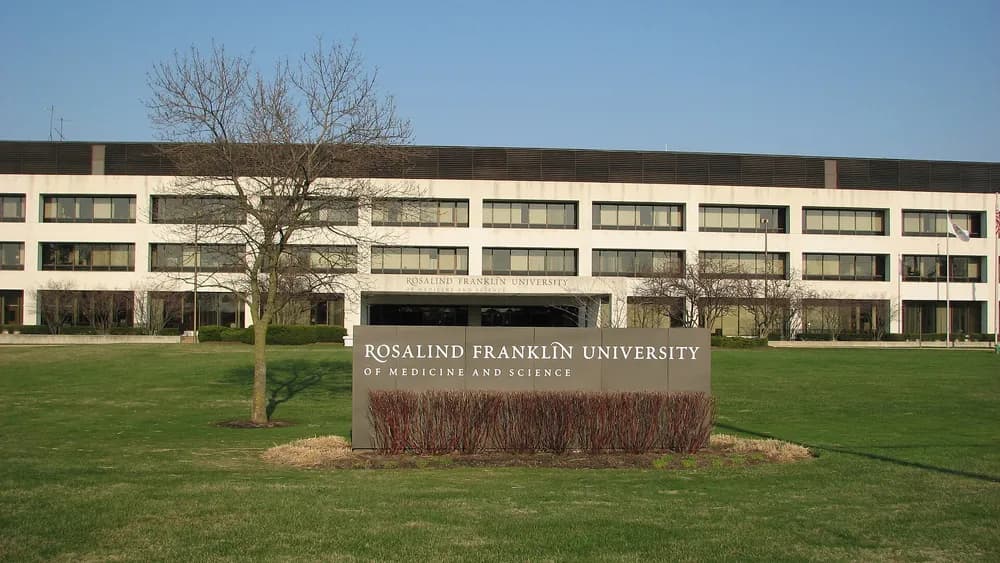
Chicago Medical School at Rosalind Franklin University of Medicine and Science, located in North Chicago, Illinois, is a private MD-granting institution within a health sciences university that emphasises interprofessional education across medicine, pharmacy, podiatry, and allied health fields. The school trains physicians with a strong clinical sciences foundation and places particular value on teamwork, communication, and collaborative care. Clinical training is distributed across the greater Chicago metropolitan area, including affiliation with Advocate Health and other North Shore Illinois health systems.
Entry Requirements
What you need to apply to Chicago Medical School at Rosalind Franklin University of Medicine and Science (MD).
Admission overview
Bachelor's degree and MCAT required. Applications via AMCAS; secondary application required. Rosalind Franklin values applicants with strong interprofessional awareness, clinical experience, and community service. No explicit Illinois residency preference.
MCAT median
508 (range 506–518)
GPA median
3.69 overall / 3.52 science (BCPM)
Acceptance rate
2.5%
Class size
190
In-state preference
None
CASPer
Not required
Holistic review emphasis
Interprofessional awareness, clinical experience, communication skills, professional narrative.
Notes
Estimates from public AAMC FACTS / AACOMAS / ADEA AADSAS / class-profile; verify current cycle.
Specialities offered
Internal Medicine, Primary Care, Surgery, Interprofessional Education, Community Medicine
Interview Format
How Chicago Medical School at Rosalind Franklin University of Medicine and Science (MD) interviews applicants.
Format
MMI (multiple mini-interview stations)
Interview window
October–February
Decision date
March 30 (AAMC standard)
Post-interview chances
Estimated post-interview acceptance rate approximately 15–25%; interprofessional communication skills and academic record are key differentiators.
What to expect at a Chicago Medical School at Rosalind Franklin University of Medicine and Science (MD) interview
Chicago Medical School at Rosalind Franklin University conducts a structured MMI on its North Chicago campus. Applicants rotate through approximately 6–8 stations of 8 minutes each, with a 2-minute preparation window per station. Stations probe ethical reasoning, interprofessional communication, healthcare policy, and professionalism scenarios. The day includes an orientation to Rosalind Franklin's interprofessional health sciences campus — which houses medicine, pharmacy, podiatric medicine, physician assistant, and health professions programmes — campus tours, and informal interactions with current students. The school's interprofessional training philosophy is reflected in some station content.
What makes Chicago Medical School at Rosalind Franklin University of Medicine and Science (MD) different
Rosalind Franklin University is one of the few US health sciences universities where medical, pharmacy, podiatric, and allied health students train in explicitly interprofessional teams throughout all four years. The school is named for Rosalind Franklin, the pioneering scientist whose X-ray crystallography work was central to understanding DNA structure, and its naming reflects a commitment to scientific rigor and underrecognised contributions to medicine. Chicago Medical School is the oldest medical school component of the institution.
Tutor insight
Rosalind Franklin's MMI rewards candidates who can articulate a genuine understanding of interprofessional healthcare — not just a buzzword, but the practical skills of working alongside pharmacists, podiatrists, PAs, and allied health professionals. The school's North Chicago location in Lake County means applicants should be aware of the regional healthcare landscape. Academic metrics are moderately competitive; strong clinical experience and a clear professional narrative can differentiate candidates with borderline stats. Research the school's namesake — Rosalind Franklin — and the values her scientific legacy represents; this occasionally appears in interview preparation discussions.
PrometheusQuestion Bank
595 medicine questions inside
Interview questions matched to Chicago Medical School at Rosalind Franklin University of Medicine and Science (MD)
Two questions our tutors flagged as a strong fit for Chicago Medical School at Rosalind Franklin University of Medicine and Science (MD)’s interview style. Try answering them out loud, then open Prometheus for the model answers and follow-up tips.
Medium·MMIQ1
Patient Advocacy: Informed Consent and a Non-English-Speaking Patient
You are a medical student on a surgery rotation. A Spanish-speaking patient is scheduled for an elective laparoscopic cholecystectomy tomorrow morning. When you visit him pre-operatively, he seems confused about what the surgery involves and says his wife — who speaks English — explained it to him when the surgeon obtained consent. The hospital has a certified medical interpreter service, but your attending says it is 'too late' to call them now and the consent form has already been signed. What do you do?
Likely follow-up · What are the legal and ethical standards for informed consent when a patient does not speak English? Is family interpretation sufficient?
3 expert tips in Prometheus
Hard·Panel · MMIQ2
US Healthcare Ethics: Medicare, Overtreatment, and Physician Incentives
Medicare's fee-for-service payment model historically rewarded physicians for volume — more procedures, more revenue. Research has consistently shown that regions of the US with higher Medicare spending per capita do not have better outcomes. A 78-year-old Medicare patient with stage IV lung cancer and declining functional status is asking your opinion about whether to pursue a fourth-line chemotherapy regimen that offers a 5% chance of significant response. How do you counsel her, and what does this scenario reveal about physician incentives in US healthcare?
Likely follow-up · What is the difference between the physician's obligation to inform versus recommend, and does it change at the end of life?
Apply to Chicago Medical School at Rosalind Franklin University of Medicine and Science (MD) with confidence
We've helped students get into Chicago Medical School at Rosalind Franklin University of Medicine and Science (MD) and other US medicine schools. Get tailored support for each stage of the application.
Chicago Medical School at Rosalind Franklin University of Medicine and Science (MD) - Frequently asked questions
Bachelor's degree and MCAT required. Applications via AMCAS; secondary application required. Rosalind Franklin values applicants with strong interprofessional awareness, clinical experience, and community service. No explicit Illinois residency preference.
MMI (multiple mini-interview stations). Chicago Medical School at Rosalind Franklin University conducts a structured MMI on its North Chicago campus. Applicants rotate through approximately 6–8 stations of 8 minutes each, with a 2-minute preparation window per station. Stations probe ethical reasoning, interprofessional communication, healthcare policy, and professionalism scenarios. The day includes an orientation to Rosalind Franklin's interprofessional health sciences campus — which houses medicine, pharmacy, podiatric medicine, physician assistant, and health professions programmes — campus tours, and informal interactions with current students. The school's interprofessional training philosophy is reflected in some station content.
Chicago Medical School at Rosalind Franklin University of Medicine and Science (MD) typically interviews in October–February.
Decisions are released March 30 (AAMC standard).
Rosalind Franklin University is one of the few US health sciences universities where medical, pharmacy, podiatric, and allied health students train in explicitly interprofessional teams throughout all four years. The school is named for Rosalind Franklin, the pioneering scientist whose X-ray crystallography work was central to understanding DNA structure, and its naming reflects a commitment to scientific rigor and underrecognised contributions to medicine. Chicago Medical School is the oldest medical school component of the institution.