
BU Chobanian & Avedisian School of Medicine Interview
Format, Questions & Prep Tips
BU Chobanian & Avedisian School of Medicine medicine interviews for 2027 entry are a traditional interview, held October 2026 through February 2027. Published figures: Annual MD class size ~135; Tuition (2025–26) ~USD 66,000/year.
- Institution
- Boston University Chobanian & Avedisian School of Medicine
- Interview (2027 entry)
- October through February
- Decisions (2027 entry)
- Regular decisions by late March; waitlist through spring

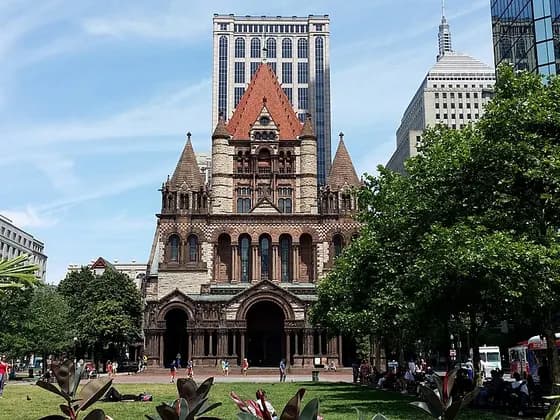


Photo: John Phelan · CC BY 3.0 · cropped
Photo: Eric Friedebach · CC BY 2.0 · Photo: Daderot · CC BY-SA 3.0 · Photo: Nick Ledford from Palm Harbor, United States · CC BY 2.0
How to get into BU Chobanian & Avedisian School of Medicine (MD) medicine
Step-by-step: entry requirements, admission tests, personal statement, interview format and the key deadlines.
Open the guide →BU Chobanian & Avedisian School of Medicine (MD) entry requirements
Admission profile, interview format, decision dates and what makes BU Chobanian & Avedisian School of Medicine (MD) different.
See the profile →The BU Chobanian & Avedisian School of Medicine MD program
Integrated + Team-based learning, 4 years, clinical rotations across Boston, wider New England and Silicon Valley, California.
See the program →The BU Chobanian & Avedisian School of Medicine (MD) medicine interview
Boston University Chobanian & Avedisian School of Medicine uses a traditional interview format with two sessions (faculty and student). BU is a large urban research university with a strong commitment to social medicine and health equity — the BUSM has one of the most diverse student bodies of any US medical school and explicitly recruits students committed to serving urban underserved communities.
BUSM's affiliation with Boston Medical Center (BMC) — the largest safety-net hospital in New England — is central to its identity. Clinical training at BMC exposes students to immigrant health, poverty, housing instability, and structural racism in a direct and sustained way. Interviewers probe whether applicants understand and are genuinely motivated by this training context.
BU is also notable for the BUSM Leadership Development Program and its early preparation of physicians for roles in healthcare administration, advocacy, and systems change.
BU Chobanian & Avedisian School of Medicine (MD) interview at a glance (2027 entry)
| Annual MD class size | ~135 |
|---|---|
| Interview format | Traditional — faculty + student sessions |
| Tuition (2025–26) | ~USD 66,000/year |
| Application system | AMCAS + BU secondary |
| Key affiliate | Boston Medical Center (largest safety-net hospital in NE) |
| Interview window | October–February |
Interview format
- Two one-on-one sessions: faculty (open-file) and student.
- No MMI.
- Interview day includes Boston Medical Center tour and overview of community health programs.
Working towards the MCAT score BU Chobanian & Avedisian School of Medicine (MD) expects? Build a week-by-week plan from your test date — free for the first two weeks.
Sample interview questions
Boston Medical Center is the largest safety-net hospital in New England. What draws you to training in a hospital that serves Boston's most vulnerable patients?
Show genuine interest in the safety-net mission rather than the academic brand. BMC serves a largely Medicaid and uninsured population with complex social needs, and the Chobanian & Avedisian School recruits students committed to that work.
BU's medical school is known for one of the most diverse student bodies in the country and a strong social-medicine identity. Why does that mission resonate with you?
Connect your values and experiences to social medicine and health equity authentically. Avoid generic statements; ground your motivation in concrete commitments.
Tell us about a community you have served over time. What did you learn about its needs that an outsider might miss?
Reveal sustained, humble engagement rather than a one-off experience. Show that you listen to communities rather than presuming to know their needs.
BU emphasizes preparing physicians for leadership and systems change. What kind of change in health care do you most want to be part of?
Tie a credible ambition — advocacy, administration, community health — to BU's Leadership Development emphasis. Show you see physicians as agents of systemic improvement, not only individual care.
Many BMC patients are refugees or recent immigrants who have experienced trauma and distrust of institutions. How do you approach a clinical encounter with someone reluctant to engage?
Discuss trauma-informed care, cultural humility, professional interpreter use, and building trust over time. BU trains physicians for this patient population every day, so be concrete and patient-centered.
A patient's biggest health threat is unstable housing, not a medical condition you can treat directly. What is the physician's responsibility when the problem is social?
Engage social determinants, screening for unmet needs, links to social work and community resources, and advocacy. BMC pioneered programs treating social needs as health interventions, so move beyond strictly clinical thinking.
An undocumented patient avoids care for fear that information will reach immigration authorities. How should the team respond?
Cover confidentiality, the duty to treat regardless of status, and building trust. Boston's large immigrant communities make this a live concern at BU.
Resources at a safety-net hospital are stretched thin. Is it ethical to spend extra time and money helping one very complex patient if it means less capacity for others? How do you think about it?
Weigh individual duty against stewardship and population fairness, and the danger of ad hoc bedside rationing. Show structured reasoning rather than a slogan in either direction.
Describe a time you built trust with someone who was initially wary of you or the institution you represented.
Use a concrete example showing patience, listening, and reliability over time. Trust-building is core to caring for BMC's patients.
Explain a treatment plan to a patient who speaks little English and is visibly anxious, with a professional interpreter present.
Address the patient directly, use the interpreter properly, keep language simple, and attend to emotion. The goal is genuine understanding and reassurance, not speed.
How can research or scholarship advance health equity, rather than only basic science? What question might you pursue?
Show familiarity with health-services research, community-based participatory research, or implementation science. Frame a genuine question relevant to under-served populations.
Walk me through a research or scholarly experience. What was genuinely your contribution, and what did it show?
Separate independent thinking from supervised tasks and be honest about limitations. Methodological clarity matters even at a mission-driven school.
How would you investigate why patients from one Boston neighborhood have worse outcomes for a chronic disease than another?
Outline a structured approach considering access, social determinants, and care quality. Resist single-cause explanations and name the data you would gather.
A recent immigrant patient is frightened and reluctant to share information because of past experiences with authorities. Speak with them, with an interpreter available.
Lead with reassurance about confidentiality, listen patiently, and build rapport before clinical questions. Trauma-informed, humble communication is essential.
A patient is overwhelmed because their main problem is that they may lose their housing, not their medical issue. Talk with them.
Acknowledge the crisis, avoid minimizing it, and connect them to social work and resources while maintaining dignity. Treat the social need as central, not peripheral.
You're shown that a Boston neighborhood served by BMC has far higher rates of a preventable condition than the city average. How would you interpret that, and what would you want to know?
Consider access, insurance, environmental and social factors, and historical disinvestment. Name the additional data — deprivation, screening rates, demographics — you would request before concluding.
Practise the BU Chobanian & Avedisian School of Medicine (MD) interview
Rehearse the real format before the day — on demand with our AI interviewers, or live with a tutor.
Sit a mock with photoreal AI interviewers — any time
A timed MMI or panel interview on video — American & international voices — with interviewers who listen, react and press with follow-ups. Rubric-scored feedback and a replay the moment you finish.





Live mocks with a tutor who’s been in the room
A full BU Chobanian & Avedisian School of Medicine (MD)-style mock with a medic or dentist tutor — honest scoring against real marking criteria, a station-by-station debrief and a written action plan.
Book a mock interviewHow to prepare for the BU Chobanian & Avedisian School of Medicine (MD) interview
Common pitfalls to avoid
BU Chobanian & Avedisian School of Medicine (MD) interview — frequently asked questions
Sources & official admissions information
Ready to nail your BU Chobanian & Avedisian School of Medicine (MD) interview?
Book a mock interview with a tutor who knows the US interview formats, orpractice unlimited stations from our interview question bank.