
Tufts University School of Medicine Interview
Format, Questions & Prep Tips
Tufts University School of Medicine medicine interviews for 2027 entry are a traditional interview, held October 2026 through February 2027. Published figures: Annual MD class size ~192; Tuition (2025–26) ~USD 68,000/year.
- Institution
- Tufts University School of Medicine
- Interview (2027 entry)
- October through February
- Decisions (2027 entry)
- Regular decisions by late March; waitlist through spring
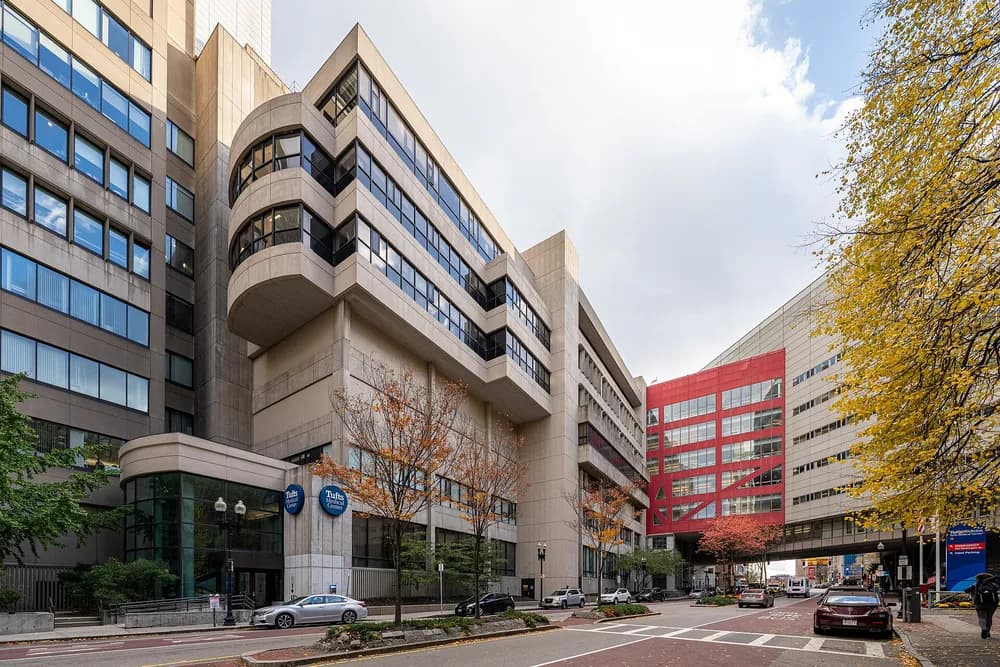



Photo: Ajay Suresh · CC BY 4.0 · cropped
Photo: Rhododendrites · CC BY-SA 4.0 · Photo: Sathiya raj · CC BY-SA 4.0 · Photo: Daderot · CC0
How to get into Tufts University School of Medicine (MD) medicine
Step-by-step: entry requirements, admission tests, personal statement, interview format and the key deadlines.
Open the guide →Tufts University School of Medicine (MD) entry requirements
Admission profile, interview format, decision dates and what makes Tufts University School of Medicine (MD) different.
See the profile →The Tufts University School of Medicine MD program
Integrated + Case-based learning, 4 years, clinical rotations across Boston, eastern Massachusetts, Maine and Portsmouth, New Hampshire.
See the program →The Tufts University School of Medicine (MD) medicine interview
Tufts School of Medicine uses a traditional interview format with two sessions (faculty and student). Tufts is known for its global health and nutrition programs — the Friedman School of Nutrition Science and Policy is on the same campus, and Tufts has strong global health partnerships in sub-Saharan Africa and Southeast Asia. Interviewers frequently probe global health commitment and nutrition-medicine integration.
Tufts has the largest number of affiliated teaching hospitals of any Massachusetts medical school — Tufts Medical Center, Lahey Hospital, and multiple community hospitals give students exposure to academic, community, and safety-net settings.
A distinctive Tufts theme is its Maine Track — a three-year program based at Maine Medical Center in Portland that trains students committed to rural and community medicine in underserved New England contexts. Applicants to the Maine Track have a separate application and interview process.
Tufts University School of Medicine (MD) interview at a glance (2027 entry)
| Annual MD class size | ~192 |
|---|---|
| Interview format | Traditional — faculty + student sessions |
| Tuition (2025–26) | ~USD 68,000/year |
| Application system | AMCAS + Tufts secondary |
| Special track | Maine Track (rural/community medicine; Maine Medical Center) |
| Interview window | October–February |
Interview format
- Two one-on-one sessions: faculty (open-file) and student.
- No MMI.
- Maine Track applicants have a separate interview at Maine Medical Center.
Working towards the MCAT score Tufts University School of Medicine (MD) expects? Build a week-by-week plan from your test date — free for the first two weeks.
Sample interview questions
Tufts shares a campus with the Friedman School of Nutrition Science and Policy. How do you think about nutrition as a clinical tool, and how would you integrate it into everyday patient care?
Nutrition is under-taught in most medical schools, so show genuine curiosity about dietary interventions, food-insecurity screening, and the social determinants that shape diet. Avoid treating it as an afterthought.
The Maine Track trains physicians for rural and community medicine based at Maine Medical Center. If you are drawn to it, what specifically attracts you to practicing in a rural or community-hospital setting?
Discuss the broader scope of practice, community accountability, resource constraints, and the link between being known and being trusted. Show you understand what rural practice genuinely involves.
Tufts has one of the largest networks of affiliated teaching hospitals in Massachusetts, spanning academic, community, and safety-net settings. Why does that breadth appeal to you?
Connect the range — Tufts Medical Center, Lahey, and community hospitals — to the adaptable physician you hope to become. Show you value seeing care delivered in varied environments.
Tell us about an experience that shaped how you understand the link between how people live and how healthy they are.
What they are listening for:
- Reveal awareness of social determinants and
- given Tufts' nutrition strength
- perhaps diet and food access
Ground it in a concrete experience rather than abstractions.
A patient with diet-related disease lives in a food desert and cannot easily access or afford healthy food. Is it useful, or even fair, to counsel them on nutrition? How do you approach it?
Engage the limits of individual advice against structural barriers, food-insecurity screening, and links to resources like SNAP and food programs. Tufts' nutrition focus makes this concrete; avoid victim-blaming.
In a small rural community, you treat patients you also know socially, and confidentiality is harder to maintain. How do you handle the blurred boundaries of rural practice?
Discuss confidentiality, professional boundaries, dual relationships, and the trade-offs of being deeply embedded in a community. This is a real feature of Maine Track-style practice.
A rural hospital lacks a specialist service a patient needs, and transfer is burdensome for the family. How do you weigh local care against the benefits of a distant specialist center?
Balance access, continuity, family burden, and quality, and consider telehealth and shared care. Show awareness of the realities of resource-limited rural settings.
A patient asks you about a popular but evidence-thin diet or supplement. How do you respond honestly without dismissing them?
Combine evidence literacy with respect for the patient's autonomy and motivation. Tufts values nutrition done rigorously, so steer toward what is supported while keeping the patient engaged.
Explain to a patient, in plain terms, how a change in their diet could affect a chronic condition, when they are skeptical that food really matters.
Avoid lecturing, connect to what the patient values, and set realistic, achievable goals. Persuasion through partnership matters more than reciting nutritional facts.
Describe a time you adapted your communication to a community very different from your own. What did you learn?
Whether rural Maine or an immigrant community in Boston, show humility and adaptability. Emphasize listening and meeting people where they are.
Tufts has strong global-health and nutrition programs. If your background includes international or population-health work, how does it shape the questions you want to study?
Connect a genuine interest to nutrition, global health, or community medicine, and frame an answerable question. Avoid name-dropping experiences without reflection.
How would you evaluate the evidence behind a nutritional claim before acting on it clinically?
Address study design, confounding (diet research is notoriously hard to study), observational versus experimental evidence, and effect size. Show that you bring rigor to a field full of weak claims.
Walk me through a research or scholarly experience. What was genuinely your contribution, and what did it show?
Separate independent thinking from supervised tasks and be honest about limitations. Methodological clarity is valued even when the topic is applied.
A patient in a small community is upset that news of their diagnosis seems to have spread locally and worries about privacy. Speak with them.
What they are listening for:
- Take the concern seriously
- reaffirm confidentiality
- explore what happened without defensiveness
Trust is fragile in tight-knit communities, so handle it with care.
A patient feels judged after you raised their weight and diet, and is now defensive. Repair the conversation.
Acknowledge how it landed, separate the person from the behavior, and re-establish partnership. Compassion and non-judgment are essential when discussing diet and weight.
You're shown that a rural Maine county has worse outcomes for a chronic disease than urban Massachusetts. How would you interpret that gap, and what would you investigate?
Consider access to specialists, distance and transport, an aging population, and socioeconomic factors. Name the additional data you would request before concluding it reflects worse care.
Practise the Tufts University School of Medicine (MD) interview
Rehearse the real format before the day — on demand with our AI interviewers, or live with a tutor.
Sit a mock with photoreal AI interviewers — any time
A timed MMI or panel interview on video — American & international voices — with interviewers who listen, react and press with follow-ups. Rubric-scored feedback and a replay the moment you finish.






Live mocks with a tutor who’s been in the room
A full Tufts University School of Medicine (MD)-style mock with a medic or dentist tutor — honest scoring against real marking criteria, a station-by-station debrief and a written action plan.
Book a mock interviewHow to prepare for the Tufts University School of Medicine (MD) interview
Common pitfalls to avoid
Tufts University School of Medicine (MD) interview — frequently asked questions
Sources & official admissions information
Ready to nail your Tufts University School of Medicine (MD) interview?
Book a mock interview with a tutor who knows the US interview formats, orpractice unlimited stations from our interview question bank.