
GWU School of Medicine Interview
Format, Questions & Prep Tips
GWU School of Medicine medicine interviews for 2027 entry are a traditional interview. GWU School of Medicine describes the format as: One blind interview of about 25 minutes with a faculty member, held virtually. Published figures: Annual MD class size ~210; Applications received ~15,000–17,000 per cycle; Interview format Traditional — 1–2 sessions, ~30–45 min each.
- Institution
- George Washington University School of Medicine and Health Sciences
- Interview (2027 entry)
- October through March; rolling invitations after secondary review
- Decisions (2027 entry)
- Rolling decisions; final by March 30; waitlist movement through summer

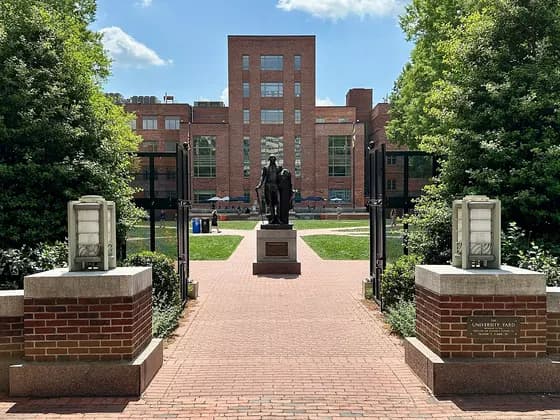


Photo: Ajay Suresh · CC BY 4.0 · cropped
Photo: APK · CC BY 4.0 · Photo: Leosmedley · CC BY-SA 3.0 · Photo: Djonesmhc · CC BY-SA 3.0
How to get into GWU School of Medicine (MD) medicine
Step-by-step: entry requirements, admission tests, personal statement, interview format and the key deadlines.
Open the guide →GWU School of Medicine (MD) entry requirements
Admission profile, interview format, decision dates and what makes GWU School of Medicine (MD) different.
See the profile →The GWU School of Medicine MD program
Integrated + Case-based learning, 4 years, clinical rotations across the Washington, DC region and Baltimore.
See the program →The GWU School of Medicine (MD) medicine interview
GWU School of Medicine and Health Sciences uses a traditional interview format — typically one or two 30–45 minute conversational sessions with faculty, current students, and/or admissions staff. Interviewers have reviewed your full application file (non-blind), so expect substantive follow-up on your experiences and motivations.
GWU’s Foggy Bottom location in Washington, DC shapes the interview experience: candidates are expected to engage intelligently with healthcare policy, global health, and federal health systems — the school’s distinctive strengths. The DC context makes health policy literacy essentially required preparation.
The school is private, nationally recruiting, and values candidates who can articulate a specific connection to GWU’s global health and health systems mission beyond general interest in medicine.
GWU School of Medicine (MD) interview at a glance (2027 entry)
| Annual MD class size | ~210 |
|---|---|
| Applications received | ~15,000–17,000 per cycle |
| Interview format | Traditional — 1–2 sessions, ~30–45 min each |
| Curriculum | Integrated + global health emphasis |
| Application system | AMCAS + GWU secondary |
| Interview window | October–March |
| Dual degrees | MD/MPH, MD/MBA available |
Interview format
- Traditional format — one or two separate conversational sessions.
- Non-blind: interviewers have reviewed your full application file.
- Sessions cover motivation, global/public health engagement, ethical reasoning, and health policy.
- Student interviewer session often included — focuses on fit and student experience.
- Interview day includes campus tour of the Foggy Bottom campus and an admissions info session.
- Rolling admission — earlier dates generally receive earlier decisions.
Working towards the MCAT score GWU School of Medicine (MD) expects? Build a week-by-week plan from your test date — free for the first two weeks.
Sample interview questions
Why GWU — how does Washington, DC’s health policy and global health ecosystem specifically align with your career goals?
Reference specific federal agencies (NIH, CDC, HHS, FDA), international organizations (PAHO, WHO/AMRO, World Bank), congressional health policy, or specific GWU global health programs. Generalities will not suffice.
The US spends more per capita on healthcare than any other developed nation but achieves worse outcomes by most metrics. What structural factors explain this and what would you prioritize changing?
Reference administrative overhead, lack of universal coverage, fee-for-service incentives, fragmentation, pharmaceutical pricing, social determinants. Argue a prioritized position — this is a policy literacy test.
Tell me about a global health experience — your own or one you studied. What did it teach you about health system design?
Be specific and analytical. GWU’s global health emphasis means interviewers probe whether you’ve genuinely engaged with health systems differences across countries, not just participated in a medical mission trip.
A country where you are on a global health rotation lacks the equipment to perform a procedure your patient needs. You have personal contacts who could arrange a private supply at high cost. What do you do?
Avoid importing inequity. Discuss the principle of resource equity, local capacity building, sustainability, and the problem with one-off individual interventions. Work within the system rather than around it.
You are presenting a research poster at a health policy conference. A senior senator approaches and asks you to summarize your findings and their policy implications in two minutes. How do you do it?
Practice a concise lay summary of a real or hypothetical project: the problem, what you found, and a specific actionable implication. Demonstrates GWU’s expectation that physicians engage with policy audiences.
Pharmaceutical companies fund a significant portion of continuing medical education (CME) in the US. What are the risks and how should they be managed?
Discuss conflict of interest, evidence that industry funding influences prescribing behavior, ACCME requirements for disclosure, and the argument for publicly funded CME. Argue a position.
How has your non-clinical background (research, policy, advocacy, international work) prepared you to be a better physician than if you had gone straight to medical school?
Frame your unique background as an asset to patient care — systems thinking, policy awareness, cultural competency. Avoid implying the standard pathway is insufficient — show what you specifically add.
The US opioid epidemic has evolved from prescription opioids to illicit fentanyl. What does this shift mean for harm reduction and public health responses?
Reference naloxone distribution, fentanyl test strips, safe consumption sites (legal status varies by state), SAMHSA frameworks, the role of primary care in buprenorphine prescribing, and racial disparities in overdose deaths.
A patient who is a federal employee discloses to you that they are engaged in activities that may violate their agency’s ethics rules. This has no direct bearing on their health. What do you do?
Medical confidentiality applies — this is not a reportable condition. You are not a law enforcement mechanism. Maintain the therapeutic relationship. If the activity were to directly harm identifiable third parties, the analysis changes.
You are a student on a clinical team. A patient from a culture where family members traditionally make healthcare decisions asks that all communication go through her son, not her directly. How do you handle this?
Respect cultural values while maintaining the patient’s autonomous right to information. Check privately with the patient whether this is her preference. If she consents to this arrangement, honor it. Ensure she has access to information independently if she wishes.
A health-policy station shows you a chart: US health spending per capita far exceeds peer nations while life expectancy lags, and the gap has widened over two decades. What do you scrutinize before using this to argue for a specific reform?
Probe the comparison:
- what's counted as health spending
- denominator and demographic differences
- the role of social spending versus medical care
- within-US disparities the average hides
GWU rewards applicants who treat policy data rigorously rather than weaponizing a single statistic.
Role play: You are a student at a DC free clinic. A patient who lost employer coverage doesn't understand the insurance options being described and is anxious about a bill. (The interviewer plays the patient.)
Translate policy into plain help: explain ACA marketplace and Medicaid options simply, connect her to an enrollment navigator and the clinic's financial counseling, and reassure her about emergency-care protections. GWU's policy emphasis is meaningful only if you can also meet an individual patient where she is.
GWU sits inside the federal health ecosystem and offers a concurrent MD/MPH through the Milken Institute SPH. How do you envision using policy or public-health training alongside clinical medicine, and what would you actually do with it?
Be specific and concrete — name agencies (NIH, CDC, HHS, FDA), an organization, or a policy problem you'd work on, and how the MD/MPH structure serves it. Avoid treating policy as a credential; show a genuine, actionable vision that fits GWU's distinctive DC position.
A patient tells you he won't get the recommended vaccine because of something he read on social media. How do you respond in a way that builds rather than breaks trust?
Don't lecture or shame. Explore the specific concern, acknowledge his autonomy, share clear evidence and your honest recommendation, and keep the door open. GWU emphasizes physicians as credible public communicators in a misinformation-heavy landscape — model that one-on-one.
You are on a global-health rotation and a well-funded short-term medical mission proposes a one-week surgical camp that local clinicians say undermines their continuity of care. How do you weigh the competing goods?
Apply the equity and sustainability lens GWU stresses: short-term missions can import inequity, distort local systems, and leave no follow-up. Privilege local leadership, capacity-building, and continuity over visible one-off interventions. Argue a position that resists 'helicopter' global health.
Practise the GWU School of Medicine (MD) interview
Rehearse the real format before the day — on demand with our AI interviewers, or live with a tutor.
Sit a mock with photoreal AI interviewers — any time
A timed MMI or panel interview on video — American & international voices — with interviewers who listen, react and press with follow-ups. Rubric-scored feedback and a replay the moment you finish.






Live mocks with a tutor who’s been in the room
A full GWU School of Medicine (MD)-style mock with a medic or dentist tutor — honest scoring against real marking criteria, a station-by-station debrief and a written action plan.
Book a mock interviewHow to prepare for the GWU School of Medicine (MD) interview
Common pitfalls to avoid
GWU School of Medicine (MD) interview — frequently asked questions
Sources & official admissions information
Ready to nail your GWU School of Medicine (MD) interview?
Book a mock interview with a tutor who knows the US interview formats, orpractice unlimited stations from our interview question bank.