
Georgetown University School of Medicine Interview
Format, Questions & Prep Tips
Georgetown University School of Medicine medicine interviews for 2027 entry are a traditional interview. Published figures: Annual MD class size ~197; Applications received ~10,000–13,000 per cycle; Interview format Traditional — 2 sessions, ~30–45 min each.
- Institution
- Georgetown University School of Medicine
- Interview (2027 entry)
- September through March; rolling invitations after secondary review
- Decisions (2027 entry)
- Rolling decisions; final by March 30; waitlist movement through summer

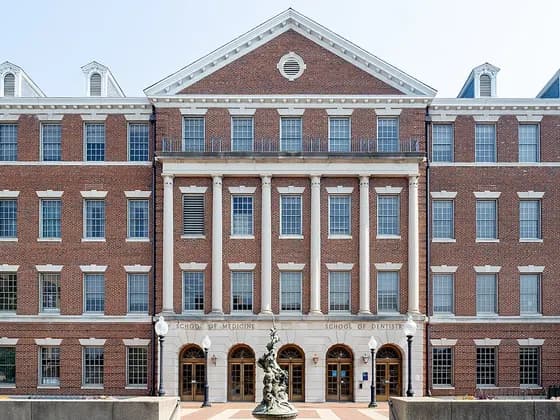


Photo: Ajay Suresh · CC BY 2.0 · cropped
Photo: Ajay Suresh · CC BY 2.0 · Photo: G. Edward Johnson · CC BY 4.0 · Photo: Ingfbruno · CC BY-SA 3.0
How to get into Georgetown University School of Medicine (MD) medicine
Step-by-step: entry requirements, admission tests, personal statement, interview format and the key deadlines.
Open the guide →Georgetown University School of Medicine (MD) entry requirements
Admission profile, interview format, decision dates and what makes Georgetown University School of Medicine (MD) different.
See the profile →The Georgetown University School of Medicine MD program
Integrated, 4 years, clinical rotations across Washington, DC, Maryland and Virginia, including Baltimore.
See the program →The Georgetown University School of Medicine (MD) medicine interview
Georgetown University School of Medicine uses a traditional interview format — two one-on-one sessions of approximately 30–45 minutes each, typically with a faculty member or physician and a current medical student. Interviews are non-blind: interviewers have reviewed your full application file.
Georgetown’s Jesuit identity deeply shapes the interview experience. Questions probe your alignment with cura personalis (care for the whole person), social justice orientation, and ethical reasoning — not just clinical competency. The Kennedy Institute of Ethics at Georgetown is one of the world’s foremost bioethics centers, and this institutional culture is present throughout the interview day.
You do not need to be Catholic to attend Georgetown — the school warmly welcomes applicants of all backgrounds — but you must be able to articulate why Jesuit values of service, justice, and holistic care resonate with your approach to medicine.
Georgetown University School of Medicine (MD) interview at a glance (2027 entry)
| Annual MD class size | ~197 |
|---|---|
| Applications received | ~10,000–13,000 per cycle |
| Interview format | Traditional — 2 sessions, ~30–45 min each |
| Curriculum | Integrated + Medical Ethics and Professionalism thread |
| Application system | AMCAS + Georgetown secondary |
| Interview window | September–March |
| Distinctive resource | Kennedy Institute of Ethics |
Interview format
- Traditional format — two separate one-on-one sessions: faculty/physician and student.
- Non-blind: interviewers have reviewed your full application file.
- Faculty session focuses on ethics, social justice, values, and career goals.
- Student session focuses on program fit and student life at Georgetown.
- Interview day includes campus tour, financial aid session, and curriculum information presentation.
- Rolling admission; earlier interview dates generally receive earlier decisions.
Working towards the MCAT score Georgetown University School of Medicine (MD) expects? Build a week-by-week plan from your test date — free for the first two weeks.
Sample interview questions
Why Georgetown — what specifically about the Jesuit tradition, cura personalis, or the Kennedy Institute of Ethics draws you to this program?
Explain what cura personalis means to you in practice, not just in principle. Reference the Kennedy Institute, the Medical Ethics and Professionalism thread, and how these align with experiences you have had. Generic prestige answers will disappoint.
A patient in the ICU is clearly dying. The family demands "everything possible" be done despite the patient's own advance directive stating she does not want CPR or mechanical ventilation. How do you navigate this?
The advance directive represents the patient's autonomous wishes and has legal force. The physician's duty is to honor the patient's documented preferences. Compassionate family communication is required, but the clinical team is not obligated to provide futile treatment against the patient's own directive.
Georgetown has strong Catholic and Jesuit roots. How do you reconcile your personal values with a situation where a patient requests a service (e.g. abortion referral, contraception, MAID) that may conflict with Catholic teaching?
Georgetown trains physicians to practice in all settings — the school’s mission requires graduates to provide standard of care or refer appropriately. The AMA Code of Ethics supports conscientious objection with mandatory referral. Be honest about your own values while demonstrating commitment to patient-centered care.
Describe an experience of service — to a community, patient, or cause — that shaped your understanding of social justice in medicine.
Georgetown’s social justice mission is not decorative — it is embedded in the Jesuit ignatian tradition. Connect a specific experience to structural insight: show that service deepened your understanding of systemic injustice, not just that it was personally meaningful.
Artificial intelligence diagnostic tools are increasingly being used in clinical settings. What ethical obligations do physicians have in deploying and overseeing these tools?
Reference algorithmic bias (AI models trained on non-diverse populations), informed consent for AI-assisted diagnosis, accountability when AI errs, transparency to patients, and the physician's ultimate accountability for clinical decisions.
A patient from a devout religious background refuses a blood transfusion that their surgeon believes is life-saving. The patient is competent and has signed a refusal form. What do you do as a medical student observing the case?
Respect patient autonomy — a competent patient’s right to refuse treatment is fundamental, even when the physician disagrees. Your role as a student is to observe the process, support the patient’s right to decide, and learn from how the attending manages the ethical tension.
The US has one of the highest maternal mortality rates in the developed world. What structural factors drive this and what would you prioritize to address it?
Reference racial disparities (Black maternal mortality 3x white), lack of universal prenatal care coverage, postpartum coverage gaps under Medicaid, provider bias, childbirth practices, and the role of midwifery and doula support. Georgetown emphasizes health equity.
A pharmaceutical sales representative offers your residency program a donation for educational equipment in exchange for access to residents during lunch sessions. What are the ethical dimensions?
This is a classic conflict-of-interest scenario. The 'gift' creates implicit pressure to use that company’s products. Reference ACCME policies, the PhRMA code, and the evidence that even small gifts influence prescribing behavior.
Tell me about a time when caring for or working with a patient challenged your personal values. What did you do?
Cura personalis means caring for the whole person even when it is uncomfortable. Georgetown expects physicians who can reflect honestly on value conflicts without either suppressing personal values or imposing them on patients.
Social media companies algorithmically amplify health misinformation because it drives engagement. As a physician, what is your responsibility in this landscape?
Discuss physician public communication obligations, social media guidelines from professional societies (AMA), the tension between free speech and public health, and practical ways physicians can build health literacy (patient education, trusted social media presence, media engagement).
An ethics-oriented station presents data showing a hospital's new sepsis-prediction algorithm performs worse for patients from certain racial and language groups. How do you reason about deploying it?
Bring the four-principles lens Georgetown prizes: non-maleficence and justice demand you not deploy a tool that worsens disparities, autonomy implies disclosure of AI use, and accountability stays with the physician. Question the data — training population, calibration by subgroup — and argue for mitigation before adoption, not after harm.
Role play: You are a student volunteer. A frightened patient facing a serious diagnosis says, 'I just need someone to be honest with me — is this as bad as I think?' but the attending hasn't yet discussed prognosis. (The interviewer plays the patient.)
Cura personalis in practice: don't lie, deflect coldly, or overstep your role. Acknowledge the fear, commit to making sure she gets the full picture from her physician promptly, and stay present with her. Demonstrate whole-person presence within appropriate student boundaries.
A patient asks you to pray with her before a frightening procedure. You do not share her faith. How do you respond?
Honor the whole person without compromising integrity. You may be present respectfully, offer chaplaincy, or hold a moment of silence — and you can gently decline to lead a prayer outside your beliefs while still supporting her spiritually. Center her need; avoid both coercion and cold refusal. This reflects Georgetown's Jesuit attentiveness to the spiritual dimension.
Ignatian spirituality speaks of being 'a person for others.' Tell me about a time you acted for someone else's good at real cost to yourself, and what it taught you about the kind of physician you want to be.
Be concrete and humble, not performative. Connect a genuine experience of service or sacrifice to Georgetown's social-justice and cura personalis mission. The point is earned insight about serving others, not a polished story of self-sacrifice.
Georgetown's Kennedy Institute of Ethics is a world-leading bioethics center. Pick an emerging bioethical issue — gene editing, AI in medicine, or resource allocation — and walk me through how you'd reason about it.
Show you can think, not recite. Frame the issue with the four principles and competing values, engage genuine complexity and counterarguments, and reach a reasoned (if provisional) position. Naming relevant Kennedy Institute work or scholarship signals real interest in why Georgetown is distinctive.
Practise the Georgetown University School of Medicine (MD) interview
Rehearse the real format before the day — on demand with our AI interviewers, or live with a tutor.
Sit a mock with photoreal AI interviewers — any time
A timed MMI or panel interview on video — American & international voices — with interviewers who listen, react and press with follow-ups. Rubric-scored feedback and a replay the moment you finish.






Live mocks with a tutor who’s been in the room
A full Georgetown University School of Medicine (MD)-style mock with a medic or dentist tutor — honest scoring against real marking criteria, a station-by-station debrief and a written action plan.
Book a mock interviewHow to prepare for the Georgetown University School of Medicine (MD) interview
Common pitfalls to avoid
Georgetown University School of Medicine (MD) interview — frequently asked questions
Sources & official admissions information
Ready to nail your Georgetown University School of Medicine (MD) interview?
Book a mock interview with a tutor who knows the US interview formats, orpractice unlimited stations from our interview question bank.