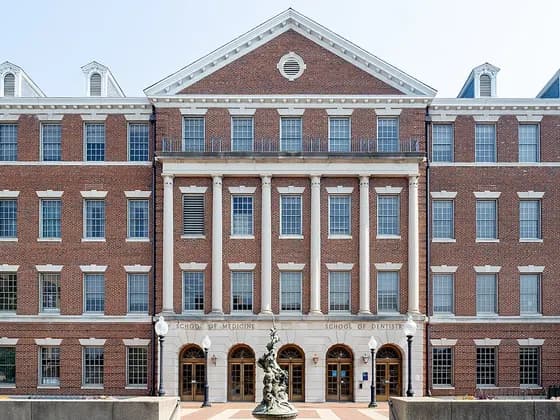
Washington, DC, USEst. 1851

Georgetown University School of Medicine (MD) Medical School - 2027 Entry Requirements & Interview Format

Georgetown University School of Medicine, founded in 1851, is one of the oldest Catholic medical schools in the United States, affiliated with the Jesuit university on the Georgetown campus in Washington, DC. The school is internationally recognised for its ethics curriculum — the Kennedy Institute of Ethics at Georgetown is one of the world's foremost bioethics centres. Georgetown's curriculum integrates Jesuit values of social justice, service to others, and whole-person care throughout the four years. Clinical training occurs at MedStar Georgetown University Hospital and affiliated DC-area hospitals.

Entry Requirements

What you need to apply to Georgetown University School of Medicine (MD).

Admission overview
Bachelor's degree and MCAT required. No specific major required; the school welcomes humanistic and diverse educational backgrounds. Demonstrated commitment to service, ethics, and whole-person care valued. Applications via AMCAS; secondary required.
MCAT median
517 (range 512–522)
GPA median
3.78 overall / 3.75 science (BCPM)
Acceptance rate
2.5%
Class size
197
In-state preference
None
CASPer
Not required
Holistic review emphasis
Ethics, Jesuit values, service orientation, whole-person care, social justice, and intellectual depth.
Notes
Estimates from public AAMC FACTS / AACOMAS / ADEA AADSAS / class-profile; verify current cycle.
Specialities offered
Biomedical Ethics, Internal Medicine, Surgery, Global Health, Primary Care

Interview Format

How Georgetown University School of Medicine (MD) interviews applicants.

Format
Traditional interview (faculty, physician, and/or student interviewers)
Interview window
September–March
Decision date
Rolling (AAMC standard latest March 30)

What to expect at a Georgetown University School of Medicine (MD) interview

Georgetown School of Medicine uses a traditional interview format, typically two one-on-one sessions of approximately 30–45 minutes each — one with a faculty member or physician and one with a current medical student. Interviews are non-blind and heavily focus on the school's Jesuit values: cura personalis (care for the whole person), social justice, ethics, and service. Applicants should expect nuanced ethical questions and direct probing of how their personal values align with the Jesuit mission. The interview day includes a campus tour, a financial aid session, and an information presentation about the curriculum.

What makes Georgetown University School of Medicine (MD) different

Georgetown's Kennedy Institute of Ethics — the world's first academic bioethics centre, founded in 1971 — gives students unparalleled access to bioethics scholarship, clinical ethics consultation, and faculty who are internationally recognised ethicists. The Jesuit cura personalis tradition means the school genuinely invests in student wellbeing alongside academic rigour. Georgetown graduates are consistently noted for their communication and ethical reasoning skills by residency programme directors.

Tutor insight

Georgetown's interview is deeply informed by the Jesuit tradition — come prepared to discuss your personal values, social justice orientation, and how you understand the physician's responsibility to the whole patient. If you are not Catholic or Jesuit-educated, there is no disadvantage — Georgetown warmly welcomes students of all backgrounds — but you should understand what cura personalis means and why it resonates with you. The ethics emphasis is genuine: read introductory bioethics material (Beauchamp and Childress principles) before the interview. The Kennedy Institute is a real resource worth researching specifically.
Prometheus
595 medicine questions inside

Interview questions matched to Georgetown University School of Medicine (MD)

Two questions our tutors flagged as a strong fit for Georgetown University School of Medicine (MD)’s interview style. Try answering them out loud, then open Prometheus for the model answers and follow-up tips.

MediumPanelQ1

AAMC Core Competency: Self-Care and Managing Personal Wellbeing

You are three months into your first year of medical school. You are sleeping less than five hours a night, have stopped exercising, and have become increasingly irritable with your family members. You know you are struggling but you feel that reducing your study time is not an option. How do you approach this situation, and what does your answer reveal about your relationship with self-care and professional sustainability?

Likely follow-up · What is the evidence for the relationship between physician wellbeing and patient safety, and how do personal health behaviours during medical training predict long-term burnout?

3 expert tips in Prometheus
MediumPanelQ2

Holistic Review: Non-Traditional Applicant

You are a 32-year-old applicant who spent six years as a paramedic before returning to complete a post-baccalaureate pre-medical programme. Some medical school admissions committees may question your gap years or your academic readiness. How do you present your non-traditional path as an asset, and what do you believe your background gives you that a traditional applicant may not yet have?

Likely follow-up · What is one clinical situation from your paramedic career that changed how you think about what physicians do?

3 expert tips in Prometheus

Ready to practise Georgetown University School of Medicine (MD)?

Book a school-specific mock interview with Georgetown University School of Medicine (MD) preselected.

Book a Georgetown University School of Medicine (MD) mock

Georgetown University School of Medicine (MD) - Frequently asked questions

Bachelor's degree and MCAT required. No specific major required; the school welcomes humanistic and diverse educational backgrounds. Demonstrated commitment to service, ethics, and whole-person care valued. Applications via AMCAS; secondary required.

Traditional interview (faculty, physician, and/or student interviewers). Georgetown School of Medicine uses a traditional interview format, typically two one-on-one sessions of approximately 30–45 minutes each — one with a faculty member or physician and one with a current medical student. Interviews are non-blind and heavily focus on the school's Jesuit values: cura personalis (care for the whole person), social justice, ethics, and service. Applicants should expect nuanced ethical questions and direct probing of how their personal values align with the Jesuit mission. The interview day includes a campus tour, a financial aid session, and an information presentation about the curriculum.

Georgetown University School of Medicine (MD) typically interviews in September–March.

Decisions are released Rolling (AAMC standard latest March 30).

Georgetown's Kennedy Institute of Ethics — the world's first academic bioethics centre, founded in 1971 — gives students unparalleled access to bioethics scholarship, clinical ethics consultation, and faculty who are internationally recognised ethicists. The Jesuit cura personalis tradition means the school genuinely invests in student wellbeing alongside academic rigour. Georgetown graduates are consistently noted for their communication and ethical reasoning skills by residency programme directors.
Reviewed by Isaac Butler-King, medical student at the University of Glasgow. Last reviewed: 6 June 2026 · NextGen MedPrep editorial team
Georgetown University School of Medicine (MD) | MCAT median 517, GPA & Interview Format | NGMP