US Medicine · 2027 Entry

Johns Hopkins University School of Medicine (MD) Medical School2027 Entry Requirements & Interview Format

Location Baltimore, MD, United StatesEstablished 1893Interviews October–JanuaryDecisions March 30

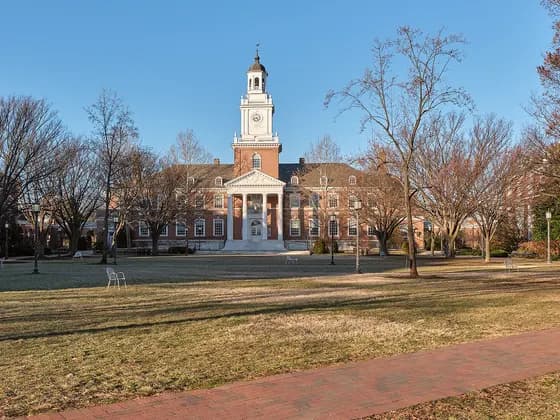
Photo: Paul Sableman from St. Louis, MO · CC BY 2.0

Start here
Overview

About Johns Hopkins University School of Medicine (MD)

Johns Hopkins University School of Medicine, founded in 1893, is widely regarded as the birthplace of modern American medical education. It pioneered the model of full-time faculty, bedside clinical teaching, and research-integrated medical training. Located at the Johns Hopkins Hospital campus in East Baltimore, the school benefits from one of the largest funded biomedical research programs in the United States.

What makes it different

The Genes to Society curriculum uniquely integrates genetic and social dimensions of disease from Day 1. Hopkins has strong ties to Bloomberg School of Public Health, enabling joint MD-MPH tracks. The school is a major NIH-funded research institution with extensive MD-PhD (MSTP) funding.

Course & teaching

Integrated curriculum. 4-year Genes to Society curriculum integrates social determinants of health and human genetics into all four years. Clinical clerkships begin in Year 2. Research is embedded throughout; a scholarly project (Scholarly Concentration) is completed across Years 2–4.

Research strengths

Johns Hopkins University School of Medicine (MD) has notable research strength in Infectious disease, Cancer immunotherapy, Population health, Genetic medicine, Health equity.

Interview

Johns Hopkins University School of Medicine (MD) interviews via Traditional interviews (typically two one-on-one sessions with faculty and/or a student).

Intake

Approximately 120 students per year.

At a glance

Founded in 1893, based in Baltimore, MD. Programmes offered: Biomedical Research, Epidemiology, Surgery, Oncology, Neuroscience.

Entry requirements

What you need to apply to Johns Hopkins University School of Medicine (MD)

Admission overview
Bachelor's degree and MCAT required. Hopkins values academic excellence, research experience, and evidence of leadership and service. No specific prerequisite major; strong science preparation expected. Secondary application required.
MCAT median
522 (range 518–527)
GPA median
3.93 overall / 3.91 science (BCPM)
Acceptance rate
1.8%
Class size
120
In-state preference
None
CASPer
Not required
AAMC PREview
Not required
Holistic review emphasis
Research achievement, intellectual leadership, community service, and commitment to innovation in medicine.
Notes
MCAT/GPA approximate from publicly available Hopkins admissions data.
Specialities offered
Biomedical Research, Epidemiology, Surgery, Oncology, Neuroscience
Interview

How Johns Hopkins University School of Medicine (MD) interviews applicants

Format
Traditional interviews (typically two one-on-one sessions with faculty and/or a student)
Interview window
October–January
Decision date
March 30
Tutor insight
Hopkins interviewers are known for probing depth of knowledge rather than testing surface familiarity with your application — expect substantive discussions about research, ethics, and healthcare systems rather than a recitation of your CV. Demonstrate intellectual rigor and genuine curiosity. The hybrid interview format means you must be comfortable in both conversational 1-on-1 settings and structured rapid-response MMI stations. Showing alignment with Hopkins' emphasis on research integrated with social determinants of health will strengthen your candidacy.
Practice

Practise for your Johns Hopkins University School of Medicine (MD) interview

PrometheusQuestion Bank621 medicine questions inside

Interview questions matched to Johns Hopkins University School of Medicine (MD)

Two questions our tutors flagged as a strong fit for Johns Hopkins University School of Medicine (MD)’s interview style. Try answering them out loud, then open Prometheus for the model answers and follow-up tips.

EasyPanelQ1

AAMC Core Competency: Reliability and Dependability Under Pressure

The AAMC lists Reliability and Dependability as a core competency, emphasising that entering medical students must demonstrate the ability to follow through on commitments — in academics, service, and professional settings — even when circumstances are difficult. Describe a specific time when external pressures made it tempting to drop or significantly reduce a commitment, and explain how you handled it and what it cost you personally.

Likely follow-up · How do you distinguish a healthy choice to withdraw from a commitment that is no longer serving you or the community versus an avoidance of difficulty?

3 expert tips in Prometheus
MediumPanelQ2

AAMC Core Competency: Integrity and Professional Identity

Early in your undergraduate career you received a failing grade in organic chemistry after submitting a lab report that included data from an experiment you did not fully complete. At the time you rationalised it as a minor exaggeration. Looking back as a medical school applicant, how do you characterise that decision, and what does it tell you about the professional identity you are still building?

Likely follow-up · How do you distinguish between a youthful mistake that reflects poor judgement and a character flaw that disqualifies someone from medicine?

3 expert tips in Prometheus
Get support

Apply to Johns Hopkins University School of Medicine (MD) with confidence

We've helped students into Johns Hopkins University School of Medicine (MD) and other US medicine schools — get tailored support for each stage of the application.

FAQ

Johns Hopkins University School of Medicine (MD) — frequently asked questions

Apply to Johns Hopkins University School of Medicine (MD) with confidence

We've helped students turn their MCAT, personal statement and interview prep into offers from Johns Hopkins University School of Medicine (MD) and other US medicine schools.