
The Johns Hopkins University School of Medicine MD program
What you actually study, and where you will be
Johns Hopkins University School of Medicine's MD is a 4-year program taught through case-based learning in an integrated curriculum, with patient contact from Year 1 and clinical rotations in the Baltimore-Washington area, plus St. Petersburg, Florida (2027 entry). The Johns Hopkins MD runs on the Genes to Society curriculum, which teaches science, clinical skills and the social side of illness together. You start learning to interview and examine patients in your first month and keep a weekly clinic from January of Year 1. Core clerkships start in January of Year 2, mainly at Baltimore-area hospitals; a sub-internship, an advanced clerkship and 34 weeks of electives complete the degree.
- Degree
- MD
- Length
- 4 years
- Teaching
- Integrated + Case-based learning
- Clinical contact
- Year 1

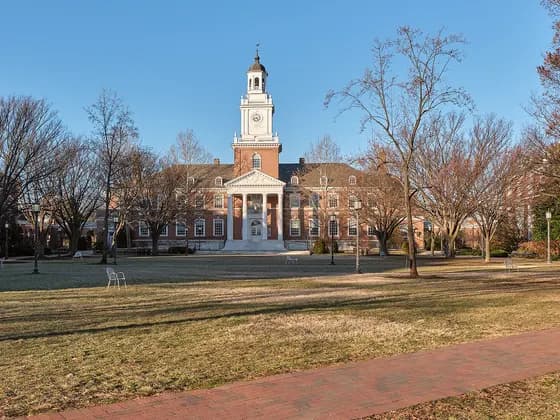
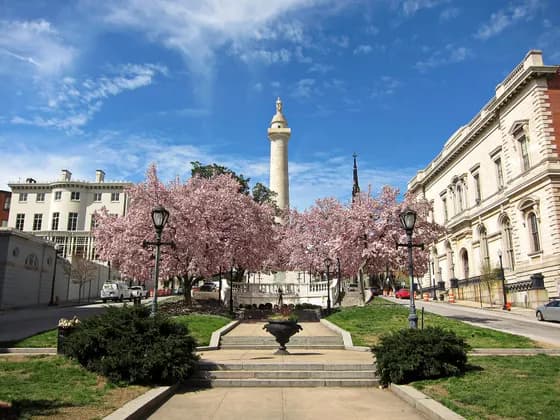

Photo: Paul Sableman from St. Louis, MO · CC BY 2.0 · cropped
Photo: chris.rycroft · CC BY 2.0 · Photo: AgnosticPreachersKid · CC BY-SA 4.0 · Photo: Oldlinestate · Public domain
The Johns Hopkins University School of Medicine MD program at a glance (2027 entry)
The Johns Hopkins University School of Medicine MD is a four-year program in Baltimore, Maryland. Each class has 120 students, including 10 to 12 in the combined MD-PhD program, according to the MD-PhD program's FAQ. The curriculum, called Genes to Society, asks you to see each patient's illness as shaped by their genes, environment and social and economic circumstances, along a range from health through pre-disease to disease.
The pre-clerkship phase, the classroom-based first stage, runs from August of Year 1 to December of Year 2: four months of foundation courses, then the body one organ system at a time. Core clerkships, the required rotations in the main clinical specialties, begin in January of Year 2.
Patients come early. You start learning to interview and examine in your first weeks. From January of Year 1 you spend a half-day each week with a physician preceptor, a doctor who supervises and teaches you in clinic. Most lectures are recorded, so required class time goes to small groups, labs and patient sessions. All pre-clerkship courses are pass/fail.
Two threads tie the program together. A faculty advisor teaches your first clinical skills course and then advises you until graduation. The Scholarly Concentrations course guides every MD student through a mentored research or scholarly project across Years 1 and 2.
The Liaison Committee on Medical Education (LCME), which accredits programs leading to the MD degree, lists the school as fully accredited, with its next survey in 2029-30.
| Degree | MD |
|---|---|
| Program length | 4 years, starting in August |
| Class size | 120 a year, including 10 to 12 MD-PhD students |
| Teaching style | Integrated by organ system; e-lectures plus case-based small groups |
| Anatomy | Seven weeks of regional dissection at the start of Year 1 |
| First patient contact | Year 1: clinical skills from the first weeks, weekly clinic from January |
| Core clerkships | From January of Year 2, mainly at Baltimore-area hospitals |
| Step 1 timing | Year 2, in a self-study block of up to nine weeks |
| Grading | Pass/fail courses and core clerkships; Honors tiers for sub-internships (acting-intern rotations) and electives |
| Accreditation | LCME, full accreditation; next survey 2029-30 |
What makes the Johns Hopkins University School of Medicine MD program different
Your own weekly clinic from January of Year 1
From January of Year 1 until late fall of Year 2, the Longitudinal Ambulatory Clerkship gives you a half-day each week in an outpatient or community clinic with a physician preceptor. You follow some of your patients over time.
The same advisor and small group for four years
Each class is split into four colleges, and each college into groups of five students with one faculty advisor. Your advisor guides your studies, career choices and application for residency, the specialty training after medical school.
Core clerkships from January of Year 2
The clinical phase follows about 17 months of pre-clerkship study. The school's published curriculum map for the Class of 2028 and later shows one group starting clerkships while another studies for Step 1, the first part of the US medical licensing exam. The two groups swap in March. Electives, rotations you choose yourself, also open when the clinical phase starts.
A mentored scholarly project for every MD student
The Scholarly Concentrations course takes you from choosing a field in the fall of Year 1 to presenting your project at the Medical Student Research Symposium in Year 2. The research office reports that 86% of students graduating in 2011-2020 published at least one paper based on research done in medical school.
Short courses on medicine beyond the organ systems
Every few months, three- or four-day Topics in Interdisciplinary Medicine (TIME) courses pause the organ systems for subjects such as health disparities, nutrition, pain care, substance use disorders and patient safety. During clerkships, four-day Translational Science courses return you to the science of fields such as cancer, genomics and immunology.
How Johns Hopkins University School of Medicine teaches medicine
Genes to Society is integrated within each year and across all four, so science, clinical skills and social context are taught together. After the fall foundation courses, Organ Systems Foundations of Medicine (OSFM) takes the body one system at a time, covering the biochemistry, cell biology, epidemiology, pathology and pharmacology of each. Some school pages call this course Genes to Society, like the whole curriculum.
Horizontal Strands carry themes through all four years. The biological strands include genetics, pharmacology, nutrition, neoplasia and aging. Others cover ethics, professionalism and health inequities, including how social and economic forces shape who gets sick, and health systems science, from health policy and informatics to patient safety.
Most lectures are prerecorded e-lectures you watch online when it suits you, and the school aims to keep lectures under 40% of required course time. Required sessions are mainly small groups working through case-based question sets, plus labs, virtual microscopy (studying digital slides on a computer), team-based learning, journal clubs and student-led workshops.
Attendance is taken seriously. Under the non-clerkship policy in force from August 2026, you must attend at least 90% of required sessions each academic year. Planning to miss a session with patients, in the Simulation Center or in a TIME course means asking a dean first. Clinical courses, including Clinical Foundations of Medicine, the weekly clinic and clerkships, allow no free personal days.
The ways you will learn
| E-lectures and case-based small groups | You watch recorded lectures in advance, then work through case questions in a small group, with answer guides to check your reasoning. Faculty who lead a group for five or more sessions give narrative feedback on your professionalism, communication and teamwork, shared with your College advisor. |
|---|---|
| Labs and team-based learning | Anatomy has its dissection lab, and histology and pathology use virtual microscopy in teaching labs where pods of six share computers in pairs. In team-based learning you prepare beforehand, then solve problems with your team; anatomy, pain care and palliative care use it. |
| Clinical correlations | Sessions inside the science and organ-system courses where a patient describes living with an illness, tying the science to a real person. Attendance at these is required. |
| Standardized patients and teaching associates | Standardized patients are people trained to play patients, so you can practice interviews and sensitive conversations safely; teaching associates coach you on physical, breast and pelvic exams. You meet both from Clinical Foundations of Medicine onward, often in the Simulation Center. |
| PRECEDE sessions | Pre-Clerkship Education Exercises open each core clerkship, and some return at its midpoint. Examples include simulated cardiac arrests and trauma in emergency medicine, a newborn exam in the nursery in pediatrics, knot-tying and suturing in surgery, and a lumbar puncture workshop in neurology. |
A typical week on the Johns Hopkins University School of Medicine program
In the fall of Year 1, science classes usually run on weekday mornings from 8 a.m. to 1 p.m., according to the Scientific Foundations of Medicine page. Afternoons bring your three-hour Clinical Foundations of Medicine group on a Monday or Wednesday, and Foundations in Public Health on Tuesdays from 2 to 4 p.m. for ten weeks. Many Thursday afternoons hold individual clinical skills tasks of about an hour.
From January, the clinic course adds one afternoon a week; once a month that slot becomes small-group and simulated-patient sessions on campus. Before your first clerkship, the school's workload policy aims for no more than 35 hours of scheduled academic work a week, averaged over two weeks, counting required e-lectures.
On clerkships, required activities are capped at 80 hours a week averaged over two weeks, with at least one day off in seven averaged over four weeks, and weekend shifts can be scheduled. On sub-internships, where you act as an intern (a first-year resident), and on other advanced rotations, overnight hospital call comes no more than every third night on average. After 24 hours of call you get at least 14 hours off.
How anatomy is taught at Johns Hopkins University School of Medicine
Anatomy comes first. Foundations of Human Anatomy runs for seven weeks at the start of Year 1, alongside Clinical Foundations of Medicine, so you learn the body's structure while you begin examining patients. In the 2025-26 calendar it ran from August 21 to October 8.
The course takes a regional approach in three parts: thorax, abdomen and pelvis; back and limbs; and head and neck. For each region you have lectures on gross anatomy, with embryology where relevant, dissect that region of the human body, and take part in clinical correlations, team-based learning and small-group work. In 2025-26 each part ended with its own exam. Histology and pathology, the study of tissue and disease under the microscope, are taught in the fall through virtual microscopy.
When you first meet patients at Johns Hopkins University School of Medicine
Clinical Foundations of Medicine runs through the fall of Year 1 (late August to late November in 2025-26). In a group of five students with your College advisor, you learn to take a history, examine a patient and present your findings. You practice through role play and with standardized patients, then interview Johns Hopkins volunteer outpatients and inpatients, and your advisor reviews a video of your interview with you.
From January of Year 1, the Longitudinal Ambulatory Clerkship (LAC) gives you a home clinic, an outpatient or community practice where a physician preceptor supervises you for a half-day each week. The course pages put the session at three or four hours. In 2025-26 it ran from January to mid-June in Year 1 and from August to late November in Year 2.
There you use your new skills with real patients, follow some of them over time and see how social, behavioral and health-system issues affect their care. You keep a learning contract and a portfolio of patient logs, case write-ups and reflections.
Year by year at Johns Hopkins University School of Medicine
- Year 1
Foundations, then the organ systems
Year 1 starts in August with orientation and a three-day course on health disparities, then four months of foundation courses. From January you move to Organ Systems Foundations of Medicine and your weekly clinic. Most students do the bulk of their scholarly project in the six- to seven-week summer that follows.
- Week one: Transition to Medical School, then TIME: Disparities and Inequities in Health and Health Care, with talks from faculty, legislators and community activists, a Baltimore City tour and an afternoon of service learning.
- August to December: Foundations of Human Anatomy and Clinical Foundations of Medicine, then Scientific Foundations of Medicine sections on histology and pathobiology, macromolecules, cell physiology, genetics, metabolism, pharmacology and immunology (2025-26 order).
- Foundations in Public Health: epidemiology, ethics and the US health care system, taught with faculty from the Bloomberg School of Public Health and the Berman Institute of Bioethics, plus two selectives you choose.
- Organ Systems Foundations of Medicine, January to June (2025-26 order): Nervous System and Special Senses; Brain, Mind and Behavior; Neoplasia; Dermatology; Microbiology and Infectious Diseases; Hematology; Renal; and Pulmonary.
- TIME courses on nutrition and behavior change, pain care and substance use disorders, plus Integrative Medicine sessions and interprofessional education events, the first held at the School of Nursing.
- Scholarly Concentrations: a fall orientation, then four modules across the year.
- Year 2, August to December
The last organ systems and Transition to the Wards
The organ-system course resumes in August and finishes in late November, with your weekly clinic running through most of the fall. December brings Transition to the Wards, which prepares you for hospital work.
- OSFM Year 2 (2025-26 dates): Cardiovascular from mid-August, then GI/Liver, Musculoskeletal, Endocrine and Reproduction, which ended on November 21.
- The LAC continues until late November and ends with written exams in the Armstrong Medical Education Building and standardized-patient exams in the Simulation Center.
- TIME courses on high value care, clinical informatics and patient safety. The 2025-26 calendar placed the first two in the fall of Year 2 for the Class of 2029, and the 2026-27 catalogue lists them in Year 2.
- Transition to the Wards fills three weeks in December. A sample week on its course page includes Basic Life Support, medical documentation, IV and blood-draw practice, chest X-ray and EKG reading, and acute care simulations. It also includes supervised skills practice in the hospital and shadowing other staff.
- Scholarly Concentrations modules 5 and 6 in September and November, then your presentation at the Medical Student Research Symposium, held on December 19 in 2025.
- January of Year 2 through Year 3
Core clerkships and Step 1
The clinical phase starts in January of Year 2, the third quarter of the academic year. Each nine-week quarter holds eight weeks of clerkships plus a one-week course. You begin with either a clerkship or Step 1 study. Year 3 brings the remaining clerkships, electives and study for Step 2 Clinical Knowledge (CK), the part of the licensing exam that tests clinical medicine.
- Eight-week core clerkships in internal medicine, surgery, pediatrics, and gynecology and obstetrics, and four-week clerkships in neurology, psychiatry and emergency medicine. The clerkship pages say neurology and psychiatry are always paired to make an eight-week block.
- A Step 1 self-study block of up to nine weeks. From the Class of 2028, at least four weeks must be registered in Quarter 3 or 4 of Year 2.
- A one-week Translational Science course after each core clerkship quarter, in infectious disease, regenerative medicine, genomic medicine, immunology, metabolism or cancer. Most students take four, each with an ethics afternoon led by the Berman Institute of Bioethics and a session with your college group.
- TIME: End of Life and Palliative Care, a required four-day course taken after at least one core clerkship, with a hospice home or inpatient visit and practice with standardized patients.
- Many clerkships and electives also run through the summer.
- Step 2 CK study, which the curriculum map places in the later part of Year 3.
- Year 4
Advanced clerkships, electives and TRIPLE
Year 4 finishes your graduation requirements: the sub-internship and advanced clerkship, which can also fall in Year 3, your remaining electives, and Step 2 CK, which you must sit by March 31. In late March or April you take the two-week TRIPLE capstone, half the class at a time, and rotations can continue until mid-May. The curriculum map says Year 4 is being reimagined to include emerging topics, so it may change for the class entering in 2027.
- A four-week sub-internship, in which you act as an intern on a hospital team, usually with fewer patients and closer supervision. It must be at a Johns Hopkins hospital, in a specialty that students can enter directly at intern level.
- One advanced clerkship, run in four-week blocks in the 2026-27 dates. The Advanced Clerkship in Critical Care places you in one of nine specialty intensive care units, with simulation and the Fundamentals of Critical Care Support course.
- The alternative, the Advanced Ambulatory Clerkship, places you in a general internal medicine or family practice office, with geriatrics clinics at Johns Hopkins Bayview, a memory clinic and home visits. It needs the medicine core clerkship and one other; its course page gives 4.5 weeks.
- TRIPLE (Transition to Residency and Internship and Preparation for Life) covers Advanced Cardiac Life Support certification, rapid response drills, central line placement, airway management, informed consent, error disclosure and handoffs.
- Residency application support from your college, including two mock interviews in September with faculty or alumni in your chosen field.
How you are assessed at Johns Hopkins University School of Medicine
Under the grading policy in force since December 2025, all pre-clerkship courses are pass/fail, as are the weekly clinic course, Transition to the Wards, the core clerkships, the two advanced clerkships and TRIPLE. Professionalism is part of every grade, and strong exam results cannot make up for falling short on it.
To pass a pre-clerkship course or exam you need the lower of 70% or 1.5 standard deviations below the class mean. Fail an end-of-course exam and you get an Incomplete and a closed-book retake at least a week later, needing 70%. A second failure brings a learning plan, possible tutoring and written short answers before a third attempt; failing that refers you to the Promotions Committee.
Core clerkship grades include at least a standardized clinical performance evaluation and a written knowledge exam. Where available, the written exam is a National Board of Medical Examiners (NBME) clinical subject exam, the national end-of-rotation shelf exam, and you must score above the 5th percentile; internal exams need 60%. Some clerkships also use a standardized-patient exam. You get two more tries at a failed knowledge or standardized-patient exam within six months; a third failure means repeating the clerkship. Every required clerkship gives you formal feedback by its midpoint. Sub-internships, clinical electives and research electives are graded Honors, High Pass, Pass or Fail.
The United States Medical Licensing Examination (USMLE), sponsored by the Federation of State Medical Boards and the NBME, has three steps. Step 1 covers the science behind medicine and has been reported only as pass or fail since January 2022. Step 2 CK tests clinical medicine, and Step 3 follows graduation. Hopkins requires you to pass Step 1 by graduation and sit Step 2 CK by March 31 of your final year.
In August 2026 the USMLE program announced a move to designated testing dates from January 2029, with Step exams offered less often each year. On the current schedule, students entering in 2027 would sit Step 1 and Step 2 CK under that model, so the school's timing rules may change.
For each step you can register for up to one quarter, nine weeks, of independent study; studying longer means a leave of absence. Your record is reviewed monthly. Failing two pre-clerkship exams or one shelf exam brings a Formal Notice, while failing a course, two shelf exams or a USMLE step brings Formal Monitored Academic Status, with closer support from your advisor.
Where you will actually train at Johns Hopkins University School of Medicine
Your clinical years are spent mainly at Johns Hopkins hospitals and affiliated hospitals and clinics in the Baltimore-Washington area. Internal medicine, for example, splits its eight weeks between The Johns Hopkins Hospital and either Johns Hopkins Bayview Medical Center or Sinai Hospital of Baltimore. Pediatrics includes a required rotation at the Kennedy Krieger Institute, a hospital for children with developmental disabilities and rehabilitation needs.
Within clerkships you rotate across services. Surgery pairs four weeks of general surgery with four on two subspecialties you choose, such as transplant surgery or neurosurgery. Gynecology and obstetrics adds two two-week selectives, such as gynecologic oncology, to inpatient obstetrics and gynecology.
The Registrar allocates clerkship places through an online system. You state preferences, including when to take Step 1, vacation plans and circumstances such as military, medical or religious needs, and a lottery decides when a clerkship is oversubscribed. Because every place must be filled each quarter, you may be given a clerkship in a period you did not choose.
Once assignments are out, you can use any block without a required course for electives or vacation. Departments then collect site preferences, without weighing career plans, and place you at random if you miss the deadline. You arrange and pay for your own transport.
Pediatrics also has a site in Florida. Usually four pediatrics students each half quarter (two inpatient, two outpatient) spend four weeks at Johns Hopkins All Children's Hospital in St. Petersburg, with round-trip airfare, local travel, a room and some meals provided. A lottery is used if more than eight students ask. If fewer ask, places are filled at random, but a compassionate-consideration process lets you explain why you need to stay near Baltimore.
On the site lists of all seven core clerkships. Johns Hopkins Medicine's 2026 fact sheet lists 1,215 licensed beds at The Johns Hopkins Hospital and 474 at Bayview.
- The Johns Hopkins Hospital
- Johns Hopkins Bayview Medical Center
Sinai takes internal medicine, pediatrics and neurology students; Greater Baltimore and Anne Arundel take gynecology and obstetrics, Anne Arundel also neurology; St. Agnes takes pediatrics; all pediatrics students rotate at Kennedy Krieger.
- Sinai Hospital of Baltimore
- Greater Baltimore Medical Center
- Anne Arundel Medical Center
- Ascension St. Agnes
- Kennedy Krieger Institute
Howard County, a 262-bed Johns Hopkins hospital, hosts surgery, pediatrics, gynecology and obstetrics, neurology and psychiatry students. The Pediatric Center is an outpatient pediatrics site.
- Johns Hopkins Howard County Medical Center
- The Pediatric Center, Columbia
Outpatient sites for the pediatrics clerkship. Your weekly clinic in Years 1 and 2 is also an outpatient or community practice.
- East Baltimore Medical Center
- Harriet Lane Clinic
- Johns Hopkins Community Physicians at Remington
- Johns Hopkins Community Physicians at Odenton/Meade
- Johns Hopkins Community Physicians at Water's Edge
Four weeks of pediatrics, inpatient or outpatient, on teams of Johns Hopkins faculty and residents.
- Johns Hopkins All Children's Hospital
Electives, selectives and away rotations at Johns Hopkins University School of Medicine
Electives open in Quarter 3 of Year 2 and generally last four weeks. Every department offers them, from laboratory research to advanced clinical work, and the Registrar's Electives Book lists what is available.
Students who started in fall 2024 or later, which includes the class entering in 2027, need 34 elective weeks (1,326 hours) to graduate. At least 26 weeks must be with School of Medicine faculty and at least 10 must be clinical. Electives should not be scheduled over university holidays or breaks unless a dean approves an exception. Study time for Step exams does not count.
Electives at other medical schools, usually called away rotations, need approval from the Associate Dean for Student Affairs, and the catalogue allows one elective quarter at a non-affiliated institution. Electives abroad need extra steps before departure, including an ethics case series on global health, a travel safety course and a health assessment. The university provides HX Global travel assistance at no charge.
The Global Health Leadership Program offers two electives of at least three to four weeks. GHLP-International sends you to a partner site, currently in India, Nepal or Peru, for clinical work and a scholarly project. GHLP-Migrant Health and Human Rights involves forensic evaluations of asylum seekers and work with Centro SOL at Johns Hopkins Bayview, with an optional six- to eight-week version that adds a Tahirih Justice Center internship.
You can also apply to two tracks that run alongside the curriculum. The Primary Care Leadership Track takes 10 first-year students a year, who do a primary care scholarly project and their weekly clinic at track sites. They return to those sites for a half-day a month, with at least two sessions required every six months, through December of Year 4. The Global Health Leadership Track runs from November of Year 1 to March of Year 4, with workshops, a global health version of the weekly clinic, field experience and a capstone.
Dual degrees and research years at Johns Hopkins University School of Medicine
Every MD student completes a scholarly project through the Scholarly Concentrations course: 55.5 scheduled hours over about 18 months. After a fall orientation in Year 1, you choose a concentration at the end of November. You then meet your concentration faculty in three-afternoon modules during TIME weeks, four in Year 1 and two in Year 2. Students in the MD-PhD program, the Medical Scientist Training Program, are exempt.
The five concentrations are Preclinical and Translational Research; Clinical Epidemiology and Outcomes Research; History of Medicine; Humanism, Ethics and the Art of Medicine (HEART); and Public Health Research. You submit a proposal, a summer progress report, an abstract and a poster or talk, and statisticians from the Biostatistics Consulting Center can help with analysis.
Many students go further. The research office says 86% of students take research electives beyond the scholarly project, and the school says nearly 100 students a summer do research with Hopkins grants. You can also step out for 9 to 12 months on Advanced Studies Program Status; the Dean's Year of Research funds a 12-month project, its stipend split between the Dean's Office and your department.
The MD-PhD program admits about 12 students a year, and all eligible admitted students are funded, with a stipend and health and dental insurance. The catalogue gives about eight years for both degrees; the School of Medicine's combined-degree page says six to eight. Most students do two years of medical school, the PhD, then the last two years; some take three medical years first, or start with the PhD.
The MD/MBA with the Carey Business School takes five years. You complete 36 MBA credits at Carey's Harbor East location between Years 2 and 3 or Years 3 and 4, and Carey counts 18 MD credits toward its 54-credit degree. You can apply with your MD application or as a current student. The MD/MS in Health Care Management, also with Carey, uses the same two windows, with applications due by June 1 of Year 2 or 3.
The school also lists dual-degree options in health sciences informatics, health innovation and technology, education in the health professions, history of medicine, bioethics and public health. Time out for a degree such as a Master of Public Health at the Bloomberg School is taken as a leave of absence.
Facilities and support at Johns Hopkins University School of Medicine
Where you will learn
Most teaching happens in the Armstrong Medical Education Building, which also serves as study space after hours. It has two 170-seat lecture halls that combine into one, small-group rooms for up to 15, 25 or 40 people, and five teaching labs for virtual microscopy. There is also an 80-seat case study room and a flat-floor Learning Studio for team-based learning, and each college has a suite on the second floor.
The Johns Hopkins Medicine Simulation Center, a partnership between the School of Medicine and The Johns Hopkins Hospital, is accredited by the Society for Simulation in Healthcare. It uses standardized patients and teaching associates, human patient simulators, virtual reality, task trainers and computer-based simulation. You use it for clinic exams, Transition to the Wards and several PRECEDE sessions.
Support while you study
The Colleges Advisory Program, founded in 2005, is the center of student support. Each of its four colleges takes 30 students from every class and has six core faculty. Within your college you belong to an advisory molecule of five students with one advisor, who teaches your Clinical Foundations of Medicine group and stays with you through graduation.
Your advisor covers personal, academic, career and residency advising, from study plans and Step scheduling to electives, research mentors and your residency application. Small-group Dialogues on Professional Growth run in every year during TIME and Translational Science weeks. Each college is paired with one of four deans in the Office of Medical Student Affairs and runs its own peer advising.
A learning specialist helps students in all four years with study plans, test-taking, time management and resources for Step and shelf exams, and can connect you with peer tutoring. If you fail a pre-clerkship exam, your College advisor is told and you are referred to the learning specialist.
Student Health and Well-Being provides primary care and mental health services on every Hopkins campus. Through TimelyCare you can reach a provider on demand at any hour or book ongoing video counseling, and a behavioral health crisis team answers a phone line around the clock.
Is the Johns Hopkins University School of Medicine program right for you?
This program may suit you if
- You want to work with patients from your first semester, including a weekly clinic of your own.
- You value a long-term faculty advisor and the same small group of classmates for four years.
- You want a required, mentored scholarly project, with summer funding and the option of a funded research year.
- You would use 34 weeks of electives to explore specialties, research or global health.
- You are curious about how genes, social conditions and health systems shape illness.
Things to think about
- The pre-clerkship phase lasts about 17 months, and Step 1 study falls in the middle of Year 2.
- You will travel between hospitals across the Baltimore-Washington area at your own expense, and site preferences are not guaranteed.
- Attendance rules are firm: at least 90% of required pre-clerkship sessions, and no free personal days on clinical courses.
- Pediatrics may send you to Florida for four weeks if too few students volunteer.
Johns Hopkins University School of Medicine MD program — frequently asked questions
Applying to Johns Hopkins University School of Medicine?
How to get into Johns Hopkins University School of Medicine
Prerequisites, MCAT, AMCAS personal statement, secondaries and interview, step by step.
Open the guide →Johns Hopkins University School of Medicine admissions profile
MCAT and GPA profile, acceptance rate, interview format and key dates.
See the profile →Compare Johns Hopkins University School of Medicine with other schools
Put the teaching style, anatomy teaching and clinical sites next to another school.
Open the comparison →Prepare for the Johns Hopkins University School of Medicine interview
Format breakdown, school-specific sample questions and prep tips from tutors who interviewed here.
Read the guide →Where this Johns Hopkins University School of Medicine program guide came from
This guide was written from 85 official sources — Johns Hopkins University School of Medicine's own program pages and curriculum documents, plus the accreditor and the hospitals and health systems the school trains students in where they publish detail — read on 2026-10-10, then checked claim by claim against those sources.
- JHU Academic Catalogue 2026-27: Doctor of Medicine, MD
- MD Program
- Genes to Society curriculum map, Class of 2028 and beyond (September 2024)
- Academic Year 2025-2026 Course Dates, Years 1 to 4
- Required Clerkship Dates, Academic Year 2026-27
- School of Medicine Calendar 2026-2027
- Genes to Society
- Genes to Society: Courses and Clerkships
- Frequently Asked Questions About Genes to Society
- Horizontal Strands
- Genes to Society: Year One Overview
- Genes to Society: Year Three Overview (PRECEDE)
- Genes to Society: Year Four Overview
- Clinical Foundations of Medicine
- Foundations of Human Anatomy
- Scientific Foundations of Medicine
- Foundations in Public Health: Epidemiology, Ethics and Health Care Systems
- Organ Systems Foundations of Medicine
- Genes to Society Course (Year Two)
- Longitudinal Ambulatory Clerkship (Year One)
- Longitudinal Ambulatory Clerkship (Year Two)
- Scholarly Concentrations (Year One)
- TIME: Disparities and Inequities in Health and Health Care
- TIME: Nutrition and Behavior Change
- TIME: Pain Care Medicine
- TIME: Substance Use Disorders
- TIME: High Value Healthcare
- TIME: Clinical Informatics
- TIME: Patient Safety and Quality Improvement
- TIME: End of Life and Palliative Care
- Transition to the Wards
- Core Clerkship in Emergency Medicine
- Core Clerkship in Internal Medicine
- Core Clerkship in Surgery
- Core Clerkship in Pediatrics
- Core Clerkship in Gynecology and Obstetrics
- Core Clerkship in Neurology
- Core Clerkship in Psychiatry
- Translational Science Intersessions
- Advanced Critical Care Clerkship
- Advanced Ambulatory Clerkship
- Transition to Residency and Internship and Preparation for Life (TRIPLE)
- Primary Care Leadership Track
- Global Health Leadership Track
- Global Health Leadership Program
- Office of the Registrar: Electives Book
- Information Regarding Participation in International Clinical or Research Electives (revised May 2024)
- Grading Policy MSPP009, effective December 4, 2025
- Policy on the Timing and Passing of the USMLE, MSPP017
- Independent Study for USMLE Policy, MSPP011
- Medical Student Elective Requirements MSPP005, effective May 7, 2026
- Scholarly Concentrations Policy, MSPP018
- Subinternship Required for Graduation MSPP019, effective May 7, 2026
- Medical Student Clerkship Assignment Process UMEBD00-8, effective February 5, 2026
- Medical Student Promotions Policy, MSPP015
- Remediation and Make-Up Exams Policy, MSPP016
- Formative Assessment and Feedback Policy, MSPP045
- Monitoring Student Workload Policy, MSPP012
- Non-Clerkship Student Attendance Policy, effective August 10, 2026
- Medical Student Non-Clerkship Attendance Policy, MSPP013 (current until August 2026; lists required small-group sessions)
- Clinical Course and Clerkship Attendance Policy, MSPP004
- Colleges Advisory Program: About Us
- Colleges Advisory Program: College Wide Programs
- Colleges Advisory Program: Advising Resources
- MD Program: Research Opportunities
- Office of Medical Student Research and Scholarship: Research Opportunities
- Office of Medical Student Research and Scholarship: Scholarly Concentrations
- Office of Medical Student Research and Scholarship: Research Funding
- Leave of Absence and Advanced Studies Program Status
- MD Program: Combined Degree Programs
- MD Program: MD/MBA Degree Program
- JHU Academic Catalogue 2026-27: MD-MBA Combined Degree
- JHU Academic Catalogue 2026-27: MD-PhD Combined Degree
- Johns Hopkins MSTP/MD-PhD Program: FAQs
- Office of Medical Student Affairs: Learning Specialist
- Student Support: Well-Being and Support Resources
- Armstrong Medical Education Building
- The Johns Hopkins Medicine Simulation Center
- Fast Facts: Johns Hopkins Medicine (2026)
- USMLE: About the USMLE
- USMLE: Step 2 CK
- USMLE Step 1 Transition to Pass/Fail Only Score Reporting (posted September 15, 2021)
- LCME Directory of Accredited Programs (updated July 22, 2026)
- USMLE: Updated Timeline for Designated Testing Dates, Transition in January 2029 (August 2026)
- USMLE: Designated Testing Dates information hub (dates the January 2029 timeline announcement August 6, 2026)
Curricula are restructured between cycles. Anything here that decides your application — how anatomy is taught, a clinical campus assignment, a required research year — should be confirmed against the official page for your entry year.
Applying to Johns Hopkins University School of Medicine?
We help US applicants with MCAT strategy, the AMCAS personal statement, secondary essays and interview prep — everything you need for a competitive Johns Hopkins University School of Medicine application.