
University of Washington School of Medicine Interview
Format, Questions & Prep Tips
University of Washington School of Medicine medicine interviews for 2027 entry are a traditional interview. Published figures: Annual MD class size ~290 (WWAMI-wide); Applications received ~4,000–6,000 per cycle; Interview format Traditional — two one-on-one sessions, ~30 min each.
- Institution
- University of Washington School of Medicine
- Interview (2027 entry)
- September through February; rolling invitations issued after secondary review
- Decisions (2027 entry)
- Primary decisions by late February; final decisions by March 30. Waitlist movement through May–August

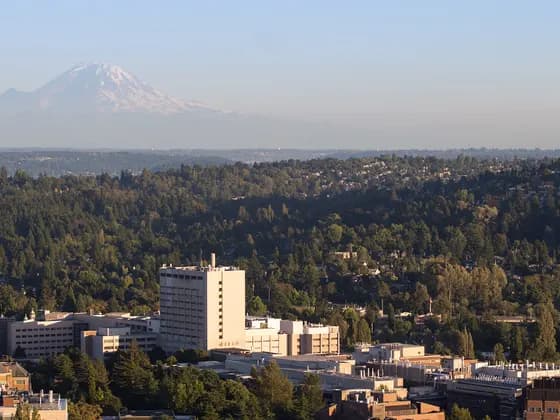


Photo: Joe Mabel · CC BY-SA 4.0 · cropped
Photo: Atomic Taco · CC BY-SA 3.0 · Photo: Daniel Schwen · CC BY-SA 4.0 · Photo: King of Hearts · CC BY-SA 4.0
How to get into University of Washington School of Medicine (MD) medicine
Step-by-step: entry requirements, admission tests, personal statement, interview format and the key deadlines.
Open the guide →University of Washington School of Medicine (MD) entry requirements
Admission profile, interview format, decision dates and what makes University of Washington School of Medicine (MD) different.
See the profile →The University of Washington School of Medicine (MD) medicine interview
The University of Washington School of Medicine uses a traditional interview format — typically two one-on-one sessions with faculty, clinicians, or senior students, each approximately 30 minutes. UW SOM is consistently ranked #1 nationally for primary care by US News and is the anchor of the unique WWAMI program that distributes medical education across five states: Washington, Wyoming, Alaska, Montana, and Idaho.
Interviewers are specifically interested in applicants who understand the Pacific Northwest’s rural health landscape, tribal health challenges, and the WWAMI model itself. Research strengths in HIV/AIDS, global health, and genomic medicine give the school an academic depth that the interview may also probe.
Applications are via AMCAS; WWAMI-state residents (WA, WY, AK, MT, ID) fill nearly all seats. Non-WWAMI applicants are rarely admitted and should carefully consider whether to apply.
University of Washington School of Medicine (MD) interview at a glance (2027 entry)
| Annual MD class size | ~290 (WWAMI-wide) |
|---|---|
| Applications received | ~4,000–6,000 per cycle |
| Interview format | Traditional — two one-on-one sessions, ~30 min each |
| Curriculum | Integrated with WWAMI distributed delivery across 5 states |
| Application system | AMCAS (WWAMI-state residents near-exclusively preferred) |
| Interview window | September–February |
| Established | 1946 |
Interview format
- Traditional format: two separate one-on-one interviews, each approximately 30 minutes, with faculty or clinician interviewers.
- Interviewers read the full application before the session — expect specific questions about WWAMI ties, research, and clinical experiences.
- Behavioral questions ("tell me about a time…") and motivational questions ("why UW / why primary care") are common.
- Full day includes orientation, UW Medical Center campus tour, and informal lunch with current students.
- In-person at Seattle or a regional WWAMI site; virtual format available in some cycles.
- Dress professionally; the day runs approximately 4–5 hours.
Working towards the MCAT score University of Washington School of Medicine (MD) expects? Build a week-by-week plan from your test date — free for the first two weeks.
Sample interview questions
The WWAMI program is unique in distributing medical education across five states. How does this model align with your career goals as a physician?
Show genuine understanding of WWAMI: the distributed preclinical year at a state-site university, the convergence for clinical training, and the goal of producing physicians for rural and underserved Pacific Northwest communities. Demonstrate that you see the model as a feature, not a logistical complication.
Why primary care? Many medical students begin with primary care interest and change to subspecialties. What makes your commitment to primary care medicine durable?
UW values authentic primary care motivation. Reference specific experiences with generalist physicians, the cognitive breadth of primary care, the longitudinal patient relationship, and the health equity argument for a robust primary care workforce. Show intellectual honesty about the challenges (pay, burnout).
You are working at a rural Alaska clinic. The nearest hospital is 200 miles away and air transport is unavailable due to weather. A patient has a condition that may require emergency surgery. What do you do?
This is a frontier medicine scenario directly relevant to WWAMI training. Discuss stabilization, telemedicine consultation, communication with the closest surgical center, informed consent for managing a case beyond your competency, and patient and family communication.
A Native American patient declines your treatment recommendation and instead wants to use traditional healing practices. How do you respond?
Reference tribal health sovereignty, the Indian Health Service framework, cultural humility, and integrative care models. The Pacific Northwest has significant Indigenous populations; dismissing traditional healing violates both cultural competency and patient autonomy principles.
You are the only Spanish-speaking provider in a rural clinic that sees a large Hispanic farmworker population. You have more patients than you can safely see in a day. How do you manage your responsibilities?
Priority and triage skills, communication with clinic management, use of interpreter services, and advocacy for hiring additional bilingual staff or contracting with interpreter services. Show both immediate problem-solving and systemic thinking.
UW's global health program has been at the forefront of HIV/AIDS research for decades. What draws you to global health medicine, and how do the lessons from international work apply to domestic underserved communities?
Reference UW's specific HIV/AIDS research contributions, the PEPFAR era, and the bidirectional lessons between global and domestic health disparities work. Show intellectual engagement beyond "I want to do international medicine".
Washington State has legalized physician-assisted death under the Death with Dignity Act. A terminally ill patient asks about this option. How do you respond?
Apply a values-neutral, patient-centered approach: provide complete information about the law's requirements, explore the patient's motivations, and discuss palliative care alternatives. If you have personal moral reservations, acknowledge them while fulfilling your duty to inform and refer.
Tell me about a clinical experience that challenged your understanding of what good medicine looks like. What did you learn?
Show intellectual growth and clinical self-reflection. The "challenged your understanding" framing invites genuine complexity — avoid stories with tidy resolutions. Strong answers involve a tension between technical correctness and humanistic care.
A patient in a rural Wyoming clinic has been diagnosed with cancer. The nearest oncologist is five hours away and telemedicine infrastructure is limited. How do you explain the situation and develop a care plan together?
WWAMI rural context. Demonstrate patient-centered communication about logistical barriers without minimizing the cancer diagnosis. Explore financial assistance for travel, telemedicine options, shared decision-making about whether to pursue aggressive treatment given access challenges, and the role of primary care in coordinating oncologic care remotely.
Should the US adopt a universal primary care guarantee — free primary care visits for all residents — similar to some European models? Defend your position.
Reference primary care cost-effectiveness data, the evidence that primary care reduces downstream specialist costs, international comparisons, and the political economy of implementation in the US. Take a position informed by evidence.
Role-play: I am a patient at a small clinic in rural Idaho. You have just recommended I travel to Seattle for specialist care, and I am telling you that is impossible — I cannot leave my farm or afford the trip. The assessor will play the patient — work this through with me.
This reflects the WWAMI rural reality. Take the barrier seriously rather than repeating the referral, explore telehealth and co-management options, and problem-solve collaboratively about what is actually feasible. Assessors in a traditional UW interview value candidates who treat access barriers as shared problems, not patient non-compliance.
You are shown data indicating that counties served by WWAMI-trained physicians have higher rates of physician retention in rural and underserved areas than the national average. What would make you confident this reflects the program's effect rather than other factors?
Discuss selection effects (WWAMI admits applicants already inclined toward rural practice) versus the program's training effect, and what comparison data would help disentangle them. UW's #1 primary-care and rural-workforce identity makes critical interpretation of its own outcomes a fair and revealing question.
UW has been a leader in HIV prevention research, including pre-exposure prophylaxis (PrEP). What is the evidence base for PrEP, and what are the implementation challenges in rural and underserved Pacific Northwest communities?
Summarize PrEP's strong efficacy evidence in preventing HIV transmission, then focus on real-world barriers — awareness, stigma, access to prescribers and monitoring, and cost — that are amplified in rural WWAMI settings. Connects UW's global/HIV research legacy to its rural mission rather than treating them separately.
A telemedicine consultation lets a rural patient avoid a 300-mile drive, but the specialist is licensed in Washington and the patient is physically in Montana. What ethical and practical issues does cross-state telemedicine raise?
Address state medical licensure and the limits it places on cross-border telehealth, the access benefit for WWAMI patients, standard-of-care and follow-up concerns, and mechanisms such as the Interstate Medical Licensure Compact. Shows you understand the regulatory reality of distributed care across five states.
An Alaska Native patient tells you they want to involve a traditional healer alongside the treatment you are proposing. How do you respond?
Respond with cultural humility and respect for tribal health sovereignty: express openness, ask the patient to help you understand the traditional practices, screen only for genuine safety conflicts (such as herb-drug interactions), and frame care as integrative rather than competing. Indigenous health is a defining WWAMI clinical context.
Practise the University of Washington School of Medicine (MD) interview
Rehearse the real format before the day — on demand with our AI interviewers, or live with a tutor.
Sit a mock with photoreal AI interviewers — any time
A timed MMI or panel interview on video — American & international voices — with interviewers who listen, react and press with follow-ups. Rubric-scored feedback and a replay the moment you finish.






Live mocks with a tutor who’s been in the room
A full University of Washington School of Medicine (MD)-style mock with a medic or dentist tutor — honest scoring against real marking criteria, a station-by-station debrief and a written action plan.
Book a mock interviewHow to prepare for the University of Washington School of Medicine (MD) interview
Common pitfalls to avoid
University of Washington School of Medicine (MD) interview — frequently asked questions
Sources & official admissions information
Ready to nail your University of Washington School of Medicine (MD) interview?
Book a mock interview with a tutor who knows the US interview formats, orpractice unlimited stations from our interview question bank.