
WesternU Heatherington COM Interview
Format, Questions & Prep Tips
WesternU Heatherington COM medicine interviews for 2027 entry are multiple mini interviews (MMI), held September 2026 through February 2027. WesternU Heatherington COM describes the format as: Online only (Zoom): a 30-minute panel interview with two or three interviewers plus two MMIs. Published figures: Annual DO class size ~112.
- Institution
- Heatherington College of Osteopathic Medicine at Western University of Health Sciences (formerly COMP-Northwest)
- Interview (2027 entry)
- September through February
- Decisions (2027 entry)
- Rolling decisions after interview
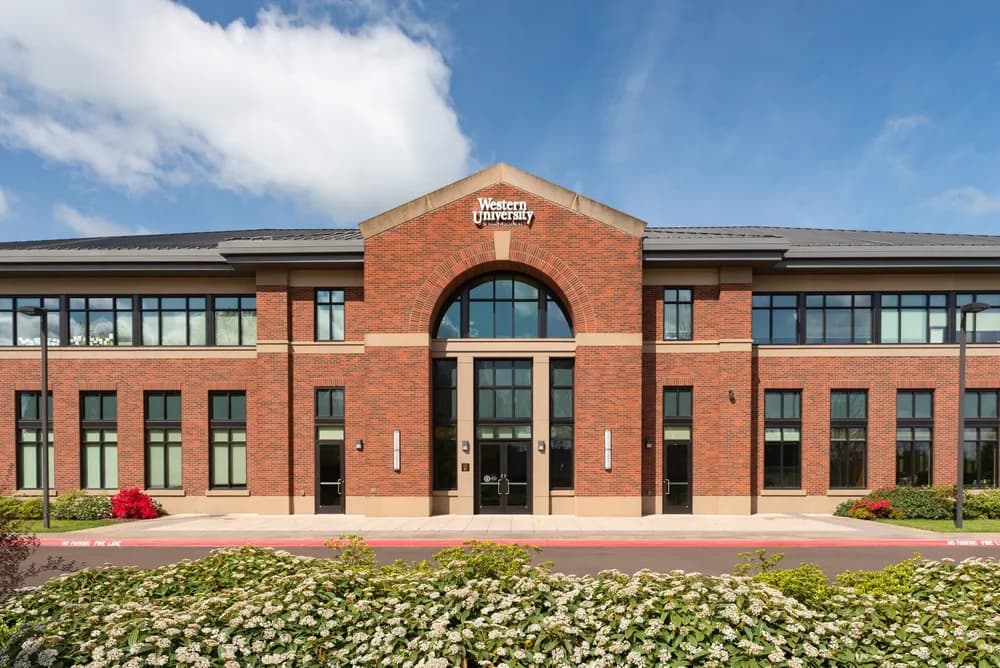
Photo: Gary Halvorson, Oregon State Archives · CC BY 4.0 · cropped
Photo: Gary Halvorson, Oregon State Archives · CC BY 4.0 · Photo: 46percent · Public domain · Photo: Rytyho usa · CC BY-SA 3.0
How to get into WesternU Heatherington COM (DO) medicine
Step-by-step: entry requirements, admission tests, personal statement, interview format and the key deadlines.
Open the guide →WesternU Heatherington COM (DO) entry requirements
Admission profile, interview format, decision dates and what makes WesternU Heatherington COM (DO) different.
See the profile →The WesternU Heatherington COM (DO) medicine interview
WesternU COM-NW uses a traditional panel interview at its Lebanon, Oregon campus in the Willamette Valley. Established in 2011 as the Northwest branch of Western University of Health Sciences, it offers Pacific Northwest-specific clinical training within a larger multi-health-sciences university system.
Casper is not currently required at WesternU COM-NW — verify on the official admissions page each cycle, as requirements change. Lebanon is a small agricultural city — interviews probe whether you are genuinely drawn to that environment, not just to a DO acceptance.
WesternU’s broader campus ecosystem (pharmacy, PA, optometry, veterinary medicine) shapes the interprofessional culture, and questions about team-based care appear regularly.
WesternU Heatherington COM (DO) interview at a glance (2027 entry)
| Annual DO class size | ~112 |
|---|---|
| Interview format | Traditional panel — faculty + student |
| CASPer required | No |
| Application system | AACOMAS primary + WesternU secondary |
| Location | Lebanon, OR (Willamette Valley) |
| Interview window | September–February |
Interview format
- Traditional panel: faculty + student; ~30–45 minutes.
- Lebanon campus tour and student interaction on interview day.
- CASPer reviewed prior to interview invitation.
Working towards the MCAT score WesternU Heatherington COM (DO) expects? Build a week-by-week plan from your test date — free for the first two weeks.
Sample interview questions
WesternU COM-NW is located in Lebanon — a small agricultural city in the Willamette Valley. Why does that specific setting appeal to you for your medical training?
What they are listening for:
- Rural Pacific Northwest medicine
- Willamette Valley agricultural communities
- access to coastal and mountain clinical settings
Show genuine regional knowledge, not just a DO acceptance.
Why osteopathic medicine, and what drew you to a Pacific Northwest program specifically?
DO philosophy plus specific Pacific Northwest context: Oregon Health Plan, rural access, agricultural worker health, or tribal health in the region.
WesternU has pharmacy, PA, optometry, and veterinary medicine on affiliated campuses. How do you see collaboration with those fields shaping your development as a physician?
What they are listening for:
- One Health concept (veterinary-human medicine overlap)
- interprofessional teamwork
- scope-of-practice mutual respect
Concrete example of cross-disciplinary work if possible.
An undocumented agricultural worker in the Willamette Valley presents with symptoms of pesticide exposure but is afraid to seek formal care. How do you approach this situation?
What they are listening for:
- Oregon Health Plan (broad Medicaid coverage including undocumented adults)
- FQHC navigation
- confidentiality
- occupational health reporting obligations vs. patient welfare
Oregon has dramatically expanded Medicaid coverage to undocumented adults. What do you see as the health and fiscal arguments for and against this policy?
What they are listening for:
- Preventive care cost reduction
- emergency department avoidance
- public health benefits of coverage — vs. budget pressures
Show nuanced policy reasoning.
How would you apply OMM to an agricultural worker who presents with repetitive-strain injuries from seasonal harvesting work?
What they are listening for:
- Occupational biomechanics
- OMM as an adjunct to musculoskeletal primary care
- return-to-work function
- whole-person view of occupational health
Describe your most meaningful experience serving a rural or agricultural community. What structural barriers did you observe?
Specific. Transport, seasonal insurance gaps, language access, occupational hazards. Reflect on what systemic change would address the root cause.
Lebanon is a small city with limited urban amenities. How do you plan to build community and sustain your wellbeing during medical school there?
Concrete plan:
- outdoor recreation in the Pacific Northwest
- community engagement in Lebanon
- connection with classmates
Show self-awareness.
Your clinical supervisor makes a medical decision you believe is suboptimal for the patient but is not clearly wrong. Do you speak up, and how?
What they are listening for:
- Constructive professional communication
- learning context vs. patient advocacy
- appropriate escalation channels in clinical settings
What is One Health, and how might it apply to your training at WesternU, which has a veterinary medicine school in its broader system?
What they are listening for:
- One Health = interconnected health of humans
- animals
- environment
WesternU's vet school is in Pomona, CA — this is an unusual and genuine interprofessional connection.
A Willamette Valley occupational-health report shows agricultural workers have high rates of musculoskeletal injury and pesticide-related illness but very low rates of workers'-compensation claims. How would you reason about that mismatch, and what would you want to verify?
What they are listening for:
- Reason about under-reporting driven by fear of job loss
- documentation status
- language barriers and unfamiliarity with the system
- rather than low true injury rates
Verify denominators and claim definitions. Shows population reasoning grounded in Oregon agricultural-worker health.
WesternU COM-NW runs a board-focused DO curriculum within a multi-profession university. How do you learn best, and how would you stay on track for COMLEX while engaging with the interprofessional environment in a small Oregon town?
Concrete study systems and COMLEX preparation, plus genuine engagement with interprofessional learning. Frame the smaller Lebanon setting as conducive to focus. Show self-discipline and a deep-learning approach.
Role-play: a seasonal farmworker presents with worsening repetitive-strain injury but says he cannot afford to rest because the harvest window is short and his income depends on it. Counsel him.
Acknowledge the economic reality, offer OMM and practical modifications that allow continued work where safe, address pesticide and ergonomic risks, and connect to FQHC and occupational resources. Whole-person care that respects his constraints, not a 'just rest' answer.
Oregon extended Medicaid coverage to undocumented adults, a policy other states reject. Setting aside your personal politics, construct the strongest health and fiscal arguments on both sides of that decision.
For: preventive care reduces costly emergency use and improves public health; against: budget strain and prioritization debates. Demonstrate balanced, structured policy reasoning rather than advocacy. Tests nuance and the ability to argue beyond personal view.
Through the WesternU system you are exposed to One Health, linking human, animal and environmental health. Explain to a skeptical patient in an agricultural community why a vet-detected illness in local livestock could matter for his own health.
Translate zoonotic and environmental-health concepts into plain, relevant language, connect to his livelihood, and avoid jargon. One Health is a genuine and unusual feature of WesternU — show you can communicate it accessibly, not just define it.
Practise the WesternU Heatherington COM (DO) interview
Rehearse the real format before the day — on demand with our AI interviewers, or live with a tutor.
Sit a mock with photoreal AI interviewers — any time
A timed MMI or panel interview on video — American & international voices — with interviewers who listen, react and press with follow-ups. Rubric-scored feedback and a replay the moment you finish.






Live mocks with a tutor who’s been in the room
A full WesternU Heatherington COM (DO)-style mock with a medic or dentist tutor — honest scoring against real marking criteria, a station-by-station debrief and a written action plan.
Book a mock interviewHow to prepare for the WesternU Heatherington COM (DO) interview
Common pitfalls to avoid
WesternU Heatherington COM (DO) interview — frequently asked questions
Sources & official admissions information
Ready to nail your WesternU Heatherington COM (DO) interview?
Book a mock interview with a tutor who knows the US interview formats, orpractice unlimited stations from our interview question bank.