
Yale School of Medicine Interview
Format, Questions & Prep Tips
Yale School of Medicine medicine interviews for 2027 entry are a traditional interview, held October 2026 through February 2027. Published figures: Annual MD class size ~101; Tuition (2025–26) ~USD 65,000/year.
- Institution
- Yale School of Medicine
- Interview (2027 entry)
- October through February
- Decisions (2027 entry)
- Regular decisions by late March; waitlist through May–August

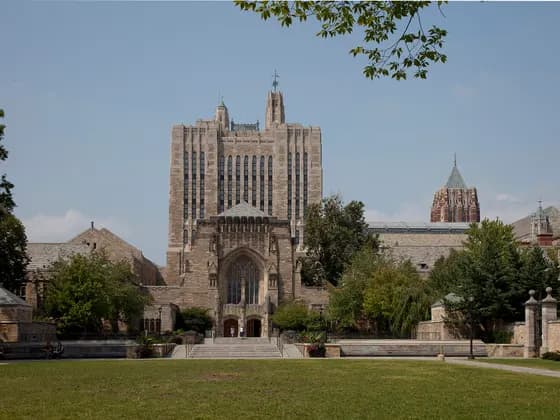
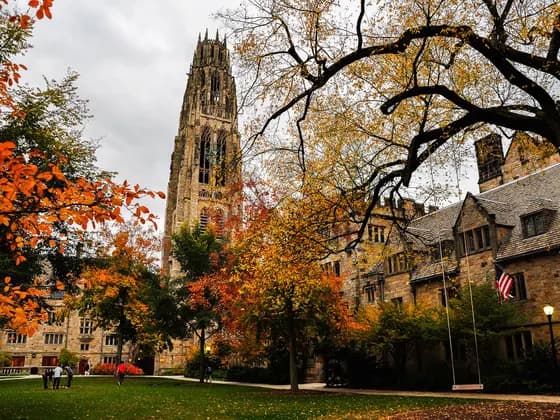

Photo: Raf2016 · CC BY-SA 4.0 · cropped
Photo: Carol M. Highsmith · Public domain · Photo: Namkota · CC BY-SA 4.0 · Photo: Christian David · CC BY-SA 4.0
How to get into Yale School of Medicine (MD) medicine
Step-by-step: entry requirements, admission tests, personal statement, interview format and the key deadlines.
Open the guide →Yale School of Medicine (MD) entry requirements
Admission profile, interview format, decision dates and what makes Yale School of Medicine (MD) different.
See the profile →The Yale School of Medicine MD program
Integrated + Case-based learning, 4 years, clinical rotations across New Haven and nearby towns, plus four more distant hospitals.
See the program →The Yale School of Medicine (MD) medicine interview
Yale School of Medicine uses a traditional open-file interview format with one or two faculty or staff interviewers. Yale is distinctive for its Yale System — students are not graded, do not rank against each other, and self-direct much of their clinical and scholarly work. Interviewers probe whether applicants genuinely understand and embrace this model.
Yale requires every student to complete a Thesis (the only AAMC school with a mandatory research thesis), and original scholarship is central to the school's identity. Interviewers ask about research experience and, more importantly, intellectual independence and the capacity to identify and pursue a question autonomously.
Yale's Office of Global Health is one of the largest in US medicine, and global health, refugee medicine, and health equity in New Haven are common interview themes.
Yale School of Medicine (MD) interview at a glance (2027 entry)
| Annual MD class size | ~101 |
|---|---|
| Interview format | Traditional open-file — one to two faculty sessions |
| Distinctive requirement | Mandatory research thesis for all MD students |
| Grading | No grades — Pass/Fail with narrative evaluations (Yale System) |
| Tuition (2025–26) | ~USD 65,000/year |
| Application system | AMCAS + Yale secondary |
| Interview window | October–February |
Interview format
- One or two one-on-one sessions with faculty, staff, or alumni — each approximately 45–60 minutes.
- Open-file; no MMI, no role-play prompts.
- Interview day includes student-led tour, lunch with students, and Dean's welcome.
Working towards the MCAT score Yale School of Medicine (MD) expects? Build a week-by-week plan from your test date — free for the first two weeks.
Sample interview questions
The Yale System means no grades, no class rank, and self-directed learning. For a student who has succeeded in competitive environments, what will it take to thrive here?
Yale interviewers probe whether applicants are genuinely attracted to the self-directed model. Authentic reflection about your relationship with external validation is valued more than reassurance that you will work hard.
Why Yale specifically, rather than another research-oriented school? What about its educational philosophy fits how you actually learn?
Name the Yale System and the thesis explicitly and connect them to evidence from your own life — times you learned best when self-directed. Avoid generic prestige answers.
Tell me about a time you pursued a question or project that nobody assigned to you. What drove you, and where did it lead?
Yale prizes intellectual independence. Show genuine intrinsic motivation and follow-through on something self-initiated, not a polished resume line.
Yale has one of the largest global-health programs in US medicine. Does global or refugee health feature in your vision, and why?
You do not need prior international work, but you should have reflected on practicing across different health-system contexts. New Haven's own refugee and immigrant communities are a legitimate starting point.
New Haven has significant poverty adjacent to the Yale medical campus. What specific obligations does Yale School of Medicine have to the New Haven community?
What they are listening for:
- Institutional responsibility
- anchor-institution obligations
- community-benefit agreements
- primary-care shortages
A concrete proposal is more compelling than a reflexive 'privilege' answer.
Black women in the US are three to four times more likely to die from pregnancy-related causes than White women. What explains this disparity and what should be done?
What they are listening for:
- Structural racism in obstetric care
- implicit bias in pain management
- lack of doula coverage
- Medicaid postpartum coverage gaps
Show you can reason about both mechanism and intervention.
A research participant in a study you are running wants to withdraw, but their data are essential to the analysis. How do you handle it?
Voluntary participation and the right to withdraw are non-negotiable. Discuss informed consent, IRB obligations, and why scientific convenience never overrides participant autonomy.
A patient declines a treatment you are confident would help them, for reasons you find irrational. How far does respecting autonomy go?
What they are listening for:
- Capacity assessment
- exploring the reasons behind the refusal
- ensuring truly informed consent
Respecting a capacitated patient's choice is not the same as abandoning them.
Yale interviewers are comfortable with long silences. If I ask you a hard question and you need a moment, how do you handle thinking out loud versus pausing?
Show you can sit with a difficult question, organize your thoughts, and reason aloud without panicking to fill the silence. Composure under ambiguity is itself the test.
Explain a complex idea from your research or studies to me as if I had no background in it.
Use plain language and a concrete analogy, check whether you are landing, and resist jargon. Teaching clarity is a core part of the scholarly clinician Yale wants.
The Yale MD requires a research thesis. What question do you want to pursue, and what draws you to it?
You do not need a thesis topic mapped out, but you should have a genuine intellectual question. The process matters: how you generate questions and identify gaps in what is known.
Walk me through your most significant scholarly project. What did you actually do, and what would you change about how you approached it?
Show ownership and methodological honesty. Yale faculty value students who can critique their own work and articulate what a stronger next study would look like.
How do you decide whether a published finding is strong enough to change clinical practice?
Discuss study design, replication, effect size, and evidence hierarchies. Balance scientific skepticism with the recognition that evidence is rarely perfect and decisions must still be made.
A fellow student in your small group is dominating discussion and shutting others down. As a peer, talk to them about it.
Address the behavior privately and specifically, assume good intent, and frame it around the group's learning. The Yale System depends on collaborative, ungraded learning communities.
A mentee you tutor has just received discouraging feedback and is questioning whether they belong in medicine. Talk to them.
What they are listening for:
- Listen first
- normalize the feeling without dismissing it
- help them separate one setback from their long-term capability
Reflect on the responsibility of being someone's mentor.
You are shown a graph where a new drug lowers a lab marker significantly but shows no improvement in patient survival. How do you interpret that, and what would you tell a patient asking for it?
Distinguish surrogate endpoints from clinical outcomes and be honest about the gap. The scientifically literate answer resists treating a moved number as a benefit patients can feel.
Practise the Yale School of Medicine (MD) interview
Rehearse the real format before the day — on demand with our AI interviewers, or live with a tutor.
Sit a mock with photoreal AI interviewers — any time
A timed MMI or panel interview on video — American & international voices — with interviewers who listen, react and press with follow-ups. Rubric-scored feedback and a replay the moment you finish.






Live mocks with a tutor who’s been in the room
A full Yale School of Medicine (MD)-style mock with a medic or dentist tutor — honest scoring against real marking criteria, a station-by-station debrief and a written action plan.
Book a mock interviewHow to prepare for the Yale School of Medicine (MD) interview
Common pitfalls to avoid
Yale School of Medicine (MD) interview — frequently asked questions
Sources & official admissions information
Ready to nail your Yale School of Medicine (MD) interview?
Book a mock interview with a tutor who knows the US interview formats, orpractice unlimited stations from our interview question bank.