SUNY Upstate Medical University Norton College of Medicine (MD)
Syracuse, NY, US
Syracuse, NY, US•Est. 1950
SUNY Upstate Medical University Norton College of Medicine (MD) Medical School - 2027 Entry Requirements & Interview Format
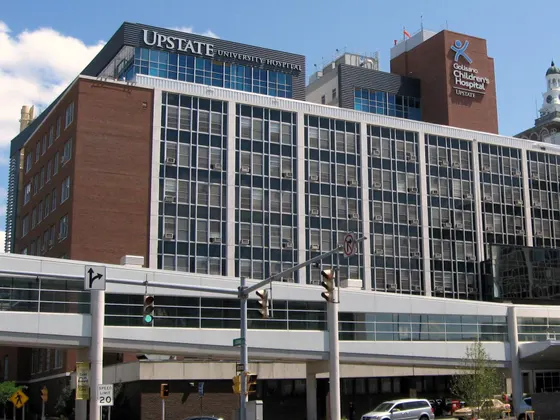
SUNY Upstate Medical University Norton College of Medicine, located in Syracuse and established in 1950, is a SUNY public medical school with a strong mission to train physicians for the healthcare needs of Central and Northern New York. The school benefits from affiliation with Upstate University Hospital, a Level I Trauma Center and the region's primary academic medical centre. With approximately 175 students per class and access to a broad network of clinical sites across Central New York, the school provides training in urban academic, suburban community, and rural healthcare environments. SUNY Upstate has strong research programmes through the Upstate Cancer Center and maintains partnerships with the Crouse Health system and other regional hospitals.
Entry Requirements
What you need to apply to SUNY Upstate Medical University Norton College of Medicine (MD).
Admission overview
Bachelor's degree and MCAT required. Prerequisite coursework in biology, chemistry (general and organic), physics, and mathematics. Applications via AMCAS; secondary application required. Strong preference for New York state residents, particularly those with ties to Central, Northern, or rural New York. The school values community service, clinical exposure, and research experience.
MCAT median
513 (range 508–518)
GPA median
3.81 overall / 3.63 science (BCPM)
Acceptance rate
2.6%
Class size
175
In-state preference
Strong — primarily in-state
In-state matriculants
85%
CASPer
Not required
Holistic review emphasis
New York state mission, rural healthcare commitment, clinical and community service experience.
Notes
Estimates from public AAMC FACTS / AACOMAS / ADEA AADSAS / class-profile; verify current cycle.
Specialities offered
Primary Care, Rural Medicine, Cancer Biology, Neuroscience, Emergency Medicine
Interview Format
How SUNY Upstate Medical University Norton College of Medicine (MD) interviews applicants.
Format
Traditional panel interview — faculty and student sessions in separate one-on-one format
Interview window
October–March
Decision date
March 30 (AAMC standard)
Post-interview chances
Approximately 20–35% of interviewed applicants receive an offer, with in-state applicants converting at higher rates consistent with SUNY mission preferences. Estimates based on publicly available data; verify with admissions.
What to expect at a SUNY Upstate Medical University Norton College of Medicine (MD) interview
SUNY Upstate Norton College of Medicine conducts traditional one-on-one interviews with faculty physicians and a current student, each lasting approximately 30–45 minutes. Interviewers review the application beforehand and ask open-ended questions about motivation, clinical and research experiences, ethics, and interest in Central New York healthcare. As the only allopathic medical school in Central New York, the school has a distinctive obligation to train physicians for rural, underserved, and upstate communities; interview questions often probe commitment to that regional mission. The full interview day includes an admissions presentation, student Q&A session, and a tour of Upstate University Hospital.
What makes SUNY Upstate Medical University Norton College of Medicine (MD) different
SUNY Upstate is the only allopathic medical school in Central New York and plays a critical role in healthcare for the vast rural and semi-urban region stretching from Syracuse to the North Country and Southern Tier. The school has particular strengths in primary care, rural medicine, and research programmes in cancer, neuroscience, and biochemistry through the Upstate Cancer Center and affiliated institutes.
Tutor insight
SUNY Upstate is the key medical school for Central New York and attracts applicants who genuinely want to train and practise in the region — demonstrate awareness of the upstate New York healthcare landscape, including rural physician shortages and the hospital system's role in the community. The traditional interview format rewards conversational authenticity; prepare to discuss your experiences deeply, not just list them. As a SUNY school, in-state preference is strong — out-of-state applicants should have clear, compelling reasons for choosing Upstate over other schools. The school is competitive but accessible relative to the NYC-based SUNY schools; strong metrics alone are not sufficient without narrative alignment to the school's mission.
PrometheusQuestion Bank
595 medicine questions inside
Interview questions matched to SUNY Upstate Medical University Norton College of Medicine (MD)
Two questions our tutors flagged as a strong fit for SUNY Upstate Medical University Norton College of Medicine (MD)’s interview style. Try answering them out loud, then open Prometheus for the model answers and follow-up tips.
Easy·PanelQ1
MCAT Preparation: Behavioural Science and the Biopsychosocial Model
The MCAT includes the Psychological, Social, and Biological Foundations of Behavior section, which tests knowledge of sociology, psychology, and behaviour alongside traditional science content. Some pre-medical students view this section as an add-on without clinical relevance. How do you think about the integration of behavioural and social science into medical education, and what has your preparation for this section revealed about your understanding of health and illness beyond the biomedical model?
Likely follow-up · Give an example of a clinical scenario where understanding social or psychological factors would change the management of a disease that has a clear biomedical explanation.
3 expert tips in Prometheus
Hard·PanelQ2
US Healthcare Ethics: Medicaid and Long-Term Care
Medicaid is the primary payer for long-term care services in the United States, covering nursing home care for millions of elderly and disabled Americans who have exhausted their personal savings. A wealthy family asks you, as their primary care physician, about Medicaid planning -- legally restructuring assets to qualify their elderly mother for Medicaid nursing home coverage earlier. Is this ethically problematic, and what is your role in this conversation?
Likely follow-up · What is the ethical tension between individual benefit-maximisation and the sustainability of a public insurance programme?
Apply to SUNY Upstate Medical University Norton College of Medicine (MD) with confidence
We've helped students get into SUNY Upstate Medical University Norton College of Medicine (MD) and other US medicine schools. Get tailored support for each stage of the application.
SUNY Upstate Medical University Norton College of Medicine (MD) - Frequently asked questions
Bachelor's degree and MCAT required. Prerequisite coursework in biology, chemistry (general and organic), physics, and mathematics. Applications via AMCAS; secondary application required. Strong preference for New York state residents, particularly those with ties to Central, Northern, or rural New York. The school values community service, clinical exposure, and research experience.
Traditional panel interview — faculty and student sessions in separate one-on-one format. SUNY Upstate Norton College of Medicine conducts traditional one-on-one interviews with faculty physicians and a current student, each lasting approximately 30–45 minutes. Interviewers review the application beforehand and ask open-ended questions about motivation, clinical and research experiences, ethics, and interest in Central New York healthcare. As the only allopathic medical school in Central New York, the school has a distinctive obligation to train physicians for rural, underserved, and upstate communities; interview questions often probe commitment to that regional mission. The full interview day includes an admissions presentation, student Q&A session, and a tour of Upstate University Hospital.
SUNY Upstate Medical University Norton College of Medicine (MD) typically interviews in October–March.
Decisions are released March 30 (AAMC standard).
SUNY Upstate is the only allopathic medical school in Central New York and plays a critical role in healthcare for the vast rural and semi-urban region stretching from Syracuse to the North Country and Southern Tier. The school has particular strengths in primary care, rural medicine, and research programmes in cancer, neuroscience, and biochemistry through the Upstate Cancer Center and affiliated institutes.