
SUNY Upstate Medical University Norton College of Medicine Interview
Format, Questions & Prep Tips
SUNY Upstate Medical University Norton College of Medicine medicine interviews for 2027 entry are a traditional interview. Published figures: Annual MD class size ~175; Applications received ~5,000–7,000 per cycle; Interview format Traditional — faculty + student, ~30–45 min each.
- Institution
- SUNY Upstate Medical University Norton College of Medicine
- Interview (2027 entry)
- October through March; rolling invitations; earlier dates generally beneficial
- Decisions (2027 entry)
- Rolling decisions from December; most offers by late March; waitlist movement through summer

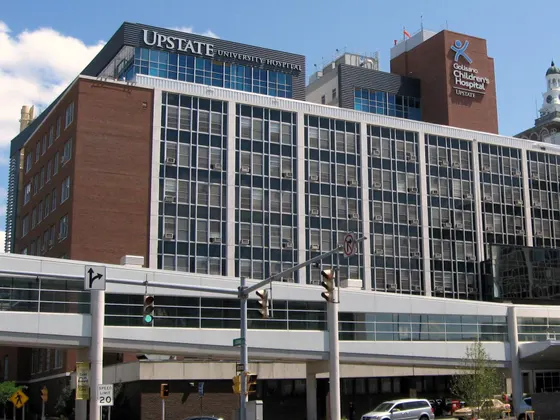
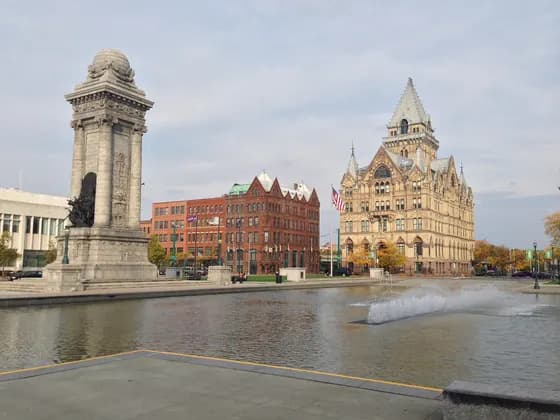

Photo: Alannafmanning · CC BY-SA 4.0 · cropped
Photo: DASonnenfeld · CC BY-SA 4.0 · Photo: Kai Brinker · CC BY-SA 2.0 · Photo: Easchiff · CC BY-SA 3.0
How to get into SUNY Upstate Medical University Norton College of Medicine (MD) medicine
Step-by-step: entry requirements, admission tests, personal statement, interview format and the key deadlines.
Open the guide →SUNY Upstate Medical University Norton College of Medicine (MD) entry requirements
Admission profile, interview format, decision dates and what makes SUNY Upstate Medical University Norton College of Medicine (MD) different.
See the profile →The SUNY Upstate Medical University Norton College of Medicine (MD) medicine interview
SUNY Upstate Norton College of Medicine uses a traditional panel interview format — two separate one-on-one sessions with a faculty clinician and a current medical student, each approximately 30–45 minutes. Interviewers read the full application in advance.
As the only allopathic medical school in Central New York, Upstate has a distinctive regional mission to train physicians for rural, underserved, and upstate communities. Interview questions consistently probe whether candidates understand and are committed to that mission — not just seeking a SUNY in-state seat.
Expect questions that probe the AAMC Premed Competencies, which fall into three categories: Professional, Science, and Thinking and Reasoning.
SUNY Upstate Medical University Norton College of Medicine (MD) interview at a glance (2027 entry)
| Annual MD class size | ~175 |
|---|---|
| Applications received | ~5,000–7,000 per cycle |
| Interview format | Traditional — faculty + student, ~30–45 min each |
| Curriculum | Traditional organ-system; clinical skills from Year 1 |
| Tuition (in-state, 2025–26) | ~USD 36,000–42,000/year |
| Application system | AMCAS |
| Interview window | October–March |
Interview format
- Two separate traditional one-on-one sessions: one faculty clinician, one current MD student.
- Each session approximately 30–45 minutes; interviewers have read the full application.
- Open-ended, behavioral and motivational questions; no MMI stations.
- Interview day includes admissions presentation, student Q&A, and tour of Upstate University Hospital.
- Regional mission alignment (Central NY, rural healthcare, upstate communities) is a major evaluative theme.
Working towards the MCAT score SUNY Upstate Medical University Norton College of Medicine (MD) expects? Build a week-by-week plan from your test date — free for the first two weeks.
Sample interview questions
Why SUNY Upstate — and why Central New York? What connects you to this region and its healthcare challenges?
The essential Upstate question. Be specific about Central New York's healthcare landscape: rural physician shortages in the Adirondacks, Southern Tier, or North Country; Upstate's role as the only Level I Trauma Center in the region; or community health challenges in Syracuse.
What is your experience with rural or underserved healthcare settings, and how has it shaped your career goals?
Upstate has a rural medicine thread and trains many physicians who practice in smaller New York communities. Concrete rural or underserved experience is valuable; if you lack it, describe how you plan to gain it during medical school.
A rural hospital with limited specialist resources receives a patient requiring care that is beyond its capacity. The nearest tertiary center is 90 minutes away. How do you manage this?
Rural medicine ethics:
- stabilize
- transfer
- telemedicine consultation
- maintain patient dignity and communication throughout
Reference EMTALA requirements and the resource disparities that make rural medicine distinctively challenging.
Describe an experience where you had to communicate uncomfortable or unwelcome information to someone. What did you do and what did you learn?
Classic traditional interview question. Use STAR structure. Focus on your process — preparation, empathy, clarity, checking understanding — not just the outcome.
What research have you done, and how did it develop your ability to think scientifically?
Upstate has solid research infrastructure through the Upstate Cancer Center. Show scientific curiosity and rigor — even if your experience is limited, frame it around how it taught you to ask questions, evaluate evidence, and tolerate uncertainty.
A patient with limited health literacy signs a consent form without truly understanding the procedure. Is the consent valid? What should you do?
Valid informed consent requires capacity, information, and voluntariness. If the patient did not understand, true informed consent was not achieved — revisit the conversation, use plain language and teach-back, and document carefully.
Where do you see yourself in 10 years, and how does the SUNY Upstate training align with that vision?
Connect your career goals to Upstate's specific strengths: Upstate University Hospital's trauma and academic medicine programs, the rural rotation network, or specific research institutes. Avoid geographic vagueness ("I'm open to anywhere").
New York State is considering a policy requiring all medical school graduates who received in-state tuition benefits to practice in New York for five years after residency. Do you support this policy?
Policy ethics. Acknowledge the workforce problem it addresses; discuss drawbacks (coercive conditions, specialist mismatch, constitutional concerns). Argue a nuanced position.
How would you explain the risks and benefits of a new medication to an elderly patient who is hard of hearing and has mild cognitive impairment?
Show adaptive communication: speak clearly and slowly, use simple language, involve a trusted family member with consent, use written materials, teach-back method, document the process.
What do you hope to contribute to the SUNY Upstate MD class community?
Shows self-awareness and a desire to contribute, not just receive. Reference your background, research interests, community health experience, or mentorship capacity — what you add to the class, not just what the class offers you.
Role-play: You are a physician in a small Central New York town and must tell a long-time patient (played by the interviewer) that, because the nearest specialist is two hours away and booked for months, you will be co-managing their complex condition by telemedicine for now. They are skeptical of 'doctoring by computer.' Begin.
Validate the skepticism, explain concretely how telemedicine co-management works and its limits, and reassure them you remain their in-person physician. This captures the rural-access reality Upstate trains for — show resourcefulness without overselling telehealth.
You are shown a map of physician-to-population ratios across New York counties, with the North Country and Southern Tier far below the state average and NYC well above it. What does this maldistribution imply, and would simply training more physicians fix it?
Recognize that aggregate supply does not solve distribution — new graduates cluster in metros and lucrative specialties. Discuss pipeline-from-the-region effects, rural training tracks, and incentives. This is exactly the workforce problem Upstate's mission targets.
A rural critical-access hospital is losing money on its obstetrics unit and considering closing it, which would force laboring patients to drive over an hour. As a physician on staff, how do you weigh the hospital's finances against community access?
Acknowledge that an insolvent hospital helps no one, while obstetric deserts raise maternal and neonatal risk. Discuss advocacy, regional partnerships, and the genuine difficulty — avoid a glib answer. Rural service-line closures are a live Central New York issue.
You are running a community health talk in a Syracuse neighborhood and a resident challenges you, saying doctors 'parachute in, do a study, and leave.' How do you respond?
Take the critique seriously — it reflects real extractive-research history. Acknowledge it, speak to sustained presence and accountability, and listen more than you defend. Shows humility and awareness of the trust gap between institutions and communities.
Upstate trains many physicians who become rural generalists needing a broad skill set. How does that workforce goal shape what an ideal preclinical-to-clinical curriculum should emphasize?
What they are listening for:
- Argue for breadth
- procedural confidence
- comfort with diagnostic uncertainty
- exposure to rural sites early
- rather than heavy subspecialty siloing
Connect curriculum design to the downstream practice reality — shows systems thinking about medical education.
Practise the SUNY Upstate Medical University Norton College of Medicine (MD) interview
Rehearse the real format before the day — on demand with our AI interviewers, or live with a tutor.
Sit a mock with photoreal AI interviewers — any time
A timed MMI or panel interview on video — American & international voices — with interviewers who listen, react and press with follow-ups. Rubric-scored feedback and a replay the moment you finish.


Live mocks with a tutor who’s been in the room
A full SUNY Upstate Medical University Norton College of Medicine (MD)-style mock with a medic or dentist tutor — honest scoring against real marking criteria, a station-by-station debrief and a written action plan.
Book a mock interviewHow to prepare for the SUNY Upstate Medical University Norton College of Medicine (MD) interview
Common pitfalls to avoid
SUNY Upstate Medical University Norton College of Medicine (MD) interview — frequently asked questions
Sources & official admissions information
Ready to nail your SUNY Upstate Medical University Norton College of Medicine (MD) interview?
Book a mock interview with a tutor who knows the US interview formats, orpractice unlimited stations from our interview question bank.