
Medical schools in Northern Ireland
Queen's Belfast and Ulster compared
Northern Ireland has two medical schools. Queen's University Belfast runs the five-year MB BCh BAO (A100), shortlisting on GCSE points plus a UCAT score before a multiple mini interview. Ulster University's four-year graduate-entry MBBS (A101) in Derry~Londonderry uses GAMSAT instead of the UCAT. In 2026/27, students from Northern Ireland and the Republic of Ireland pay £4,985 a year at both; students from Great Britain pay £9,790.
- Medical schools
- 2: QUB and Ulster
- QUB home places, 2027
- 236 a year
- NI and ROI fee, 2026/27
- £4,985 a year
- GB fee, 2026/27
- £9,790 a year
- 2027 entry deadline
- 15 October 2026 (closed)


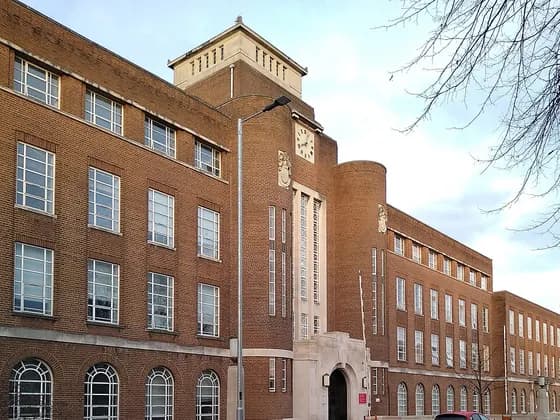

Photo: Nick Birse · CC BY-SA 4.0 · cropped
Photo: Conradder / Wikimedia Commons · CC BY-SA 4.0 · Photo: Mx. Granger · CC0 · Photo: Simon Burchell · CC BY-SA 4.0
Medical schools in Northern Ireland at a glance
Northern Ireland has two medical schools, and they suit different people. Queen's University Belfast (QUB) runs a five-year degree for school leavers and graduates. Ulster University runs a four-year course only for people who already have a degree, at its Magee campus in Derry~Londonderry.
The two schools select in very different ways. QUB ranks applicants on GCSE grades and their UCAT score (the University Clinical Aptitude Test, an online admissions test), interviews the top of that list, then makes offers on interview performance alone. Ulster asks for a 2:1 degree in any subject and a GAMSAT score (the Graduate Medical School Admissions Test), followed by its own interview.
Both degrees are primary medical qualifications recognised by the GMC (General Medical Council), the UK regulator for doctors. Graduates of either school can apply for provisional registration and for Foundation Programme training posts, where new UK doctors start work.
| Schools | Queen's University Belfast (A100) and Ulster University (A101) |
|---|---|
| Admissions test and interview | QUB: the UCAT, sat in the summer before you apply. Ulster: GAMSAT, not the UCAT. Both interview with multiple mini interviews (MMIs) |
| UCAS deadline, 2027 entry | 15 October 2026 at 18:00 UK time (now passed) |
| QUB places, 2027 entry | 236 for home students and 36 for international students |
Queen's Belfast and Ulster: the two NI medical schools compared
Each card links to that school's full guide. The table sets the two courses side by side for 2027 entry.
| Course detail | Queen's University Belfast | Ulster University |
|---|---|---|
| Degree and UCAS code | MB BCh BAO, A100 | MBBS, A101 |
| Length | 5 years | 4 years |
| Who can apply | School leavers and graduates | Graduates only: a 2:1 in any subject, or a Master's at 60% or above |
| Admissions test | UCAT, required from every applicant | GAMSAT; the UCAT is not used |
| Usual academic offer | A*AA, or AAA plus an A in a fourth AS-level, with Chemistry | A degree instead of A-levels, plus GCSE English Language and Maths at C/4 |
| Interview | MMI: nine stations in person for home applicants, seven online for international applicants | MMI, with at most two attempts |
| Campus | Belfast | Magee campus, Derry~Londonderry |
| Teaching | Case-based learning in years 1 to 4; cadaveric dissection, specimens permitting | Problem-based learning; anatomy taught with technology and imaging, no cadaveric work |
| Patient contact | From Year 1 | From the fourth week of Year 1 |
Queen's University Belfast (A100)
QUB's MB BCh BAO is the only route into medicine in Northern Ireland that school leavers can take. Teaching is organised around clinical cases in years 1 to 4, and by Year 3 almost all of it happens in hospitals and GP practices across the region. Final year includes an assistantship, where you take on the tasks of a Foundation doctor, and a clinical elective that many students spend abroad.
Graduates are considered for the same five-year course. You sit the applied knowledge test of the Medical Licensing Assessment, which UK medical graduates must now pass, at the start of final year.
Ulster University School of Medicine (A101)
Ulster opened Northern Ireland's first graduate-entry medical school in August 2021, with 70 students at Magee. It received GMC accreditation in April 2025 and celebrated its first graduates in June 2025. Ulster says 84% of them accepted a place on the Northern Ireland foundation programme.
The course welcomes graduates from science and non-science backgrounds. The Northern Ireland Executive funds it to help ease the shortage of doctors. Ulster therefore gives priority to applicants who normally live in Northern Ireland or the Republic of Ireland, with fewer places for applicants from Great Britain.
QUB medicine entry requirements for 2027: A-levels, GCSEs, IB and Leaving Cert
These are QUB's normal requirements for 2027 entry. Offers are conditional on them, but on the standard route school leavers are shortlisted on GCSEs and the UCAT, not on predicted grades.
| A-levels, route 1 | AAA plus an A in a fourth AS-level, including A-level Chemistry and one of Biology/Human Biology, Maths or Physics |
|---|---|
| A-levels, route 2 | A*AA including Chemistry and Biology/Human Biology |
| A-levels, route 3 | A*AA including Chemistry and Maths or Physics, plus AS-level Biology at grade B |
| Instead of the fourth AS-level | An A in the EPQ (Extended Project Qualification) or the Advanced Welsh Baccalaureate, or a B in a fourth A-level. None of these replaces the Biology requirement |
| Biology on route 1 | If not taken at A-level, Biology/Human Biology at grade A as a fourth AS-level or grade B as a fifth |
| GCSEs | English Language at C/4; Maths at C/4 and Physics at C/4 (or Double Award Science at CC/44) if not taken higher. Your best nine are scored for shortlisting |
| International Baccalaureate | 36 points with 6, 6, 6 at Higher Level including Chemistry and Biology |
| Irish Leaving Certificate | H1 H1 H1 H1 H2 H2 including H1 in Biology and Chemistry; your Junior Certificate grades are scored for shortlisting |
| Scottish qualifications | At least ABBBB in Highers at the first sitting, then AA to AAA in Advanced Highers depending on your Highers |
| Graduates | A 2:1 in your first degree plus ABB at A-level at the first attempt (BBB with a First or a PhD), including Chemistry and one of Biology, Maths or Physics |
| Not accepted | A-level Critical Thinking, General Studies at AS or A-level, and Access courses |
How QUB shortlists for interview: GCSE points plus UCAT deciles
For 2027 entry QUB ranks every applicant out of 45 points: up to 36 for academic background (GCSEs, for school leavers taking A-levels) and up to 9 for the UCAT. Those above the line are interviewed, and offers then depend on the interview alone.
Your best nine GCSEs are scored
QUB scores your best nine GCSEs: 4 points for an A* or 9, 3 for an A, 7 or 8, 2 for a B or 6, and 1 for a C*, C, 5 or 4. Only GCSEs taken in Years 11 and 12 in Northern Ireland (Years 10 and 11 in England and Wales) count. Nine top grades give the maximum of 36.
Your UCAT total adds up to 9 points
QUB turns your UCAT total for Verbal Reasoning, Decision Making and Quantitative Reasoning into 0 to 9 points by decile, using results from the 2026 UCAT. A score in the top 10% earns 9 points; a score at or below the 10th percentile earns none.
Everyone is ranked and the top group interviewed
Applicants are ranked on the combined score and a proportion are invited to interview. The line moves every year: 30 out of 42 for 2025 entry, then 32 out of 45 for 2026 entry, the first year scored out of 45. QUB says it cannot be predicted in advance.
Offers depend on the interview alone
After interviews, applicants are ranked on interview score alone and offers go down that list. QUB expects most decisions by the end of March and the rest by late April or early May. The UCAT Situational Judgement Test (SJT) can separate borderline applicants before or after interview.
| QUB points | Centile band | UCAT 2026 total score |
|---|---|---|
| 0 | 10th percentile or below | 1,590 or below |
| 1 | Above 10th, up to 20th | Above 1,590, up to 1,700 |
| 2 | Above 20th, up to 30th | Above 1,700, up to 1,780 |
| 3 | Above 30th, up to 40th | Above 1,780, up to 1,850 |
| 4 | Above 40th, up to 50th | Above 1,850, up to 1,920 |
| 5 | Above 50th, up to 60th | Above 1,920, up to 1,980 |
| 6 | Above 60th, up to 70th | Above 1,980, up to 2,050 |
| 7 | Above 70th, up to 80th | Above 2,050, up to 2,140 |
| 8 | Above 80th, up to 90th | Above 2,140, up to 2,250 |
| 9 | Above 90th | Above 2,250 |
Points bands from QUB's 2027 admissions policy. Scores are the UCAT Consortium's final 2026 decile points (42,359 tests; mean 1,918; each subtest scored 300 to 900). QUB uses the centile UCAT records for you, so treat a score right on a boundary as approximate.
A Year 14 student in Belfast has seven A*s and two As at GCSE and scored 2,000 in the 2026 UCAT. How would QUB score them?
Seven A*s give 28 points and two As give 6, so 34 of 36 for GCSEs. A UCAT total of 2,000 falls between the 2026 sixth and seventh decile scores, which is 6 points on QUB's table. That makes about 40 out of 45, well above the 2026-entry line of 32, though QUB says each year's line cannot be predicted in advance.
A student in England has four 9s, three 8s and two 6s at GCSE and scored 1,880 in the 2026 UCAT.
Four 9s give 16 points, three 8s give 9 and two 6s give 4, so 29 for GCSEs. A UCAT of 1,880 sits between the 2026 fourth and fifth deciles, worth 4 points. The total of about 33 would just have cleared the 2026-entry line of 32. With 36 of the 45 points coming from GCSEs, grades carry most of the weight.
QUB's multiple mini interview: format, timing and sample stations
An MMI is a circuit of short stations, each marked separately. QUB uses it to test empathy, problem-solving, moral reasoning and communication.
| Format, 2027 entry | Nine stations in person in Belfast for home applicants; seven stations online for international applicants |
|---|---|
| When, 2027 entry | Between December and March |
| The circuit (2026-entry guidance) | 12 stations: 9 marked stations and 3 rest stations. Interviewers ask questions at 5 stations and 4 use role-players |
| Timing (2026-entry guidance) | 1 minute to read the task outside each station, then 5 minutes inside, with a warning when 1 minute is left |
| How long it takes (2026-entry guidance) | Over an hour, after a 45-minute registration and briefing |
| Marking | Every station carries equal marks; if you ask, the interviewer repeats the question word for word |
| Personal statement | Not scored in QUB's 2027 selection process |
| Your odds once interviewed | For home places, QUB says it normally expects at least a one-in-two chance of an offer for those it interviews |
You are a first-year medical student. At a bus stop on the way home, a classmate whose name you don't know is sitting there, looking upset. Show how you would approach them. An actor plays the classmate.
QUB says this station tests communication and empathy. A strong candidate approaches gently, introduces themselves and asks open questions, then listens more than they talk. They acknowledge the feeling before offering options, and end by agreeing a next step without taking over.
- Introduce yourself and ask if it's OK to sit down
- Ask open questions, then pause and listen
- Name the feeling before suggesting anything
- Agree a next step together
You share a student house. The neighbours have complained about noise coming from your house. What options do you have?
QUB uses this to test problem-solving and how clearly you talk it through with the assessor. A strong answer lists options before choosing: talking to housemates, apologising to the neighbours, agreeing quiet hours, and involving the landlord only if that fails. Weigh each option out loud so the assessor can follow your reasoning.
Your mother asks for help with a family decision. Her 70-year-old father has a condition that will kill him within five years. An operation would cure it but has a 10% death rate. He wants it; she does not. How would you help?
QUB's notes for interviewers look for sensitivity to others and respect for the patient's right to be fully involved in decisions about his care. They also look for ways to calm a disagreement driven by emotion, and for knowing the limits of your own knowledge. A strong answer keeps the grandfather's informed choice at the centre and suggests talking to his doctors together.
Before a QUB MMI
- Read QUB's guidance for candidates and the information site it sends once you confirm your interview.
- Prepare real examples from your own life that show empathy, problem-solving, moral reasoning and communication.
- Use the minute of reading time to work out which competency the station is testing.
- Treat each station as a fresh start: every one is worth the same.
- Bring photo ID: you cannot start without it.
- Plan your travel. QUB's 2026 guidance said there is no parking at the venue itself and interviews start on time.
Ulster University graduate-entry medicine: degree, GAMSAT and MMI
Ulster's A101 is only for people who already have a degree. If you are still at school, it is a route for later rather than an alternative to QUB now.
| Degree | A 2:1 honours degree in any subject, or a Master's at 60% or above, finished by the end of June in the year you start |
|---|---|
| GCSEs | English Language and Maths at C/4 or above. Essential Skills Application of Number does not replace GCSE Maths |
| Admissions test | GAMSAT: at least 50 in each section, plus an overall score above that year's interview threshold |
| Recent benchmark | Across 2020 to 2025, the average overall GAMSAT of applicants invited to interview was 59 |
| GAMSAT sittings accepted | Any sitting from March 2023 to September 2026 |
| Late applications | Ulster may accept applications after 15 October 2026 from people registered for the March 2027 GAMSAT |
| Interview | Multiple mini interviews, with a maximum of two attempts |
| Who gets priority | Applicants who normally live in NI or the Republic of Ireland; the number of GB places varies each year |
| Start date | 16 August 2027, with full attendance expected from day one |
| English language (international applicants) | IELTS 7.5 overall with at least 7.0 in each band, or a degree taught in a majority English-speaking country |
GAMSAT is set by the Australian Council for Educational Research (ACER) and has three sections: Written Communication, Humanities and Social Sciences, and Biological and Physical Sciences. There are two sittings a year, in March and September. If your degree is not in science, plan extra time for the science section.
Teaching uses problem-based learning in small groups, built around clinical cases. On the 2027/28 course, students spend over 83 core weeks on clinical placement, with the chance to spend up to 30% of it in primary care. Placements are spread across Northern Ireland, so you will need to travel.
How many medicine places are there in NI, and is there an NI quota?
For 2027 entry QUB has 236 places for home students, a number fixed by the Department of Health and the clinical placements available, plus 36 for international students. QUB says it has no quota for any group within the home category. Applicants from Northern Ireland, Great Britain and the Republic of Ireland compete for the same places under the scoring system in QUB's admissions policy. Leaving Certificate applicants' Junior Certificate grades are scored instead of GCSEs, and some contextual routes are open only to Northern Ireland applicants.
The Irish Government funded 50 extra QUB places, 25 for 2024 entry and 25 for 2025, for qualifying students from Ireland or Northern Ireland. Those students pay the Irish student contribution rate and commit to applying for an intern post with the HSE (the Irish health service). QUB says the places were not available for 2026 entry, and that talks on continuing the arrangement for 2027 entry are still going on.
Ulster's 2027 course page gives no fixed number of places. It gives priority to applicants who normally live in Northern Ireland or the Republic of Ireland.
| UCAS cycle | Offers by the May decision deadline | Admitted later from the reserve list |
|---|---|---|
| 2023 | 333 | 48 |
| 2024 | 432 | 64 |
| 2025 | 480 | 45 |
| 2026 | 487 | 32 (as of 18 September 2026) |
QUB makes more offers than places because some applicants decline or miss their grades. It says the 50 Irish-funded places partly explain the rise in 2024 and 2025.
Medicine fees in Northern Ireland for NI, GB, Irish and international students
Your fee depends on your fee status, mainly where you normally live. NI, Irish and GB figures are for 2026/27; 2027/28 rates are not published yet.
| Fee status | QUB (A100) | Ulster (A101) |
|---|---|---|
| Northern Ireland | £4,985 (2026/27) | £4,985 (2026/27) |
| Irish citizens living in the ROI | £4,985 (2026/27) | £4,985 (2026/27) |
| England, Scotland or Wales | £9,790 (2026/27) | £9,790 (2026/27) |
| International and non-Irish EU | £39,990 pre-clinical rate for 2027/28 entry; clinical-year rate not yet set | £40,980 for 2027/28 |
International medical students also pay a Department of Health clinical placement levy every year: £12,133 in 2026/27, with the 2027/28 figure not yet set. Ulster's fee tables give one undergraduate rate for home and GB students rather than a separate medicine rate.
NI students: loans for fees
Student Finance NI (SFNI) lends up to £4,985 for a public university in Northern Ireland and up to £9,790 for one in England, Scotland or Wales in 2026/27. You start repaying only after you leave your course and earn over £26,900 a year.
NI students: Department of Health support from Year 4
SFNI's 2026/27 guide covers NI students on a first degree in medicine anywhere in the UK. From the fourth year of study, you may get a means-tested Department of Health (DoH) bursary and have your fees paid in full by the DoH. The exact year depends on whether you take an intercalated degree (an extra year studying a related subject). You may also get a reduced-rate maintenance loan.
Graduate entry: loans since 2025/26
Since 2025/26, NI students on graduate-entry medicine in Northern Ireland can get an SFNI tuition fee loan and maintenance loan, but no maintenance grant; Ulster says fee loans are open to eligible NI and ROI students. On four-year graduate-entry courses in Great Britain, NI students get no fee support or DoH bursary, only a maintenance loan.
Republic of Ireland students
nidirect says ROI residents starting a degree in Northern Ireland in 2026/27 pay at most £4,985, and can apply for a loan of up to £4,985 to cover it through student finance for EU students.
Travel to placements
SFNI's income-assessed Travel Grant can help NI medical students with reasonable travel costs for clinical training away from their usual place of study, after the first £309 in 2026/27.
Contextual admissions for medicine in Northern Ireland
QUB's routes below are for applicants who live and study in Northern Ireland. Each one is set out in its 2027 medicine admissions policy.
Pathway Opportunity Programme
A QUB programme across Years 13 and 14 with events, assessed work and a one-week residential summer school. Students who complete its Medicine, Dentistry and Biomedical Sciences pathway successfully get a guaranteed interview and a possible offer one A-level grade below the normal target. Open only to students with a BT postcode at a school in Northern Ireland.
Secondary school route
If you were educated at a qualifying secondary school in Northern Ireland to at least Year 12, QUB shortlists you on AS-level grades, UCAT and predicted A-levels instead of GCSEs. QUB links to the Department of Education's schools list so you can check.
Free school meals
Applicants with a BT postcode who attend a school in Northern Ireland and receive free school meals are shortlisted for interview if they are taking A-levels for the first time in 2027. They must take the required subjects and meet the GCSE requirements, and QUB asks for evidence.
Care-experienced applicants
The same guaranteed shortlisting applies to Northern Ireland applicants who have spent at least three months in care, provided they take the required subjects and meet the GCSE requirements.
Pathway Opportunity Programme 2027: who can apply
- You normally live in Northern Ireland and study full time at a school or college there.
- You are in the first year of a two-year Level 3 course such as A-levels.
- Neither parent has been to university or has a degree.
- You have at least five GCSEs at C/4 or above, including English Language.
- You take A-levels that suit medicine: BTECs and similar do not count towards its A-level requirement.
- You also meet at least one widening-access criterion. Examples include free school meals or Education Maintenance Allowance in the last two years, a caring role, care experience, or a postcode NISRA (the NI statistics agency) rates as disadvantaged.
Where NI medical students train: hospitals, GP practices and HSC trusts
Northern Ireland has six health and social care (HSC) trusts: Belfast, Northern, South Eastern, Southern and Western, plus the Northern Ireland Ambulance Service. Both medical schools place students across the region, so expect to travel and sometimes stay away from home.
QUB's 2027/28 course page says its students are welcomed in all of the region's hospitals and in over 150 GP practices, and that 25% of clinical placements are in primary care. In Years 1 and 2 you attend a weekly clinical skills attachment in a GP practice or hospital. You get your trust allocation in Year 2 for the rest of the course, and in Years 3 to 5 you do at least two placements in Belfast and two elsewhere in Northern Ireland.
Ulster places students in general practice and hospital trusts throughout Northern Ireland from Years 1 and 2, with clinical attachments taking over in Years 3 and 4. Students pay for their own accommodation and travel while on placement.
| Criminal record check | An AccessNI enhanced check, currently £32, at both schools |
|---|---|
| QUB kit | A basic stethoscope (about £60), 3 to 4 sets of scrubs (about £30 each) and a name badge (£8) |
| QUB hospital placements | Accommodation arrangements for Years 3 to 5 are under review with the Department of Health; some trusts charge a refundable deposit |
| QUB GP placements | B&B costs in Years 4 and 5 can be reclaimed up to a limit, £33.75 a night as at December 2024 |
| QUB elective | QUB estimates £100 to £5,000, depending on where you go |
| Ulster health checks | Occupational health screening £35, plus up to £50 for vaccinations not done through your GP |
Mistakes to avoid when applying to medicine in Northern Ireland
Medical schools in Northern Ireland: your questions answered
Where this guide's facts come from
Checked against these sources on 19 October 2026. Rules change between cycles, so confirm anything that decides your application on the official page for your entry year.
Aiming for Queen's or Ulster?
QUB interviews for 2027 entry run from December to March. Practise MMI stations, including role-play, with a tutor, or plan your next application with our free strategy tool.