
University of Otago Medicine Interview
Format, Questions & Prep Tips
University of Otago lists no interview on its standard medicine entry route for 2027 entry. Published figures: Domestic places (2027 entry) Approximately 322 (maximum, across all categories); Alternative Category interview 40-min structured Zoom videoconference; UCAT ANZ threshold (2027 entry) VR ≥ 20th percentile AND SJT ≥ 10th percentile.
- Institution
- University of Otago
- Interview (2027 entry)
- Alternative category only — Zoom interviews approximately eight weeks after the 1 May close (in 2026, interview offers had to be accepted by 5 June)
- Decisions (2027 entry)
- HSFY and Graduate categories: outcomes by 18 December. Alternative category: outcomes by 31 August

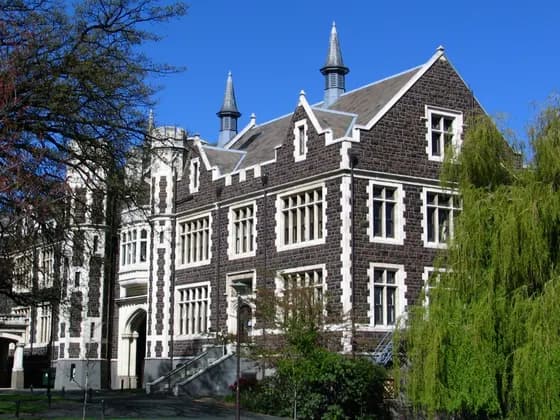


Photo: Bernard Spragg. NZ · CC0 · cropped
Photo: Benchill · CC BY-SA 3.0 · Photo: AnnWoolliams · CC BY-SA 4.0 · Photo: Krzysztof Golik · CC BY-SA 4.0
How to get into University of Otago — Medicine (MBChB) medicine
Step-by-step: entry requirements, admission tests, personal statement, interview format and the key deadlines.
Open the guide →University of Otago — Medicine (MBChB) entry requirements
Admission profile, interview format, decision dates and what makes University of Otago — Medicine (MBChB) different.
See the profile →The University of Otago medicine course
Integrated + Case-based learning, 6 years (incl. health sciences first year), placements across Dunedin, Christchurch, Wellington and regional and rural New Zealand.
See the course →The University of Otago — Medicine (MBChB) medicine interview
Otago MBChB selection is almost entirely academic — for the two main domestic pathways (Health Sciences First Year / HSFY and Graduate Category), there is no interview. Offers for HSFY applicants are determined by academic ranking on the average of the best 7 paper scores from a single year of full-time study; the 2026 offer range was 93.14–99.00 out of 100 for the General pathway and 86.43–98.14 for NZ Rural Origins (Otago, Admissions Statistics 2026). UCAT ANZ functions only as a pass/fail threshold gate (for 2027 entry, Verbal Reasoning ≥ 20th percentile AND Situational Judgement ≥ 10th percentile) and is not weighted in the academic ranking once cleared.
The Alternative Category is the only Otago MBChB pathway that includes an interview. Alternative Category applicants are domestic applicants who completed a New Zealand degree more than three years ago (or an overseas degree at NZQF Level 7 equivalent or above completed not less than three years prior) and can demonstrate substantial health-related professional experience. Shortlisted applicants attend a structured interview via Zoom about eight weeks after the 1 May close, with outcomes by 31 August. Otago states that interviews last 40 minutes. UCAT ANZ is not required for the Alternative Category. Applications for the Alternative Category open 1 April and close 1 May (a different window from HSFY/Graduate which closes in August).
Unlike Auckland's MMI-based process, Otago's standard pathways reward sustained academic excellence. Understanding this distinction is critical — applicants who invest heavily in MMI preparation at the expense of HSFY academic performance misallocate their effort. The Alternative Category interview content below reflects the structured Zoom format; sample questions target the professional-experience and maturity dimensions that Alternative Category applicants are expected to demonstrate.
University of Otago — Medicine (MBChB) interview at a glance (2027 entry)
| Domestic places (2027 entry) | Approximately 322 (maximum, across all categories) |
|---|---|
| HSFY pathway interview | None — academic ranking only |
| Graduate Category interview | None — academic ranking only |
| Alternative Category interview | 40-min structured Zoom videoconference |
| UCAT ANZ (HSFY / Graduate) | Pass/fail threshold only (not weighted) |
| UCAT ANZ threshold (2027 entry) | VR ≥ 20th percentile AND SJT ≥ 10th percentile |
| UCAT ANZ (Alternative Category) | Not required |
| 2026 HSFY offers range (General) | Academic score ~93–99 / 100 |
| 2026 HSFY offers range (Rural) | Academic score ~86–98 / 100 |
| Domestic tuition (2026) | NZD 18,800–19,100 per year |
Interview format
- **HSFY pathway:** No interview. Selection is academic ranking on the average of best 7 HSFY paper scores. UCAT ANZ is a pass/fail gate only — once cleared it does not affect ranking.
- **Graduate Category:** No interview. Selection is weighted academic score from qualifying degree results. UCAT ANZ pass/fail gate applies (same thresholds as HSFY).
- **Alternative category only:** structured interview conducted via Zoom, lasting 40 minutes. No specific station count is published. Shortlisted applicants are selected based on holistic ranking of aptitude including health-related professional experience.
- Years 2–3 (Early Learning in Medicine) are in Dunedin; from fourth year the class is split across Dunedin, Christchurch and Wellington for the three clinically based years (Advanced Learning in Medicine).
- Equity sub-pools exist for Rural Origins, Māori, Pacific, Socioeconomic Equity, and Refugee Background applicants within each category. Rural applicants are ranked separately with lower effective cut-offs.
- Government-funded rural places are allocated annually; the exact annual quota is set by the Council and is not separately published.
- International applicants were previously exempt from UCAT ANZ. From 2027 entry they must sit it too (with a narrow exception for some government-sponsored Kuwaiti and Omani Foundation students), and from 2028 entry every HSFY and Graduate applicant must.
Working towards the UCAT score University of Otago — Medicine (MBChB) expects? Build a week-by-week plan from your test date — free for the first two weeks.
Sample interview questions
(Alternative Category) Walk us through your career in your health profession and explain what specifically prompted you to apply to medical school at this point in your life.
Be honest and specific about the timing. Assessors for the Alternative Category want to understand genuine professional maturity — a pivot story that shows patient-care depth rather than ambition alone.
(Alternative Category) What have you learned about medicine from working alongside doctors as an allied health professional that surprised you or changed your understanding of what a doctor does?
Draw on specific clinical observations. Show that you understand the scope boundary between your current role and medicine, and why crossing that boundary serves patients better.
(Alternative Category) Describe a situation in your current clinical role where you faced an ethical conflict. How did you resolve it, and what would you do differently?
Structured answer: identify the competing principles, the stakeholders, the decision you made, the outcome, and the genuine reflection. Alternative Category applicants are expected to demonstrate ethical reasoning from lived clinical experience.
(Alternative Category) Tell us about a time you had to advocate for a patient against a system barrier — for example, delayed referral, resource constraints, or a breakdown in inter-professional communication.
What they are listening for:
- Concrete example
- specific barrier
- specific action
Show the outcome and the learning. Otago interviewers value professional maturity over polished rhetoric.
(Alternative Category) Te Tiriti o Waitangi creates obligations for health professionals in New Zealand. How have these obligations shaped your work in your current role?
Treaty obligations are not restricted to Auckland — Otago MBChB and the New Zealand healthcare system broadly are governed by these principles. Reference the MCNZ cultural safety framework and specific equity commitments relevant to your field.
(Alternative Category) You have been out of a university academic environment for several years. How have you prepared academically, and how confident are you that you can meet the demands of a 6-year MBChB programme?
Practical answer:
- any refresher study
- academic preparedness
- learning strategies developed in professional life
Address the legitimate question honestly without being defensive.
(HSFY / general preparation) Why do you want to study medicine at Otago specifically, given that Auckland and overseas medical schools are alternatives?
Engage with Otago-specific features: the HSFY competitive academic environment, the three-campus clinical years (Dunedin, Christchurch, Wellington), the research culture at OMS, and the rural health mission. Specific is better than generic.
A colleague in your HSFY cohort is clearly struggling academically but refuses any support. They have asked you not to mention it to anyone. What do you do?
Weigh confidentiality, respect for autonomy, and duty of care. Your obligation is to your colleague's welfare, not just their preferences. Explore pastoral care options at Otago that don't require you to override their explicit request.
Explain what Health Sciences First Year is to a school student in Year 12 who has never heard of the Otago system.
What they are listening for:
- Clear
- accurate
- jargon-free
Cover: enrolment at Otago in Dunedin, the 7 compulsory papers, how academic performance determines entry to professional programmes including MBChB and BDS. Confirm understanding.
Otago allocates rural places to build the rural health workforce. If you received a rural-origin equity offer, what commitment do you feel you are making to rural communities in New Zealand?
No formal bonded obligation exists under the rural equity sub-pool at Otago. But the intent is clear. Articulate your genuine values around rural practice — not what the question "wants to hear" but what you actually believe.
Should Otago MBChB introduce interviews for HSFY applicants, similar to Auckland's MMI model?
A genuine policy question with no right answer. Arguments for: predictive validity of non-cognitive skills, equity for students from under-resourced schools (rank scores may disadvantage them). Arguments against: academic rank is objective; interviews introduce interviewer bias and disadvantage rural/Māori/Pacific applicants who have less access to interview prep.
Your HSFY academic score is borderline — you are sitting at 92 and the 2025 cut-off was 93. What is your contingency plan?
Rational:
- understand the Rural sub-pathway eligibility
- the Graduate Category timeline
- other health science professional programme options (BDS, pharmacy, physiotherapy)
Show resilience and a realistic plan rather than catastrophising.
(Alternative category — discuss, rather than act out) a patient you have been treating in your allied health role for two years discloses significant mental health deterioration and says they feel they have nothing to live for. How do you respond in your current role?
This tests clinical boundaries: you are not a doctor yet. Appropriate response in allied health: acknowledge the disclosure, ask directly about suicidal ideation (safe messaging principles), apply your professional's scope to connect them to crisis support, document and notify the responsible clinician urgently.
What do you think is the most important unsolved problem in New Zealand's healthcare system right now?
Strong candidates have a genuine view informed by reading. Options: rural workforce shortages, Māori health inequity, mental health system underinvestment, the Te Whatu Ora restructure impact on service continuity, primary care funding gap.
Describe a time you had to explain a complex clinical concept to a patient who was scared and not taking in information well. What strategies did you use?
STAR with specific communication techniques: chunking information, teach-back, emotional acknowledgement before information delivery, plain language, follow-up written summary. Relevant for both Alternative Category applicants and general HSFY-prep candidates.
Planning around University of Otago — Medicine (MBChB)
University of Otago — Medicine (MBChB) selects without an interview in its standard entry routes, so there is no interview here to rehearse. Put the effort into where else you apply.
Talk your choices through with an adviser
A 1-to-1 call on where University of Otago — Medicine (MBChB) fits in your application and which schools to pair it with.
Book a strategy callHow to prepare for the University of Otago — Medicine (MBChB) interview
Common pitfalls to avoid
University of Otago — Medicine (MBChB) interview — frequently asked questions
Sources & official admissions information
Ready to nail your University of Otago — Medicine (MBChB) interview?
Book a mock interview with a tutor who knows the New Zealand interview formats, orpractise unlimited stations from our interview question bank.