
The UWA Dental course
What you actually study, and where you will be
UWA Dental's DMD is a 4-year (graduate entry) course with an integrated curriculum, with patient treatment from DMD Year 2 and placements in Perth, Bunbury and rural Western Australia (2027 entry). UWA's Doctor of Dental Medicine is a four-year graduate dental degree built around the Oral Health Centre of Western Australia, a public dental teaching hospital in Nedlands. Year 1 is medical and dental science with simulation practice, you start treating patients in year 2, and final year is mostly supervised clinical work, including rural and private practice rotations. School leavers can take a six-year Assured Pathway: three years of a Bachelor of Biomedicine (Specialised), then the last three years of the DMD.
- Degree
- DMD
- Length
- 4 years (graduate entry)
- Teaching
- Integrated
- First patients
- DMD Year 2
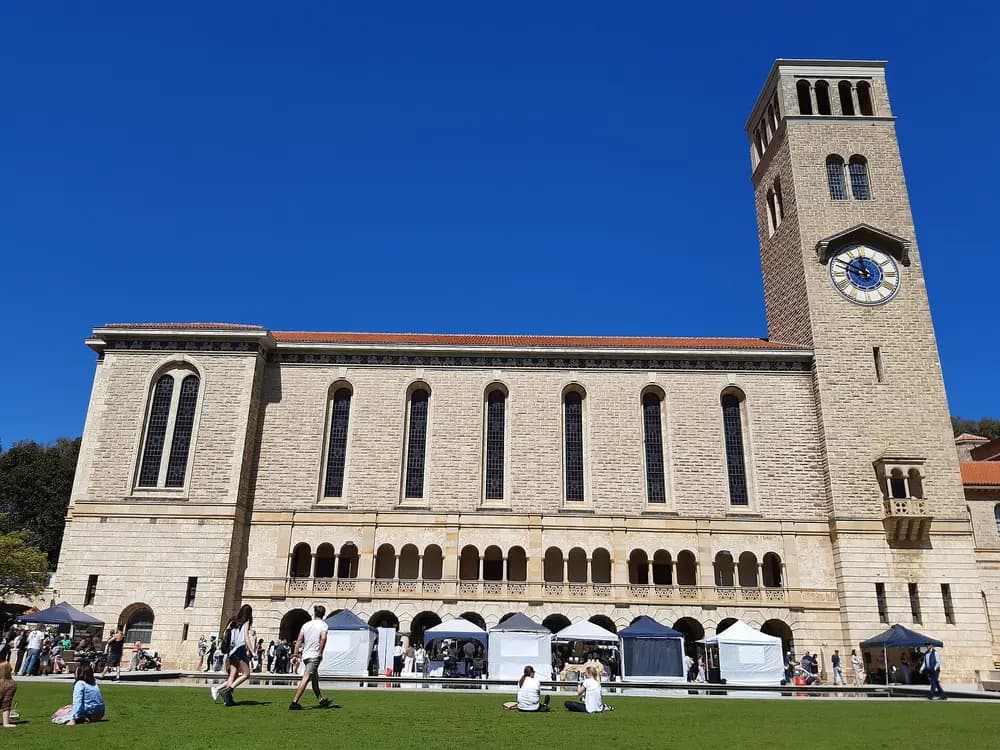
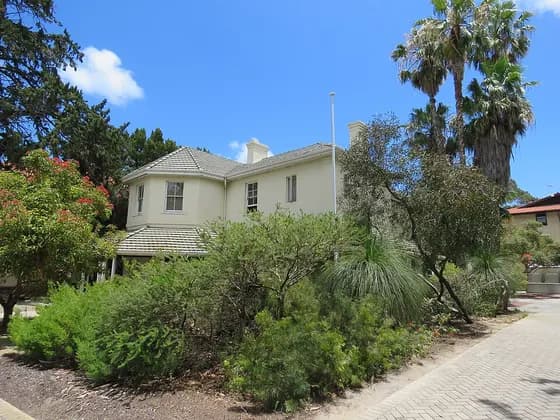
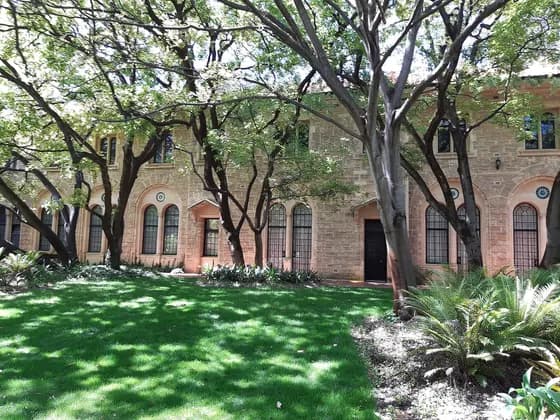

Photo: Calistemon · CC BY-SA 4.0 · cropped
Photo: Calistemon · CC BY-SA 4.0 · Photo: Calistemon · CC BY-SA 4.0 · Photo: -wuppertaler · CC BY 4.0
The UWA Dental course at a glance (2027 entry)
The Doctor of Dental Medicine (DMD) is UWA's four-year, full-time degree for becoming a dentist, run by the UWA Dental School. Despite the title, UWA classes it as a professional-practice masters degree. The Australian Dental Council (ADC), which accredits dental courses, has accredited it until the end of 2032. The handbook says graduates can register with the Dental Board of Australia, through the Australian Health Practitioner Regulation Agency (Ahpra), and start work as dentists straight away.
There are two ways in. Graduate entrants join after finishing any bachelor degree and spend four years in the DMD. School leavers apply from Year 12 for an Assured Pathway: a DMD place held for them on condition that they first complete UWA's Bachelor of Biomedicine (Specialised) with the Integrated Dental Sciences extended major. That bachelor's third year is the same set of units as DMD year 1, so school leavers move straight into DMD year 2 and finish in six years.
Clinical teaching is based at the Oral Health Centre of Western Australia (OHCWA), which the Dental School runs. It is a dental teaching hospital and public dental clinic at 17 Monash Avenue, Nedlands, on UWA's Health Campus beside the Queen Elizabeth II Medical Centre. Its patients are members of the public who hold a healthcare or pension concession card, and dental students treat many of them under the supervision of dentists and specialists.
The course moves from classroom to clinic in stages. Year 1 covers the medical and dental sciences alongside practice on simulators. Year 2 adds your first patients and year 3 puts clinical work at the centre of the timetable. Year 4 is an intensive clinical year with rotations away from OHCWA, including rural and private practice. A group research project runs from the second half of year 2 to the end of the course.
Expect full days: UWA asks DMD students to commit to an 8am to 5pm schedule, and the course starts in mid-January. Unit names, hours and assessments in this guide come from UWA's 2026 handbook, the latest edition when this guide was checked.
| Degree | DMD (Doctor of Dental Medicine), a professional-practice masters degree |
|---|---|
| Course length | 4 years full time from mid-January; 6 years via the Assured Pathway |
| Class size | Up to 70 a year: 50 domestic and 20 international places |
| Main clinical base | Oral Health Centre of Western Australia, Nedlands (UWA Health Campus) |
| Teaching style | Integrated sciences and simulation in year 1, then mostly supervised clinics |
| First patients treated | DMD year 2, at the Oral Health Centre under supervision |
| Placement area | Perth clinics, Bunbury and rural WA clinics; rotations mainly in final year |
| Research | Group project from year 2, written up as a journal manuscript |
| Honours or intercalation | None built in; every DMD unit is compulsory |
| Accreditation | Australian Dental Council, 1 January 2026 to 31 December 2032 |
What makes the UWA Dental course different
Training inside a public dental teaching hospital
OHCWA is part of WA's public dental system and says it treats more than 13,000 patients a year at over 60,000 appointments. In 2022 UWA said OHCWA's patients included pensioners, low-income families, people with disabilities, people experiencing homelessness, Indigenous people and refugees. In 2025 the ADC said it had concerns about the diversity of patients at the OHCWA and Mount Henry clinics, which the rural placements help to offset.
Time in specialist dental clinics
From year 3 you are rostered to specialist dental clinics to watch and, where appropriate, treat patients. OHCWA says it is the only provider of specialist dental care for public patients in WA, covering root canal (endodontics), gum (periodontics), crown and denture (prosthodontics), children's dentistry, orthodontics, oral surgery and oral medicine. Specialist registrars, qualified dentists training as specialists, work there too.
Rural placements in the Kimberley and Pilbara
Since 2023 Rural Health West, a not-for-profit rural health workforce agency, has worked with the Dental School to place final-year students in remote clinics. Placements it reported between 2023 and 2025 include Derby, Roebourne, Newman and Katanning. The ADC's 2025 report praised them and recommended that UWA keep expanding them so that every student has access.
A research project written up for a journal
In the second semester of year 2 your group designs a research project that runs through years 3 and 4. You collect and analyse data, then give a presentation and write a manuscript for submission to a peer-reviewed dental journal. The ADC's 2025 report found that students' research experience varied widely with resources, staff support and their own engagement, and recommended making it more consistent.
Cultural safety built into the course
The school has introduced Joining the Dots, a cultural safety curriculum for the care of Aboriginal and Torres Strait Islander peoples developed by the Australasian Council of Dental Schools. The ADC's 2025 report said this, the rural placements and committed staff had advanced cultural safety. Culturally safe care is a stated outcome of the year 3 and final-year units.
How UWA Dental teaches dentistry
The DMD has 20 units, grouped into streams covering comprehensive clinical care, developmental and behavioural sciences, diagnostic and surgical sciences, and restorative and rehabilitative sciences. In years 1 and 2 you take four 6-point units each semester. Years 3 and 4 each have two 24-point Integrated Dental Practice units, one per semester, so the timetable is built around clinics rather than separate subjects.
Science and hands-on skills run together from the start. In the same first semester that you study the body systems and head and neck anatomy, you learn infection control, ergonomics and the basics of operative dentistry on simulators. The school says it favours student-centred teaching, and that you learn either by treating patients under close supervision or by watching general and specialist dentists at work.
The balance shifts every year. Lectures carry much of the early timetable, but by final year you have two a week and spend most of your time treating patients. Personal and professional development runs through years 2 to 4, and ethics and public health dentistry, first met in year 1, return in the final years.
The ADC's 2025 report noted significant recent changes to the curriculum and praised the school for reviewing the program, including an internal review carried out by external parties. Interviews at the visit pointed to an apparent disconnect between some classroom and clinic teaching, and UWA had already mapped the curriculum to align the two. The ADC asked it to evaluate the revised curriculum by 1 August 2026.
The ways you will learn
| Lectures | Lectures carry the medical science and the theory behind each clinical discipline, such as how tooth decay develops. |
|---|---|
| Simulation and phantom-head sessions | A phantom head is a manikin head fitted with model teeth and mounted on a dental simulator. In the simulation laboratories you practise fillings, root canal treatment, crowns and children's procedures on model teeth before doing them on patients, while keeping a safe working posture. |
| Dental laboratory work | You learn the laboratory stages behind dentures and removable orthodontic appliances. In year 2 you make and fit complete and partial dentures in simulation, and in year 3 you construct and adjust removable orthodontic appliances, first in simulation and then for patients. |
| Supervised student clinics | At OHCWA you treat your own patients under supervising dentists, from examinations, treatment plans and gum, root canal and filling work in year 2 to extractions and more complex care later on. As each semester goes on, you are allowed to take on more procedures. |
| Day surgery observation | You also attend the day surgery unit to watch the oral and maxillofacial surgery team operate on teeth and the surrounding bone, and on non-cancerous conditions of the mouth and jaws. |
A typical week on the UWA Dental course
The handbook lists approximate contact hours for every unit, and together they show the week changing from lectures and simulation to clinics. It allows for about 36 weeks of contact time a year, and the course page says the first DMD year runs 39 weeks in all. Your own timetable will vary from week to week.
- DMD year 1: four units each semester at roughly 5 to 6 hours a week each. Anatomy and Oral Sciences, for example, has 2 lectures and 3 hours of practical work.
- DMD year 2: four units each semester, mostly 3 lectures and about 3 hours of practical or clinical sessions per unit each week.
- DMD year 3: 8 lectures and about 21 hours of practical and clinical sessions a week.
- DMD year 4: 2 lectures and about 24 hours of practical and clinical sessions a week.
- School leavers: UWA quotes 30 to 35 hours of teaching time a week for the Integrated Dental Sciences major, plus study time. Its year 3 dental units run over two 18-week semesters starting in mid-January and early July.
How anatomy is taught at UWA Dental
Head and neck anatomy is taught in Anatomy and Oral Sciences (DENT3003), in the first semester of DMD year 1. It covers the bones, muscles, blood supply and nerves of the head and neck. It also covers the anatomy, histology (tissue structure under the microscope), physiology and development of the mouth and teeth, including both baby and adult teeth.
Each week has two lectures and three hours of practical work, and you apply what you learn through pre-clinical exercises. The unit is assessed through written and practical assessments.
The rest of the body is covered in Body Systems 1 and 2, which take the anatomy, histology, physiology and pathology of each organ system as it relates to dentistry. Radiographic anatomy follows in second semester, when you learn to read X-rays of the head and neck. School leavers meet the human body plan and basic histology earlier, in their first bachelor unit, Form and Function.
When you start treating patients at UWA Dental
You learn hand skills on simulators before you touch a patient. From the first semester of year 1 you practise operative dentistry in a simulation setting, with attention to posture and instrument handling, and in second semester you place fillings on model teeth. UWA also describes early dental immersion activities in year 1 that introduce clinical dentistry.
Patient care starts in DMD year 2. In the first semester you carry out full oral and radiographic (X-ray) examinations, diagnose common problems, start initial treatment and give local anaesthetic to patients in the clinic. In the second semester you give your own patients a wider range of gum, root canal and restorative care, adding procedures under supervision as the weeks go on. Alongside the clinic, more advanced root canal work, multi-tooth restorations and dentures are practised in simulation.
In years 3 and 4 the number and complexity of your procedures rise. You learn extractions and minor oral surgery, manage oral disease and dental injuries, and treat children. UWA describes final year as close to independent but still supervised practice, including emergency care at OHCWA, aimed at readying you to work as a dentist on your own.
Your patients must be able to come regularly, because appointments with students can run up to three hours and student treatment takes more visits. Cases beyond a student's skills go to a specialist, a registrar, a staff dentist or another public clinic.
Year by year at UWA Dental
- Bachelor years 1–2 (school leavers only)
Biomedical science foundations
School leavers on the Assured Pathway start in Semester 1 (late February) with the Bachelor of Biomedicine (Specialised), taking the Integrated Dental Sciences extended major on UWA's Perth (Crawley) campus. The example study plan has two core units and two electives each semester. Your DMD place depends on completing this degree with the major.
- Year 1: Form and Function (body plan, histology, physiology), The Facts of Life (cell chemistry, molecular biology, heredity), Cell Survival and Communication (metabolism and cell signalling), and Health and Society.
- Health and Society covers immunity, disease outbreaks, drugs and alcohol, mental health, and how history and culture have affected Aboriginal people's health and health care.
- Year 2: Body Defences (microbiology and immunology), Blood and Drugs (haematology and pharmacology), Medical Sciences Research Methodologies, and Human Development and Genetics.
- Students without ATAR Chemistry or Mathematics Applications take bridging units, Introductory Chemistry (CHEM1003) or Mathematics Fundamentals (MATH1720), in first year.
- Most units are assessed through in-semester tests and a final exam, with practical or workshop assessments in some.
- Before the dental units start in year 3 you must meet the Dental School's infection control requirements, show first aid competence and hold a clear, current national police clearance. The DMD rules require infection control compliance throughout the course.
- DMD Year 1
Medical and dental sciences, and first simulation
In the 2026 handbook this year has eight 6-point units, four each semester. Graduate entrants without the Integrated Dental Sciences major take them as conversion units, and school leavers take the same units as the third year of their bachelor. The science is taught as it applies to dentistry, and simulation work starts straight away.
- Body Systems 1 and 2: anatomy, histology, physiology, biochemistry, genetics and pathology by organ system, from the immune, heart, lung and nervous systems to the gut, kidneys, hormones and skin. They also cover behavioural and psychiatric conditions relevant to dentistry.
- Anatomy and Oral Sciences: head and neck anatomy and the structure, function and development of the mouth and teeth.
- Introduction to Clinical Dentistry: professional practice, infection prevention and control, ethics, ergonomics, dental materials and your first operative work on simulators.
- General Medicine and Pharmacology: medical conditions that affect dental care, infections, handling medical emergencies in the dental chair, how drugs work, and writing a prescription.
- Biofilm Sciences and Diagnostic Imaging: plaque, gum inflammation and tooth decay and how to prevent them, plus the principles of dental X-rays and reading head and neck images.
- Fundamentals of Clinical Dentistry 1 and Dental Public Health and Research Methodology: clinical examination, occlusion (how the teeth meet), fillings on model teeth, oral health across the population, and evidence-based practice.
- DMD Year 2
Clinical disciplines and your first patients
Year 2 introduces the main clinical disciplines and gives you your first patients at OHCWA. In each semester three units are mostly theory and simulation, while an Introduction to Clinical Dental Practice unit takes you into the clinic. Your group research project begins in second semester.
- Fundamentals of Clinical Dentistry 2: root canal treatment, gum disease and single-tooth crowns and similar restorations, including CAD/CAM (computer-aided design and manufacture), practised in simulation, plus an introduction to children's dentistry and orthodontics.
- Children's dentistry covers growth, managing children's behaviour, consent, and your legal duty to act on suspected child abuse and neglect.
- Introduction to Clinical Dental Practice 1: full oral and radiographic examinations, diagnosis, initial treatment plans, pain control and giving local anaesthetic to patients.
- Fundamentals of Clinical Dentistry 3: advanced root canal work and restorations spanning several teeth, orthodontic analysis including cephalometric tracing (measurements from skull X-rays), oral pathology and oral cancer, and special needs dentistry. You also build complete and partial dentures in simulation.
- Introduction to Clinical Dental Practice 2: treating your own patients with gum, root canal and restorative care, and designing the group research project.
- DMD Year 3
Integrated Dental Practice 1 and 2
Clinical work becomes the centre of the year, with about 21 hours of practical and clinic sessions a week. You keep treating your own patients across all the disciplines, take on harder procedures as the year goes on, and are rostered into specialist clinics. The research project continues.
- Oral surgery: tooth extractions, minor surgery around the teeth, managing complications after extractions, facial infections, and the use of sedation and general anaesthesia in dentistry.
- Oral medicine and pathology: diagnosing diseases of the mouth lining and mouth signs of general illness, arranging tests, and assessing facial pain and jaw joint problems.
- Restoring root-filled teeth with posts and cores in simulation and in the clinic, and planning partial dentures and multi-tooth restorations for patients after practising them in simulation.
- Second semester adds dental and facial trauma, such as splinting injured teeth, plus diagnostic imaging, public health dentistry and special needs dentistry.
- Care plans for older patients and people with special health care needs, and culturally safe care for Aboriginal and Torres Strait Islander patients.
- Making and adjusting removable orthodontic appliances for patients, and analysing and reporting your research data.
- DMD Year 4
Intensive clinical practice
The final year consolidates your skills by moving you through different clinics: OHCWA, Dental Health Services community clinics in Perth and rural clinics, with compulsory rural and private practice rotations. Teaching drops to two lectures a week. The aim is to make you ready for independent general practice.
- Comprehensive care: examining patients, building full treatment plans and carrying them out across the disciplines.
- Emergency dental care at OHCWA, plus time in external emergency clinics.
- Specialist clinic rosters, looking at how specialist treatment fits into a patient's overall care.
- Ethics, public health dentistry, the business and regulatory side of practice, and responding to family and domestic violence, including coercive control, with trauma-informed care.
- Assessment includes a written exam, clinical session scores, professional behaviour and a multi-station Objective Structured Clinical Examination (OSCE) on comprehensive care, a practical exam made up of timed clinical stations.
- The research project ends with a presentation and a manuscript prepared for a peer-reviewed dental journal.
How you are assessed at UWA Dental
Most units combine written and practical assessments, while the Body Systems units use assignments, tests and an exam. To pass a unit you need at least 50 per cent overall and the required standard in each main component. Professional behaviour, including attendance, punctuality, communication and how you respond to feedback, is observed throughout every unit. It is graded pass or fail, and you must pass it to pass the unit.
In the final-year OSCE you move through timed stations that each test a clinical task, all built around comprehensive patient care. The written assessment pass mark is 50 per cent, and in the first final-year unit clinical session scores must reach 60 per cent. The last unit also grades the research project.
Clinical feedback is recorded in PebblePad, an online portfolio. The ADC's 2025 report said it had made feedback more consistent and transparent, but that supervisors were still being calibrated to give consistent feedback. UWA was asked to report on this by October 2025, and the ADC has recorded that requirement as met.
Progression rules are strict. You must pass every unit in a teaching period to move on, and you must complete all compulsory sessions and pass the practical and clinical work before sitting final assessments. A student who fails is normally put on probation and repeats the whole academic year, and failing again after repeating a unit normally means exclusion.
A resit, called supplementary assessment, is possible only for a failed written or non-clinical practical component. It is not offered if you fail more than two units or modules in a teaching period, are on probation or are repeating a year. Graduates with a weighted average mark of 80 per cent or more receive the degree with distinction.
Where you will actually be at UWA Dental
Most of your clinical time is at OHCWA in Nedlands. The course rules also require clinical work at other locations the Dental School approves, and final year is when you spread out. UWA lists OHCWA clinics, Dental Health Services community dental clinics in metropolitan Perth and various rural dental clinics, with compulsory rural and private practice rotations.
Dental Health Services is funded by the state government, and WA Health describes it as the largest public dental provider in Western Australia. It runs general dental clinics across Perth and country WA for concession card holders. The ADC's 2025 report also names a Mount Henry clinic, which its team toured and whose clinical supervisors it interviewed.
OHCWA runs a second clinic in Bunbury, at the UWA Dental School on the Edith Cowan University (ECU) campus, 585 Robertson Drive, where patients can ask to be treated by student dentists. The ADC interviewed Bunbury clinical supervisors in 2025. Rural Health West said in 2023 that Bunbury had until then been the only regional placement option.
Remote placements began in April 2023. Two students and a clinical supervisor spent two weeks at the Derby Aboriginal Health Service dental clinic in the Kimberley, mostly giving emergency care, then visited dental services in Broome. Rural Health West set up the placements with senior lecturer Dr Jilen Patel. It reported further placements in Roebourne and Newman in the Pilbara and Katanning in the Great Southern by May 2023.
In October 2025 Rural Health West said the program places final-year students in clinics across the Pilbara and Kimberley, such as Mawarnkarra Health Service in Roebourne. At its April 2025 visit the ADC had concerns about the diversity of patients at OHCWA and Mount Henry. It praised the rural placements for widening the range of patients students see, and recommended expanding them so all students have access. UWA was asked for a progress report by October 2025, and the ADC has recorded that requirement as met.
The 2026 handbook lists urban, rural, interstate and international placements among the final-year costs students meet themselves, estimated at $1,000 to $5,000.
Your base for simulation and clinical work, on UWA's Health Campus beside the QEII Medical Centre, with Perth Children's Hospital across the road.
- Oral Health Centre of Western Australia, 17 Monash Avenue
Final-year rotations to Dental Health Services community clinics. The Mount Henry clinic is named in the ADC's 2025 report.
- Dental Health Services community dental clinics
- Mount Henry clinic
A UWA-run public clinic where patients can be treated by student dentists; the ADC met its clinical supervisors in 2025.
- OHCWA Bunbury clinic, UWA Dental School, ECU campus, 585 Robertson Drive
First remote placement, April 2023: two students and a supervisor for two weeks (Rural Health West).
- Derby Aboriginal Health Service
Roebourne and Newman placements were reported in 2023, and Roebourne again in Rural Health West's October 2025 article.
- Mawarnkarra Health Service, Roebourne
Katanning placements were reported by Rural Health West in 2023.
Electives, selectives and options at UWA Dental
The DMD itself has no electives. Every unit in its 2026 structure is compulsory, from the eight first-year units to the four Integrated Dental Practice units.
School leavers get some choice in the first two years of the bachelor. The example study plan leaves two elective slots each semester in years 1 and 2, and every UWA bachelor student must take at least four broadening units (24 points) outside their major. A one-semester exchange is possible only in semester 1 of second year, depending on places at partner universities, and dental-pathway students must get advice before going.
Because Integrated Dental Sciences is an extended major, there is no room for a second major alongside it in year 3.
Intercalation and research degrees at UWA Dental
Some courses let you take an extra year of research partway through, called an intercalated or Honours year. The DMD has none: all of its units are compulsory and run in sequence, and UWA says the Integrated Dental Sciences major does not lead to Honours either.
After graduating, you could take one of UWA's graduate diplomas in Dental Public and Primary Health, Forensic Odontology or Health Professions Education. Other options are a Master of Dental Public and Primary Health, a PhD, and the three-year Doctor of Clinical Dentistry. That degree trains dentists as specialists in endodontics, orthodontics, periodontics, prosthodontics, paediatric dentistry or oral medicine.
Facilities and support at UWA Dental
Where you will learn
OHCWA combines the Dental School's teaching spaces with a working public dental clinic. The Dental School lists clinic and laboratory teaching spaces, a prosthodontics laboratory, research laboratories and student learning areas. UWA reported in January 2022 that its refurbished main clinic was open to patients.
Pre-clinical work happens in the Dental School's Simulation and Operative Technique Laboratories, where you practise on model teeth and mouths, some fitted in phantom heads on dental simulators. The ADC's team toured the simulation clinics in April 2025 and found OHCWA's learning spaces, clinics and equipment well suited to building the skills students need to qualify.
In 2022 UWA announced a $2.9 million project to turn the 20-year-old Operative Technique laboratory at OHCWA into a Clinical Skills Simulation Laboratory, with more workstations and new equipment. In November 2022 it said the work was scheduled for the coming summer break.
For digital dentistry there is a digital radiology suite, a central production lab with CAD/CAM equipment and a Virtual Learning Centre. Its computers are used for designing restorations by CAD/CAM, digital radiology and virtual microscopy, which means studying tissue slides on screen.
Support while you study
The ADC's 2025 report commended the support and mentoring students receive, including from clinical coordinators, a role the school had recently added. The coordinators sort incoming patients so that each student gets a fair share of suitable cases.
Student representatives meet the Head of School to give feedback, which the ADC said students valued. For short-term compassionate, medical or personal leave you apply to the course coordinator, and any missed compulsory session must be made up in the same teaching period. Approved leave, a formal break from the course, is not available in the first year of the DMD.
Is the UWA Dental course right for you?
This course may suit you if
- You want to treat public patients from your second DMD year, in a teaching hospital that serves concession card holders.
- You are sure about dentistry in Year 12 and would like a DMD place held for you while you complete a three-year biomedicine degree.
- You are drawn to rural and Aboriginal community dental care: final year has a compulsory rural rotation, and some students have been placed in Kimberley and Pilbara clinics, including Derby Aboriginal Health Service.
- You want to see specialist dentistry close up, through specialist clinic rosters from year 3.
- You like the idea of a group research project that ends in a journal manuscript.
Things to think about
- Failing a single unit normally means repeating the whole year, and failing again after a repeat normally ends your course.
- Days run 8am to 5pm and the year starts in mid-January.
- The remote placements are still growing: in 2025 the ADC asked UWA to extend them to every student, so experiences may differ between students.
- You pay for final-year placement costs, estimated at $1,000 to $5,000, and for loupes (magnifying glasses) and headlights, estimated at $1,000 to $2,000.
- The school-leaver route takes six years before you can register, and its extended major leaves no room for a second major or Honours.
- UWA recommends an eye test before you start, with any correctable problem sorted first, and says colour vision matters for tasks such as matching crown shades to natural teeth.
- In 2025 the ADC found that students' research experience varied widely, so ask how projects are supported now.
UWA Dental course — frequently asked questions
Applying to UWA Dental?
How to get into UWA Dental
Entry requirements, admission tests, written application and interview, step by step.
Open the guide →UWA Dental entry requirements
ATAR or GPA, GAMSAT and UCAT ANZ thresholds, interview format and place types.
See the requirements →Compare UWA Dental with other schools
Put the teaching style, anatomy teaching and placements next to another school.
Open the comparison →Prepare for the UWA Dental interview
Format breakdown, school-specific sample questions and prep tips from tutors who interviewed here.
Read the guide →Where this UWA Dental course guide came from
This guide was written from 47 official sources — University of Western Australia Dental School's own course pages and programme documents, plus the Australian Medical Council or Australian Dental Council and the health services the school places students with where they publish detail — read on 2026-10-10, then checked claim by claim against those sources.
- Doctor of Dental Medicine course page, University of Western Australia
- Doctor of Dental Medicine [91860], UWA Handbook 2026: description, structure and course rules
- Integrated Dental Sciences extended major course page, University of Western Australia
- Integrated Dental Sciences [MJD-DENTS], UWA Handbook 2026
- Bachelor of Biomedicine (Specialised) [BP056], UWA Handbook 2026
- Example study plan, Bachelor of Biomedicine (Specialised) with Integrated Dental Sciences, UWA Handbook 2026
- UWA Dental School: courses, research groups and facilities
- The Oral Health Centre of Western Australia: services, patients and student treatment
- OHCWA Bunbury application for dental treatment (V6/2025), with clinic address
- A vital community service: revitalising the Oral Health Centre (UWA news, January 2022)
- Renewing the Oral Health Centre of Western Australia (UWA news, June 2022)
- Mastering the Art of Dentistry: plans for the Clinical Skills Simulation Laboratory (UWA news, November 2022)
- Western Australian Dental Foundation and the Dental Clinical Simulation Laboratory project, UWA Alumni
- Australian Dental Council accredited programs list
- Australian Dental Council report on UWA's Doctor of Dental Medicine (April 2025, updated November 2025)
- All smiles for rural dental placements, Rural Health West media statement (May 2023)
- Dental students fill the gap, Rural Health West (May 2024)
- Dental immersions building skills, connection and rural commitment, Rural Health West (October 2025)
- Dental Health Services, WA Department of Health
- Body Systems 1 [DENT3001], UWA Handbook 2026
- Body Systems 2 [DENT3002], UWA Handbook 2026
- Anatomy and Oral Sciences [DENT3003], UWA Handbook 2026
- Introduction to Clinical Dentistry [DENT3004], UWA Handbook 2026
- General Medicine and Pharmacology [DENT3005], UWA Handbook 2026
- Biofilm Sciences and Diagnostic Imaging [DENT3006], UWA Handbook 2026
- Fundamentals of Clinical Dentistry 1 [DENT3007], UWA Handbook 2026
- Dental Public Health and Research Methodology [DENT3008], UWA Handbook 2026
- Fundamentals of Clinical Dentistry 2 Part 1 [DENT4212], UWA Handbook 2026
- Fundamentals of Clinical Dentistry 2 Part 2 [DENT4213], UWA Handbook 2026
- Fundamentals of Clinical Dentistry 2 Part 3 [DENT4214], UWA Handbook 2026
- Introduction to Clinical Dental Practice 1 [DENT4215], UWA Handbook 2026
- Fundamentals of Clinical Dentistry 3 Part 1 [DENT4216], UWA Handbook 2026
- Fundamentals of Clinical Dentistry 3 Part 2 [DENT4217], UWA Handbook 2026
- Fundamentals of Clinical Dentistry 3 Part 3 [DENT4218], UWA Handbook 2026
- Introduction to Clinical Dental Practice 2 [DENT4219], UWA Handbook 2026
- Integrated Dental Practice 1 [DENT5310], UWA Handbook 2026
- Integrated Dental Practice 2 [DENT5311], UWA Handbook 2026
- Integrated Dental Practice 3 [DENT5409], UWA Handbook 2026
- Integrated Dental Practice 4 [DENT5410], UWA Handbook 2026
- Form and Function [IMED1001], UWA Handbook 2026
- The Facts of Life [IMED1002], UWA Handbook 2026
- Cell Survival and Communication [IMED1003], UWA Handbook 2026
- Health and Society [IMED1004], UWA Handbook 2026
- Body Defences [IMED2001], UWA Handbook 2026
- Blood and Drugs [IMED2002], UWA Handbook 2026
- Medical Sciences Research Methodologies [IMED2003], UWA Handbook 2026
- Human Development and Genetics [IMED2004], UWA Handbook 2026
Courses are restructured between cycles. Anything here that decides your application — an anatomy offer, a placement city, a compulsory intercalated year — should be confirmed against the official page for your entry year.
Applying to UWA Dental?
We have helped hundreds of applicants turn their GAMSAT / UCAT ANZ, written application and interview prep into offers from UWA Dental and other Australian dentistry schools.