
LSU Health New Orleans School of Medicine Interview
Format, Questions & Prep Tips
LSU Health New Orleans School of Medicine medicine interviews for 2027 entry are a traditional interview. Published figures: Annual MD class size ~200; Interview format 1–2 traditional one-on-one interviews, 30 min each; In-state preference Very strong — ~95% Louisiana residents.
- Institution
- LSU Health Sciences Center School of Medicine in New Orleans
- Interview (2027 entry)
- October through January; rolling invitations after secondary review
- Decisions (2027 entry)
- Rolling decisions from November through March 30; waitlist movement through spring



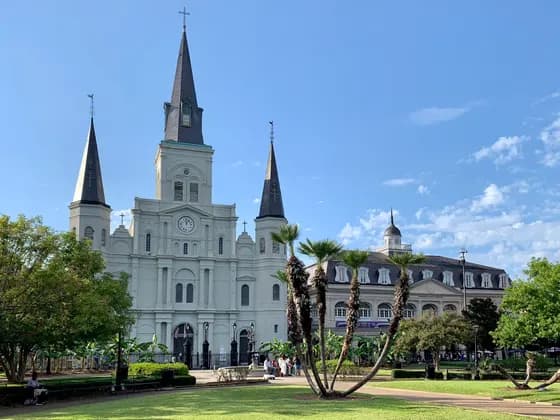
Photo: Infrogmation of New Orleans · CC BY-SA 3.0 · cropped
Photo: Infrogmation of New Orleans · CC BY-SA 4.0 · Photo: Reading Tom · CC BY 2.0 · Photo: APK · CC BY-SA 4.0
How to get into LSU Health New Orleans School of Medicine (MD) medicine
Step-by-step: entry requirements, admission tests, personal statement, interview format and the key deadlines.
Open the guide →LSU Health New Orleans School of Medicine (MD) entry requirements
Admission profile, interview format, decision dates and what makes LSU Health New Orleans School of Medicine (MD) different.
See the profile →The LSU Health New Orleans School of Medicine (MD) medicine interview
LSU Health New Orleans School of Medicine uses a traditional interview format. Interview days in the New Orleans Medical District include one to two one-on-one faculty or clinician interviews of approximately 30 minutes each, plus a campus tour, financial aid session, and student interactions.
The school has an extraordinary historical context: it is the institutional successor to Charity Hospital, which trained physicians for over two centuries as the primary public hospital for Louisiana’s poor and uninsured. That legacy — preserved today at University Medical Center New Orleans (UMC) — permeates the school’s culture and interview conversations.
Interviewers probe awareness of New Orleans public health history, post-Katrina recovery, and the complex health disparities of south Louisiana. Expect questions that probe the AAMC Premed Competencies, with strong emphasis on service orientation, resilience, and community health awareness.
LSU Health New Orleans School of Medicine (MD) interview at a glance (2027 entry)
| Annual MD class size | ~200 |
|---|---|
| Interview format | 1–2 traditional one-on-one interviews, 30 min each |
| Clinical affiliate | University Medical Center New Orleans (UMC) — post-Katrina safety-net hospital |
| In-state preference | Very strong — ~95% Louisiana residents |
| Application system | AMCAS |
| Interview window | October–January |
| Tuition (in-state approx.) | ~USD 28,000–33,000/year |
Interview format
- One to two traditional one-on-one or panel interviews with faculty, clinicians, or current students.
- Each session approximately 30 minutes; interviewers have typically reviewed the full application.
- Tour of LSU Health Sciences Center complex and University Medical Center New Orleans.
- Financial aid and curriculum overview session.
- Informal student interactions.
- Full day approximately 4–5 hours.
Working towards the MCAT score LSU Health New Orleans School of Medicine (MD) expects? Build a week-by-week plan from your test date — free for the first two weeks.
Sample interview questions
LSU Health New Orleans has a historic connection to Charity Hospital. What does that legacy mean to you, and how does it shape your understanding of why you want to train here?
Charity Hospital is central to LSU Health New Orleans' identity. Show you have researched the history: two centuries of free care for Louisiana's poor, the role it played in training generations of LSU and Tulane physicians, and how UMC continues that mission.
Hurricane Katrina fundamentally disrupted healthcare in New Orleans and revealed deep health system vulnerabilities. What do you know about how the city's healthcare system was rebuilt, and what lessons does that hold for medicine?
Post-Katrina healthcare context is unique to New Orleans. Shows historical awareness and systems-level thinking. Reference UMC's construction, the dispersal of Charity Hospital's patient population, and the health disparities that emerged post-flood.
A patient from a low-income community without insurance arrives at UMC with a complex chronic illness that requires expensive medications and follow-up care they cannot afford. How do you approach their care?
Safety-net hospital context. Explore: Louisiana Medicaid, patient assistance programs, community health workers, FQHC referrals, and long-term care coordination. Show practical knowledge of the resources available in the New Orleans safety-net system.
New Orleans has a distinct culture, history, and patient population. How does your background prepare you to connect with patients from communities very different from your own?
Cultural humility in a uniquely complex city: significant African American, Creole, Vietnamese American, and immigrant communities with distinct health beliefs and historical healthcare relationships. STAR example; show genuine cross-cultural experience.
What health challenge in south Louisiana do you find most compelling from a medical and public health perspective?
South Louisiana has distinctive health challenges: high infectious disease burden (HIV, STIs, TB), cardiovascular disease, coastal community environmental health (petrochemical exposure, flooding), and the residual trauma of Katrina. Pick one and show depth.
A patient refuses a recommended treatment because of deep-seated distrust of the medical system, rooted in historical experiences of medical mistreatment. How do you approach the relationship?
Directly relevant to the New Orleans context: African American communities in Louisiana have documented historical reasons for medical system distrust (Tuskegee, Charity Hospital racial segregation era, post-Katrina displacement). Show awareness, empathy, and strategies for building trust over time.
Describe an experience where you encountered a complex problem without a clear answer. How did you reason through it?
Thinking & Reasoning competency. Medical decision-making under uncertainty is a core skill. Show a structured reasoning process, comfort with ambiguity, and willingness to seek input.
Why New Orleans specifically? What is it about this city's unique health context that makes you want to train and possibly practice here?
Show genuine engagement with New Orleans as a place — its community health history, cultural richness, and the challenging but meaningful clinical training environment at UMC.
Louisiana has among the highest incarceration rates in the world. As a physician, what responsibilities do you have to incarcerated patients?
What they are listening for:
- Correctional health
- Eighth Amendment rights to healthcare
- healthcare equity for incarcerated populations
- the physician's role in advocating for humane conditions
Louisiana-specific context: Angola and the state prison system's well-documented health issues.
Describe a time you had to advocate for a patient or community whose needs were being overlooked. What did you do?
Service orientation and advocacy. Show concrete action taken, not just awareness of the problem. STAR structure.
You are shown data indicating New Orleans has one of the highest new-HIV-diagnosis rates among US metros, alongside a graph showing PrEP uptake remaining low in the most affected neighborhoods. How would you interpret the gap between need and prevention uptake, and what would you want to verify?
Demonstrate appraisal: question how 'uptake' was measured, geographic and demographic confounders, and access barriers. Connect to the safety-net mission at UMC and the documented distrust rooted in the city's medical history, without overstating any single figure.
Role play: you are a student at UMC. A patient who was displaced after Katrina and has bounced between cities tells you she has lost track of her medications and does not trust that 'this hospital will still be here next year.' Begin the conversation.
Demonstrate trust-building live. Acknowledge the legitimacy of her wariness given the city's history, focus on continuity and concrete next steps, and avoid being defensive about the health system.
South Louisiana has a distinctive infectious-disease and environmental-health profile. If you encountered a clinical presentation that did not fit the common diagnoses you had learned, how would you reason your way toward the less obvious possibilities?
Thinking & Reasoning under uncertainty. Show a structured differential approach, awareness of regional context (vector-borne and environmental exposures), and willingness to seek input rather than anchoring on the first diagnosis.
Tell me about a time you advocated within a system or organization to get a person the resources they were entitled to but had been denied. What obstacles did you face?
Service orientation and advocacy mapped to the Charity Hospital legacy. Emphasize concrete action and navigating bureaucracy on someone's behalf, with a clear outcome.
The Charity Hospital legacy is about caring for those whom the rest of the system left behind. Beyond admiring that history, what would you personally carry forward from it into your own practice?
Reflective depth. LSU New Orleans interviewers notice when candidates engage with the legacy as a living commitment rather than a historical fact — connect it to a concrete practice value.
Practise the LSU Health New Orleans School of Medicine (MD) interview
Rehearse the real format before the day — on demand with our AI interviewers, or live with a tutor.
Sit a mock with photoreal AI interviewers — any time
A timed MMI or panel interview on video — American & international voices — with interviewers who listen, react and press with follow-ups. Rubric-scored feedback and a replay the moment you finish.






Live mocks with a tutor who’s been in the room
A full LSU Health New Orleans School of Medicine (MD)-style mock with a medic or dentist tutor — honest scoring against real marking criteria, a station-by-station debrief and a written action plan.
Book a mock interviewHow to prepare for the LSU Health New Orleans School of Medicine (MD) interview
Common pitfalls to avoid
LSU Health New Orleans School of Medicine (MD) interview — frequently asked questions
Sources & official admissions information
Ready to nail your LSU Health New Orleans School of Medicine (MD) interview?
Book a mock interview with a tutor who knows the US interview formats, orpractice unlimited stations from our interview question bank.