
UC Riverside School of Medicine Interview
Format, Questions & Prep Tips
UC Riverside School of Medicine medicine interviews for 2027 entry are multiple mini interviews (MMI). Published figures: Annual MD class size ~75; Applications received ~3,500–5,000 per cycle; Interview format MMI — multiple stations, ~6–8 min each.
- Institution
- University of California, Riverside School of Medicine
- Interview (2027 entry)
- October through March; rolling invitations after secondary review
- Decisions (2027 entry)
- Primary decisions by March 30; waitlist movement through May–August

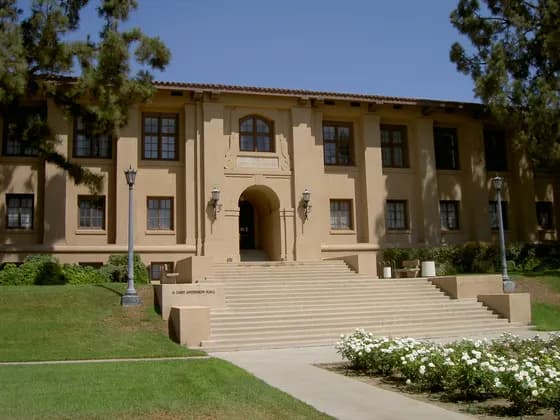
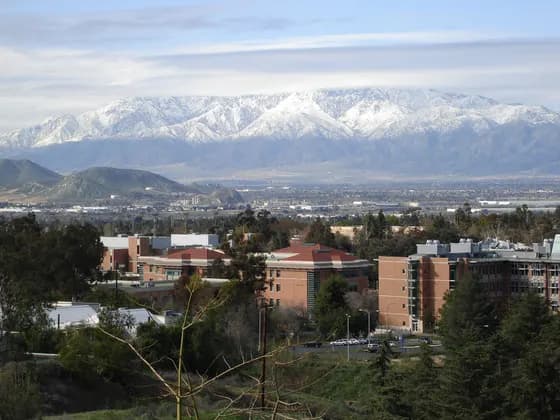
Photo: University of California, Riverside · Public domain · cropped
Photo: Americanist · Public domain · Photo: Arvind Ramanandan Arvindleela · Public domain · Photo: Maliagould · CC BY-SA 4.0
How to get into UC Riverside School of Medicine (MD) medicine
Step-by-step: entry requirements, admission tests, personal statement, interview format and the key deadlines.
Open the guide →UC Riverside School of Medicine (MD) entry requirements
Admission profile, interview format, decision dates and what makes UC Riverside School of Medicine (MD) different.
See the profile →The UC Riverside School of Medicine MD program
Integrated + Case-based learning, 4 years, clinical rotations across Riverside and San Bernardino counties and the Coachella Valley.
See the program →The UC Riverside School of Medicine (MD) medicine interview
UC Riverside School of Medicine uses a **Multiple Mini Interview (MMI)** held on the Riverside campus. The format reflects the school’s social mission: stations probe communication skills, ethical reasoning, and — centrally — commitment to serving the Inland Empire’s underserved communities.
Each station runs approximately 6–8 minutes. Applicants read a brief prompt outside the door before entering. At least one station typically engages with the unique health challenges of inland Southern California: limited specialist access, high rates of diabetes and obesity, environmental exposures, and large Latino agricultural-worker populations.
As the newest UC medical school (est. 2013), UCR Med was purpose-built for a regional physician shortage mission. Interviewers look for primary-care orientation and authentic community ties, not just strong academic metrics.
UC Riverside School of Medicine (MD) interview at a glance (2027 entry)
| Annual MD class size | ~75 |
|---|---|
| Applications received | ~3,500–5,000 per cycle |
| Interview format | MMI — multiple stations, ~6–8 min each |
| Curriculum | Integrated + community health placements |
| Application system | AMCAS + UCR secondary |
| Interview window | October–March |
| Notable program | BA/MD direct-entry pathway from high school |
Interview format
- MMI format: multiple timed stations with written prompts outside each door.
- Each station runs approximately 6–8 minutes; interviewer or actor inside.
- Stations include: ethical dilemma, communication role-play, health-systems question, motivation for primary care, and community health scenario.
- Blind format — interviewers do not review your application before the station.
- Interview day includes campus and hospital tour and informal student interaction.
- BA/MD applicants have a separate interview process with additional evaluation of long-term career intent.
Working towards the MCAT score UC Riverside School of Medicine (MD) expects? Build a week-by-week plan from your test date — free for the first two weeks.
Sample interview questions
Why UC Riverside — specifically, why does the Inland Empire's physician shortage matter to you, and why primary care?
Reference UCR's founding mission, the Inland Empire's physician-to-population ratio, and your personal connection. Vague answers about "helping underserved communities" will not suffice — be specific.
A patient in a rural clinic needs a specialist referral, but the nearest specialist is two hours away and does not accept Medi-Cal. How do you handle this?
Explore telehealth options, Federally Qualified Health Center resources, care co-ordination, patient advocacy, and systemic advocacy to expand specialist access. Shows Inland Empire literacy.
Role play: You are a first-year medical student. A patient's family member confronts you aggressively in the hallway, demanding to know why their relative has not been seen yet. How do you respond? (Actor plays the family member.)
De-escalate: acknowledge frustration, avoid being defensive, explain your role limitations, offer to connect them with the attending or charge nurse. Do not give clinical information.
The Inland Empire has some of the worst air quality in California, driven partly by warehouse distribution centers. As a future physician, what is your responsibility regarding environmental determinants of health?
This is a local issue UCR takes seriously. Discuss clinical recognition of respiratory and cardiovascular effects of air pollution, documentation, community advocacy, and public health partnerships.
Tell me about a time you worked with a community facing significant structural barriers. What did you do and what was the limit of what you could accomplish?
Show realism alongside commitment. UCR values applicants who understand systemic constraints, not just those who believe individual effort alone solves structural problems.
Diabetes prevalence in Riverside and San Bernardino counties is significantly above the California average. What structural factors drive this, and what interventions have evidence?
Reference food access (food deserts, SNAP participation), built environment, income, insurance coverage, and evidence-based programs like DSMES. Shows regional literacy.
You are part of a student-run community health clinic team. Your team leader proposes an outreach event that you believe has logistical flaws that could harm participants. How do you raise this?
Professional disagreement: raise concerns directly with the leader first, be specific about the risks, propose alternatives, and document. Show you balance team cohesion with patient safety.
Should the state mandate that UC-trained physicians who received subsidized tuition practice in underserved areas for a set number of years? Defend your position.
Directly relevant to UCR's mission. Argue a position — acknowledge both student autonomy concerns and the public investment in medical education and regional need.
Describe a failure or setback in your path to medicine. What did it reveal about your resilience?
STAR structure. UCR values authentic self-awareness over polished narratives. Show the emotion, the reassessment, and the specific change in approach that followed.
A colleague reveals to you that they are struggling with substance use that has not yet affected their performance. What do you do?
Balance confidentiality with patient safety obligations. Reference physician health programs (PHPs), the duty to report if patient safety is at risk, and how to support a colleague without being punitive.
A station shows you Inland Empire respiratory-illness rates rising alongside the growth of warehouse and logistics facilities near residential neighborhoods. How do you reason from this association toward — or away from — a causal claim?
Distinguish ecological association from individual causation: consider diesel-particulate exposure pathways, confounders (poverty, pre-existing burden), the temporal sequence, and dose-response. UCR takes warehouse-driven air quality seriously — show you can hold the genuine environmental-justice signal while respecting the limits of ecological data.
Role play: You are a student in a UCR community clinic. A patient is furious that the specialist you referred her to does not accept Medi-Cal and the next available appointment is months away. (The interviewer plays the patient.)
What they are listening for:
- Validate her frustration without defensiveness
- take ownership of helping her navigate
- offer concrete alternatives — telehealth specialty consults
- a different in-network specialist
- FQHC resources
This is the Inland Empire specialist-access problem UCR is built around; show problem-solving, not platitudes.
A monolingual Spanish-speaking patient at your Riverside clinic has poorly controlled diabetes and tells you, through an interpreter, that she cannot afford fresh produce and cooks what is cheapest. How do you proceed?
Avoid prescriptive lecturing on diet. Acknowledge the food-access reality, connect her to SNAP, food banks, and any produce-prescription program, and tailor realistic dietary guidance to what she can actually obtain. Use the professional interpreter properly and confirm understanding with teach-back.
UCR's BA/MD pathway recruits Inland Empire students from high school to build a homegrown physician workforce. Why does growing physicians from within the community matter for solving a regional shortage, compared with recruiting graduates from elsewhere?
Show you grasp the evidence and logic: physicians are far likelier to practice where they have roots, so local pipelines address shortages more durably than recruitment. Connect this to UCR's mission and, if relevant, your own ties to or commitment to the Inland Empire.
As the newest UC medical school, UCR has a leaner research and subspecialty infrastructure than UCLA or UCSF. If you have research ambitions, how do you reconcile that with UCR's primary-care and community focus?
Be honest about the trade-off. Frame community-engaged and health-services research on Inland Empire problems as a genuine strength, and explain why the mission fit matters more to you than a larger research engine. Avoid implying UCR is merely a fallback.
Practise the UC Riverside School of Medicine (MD) interview
Rehearse the real format before the day — on demand with our AI interviewers, or live with a tutor.
Sit a mock with photoreal AI interviewers — any time
A timed MMI or panel interview on video — American & international voices — with interviewers who listen, react and press with follow-ups. Rubric-scored feedback and a replay the moment you finish.






Live mocks with a tutor who’s been in the room
A full UC Riverside School of Medicine (MD)-style mock with a medic or dentist tutor — honest scoring against real marking criteria, a station-by-station debrief and a written action plan.
Book a mock interviewHow to prepare for the UC Riverside School of Medicine (MD) interview
Common pitfalls to avoid
UC Riverside School of Medicine (MD) interview — frequently asked questions
Sources & official admissions information
Ready to nail your UC Riverside School of Medicine (MD) interview?
Book a mock interview with a tutor who knows the US interview formats, orpractice unlimited stations from our interview question bank.