
David Geffen School of Medicine at UCLA Interview
Format, Questions & Prep Tips
David Geffen School of Medicine at UCLA medicine interviews for 2027 entry are a traditional interview, held October 2026 through February 2027. David Geffen School of Medicine at UCLA describes the format as: Virtual one-on-one interviews with DGSOM faculty members, the core format for 2026–27. Published figures: Annual MD class size ~175; Interview format Two ~30-min one-on-one virtual interviews (open file); MMI only for PRIME-LA; Tuition (2025–26) ~USD 36,000 (in-state) / USD 48,000 (out-of-state).
- Institution
- David Geffen School of Medicine at UCLA
- Interview (2027 entry)
- October through February
- Decisions (2027 entry)
- Regular decisions by late March; waitlist through May–August


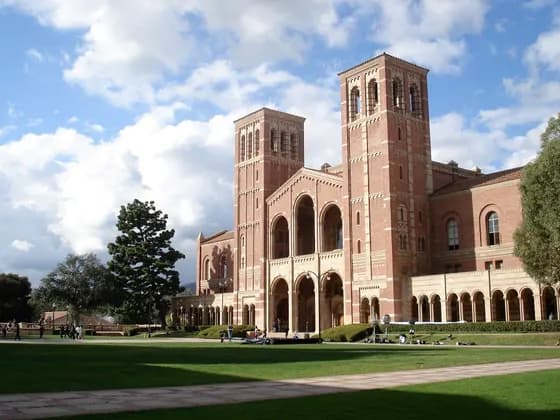

Photo: King of Hearts · CC BY-SA 3.0 · cropped
Photo: Cayambe · CC BY-SA 4.0 · Photo: Alton · CC BY-SA 3.0 · Photo: Daderot · CC0
How to get into David Geffen School of Medicine at UCLA (MD) medicine
Step-by-step: entry requirements, admission tests, personal statement, interview format and the key deadlines.
Open the guide →David Geffen School of Medicine at UCLA (MD) entry requirements
Admission profile, interview format, decision dates and what makes David Geffen School of Medicine at UCLA (MD) different.
See the profile →The David Geffen School of Medicine at UCLA MD program
Case-based learning + Integrated, 4 years, clinical rotations across Los Angeles, wider Southern California and Bakersfield.
See the program →The David Geffen School of Medicine at UCLA (MD) medicine interview
David Geffen School of Medicine at UCLA interviews standard MD-track applicants through two ~30-minute one-on-one virtual interviews (open file — interviewers have reviewed your application). The 8-station campus MMI described in older UCLA materials now applies only to the PRIME-LA pathway.
UCLA has a breadth of affiliated hospitals — Ronald Reagan UCLA Medical Center, Olive View-UCLA Medical Center (safety-net), VA Greater Los Angeles, Harbor-UCLA, and Santa Monica UCLA — giving students exposure to radically different patient populations. Interviewers probe whether applicants have sought diverse clinical settings.
Post-SCOTUS 2023 holistic review focuses heavily on first-generation status, socioeconomic background, geographic diversity, and service commitment.
David Geffen School of Medicine at UCLA (MD) interview at a glance (2027 entry)
| Annual MD class size | ~175 |
|---|---|
| Interview format | Two ~30-min one-on-one virtual interviews (open file); MMI only for PRIME-LA |
| Tuition (2025–26) | ~USD 36,000 (in-state) / USD 48,000 (out-of-state) |
| Application system | AMCAS + UCLA secondary |
| PRIME-LA track | Urban underserved concentration (competitive sub-application) |
| Interview window | October–February |
Interview format
- Two ~30-minute one-on-one virtual interviews with faculty or admissions committee members.
- Open file: interviewers have read your application — know every activity and essay cold.
- Conversational, not station-based; the MMI applies only to the PRIME-LA pathway.
Working towards the MCAT score David Geffen School of Medicine at UCLA (MD) expects? Build a week-by-week plan from your test date — free for the first two weeks.
Sample interview questions
UCLA trains physicians who serve Los Angeles — one of the most ethnically and socioeconomically diverse metropolitan areas in the world. How has your experience with diversity shaped your vision of clinical medicine?
Post-SCOTUS holistic review. Connect lived diversity experience to specific clinical insights rather than abstractions, and avoid framing diversity in racial terms the law no longer permits in admissions.
Why the David Geffen School of Medicine specifically? What about its public-service mission and clinical settings fits you?
Name the public mission, PRIME-LA, or the range of affiliated hospitals. Treat UCLA as a public-service institution, not just a brand — faculty notice the difference.
UCLA students train across very different sites — from Ronald Reagan to Olive View-UCLA and Harbor-UCLA. Have you sought out clinical or service settings that stretched you, and what did you learn?
Interviewers probe whether applicants have engaged with diverse, including safety-net, populations. Show you have deliberately moved toward, not away from, complexity.
Tell me about a sustained commitment to an underserved community. What kept you involved beyond a single experience?
UCLA values durable service over resume-building. Show genuine relationships and what you learned by staying long enough to understand the community's strengths and constraints.
You are a resident at Olive View-UCLA, a safety-net hospital. A patient with an asthma exacerbation has substandard housing triggering her condition. She speaks limited English. How do you manage this holistically?
What they are listening for:
- Medical management plus social-determinants screening
- community-health-worker referral
- interpreter services
- legal aid for tenant rights
Address the cause, not just the flare.
California has legalized medical aid in dying (End of Life Option Act). How do you think about the physician's role, and what concerns you about the current implementation?
What they are listening for:
- Patient autonomy
- eligibility criteria
- access disparities
- conscientious objection
- palliative-care alternatives
Show you can engage the issue thoughtfully from multiple angles.
A patient at Harbor-UCLA without insurance needs a costly medication. What is your responsibility, and how far does it extend?
What they are listening for:
- Manufacturer assistance programs
- county health-plan eligibility
- formulary alternatives
- advocacy
Reason within the safety net rather than treating cost as the patient's problem alone.
A patient asks you to withhold a diagnosis from their family, but the family is the patient's primary caregiver. How do you navigate it?
Patient autonomy and confidentiality balanced against the practical realities of caregiving. Explore the patient's reasons and find a path that respects their wishes while supporting safe care.
You must explain a complex treatment plan to a patient through an interpreter. How do you make sure they truly understand?
Speak to the patient, use short chunks, teach-back to confirm understanding, and avoid jargon. In a city with hundreds of languages, interpreter skills are essential clinical competence.
A patient is angry about being transferred between hospitals in the UCLA system and feels no one is taking ownership of their care. Respond to them.
Acknowledge the frustration, take responsibility for coordination, and reassure them about continuity. De-escalate first; defend the system later if at all.
Describe a research or scholarly project you contributed to. What was your role, and what was its main limitation?
UCLA is a major research institution. Show methodological understanding and the honesty to name limitations and next steps rather than overstating findings.
How would you study whether a program placing community-health workers in safety-net clinics actually improves chronic-disease control?
Discuss outcome definition, comparison group, confounding, and feasibility in a real-world setting. Structured reasoning matters more than a perfect design.
How do you decide whether a published finding is strong enough to change clinical practice?
What they are listening for:
- Study design
- replication
- effect size
- applicability to the diverse populations UCLA serves
Balance scientific rigor with the need to act under uncertainty.
A patient at a free clinic where you volunteer says no one respects people who can't pay and is ready to walk out. Talk to them.
Acknowledge the legitimacy of the frustration before anything else, take ownership where you can, and rebuild trust. Show the patient they have been heard.
A classmate confides they feel they don't belong at UCLA because of their background. Respond to them.
What they are listening for:
- Listen
- validate without dismissing
- help them see their perspective as an asset
Reflect on supporting peers within a diverse community.
You are shown LA County data where one neighborhood has far higher diabetes and asthma rates than a wealthier area nearby. What questions do you ask before drawing conclusions?
What they are listening for:
- Probe access to care
- food and pharmacy availability
- housing and environmental exposures
- insurance
- data quality
Connect the gap to structural determinants rather than individual behavior.
Practise the David Geffen School of Medicine at UCLA (MD) interview
Rehearse the real format before the day — on demand with our AI interviewers, or live with a tutor.
Sit a mock with photoreal AI interviewers — any time
A timed MMI or panel interview on video — American & international voices — with interviewers who listen, react and press with follow-ups. Rubric-scored feedback and a replay the moment you finish.





Live mocks with a tutor who’s been in the room
A full David Geffen School of Medicine at UCLA (MD)-style mock with a medic or dentist tutor — honest scoring against real marking criteria, a station-by-station debrief and a written action plan.
Book a mock interviewHow to prepare for the David Geffen School of Medicine at UCLA (MD) interview
Common pitfalls to avoid
David Geffen School of Medicine at UCLA (MD) interview — frequently asked questions
Sources & official admissions information
Ready to nail your David Geffen School of Medicine at UCLA (MD) interview?
Book a mock interview with a tutor who knows the US interview formats, orpractice unlimited stations from our interview question bank.