
Western University COMP Interview
Format, Questions & Prep Tips
Western University COMP medicine interviews for 2027 entry are multiple mini interviews (MMI), held September 2026 through March 2027. Western University COMP describes the format as: Online or on-campus interview day plus a separate, required 30-minute MMI. Published figures: Annual DO class size 322 (227 Pomona + 95 Oregon; 2025–26); Tuition (2025–26) ~USD 62,000/year.
- Institution
- Western University of Health Sciences College of Osteopathic Medicine of the Pacific
- Interview (2027 entry)
- September through March
- Decisions (2027 entry)
- Rolling decisions

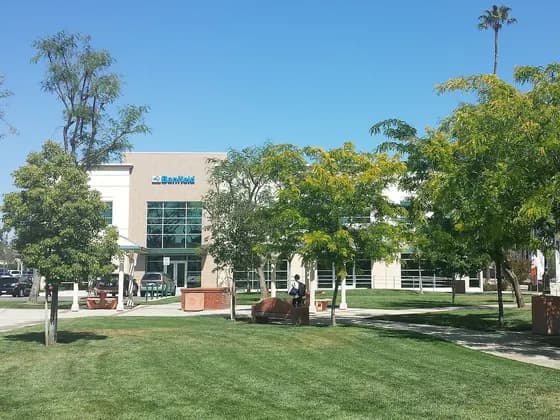


Photo: Ryan Hoff · CC BY-SA 4.0 · cropped
Photo: Ryan Hoff · CC BY-SA 4.0 · Photo: JERRYE & ROY KLOTZ, M.D. · CC BY-SA 4.0 · Photo: Robotics · CC0
How to get into Western University COMP (DO) medicine
Step-by-step: entry requirements, admission tests, personal statement, interview format and the key deadlines.
Open the guide →Western University COMP (DO) entry requirements
Admission profile, interview format, decision dates and what makes Western University COMP (DO) different.
See the profile →The Western University COMP (DO) medicine interview
Western University of Health Sciences College of Osteopathic Medicine of the Pacific (COMP) uses a traditional interview format — typically two sessions (faculty and student) at its Pomona, CA campus (or the Northwest campus in Lebanon, OR). COMP is a health sciences university with programs in pharmacy, nursing, PA studies, and veterinary medicine alongside osteopathic medicine, making interprofessional education (IPE) genuinely embedded in student life.
Casper is not currently required at Western University COMP — verify on the official admissions page each cycle, as requirements change. The school's Southern California location means clinical training occurs in one of the most diverse and medically complex regions of the US — the Inland Empire has high rates of diabetes, uninsured Latinx families, and rural agricultural health challenges.
COMP is notable for its One Health initiative — integrating human, animal, and environmental health perspectives — and for its research programs in musculoskeletal medicine and OMT efficacy.
Western University COMP (DO) interview at a glance (2027 entry)
| Annual DO class size | 322 (227 Pomona + 95 Oregon; 2025–26) |
|---|---|
| Interview format | Traditional — faculty + student sessions |
| CASPer required | No |
| Application system | AACOMAS primary + Western U secondary |
| Tuition (2025–26) | ~USD 62,000/year |
| Interview window | September–March |
Interview format
- Two sessions: faculty and student; ~30 minutes each.
- IPE is genuinely embedded — students share facilities and courses with pharmacy, PA, and other health professions students.
- No MMI.
Working towards the MCAT score Western University COMP (DO) expects? Build a week-by-week plan from your test date — free for the first two weeks.
Sample interview questions
Why osteopathic medicine, and what about the DO approach fits the kind of physician you want to become?
Ground the answer in the osteopathic tenets, the structure-function relationship, and OMT as a clinical tool. Frame DO positively and on its own merits. At COMP you can link it to the school's musculoskeletal-medicine and OMT-efficacy research strengths.
COMP sits within a multi-college health-sciences university with pharmacy, PA, nursing, dental, and veterinary programs. Why does training in a genuinely interprofessional environment matter to you?
Show you understand that real IPE means shared coursework and team-based care, not just shared buildings. Connect it to safer, more coordinated patient care and to your own collaborative experiences.
What draws you to practicing in Southern California's Inland Empire, one of the most medically underserved regions in the state?
Be specific:
- high diabetes prevalence
- large uninsured Latinx and immigrant populations
- agricultural and warehouse-worker health
- primary-care shortages
Tie it to evidenced commitment, not just the appeal of the location.
Western U's One Health initiative integrates human, animal, and environmental health. Does that framework resonate with how you think about medicine?
What they are listening for:
- One Health connects zoonotic disease
- environmental exposures
- human illness
If you have veterinary, public-health, or environmental experience, use it. Show intellectual curiosity rather than reciting the brochure.
A farmworker in the Inland Empire presents with heat exhaustion after a long shift in the fields. Beyond the acute management, what systemic factors do you weigh?
What they are listening for:
- Heat-illness prevention rules
- pesticide exposure
- lack of paid sick leave
- uninsurance
- immigration fears
- the FQHC and promotora infrastructure
Show structural thinking and respect for the patient's constraints.
A patient declines a recommended vaccine for their child based on information they read online. How do you respond?
Respect autonomy while fulfilling beneficence and your duty to the child. Explore concerns, use motivational interviewing, share evidence without condescension, and keep the relationship intact for future visits.
You discover a senior clinician has been cutting corners on documentation in a way that could affect patient safety. What do you do as a student?
Patient safety and professional integrity outweigh hierarchy. Describe escalating through appropriate channels, the difficulty of speaking up against seniority, and how to do so constructively.
Describe a time you learned something important from a non-physician clinician. How did it change your clinical thinking?
Pick a real encounter with a pharmacist, nurse, social worker, or PA. Show humility and that you value distributed expertise. This maps directly onto COMP's IPE culture.
Tell me about a time you had to deliver information someone did not want to hear. How did you handle their reaction?
What they are listening for:
- Empathy
- clarity
- allowing silence
- checking understanding
Avoid sounding clinical or detached; show you can hold difficult emotion.
COMP uses an integrated, systems-based curriculum alongside a demanding OMM lab. How do you learn, and how would you keep up?
Concrete, evidence-based study strategies and honest self-knowledge. Reference COMLEX-USA (and USMLE if you plan both) accurately and how you recover from a poor result.
Is there a part of your application — a grade trend or gap — you would want the committee to understand in context?
Own it, explain the lesson, and point to a sustained upward trajectory. Do not blame others.
A patient who speaks limited English has come in without a family member to translate. The clinic is busy. How do you proceed?
Use a professional interpreter (phone or video), never a child or rushed bilingual staff member. Show patience and awareness of the legal and ethical right to language access, relevant to the Inland Empire's Latinx population.
You are a student and a diabetic patient admits they have not been taking insulin because they cannot afford it. Talk to them.
Avoid judgment; explore the real barrier, problem-solve (patient assistance programs, formulary options, social work), and rebuild trust. Demonstrate the whole-person approach.
You are shown county data: diabetes-related hospitalizations are far higher in parts of the Inland Empire than in coastal LA. How do you interpret it?
Look beyond individual choices to food access, insurance, primary-care availability, and built environment. Propose both clinical and population-health responses; avoid blaming patients.
What experience first made medicine feel real to you rather than idealized, and how did it shape you?
Reflective and specific. Show you have seen the difficulty as well as the reward and that it deepened, rather than dented, your commitment.
An uninsured patient needs a workup you suspect they cannot afford. How do you balance thoroughness with cost?
What they are listening for:
- High-value care
- shared decision-making
- sliding-scale and FQHC resources
- honesty about trade-offs
Show stewardship without compromising safety.
Practise the Western University COMP (DO) interview
Rehearse the real format before the day — on demand with our AI interviewers, or live with a tutor.
Sit a mock with photoreal AI interviewers — any time
A timed MMI or panel interview on video — American & international voices — with interviewers who listen, react and press with follow-ups. Rubric-scored feedback and a replay the moment you finish.






Live mocks with a tutor who’s been in the room
A full Western University COMP (DO)-style mock with a medic or dentist tutor — honest scoring against real marking criteria, a station-by-station debrief and a written action plan.
Book a mock interviewHow to prepare for the Western University COMP (DO) interview
Common pitfalls to avoid
Western University COMP (DO) interview — frequently asked questions
Sources & official admissions information
Ready to nail your Western University COMP (DO) interview?
Book a mock interview with a tutor who knows the US interview formats, orpractice unlimited stations from our interview question bank.