
The Northwestern University Feinberg School of Medicine MD program
What you actually study, and where you will be
Northwestern University Feinberg School of Medicine's MD is a 4-year program taught through problem-based learning in an integrated curriculum, with patient contact from Year 1 and clinical rotations in Chicago, plus a few suburban clinics and hospitals (2027 entry). Feinberg's MD runs in three phases on Northwestern's Chicago campus. Phase 1 teaches the sciences in 20 months of organ-system modules, largely in small groups, while you start visiting the primary care clinic you keep for four years. Phase 2 is a year of block clerkships from May of your second year, and Phase 3 adds advanced rotations, teaching junior students and a required research write-up.
- Degree
- MD
- Length
- 4 years
- Teaching
- Integrated + Problem-based learning
- Clinical contact
- Year 1
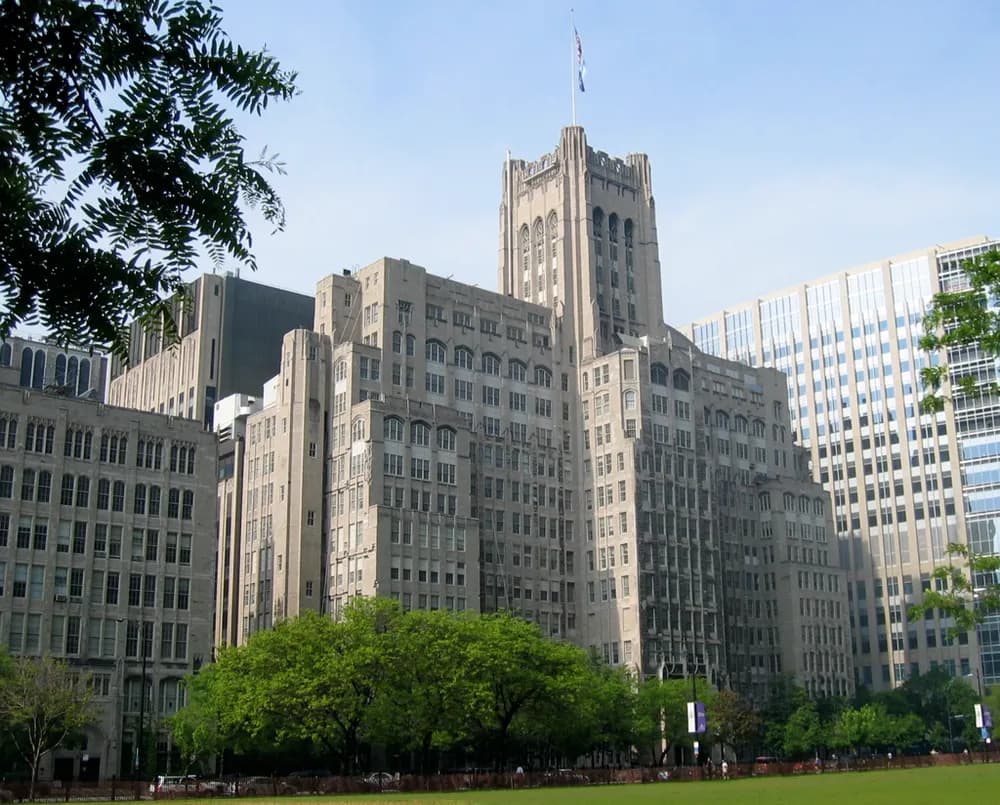



Photo: User:JeremyA · CC BY-SA 2.5 · cropped
Photo: Sergei Gussev · CC BY 2.0 · Photo: Viplav Valluri · CC BY-SA 4.0 · Photo: Warren LeMay from Covington, KY, United States · CC BY-SA 2.0
The Northwestern University Feinberg School of Medicine MD program at a glance (2027 entry)
Northwestern University Feinberg School of Medicine runs a four-year MD program on Northwestern's Chicago campus in Streeterville, which its teaching and research buildings share with its main clinical affiliates. The admissions office gives the entering class size as 140. The Liaison Committee on Medical Education (LCME), which accredits MD programs in the United States, lists the program as fully accredited, with its next survey in 2028-29.
The curriculum, which the admissions office says was updated in 2012, has three phases. Phase 1, the pre-clerkship (pre-clinical) phase, fills the first 20 months, the years the school calls M1 and M2, with modules organized by organ system. Phase 2 (M3) is a year of core clerkships, the required clinical rotations in the main specialties. Phase 3 (M4) brings advanced clerkships, electives and preparation for residency, the specialty training that follows medical school.
Four strands run through all three phases: Science in Medicine, Clinical Medicine, Health and Society, and Professional Development. The school favors active learning over the lecture hall, so much of your contact time is in small groups, especially problem-based learning, Health and Society, and Professional Development. Synthesis and Application Modules (SAMs), review blocks of up to a week, sit between the modules.
Patients come early. In your first week you are assigned to an Education-Centered Medical Home (ECMH), a primary care practice where you keep the same preceptor and student team for four years. Later clinical training is mainly at six Chicago hospitals, led by Northwestern Memorial Hospital.
Almost every student also completes the Area of Scholarly Concentration (AOSC), a mentored research project that ends in a first-author manuscript or a thesis, and final-year students teach first- and second-year students.
| Degree | MD |
|---|---|
| Program length | 4 years in three phases; optional research or dual-degree year |
| Class size | Entering class of 140, per the admissions FAQ |
| Main campus | Northwestern's Chicago campus in Streeterville |
| Teaching style | Integrated organ-system modules with small-group problem-based learning |
| Anatomy | Prosection-based, with optional dissection sessions (2022 school description) |
| First patient contact | Year 1: a primary care clinic from your first week |
| Step 1 timing | Before clerkships, usually April of the second year |
| Grading | Phase 1 pass/fail; clerkships honors, high pass, pass or fail |
| Accreditation | LCME: full, next survey 2028-29 |
What makes the Northwestern University Feinberg School of Medicine MD program different
The same primary care clinic for all four years
From your first week you belong to an ECMH, where teams with four students from each class, alongside physician assistant students, residents and faculty, care for high-risk patients. Patients, peers and your preceptor all give you feedback.
A required research project ending in a manuscript
The AOSC is a hypothesis-driven project you design with a faculty mentor. You start it in a four-week summer block after M1, present it orally and as a poster in the fall of M2, and finish with a manuscript or thesis by January of M4.
Teaching junior students is a graduation requirement
In the Phase 3 Teaching Selective you teach first- and second-year students in clinical skills, problem-based learning, anatomy or the Personal Transition to the Profession course, and practice mentoring and giving feedback. An archived 2024 course page adds that you get feedback and write an improvement plan.
Critical care and rehabilitation rotations for everyone
Phase 3 requires four weeks of critical care in an adult or pediatric intensive care unit (ICU). It also requires two weeks of physical medicine and rehabilitation (PM&R), the specialty that helps patients regain function after injury or illness.
A structured send-off into residency
From the class graduating in 2027 onward, which covers anyone entering in 2027, the final phase has a Longitudinal Transition to Residency. It includes a baseline clinical skills exam and a follow-up, a one-week bootcamp and a one-week Capstone. In the 2026-27 planner the bootcamp weeks run from August to October, and the Capstone weeks fall in April and May.
How Northwestern University Feinberg School of Medicine teaches medicine
Each Phase 1 module contains all four curricular elements, led by Science in Medicine. Sciences such as anatomy and genetics run through the organ-system modules and return in the clinical phases. In the school's 2025 description of the cardiovascular module, you practice the heart exam on simulators, standardized patients (trained actors who portray patients) and your own clinic patients.
Health and Society looks at how individual, community, policy and system factors shape health, and each module shows how social conditions affect the diseases you study. Four threads get extra weight: digital health and data science, quality and patient safety, health equity and advocacy, and the business of medicine. Professional Development covers clinical ethics, medical humanities seminars, interprofessional teamwork and a leadership curriculum that ends with a self-assessment reviewed with a coach.
From Phase 2 the focus shifts to clinical medicine and professional development. SAM weeks continue, now preparing you for clerkships and electives, and once a month the whole class meets on a Friday afternoon to connect material across disciplines.
The ways you will learn
| Problem-based learning (PBL) | Groups of six to nine students with a faculty facilitator work through a clinical case over several sessions, with patient information released step by step. You form hypotheses, pick out what you need to learn, share out tasks and finish each case with a concept map. |
|---|---|
| Team-based learning and plenaries | Science in Medicine also uses team-based learning, where you prepare beforehand and then solve problems with your team in class, plus quizzes, audience response, simulation and whole-class learning plenaries. |
| Synthesis and Application Modules (SAMs) | You revisit earlier material and apply it to new clinical scenarios, through simulations, case-based learning, clinical reasoning and ethics panels. Attendance is required. |
| Clinical skills with standardized patients | In faculty-led small groups you practice interviewing and examination with standardized patients in the Outpatient Simulation Center. In the 2025 module descriptions, sessions track each module, from motivational interviewing in Foundations to the mental status exam in Psychiatry. |
| Medical Decision-Making | Small groups on evidence-based medicine, from study design and decision analysis in M1 to critically appraising published research in M2. |
| Ward and clinic teaching | In Phases 2 and 3 you learn as part of hospital and clinic teams, presenting patients and writing notes. The now-archived 2024-25 clerkship pages and the clerkship objectives describe weekly conferences, case-based sessions, ethics discussions and simulation, plus physical examination rounds in medicine and neurology. |
A typical week on the Northwestern University Feinberg School of Medicine program
According to the school's undated faculty teaching page, afternoons carry most small-group work. PBL meets twice a week for two hours, 1 to 3 p.m. in M1 and 3 to 5 p.m. in M2. Clinical skills groups of four to eight students meet for two hours every week or every other week.
The same page lists Science in Medicine sessions as 50-minute lectures or 80-minute team-based learning sessions. Medical Decision-Making small groups meet about every other week in M1 (twelve sessions) and monthly in M2 (seven, mostly student-led). Hands-on ultrasound sessions of two to three hours come several times a year.
Phase 1 policies cap required activities at an average of 28 contact hours a week per module, including required pre-reading and videos but not your own study. Optional classroom sessions are recorded, so you can choose whether to attend. Sessions built on participation, or with patients or guest speakers, are compulsory, and you must attend more than half of each type of small group in a module. Exams usually fall on a module's final Friday, and you get up to five personal days a year.
In Phases 2 and 3, duty hours are capped at 80 a week averaged over four weeks, with no more than 16 consecutive hours caring for patients, plus up to 2 for handoffs. You get at least eight hours off between shifts and, on average, one day off a week. You may miss at most two days of a four- or six-week clerkship and three days of an eight-week one, and up to three days of a four-week elective for residency interviews.
How anatomy is taught at Northwestern University Feinberg School of Medicine
Anatomy is taught inside the Phase 1 organ-system modules. A February 2022 school news article describes the approach: rather than dissecting donor bodies yourself, you mainly study prosections, specimens that have already been dissected. Teams rotate through lab stations that pair the specimens with clinical cases, medical imaging and histopathology, diseased tissue seen under the microscope.
The article also describes hands-on ultrasound and HoloAnatomy, Case Western Reserve University software that shows body structures as 3D holograms through Microsoft HoloLens 2 headsets. Students can sign up for optional dissection sessions with each organ module. In the fourth year, students preparing for surgical or procedural specialties can return to the lab to dissect, and the 2026-27 catalog lists an Advanced Clinical Anatomy elective.
Later documents mostly agree. The March 2024 anatomy-lab policy describes sessions with few students and no dissection. An archived 2025 Phase 1 page, however, says musculoskeletal anatomy was reinforced partly by dissection. Expect prosection-based teaching, with dissection as an option rather than the core method.
Donor bodies come through the Anatomical Gift Association of Illinois, which supplies all of the state's medical schools. At the end of anatomy lab, students hold an Anatomy Closing Ceremony that honors the donors with prose and music.
When you first meet patients at Northwestern University Feinberg School of Medicine
Clinical training begins in your first week, when you are assigned to an ECMH, a primary care practice. You help care for patients, many of them high-risk, under a faculty preceptor.
The undated admissions FAQ describes a half-day about every other week. The March 2026 graduation policy counts visits instead: 12 in Phase 1a and 12 in Phase 1b. Phase 2 has 14 plus a two-week Integrated Primary Care block, and Phase 3 has 10 from 2026-27.
ECMH sites range from Northwestern Medical Group practices in the Galter, Lavin and Arkes pavilions and city neighborhoods to community health centers such as Erie Family Health Centers. A few lie just outside the city.
Responsibility grows. Archived 2024 pages describe Phase 2 students writing their own assessments and plans, and Phase 3 students moving toward managing complex chronic patients independently. The Community Health Advocacy Initiative (CHAI) offers longitudinal, hands-on training and mentorship in community engagement and advocacy.
Year by year at Northwestern University Feinberg School of Medicine
- Phase 1a (M1)
Foundations and the first organ systems
M1 runs from early August to mid-May, opening with Intro to the Profession week and a Founders' Day ceremony. Module lengths come from the 2026-27 calendar, the latest posted, so dates for a 2027 entrant are projections. Content is from the Phase 1 page archived in May 2025.
- Foundations 1 (5 weeks): biochemistry, genetics and cell biology, plus opening a patient encounter, history-taking, vital signs and basic ethics.
- Foundations 2 (4 weeks): pharmacology, embryology, anatomy, histology, pathology and the organization and economics of medicine, with first ultrasound practice on pregnant patients.
- Foundations 3 (5 weeks): microbiology, immunology, health equity and the start of clinical reasoning through differential diagnoses and case presentations.
- Cardiovascular-Blood (6 weeks), Pulmonary (4) and Renal (4), adding the heart, lung and abdominal exams in turn.
- Musculoskeletal (4 weeks, with a practical exam) and Dermatology (2 weeks), with a short SAM in November and another after spring break.
- Practice exams from the National Board of Medical Examiners (NBME) after the first two blocks, and 12 ECMH visits.
- From mid-May, four weeks of full-time work on your AOSC project, then five weeks of summer break before Phase 1b starts in mid-July.
- Phase 1b (M2)
The remaining systems and Step 1
M2 runs from mid-July to early March. The overview counts 14 Phase 1 modules; the March 2026 policy and calendars list 15, splitting musculoskeletal and dermatology. You must pass each block to move on; content again comes from the archived 2025 page.
- Head and Neck (4 weeks) and Neuroscience (6 weeks), each with a practical exam, covering the eye, the neurological exam and case presentations.
- Psychiatry (3 weeks): the mental status exam and substance-misuse interventions with standardized patients, and patients describing their experience of illness.
- Gastrointestinal (4 weeks) and Endocrine (3 weeks), which ends with the full head-to-toe exam.
- Reproduction-Genitourinary (5 weeks), including the pelvic exam with trained teaching associates, and Hematology-Oncology (4 weeks), including how to deliver bad news.
- The NBME Comprehensive Basic Science Examination (CBSE) in February, a final SAM in March and a portfolio review before clerkships.
- Six weeks of Step 1 Knowledge Consolidation from mid-March, mixing study and a break. Most students take Step 1 of the United States Medical Licensing Examination (USMLE) in April.
- Twelve more ECMH visits, then the required Intro to Phase 2 week in late April.
- Phase 2 (M3)
Core clerkships
Phase 2 runs from early May to the following April. You submit preferences for clerkship order and electives, and a lottery assigns schedules. On the 2026-27 pattern, a 2027 entrant would start in May 2029.
- Medicine (8 weeks): two four-week ward rotations caring for hospitalized adults. At least four weeks are at Northwestern Memorial Hospital (NMH), and some students spend four weeks at the Jesse Brown Veterans Affairs (VA) Medical Center (2020 objectives).
- Surgery (8 weeks): four weeks of abdominal surgery and four in a selected subspecialty, at NMH, Lurie Children's Hospital or the VA (archived 2024 page). Skills sessions cover suturing, IV lines and urinary catheters, and the live department page lists inpatient work in general surgery, orthopedics and urology.
- Pediatrics (6 weeks) at Lurie Children's: general and subspecialty inpatient care, the newborn nursery with urgent care shifts, and ambulatory (outpatient) pediatrics around Chicagoland (archived 2025 page; the live department page confirms the mix).
- Obstetrics and gynecology (OB/GYN, 6 weeks), with two clerkship sites, Prentice Women's Hospital and Stroger Hospital. You work in labor and delivery, by day and on night float shifts, on a gynecologic surgery service and in clinics, with at least one 10-hour weekend call.
- Psychiatry (4 weeks; archived 2025 page): inpatient psychiatry or consultation-liaison work, seeing patients on medical, surgical and OB/GYN floors, at NMH, the VA or Lurie Children's. Lectures and emergency call are at NMH.
- Neurology (4 weeks): two weeks inpatient on two services, such as stroke, consults or the neurology ICU, and two weeks in outpatient clinics (2024 objectives).
- ECMH: 14 visits and the two-week Integrated Primary Care block, which an archived 2024 page describes as your own and another primary care clinic plus geriatrics, lifestyle medicine and chronic disease clinics. The 2026 ECMH policy for MD-PhD students lists an NBME ambulatory care exam.
- A SAM week in late August, early electives and two-week selectives.
- Phase 3 (M4)
Advanced clerkships and the move to residency
Phase 3 runs from late April to graduation in mid- to late May. Beforehand, you agree on an elective schedule with the Associate Dean or Assistant Director of Student Affairs. Required advanced clerkships must be finished by the last four-week block in April, apart from the Capstone.
- Sub-internship (4 weeks) in medicine, surgery, pediatrics or OB/GYN. A sub-internship, or acting internship, means working at the level of a first-year resident, with primary responsibility for your own patients.
- Critical care (4 weeks) in an adult or pediatric ICU. The adult clerkship's 2025 objectives include intubation and central and arterial lines on simulated patients, and an archived 2025 page describes switching ICUs after two weeks.
- Emergency medicine (4 weeks) in the NMH emergency department, at sub-intern level. An archived 2024 page lists 13 eight-hour shifts, with two to three night shifts and four to five weekend shifts.
- Physical medicine and rehabilitation (2 weeks) at Shirley Ryan AbilityLab, a rehabilitation hospital, plus 10 ECMH visits and the Teaching Selective.
- Step 2 Clinical Knowledge (CK), after all core clerkships and a four-week consolidation block you choose, by the end of August.
- Electives, a self-directed Career Development week, and a Residency Preparedness and Interviewing Elective if you are applying to residency.
- Longitudinal Transition to Residency, with a one-week Capstone. The curriculum overview still describes a two-week capstone, which the March 2026 policy limits to the Class of 2026.
- Your AOSC manuscript or thesis, due by January.
How you are assessed at Northwestern University Feinberg School of Medicine
Assessment is competency-based, tied to eight Feinberg competencies such as patient-centered medical care. Formats include multiple-choice, oral and practical exams, evaluations from peers and nurses, and objective structured clinical examinations (OSCEs). In an OSCE you rotate through timed stations, interviewing or examining standardized patients while being scored. Your transcript shows block and clerkship grades, not individual exam results.
Phase 1 is pass/fail. Each block of two to four modules gets one grade from a composite of its assessments. Modules of four weeks or more give feedback at the midpoint, and every module has practice exams. If your block score falls below the pass mark, you agree on a study plan with faculty and can still earn a Pass by remediating within the year.
Clerkships are graded honors, high pass, pass or fail, except the longitudinal ECMH and Transition to Residency, which are pass/fail. Grades draw on faculty and resident assessments, exams, end-of-rotation OSCEs in several clerkships, professionalism and evaluations from team members. Clerkships of four weeks or more include a face-to-face midpoint meeting that reviews your clerkship log, the record of required patient encounters.
Core clerkships end with an NBME subject exam, a national multiple-choice test often called a shelf exam. The pass mark is the 10th percentile of the latest national cohort. If you fail, the clerkship stays Incomplete until you pass a retake within six months, and you earn no more than 5 points for that part of the grade. A third failure means a Fail and referral to the Student Promotions Committee.
You must pass USMLE Step 1 and Step 2 CK to graduate. Step 1, on the basic sciences behind medicine, has been reported pass/fail since January 26, 2022; Step 2 CK tests clinical knowledge. If you have not taken Step 1 by the end of the six-week consolidation block, you join an Advanced Knowledge Consolidation Module for up to six more weeks. If you fail Step 1, you can finish your current clerkship but cannot start another until you pass a retake, due within three months.
In August 2026 the USMLE program announced a move to designated testing dates from January 2029, with Step exams offered less often each year. This replaced a 2028 start announced in June 2026. Feinberg's 2027-28 calendars are not yet posted. On the current schedule, projected from the 2026-27 planners, an August 2027 entrant would take Step 1 around April 2029 and Step 2 CK by the end of August 2030, both after the change. USMLE has urged schools to review when students must test, so this timing may change.
- Your assessments collect in an electronic portfolio. You review it yearly with your college mentor in M1 to M3, and a faculty committee reviews it before clerkships and after the core clerkships. These reviews can lead to an educational support plan but stay off your transcript.
Where you will actually train at Northwestern University Feinberg School of Medicine
Clinical training is concentrated in Chicago, mostly at the six hospitals below, led by Northwestern Memorial Hospital, the primary teaching affiliate. Northwestern Medicine's outpatient sites across the city add clinic experience. The school says Feinberg faculty oversee you at every site and your role in each discipline stays the same.
The Jesse Brown VA, a 200-bed acute care hospital with four community outpatient clinics, can host students in all four years, and a free shuttle runs daily from campus. Stroger, a 450-bed teaching hospital at the center of Cook County Health, is one of two OB/GYN clerkship sites. The admissions office says third- and fourth-year students may choose OB/GYN and other rotations there.
The family medicine department's electives cover urban underserved and rural family medicine in Chicago and the western suburbs.
The ECMH director and clerkship directors assign sites, letting you rank preferences where possible. You travel by university shuttle, public transportation or your own car. Travel may be reimbursed, up to $40 per one-way trip, for shifts before 6 a.m. or after 9:30 p.m. (or the last VA shuttle) and for sites hard to reach by transit.
The main sites for clerkships, sub-internships and advanced rotations.
- Northwestern Memorial Hospital
- Prentice Women's Hospital
- Ann & Robert H. Lurie Children's Hospital of Chicago
- Shirley Ryan AbilityLab
- Jesse Brown VA Medical Center
- John H. Stroger Jr. Hospital of Cook County
Your four-year primary care clinic, assigned by the ECMH director.
- Northwestern Medical Group and Northwestern Medicine practices (Galter, Lavin and Arkes pavilions; Belmont, Bucktown, Lincoln Square, the Loop)
- Erie Family Health Centers
- Howard Brown Health Center
- PCC Community Wellness (Chicago and Berwyn)
- Winfield Moody Health Center
- Denny Community Health Center
- Community Health
- Lau Medical
- MiMedico
- Oak Street Health (Harwood Heights)
- Lurie Children's Pediatrics
Family medicine selectives and community family medicine electives.
- Northwestern Medicine Delnor Hospital
- Northwestern Medicine Lake Forest Hospital
Electives, selectives and away rotations at Northwestern University Feinberg School of Medicine
On the traditional MD you need 20 weeks of electives, including at least one four-week clinical elective. MD/MBA, MD/MPH and MD/MA students need 16 weeks, and MD-PhD students in the Medical Scientist Training Program (MSTP) need 4. Four-week electives are graded honors, pass or fail, except the Global Health elective, which is credit or no credit. Two-week selectives, short introductory rotations with no prerequisites, are credit or no credit, and up to three count toward the total.
Electives start in Phase 2, so you can try specialties early. The 2026-27 catalog runs from cardiology, radiology and pediatric subspecialties to Culinary Medicine, Medical Spanish, LGBTQ+ Health, Medical Informatics and NUvention: Medical Innovation. No more than 12 weeks may be in one discipline.
Away rotations are electives at other medical schools. Many host schools take applications through the Association of American Medical Colleges' (AAMC) Visiting Student Learning Opportunities (VSLO) system, which you can use from your Phase 2 year. Away rotations count only if you register with Feinberg at least four weeks ahead, which also puts you under the university's malpractice insurance. Feinberg students get first access to electives before visiting students.
Global health rotations need advance approval from the Associate Dean for Student Affairs and the Robert J. Havey, MD Institute for Global Health, and are generally not approved in countries with US State Department travel warnings. The institute offers structured experiences in the summer after M1 and electives in Phases 2 and 3, with travel grants available. Electives run at institutions in high- and low-income countries, including Bolivia, China, France, Germany, Japan, Mexico, Senegal and Uganda.
Phases 2 and 3 also allow flex time, unscheduled weeks for research, longitudinal requirements or residency interviews, up to 8 weeks in any 16.
Dual degrees and research years at Northwestern University Feinberg School of Medicine
Research is built in through the AOSC. In M1, sessions cover research ethics, finding a mentor and possible projects, and you write a proposal. Later you work with your mentor and a small-group faculty leader, and can take 2 to 12 weeks of research elective credit in M3 and M4.
The AOSC ends when you submit a first-author manuscript to a peer-reviewed journal, or a research thesis, by January of M4. A global health research project can count. MSTP, MD/MPH and MD/MA students are exempt, and the admissions FAQ says MD/MPH students do a public health project instead. The funded T35 program offers 8 places for 8 to 10 weeks of research in the summer after M1, in fields such as diabetes and kidney disease, and counts as the AOSC.
The Research Intensive Scholarly Emphasis (RISE) program funds a full extra research year, usually after M2 or M3, with historically 10 to 15 places. You receive the standard predoctoral stipend of about $35,000, usually shared between your mentor and the school, plus a $1,250 professional development fund. The year counts as 4 weeks of research elective credit.
The MSTP, Northwestern's MD-PhD, takes seven to eight years in three stages. You complete Phase 1 of the MD and Step 1, spend three or more years on PhD research, then return for Phases 2 and 3 with reduced clerkship requirements. You choose a thesis adviser from over 400 graduate faculty in 36 departments after three four-week lab rotations. Five MSTP colleges of about 28 students meet every Friday.
Two master's degrees can fit inside the four years through part-time evening study on the Chicago campus. The MD/MPH covers biostatistics, epidemiology, research methods, behavioral health, health equity and health communication, with a public health practice project and a thesis-style project. The MD/MA in Medical Humanities and Bioethics has eight courses, two tutorials and a capstone, with core classes one evening a week. Its usual plan is four years part-time, with a five-year full-time option.
Two more degrees add about a year; you apply in M3. For the MD/MBA with Northwestern's Kellogg School of Management, Kellogg's current page, with 2026-27 application rounds, says you enroll in the summer quarter after M3 and spend about a year on the Evanston campus. Feinberg's undated admissions FAQ instead describes a year in Kellogg's MS in Management Studies program in Chicago, then evening classes during M4. The MD/MS in Health Services and Outcomes Research is a full-time year between M3 and M4, ending in a manuscript submitted for publication.
Facilities and support at Northwestern University Feinberg School of Medicine
Where you will learn
The Outpatient Simulation facility works with more than 1,200 trainees a year, mostly Feinberg medical students, using standardized patients. It has 15 exam rooms with video recording and an observation room. There are also seminar rooms, a computer lab, a skills lab with a cardiac simulator called Harvey, and trainers for ear, breast, pelvic and male urological exams. It is part of Northwestern Simulation, the school's simulation center in McGaw Pavilion, which also has clinical and surgical simulation and virtual-reality spaces.
The anatomy-lab policy refers to the Tarry basement laboratory, where air quality has been tested during classes. The Galter Health Sciences Library provides study space and resources.
Support while you study
In M1 you join a college of about 20 students led by a faculty mentor, according to the undated admissions FAQ. Your mentor coaches you but does not grade you, since the school separates mentoring from assessment. A current school page describes the colleges as a social and academic community throughout medical school, and the societies as groups where students connect over shared interests.
The MSTP's mentoring page says every medical student is assigned a society with college mentors. A March 2010 school news article described four colleges per class and four societies named for historic graduates, such as Mary Thompson and Howard Ricketts; treat that old account as background. You also get an AOSC adviser and a research mentor, and in M3 you choose a clinical faculty member as your career adviser.
The academic support team offers study coaching, individual study plans, workshops and help with module exams, shelf exams and USMLE preparation. MD-PhD students and third- and fourth-year students who have finished Phase 1 serve as peer tutors. The monthly Personal Transition to the Profession course covers topics such as work-life balance and coping with mistakes, and an ombudsperson helps resolve mistreatment complaints in confidence.
Is the Northwestern University Feinberg School of Medicine program right for you?
This program may suit you if
- You want continuity: the same primary care clinic, preceptor and student team for four years, from your first week.
- You learn well working through cases with peers, in PBL groups of six to nine, team sessions and review weeks.
- You want research built in, with a mentored project ending in a manuscript or thesis, plus funded options such as T35 and RISE.
- You would like to teach: final-year students teach first- and second-year students as a graduation requirement.
- You want to train at an academic medical center, a children's hospital, a VA, a county hospital, a rehabilitation hospital and community health centers in one city.
Things to think about
- Phase 1 lasts 20 months, so Step 1 comes in April of your second year and clerkships start straight after, in May.
- The research requirement has a firm deadline: a submitted manuscript or thesis by January of M4, alongside Phase 3 rotations.
- Anatomy is mainly prosection-based. If dissecting matters to you, ask how the optional sessions run now.
- Designated USMLE testing dates start in January 2029, before a 2027 entrant would take Step 1 on the current schedule, so timing may move.
- Sites are spread across Chicago and a few suburbs, so expect shuttles, public transit or a car.
Northwestern University Feinberg School of Medicine MD program — frequently asked questions
Applying to Northwestern University Feinberg School of Medicine?
How to get into Northwestern University Feinberg School of Medicine
Prerequisites, MCAT, AMCAS personal statement, secondaries and interview, step by step.
Open the guide →Northwestern University Feinberg School of Medicine admissions profile
MCAT and GPA profile, acceptance rate, interview format and key dates.
See the profile →Compare Northwestern University Feinberg School of Medicine with other schools
Put the teaching style, anatomy teaching and clinical sites next to another school.
Open the comparison →Prepare for the Northwestern University Feinberg School of Medicine interview
Format breakdown, school-specific sample questions and prep tips from tutors who interviewed here.
Read the guide →Where this Northwestern University Feinberg School of Medicine program guide came from
This guide was written from 93 official sources — Northwestern University Feinberg School of Medicine's own program pages and curriculum documents, plus the accreditor and the hospitals and health systems the school trains students in where they publish detail — read on 2026-10-10, then checked claim by claim against those sources.
- Feinberg MD Education: Curriculum Overview
- Feinberg MD Admissions: MD Curriculum FAQ
- Feinberg MD Education: Science in Medicine
- Feinberg MD Education: Problem-Based Learning
- Feinberg MD Education: Synthesis and Application Modules
- Feinberg MD Education: Clinical Medicine
- Feinberg MD Education: Education-Centered Medical Home, sites and goals
- Feinberg MD Education: Health and Society
- Feinberg MD Education: Professional Development
- Feinberg MD Education: Student Research (AOSC, RISE, T35)
- Feinberg MD Education: Area of Scholarly Concentration
- Feinberg MD Education: Research Intensive Scholarly Emphasis (RISE)
- Feinberg MD Education: Assessment and Competencies
- Feinberg Academy of Medical Educators: MD Program teaching opportunities (weekly Phase 1 schedule)
- Feinberg MD Education: Clinical Transportation Guideline
- Feinberg MD Education: About Us (Office of Medical Education history)
- Feinberg policy: Requirements for Graduation (approved March 4, 2026)
- Feinberg policy: USMLE Step Examination Policy (approved March 5, 2025)
- Feinberg policy: Examination Policy and Procedure, including NBME shelf exams (approved May 6, 2026)
- Feinberg policy: Assessment Policy for Phase 1 (approved May 7, 2025)
- Feinberg policy: Assessment Policy for Clerkships and Electives, Phases 2 and 3 (approved May 6, 2026)
- Feinberg policy: Assessment System Overview (approved March 5, 2025)
- Feinberg policy: Portfolio Assessment Policy and Procedure
- Feinberg policy: Phase 1 Curricular Hours Policy (approved March 4, 2026)
- Feinberg policy: Phases 2 and 3 Scheduling Policy
- Feinberg policy: Student Assignment to Clinical Sites
- Feinberg policy: Electives Counseling
- Feinberg policy: Global Health Policy
- Feinberg policy: ECMH Requirements for MSTP Students (approved March 4, 2026)
- Feinberg policy: Anatomy Lab Policies and Procedures (approved March 6, 2024)
- Feinberg policy: Phase 1 Attendance Policy and Procedure
- Feinberg policy: Duty Hours Policy
- Feinberg policy: Phases 2 and 3 Attendance Policy and Procedure (approved May 6, 2026)
- Feinberg Phase 1A Calendar 2026-27
- Feinberg Phase 1B Calendar 2026-27
- Feinberg Phase 2 Academic Planner 2026-27
- Feinberg Phase 3 Academic Planner 2026-27
- OASIS public course catalog, Feinberg MD Phase 2 and Phase 3 courses, 2026-27
- Feinberg MD Education: Registration and Records (scheduling, away rotations, research credit)
- Feinberg MD Education: Visiting Students
- Feinberg MD Education: Academic Advising
- Feinberg MD Education: Student Support (ombudsperson)
- Feinberg MD Education: Safe and Healthy Learning Environment (colleges and societies)
- Feinberg MD Admissions: Clinical Training (affiliated hospitals)
- Feinberg School of Medicine: Clinical Care (primary clinical affiliates)
- Feinberg MD Admissions: Programs and dual degrees
- Feinberg MD Admissions: Prospective Students FAQ (dual degrees)
- Feinberg MD Admissions: Feinberg FAQ (class size, clinical affiliates)
- Northwestern MSTP: Curriculum
- Northwestern MSTP: Mentoring Resources (MSTP colleges and Feinberg societies)
- Northwestern MSTP: Required Courses and Colleges
- Center for Bioethics and Medical Humanities: MD/MA Dual-Degree Program
- Feinberg Master of Public Health: MD/MPH
- Kellogg School of Management: MD-MBA Program
- Feinberg Internal Medicine Clerkship Goals and Objectives (2020)
- Feinberg Surgery Clerkship Goals and Objectives (2020)
- Feinberg Neurology Clerkship Goals and Objectives (2024)
- Feinberg Adult Critical Care Clerkship Goals and Objectives (2025)
- Feinberg Emergency Medicine Clerkship Goals and Objectives (2020)
- Feinberg Department of Obstetrics and Gynecology: Third-Year Clerkship
- Feinberg Department of Surgery: Clerkship
- Feinberg Department of Surgery: Surgery Subinternship
- Feinberg Department of Pediatrics: Medical Students
- Feinberg Department of Emergency Medicine: Feinberg Students
- Feinberg Department of Family and Community Medicine: MD Students
- Feinberg News Center: Feinberg Augments Anatomy Curriculum with Mixed Reality Software (February 7, 2022)
- Feinberg Department of Medical Education: Outpatient Simulation
- Northwestern Simulation: Home (McGaw Pavilion simulation center)
- Northwestern Simulation: Outpatient Simulation
- Robert J. Havey, MD Institute for Global Health: Medical Students
- Feinberg News Center: Colleges and Societies Build Student Connections (March 19, 2010)
- Feinberg School of Medicine: Body Donation (Anatomical Gift Association, Anatomy Closing Ceremony)
- LCME: Directory of Accredited Programs (updated July 22, 2026)
- USMLE: Designated Testing Dates Information Hub (lists the August 6, 2026 announcement)
- USMLE: Updated Timeline for Designated Testing Dates, Transition in January 2029 (August 6, 2026)
- USMLE: Transition to Limited Testing Dates Each Year Starting in 2028 (June 23, 2026, since updated)
- USMLE: Step 1 Transition to Pass/Fail Only Score Reporting
- Feinberg MD Education: Phase 1 Modules, archived May 15, 2025 (page since removed)
- Feinberg MD Education: Medicine Clerkship, archived April 24, 2025 (page since removed)
- Feinberg MD Education: Surgery Clerkship, archived June 13, 2024 (page since removed)
- Feinberg MD Education: Pediatric Clerkship, archived May 20, 2025 (page since removed)
- Feinberg MD Education: Psychiatry Clerkship, archived January 15, 2025 (page since removed)
- Feinberg MD Education: Obstetrics and Gynecology Clerkship, archived June 22, 2025 (page since removed)
- Feinberg MD Education: ECMH Phase 2, archived September 18, 2024 (page since removed)
- Feinberg MD Education: ECMH Phase 3, archived September 19, 2024 (page since removed)
- Feinberg MD Education: Emergency Medicine Clerkship, archived November 10, 2024 (page since removed)
- Feinberg MD Education: Adult Critical Care Clerkship, archived May 15, 2025 (page since removed)
- Feinberg MD Education: Teaching Selective, archived November 10, 2024 (page since removed)
- Feinberg policy: Clerkship Log Policy and Procedure
- Feinberg Pediatric Clerkship Goals and Objectives (2020)
- Feinberg Physical Medicine and Rehabilitation Clerkship Goals and Learning Objectives (2022)
- Feinberg MD Education: Medicine Subinternship, archived April 24, 2025 (page since removed)
- Feinberg MD Education: Pediatric Subinternship, archived April 27, 2025 (page since removed)
Curricula are restructured between cycles. Anything here that decides your application — how anatomy is taught, a clinical campus assignment, a required research year — should be confirmed against the official page for your entry year.
Applying to Northwestern University Feinberg School of Medicine?
We help US applicants with MCAT strategy, the AMCAS personal statement, secondary essays and interview prep — everything you need for a competitive Northwestern University Feinberg School of Medicine application.