
The NYU Grossman School of Medicine MD program
What you actually study, and where you will be
NYU Grossman School of Medicine's MD is a 3-year (plus an optional fourth) program with an integrated curriculum, with patient contact from Year 1 and clinical rotations in Manhattan and Brooklyn, New York City (2027 entry). Since 2023, three years has been the standard length of NYU Grossman's MD for every student. An 11-month preclerkship year pairs organ-system science with bedside clinical skills, clerkships start in August of year 2, and the final stage brings acting internships, electives and a scholarly project. An optional Plus One year for a master's degree or research can sit between the clerkship year and the final stage.
- Degree
- MD
- Length
- 3 years (plus an optional fourth)
- Teaching
- Integrated
- Clinical contact
- Year 1

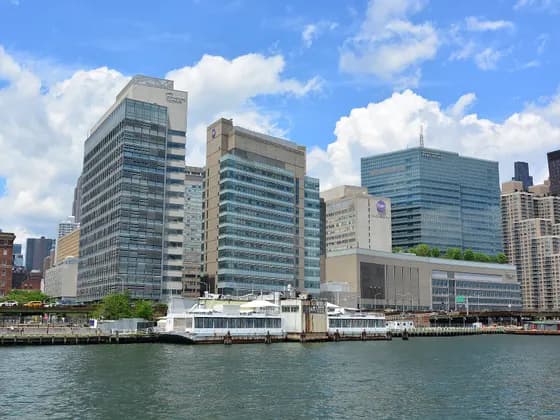

Photo: Joe Shlabotnik · CC BY 2.0 · cropped
Photo: Joe Mabel · CC BY-SA 4.0 · Photo: Diego Delso · CC BY-SA 4.0 · Photo: Dietmar Rabich · CC BY-SA 4.0
The NYU Grossman School of Medicine MD program at a glance (2027 entry)
NYU Grossman School of Medicine is the medical school of NYU Langone Health. Its campus is at 550 First Avenue in Midtown Manhattan, in a biomedical corridor along the East River. About 100 students started the MD in July 2026. The Liaison Committee on Medical Education (LCME), which accredits US MD programs, lists the program as fully accredited, with its next survey due in 2030-31.
The curriculum is called C21, short for Curriculum for the 21st Century: Personalized Pathways. The school began offering a three-year MD to selected students in 2013, and a May 2026 NYU Langone release says three years became the standard for all students in 2023. That release calls the curriculum C21: 3+1 Personalized Pathways; the fourth year is optional, for research or a dual degree.
The program has three stages. Stage one is an 11-month preclerkship year, the classroom-based phase before full-time clinical work, built largely around the body's organ systems. Stage two is the clerkship year: from August of year 2 you rotate through clerkships, the core clinical rotations, on hospital teams. Stage three is individualized exploration, with senior rotations, electives, a scholarly project and residency interviews.
Patients come early, and anatomy is taught differently. A clinical skills module takes you to the bedside throughout year 1, and anatomy comes from scans, 3D prints and virtual reality instead of routine dissection. Most rotations are at NYU Langone hospitals, NYC Health + Hospitals/Bellevue and the Department of Veterans Affairs (VA) NY Harbor Healthcare System. These sit close to the school on Manhattan's East Side, with some rotations at NYU Langone's Brooklyn hospital.
Since fall 2018 every MD student has received a Full-Tuition Scholarship, with no application, as long as they make satisfactory academic progress. The aid pages say it covers full tuition, and the admissions page says most of the cost of attendance; fees and living costs are listed separately, with need-based Debt-Free Scholarships for those who qualify.
| Degree | MD, fully accredited by the LCME; next survey 2030-31 |
|---|---|
| Program length | 3 years since 2023, plus an optional Plus One fourth year |
| Class size | About 100 students started in July 2026 (Class of 2029) |
| Main campus | 550 First Avenue, Midtown Manhattan, the same address as Tisch Hospital |
| Teaching style | Integrated organ-system modules in year 1, graded pass/fail |
| Anatomy | No routine dissection: scanned cadavers, 3D prints, VR and imaging |
| First patient contact | Year 1, in bedside Foundational Clinical Skills sessions |
| Clerkships | From August of year 2, in four 10-week blocks set by lottery |
| Clinical sites | Tisch, Kimmel Pavilion, Bellevue, the VA and NYU Langone Hospital—Brooklyn |
| Step 1 timing | Usually after the clerkship year, with Step 2 CK; before any Plus One year |
What makes the NYU Grossman School of Medicine MD program different
Three years for everyone, with an optional fourth
Every student now finishes in three years unless they choose more time. A Plus One year between the clerkship year and the final stage lets you earn an NYU master's degree or spend 9 to 12 months on research. It is also the only route to an MD with honors.
A conditional path into an NYU Langone residency
On the Three-Year MD Directed Pathway you commit to a specialty early and do your summer research in that department. If you meet graduation standards, you are ranked to match into that NYU Grossman residency through the National Resident Matching Program, the national system that pairs graduates with residency programs. If you rank it too, you match there.
Anatomy from scans, 3D prints and virtual reality
Living Anatomy replaced routine cadaver dissection with scanned cadavers, digital atlases, 3D prints and CT and MRI images. Radiologists and NYU Langone surgeons are among the teachers.
Bellevue, the VA and Kimmel Pavilion a few blocks apart
Rotations move between NYU Langone's own hospitals, public Bellevue and the VA. The Class of 2026 speaker described Bellevue as a few blocks from Kimmel Pavilion, and the VA as a few blocks further on.
A simulated night on call before graduation
In stage three, the Senior Clinical Skills Exam casts you as the intern for a night on call in the simulation center. You evaluate patients, work with colleagues inside and outside your team, document your care and weigh evidence for decisions. Written feedback then sets out strengths and gaps to work on before residency.
How NYU Grossman School of Medicine teaches medicine
Stage one is built from interdisciplinary modules rather than separate subject courses. In Organ Systems, for example, each block covers one system's physiology, pathology and disease mechanisms together, and shows how disease in one system affects the others. The school describes its teaching as patient-centered and disease-focused, linking classroom science to real clinical problems.
Clinical skills are taught alongside the science, not after it. The Foundational Clinical Skills module runs all year, joining class and lab topics to bedside sessions on diagnosis, clinical reasoning and communication. One student profile on the school's site describes studying how cystic fibrosis damages the body and then working with a patient who has it.
From year 2 the setting moves to the wards. The school says daily patient contact, online and simulation exercises at NYSIM, the New York Simulation Center for the Health Sciences, and progress assessments reinforce the science from then on. Two short Integrated Clinical Skills sessions break up the clerkship year, and stage three adds an Advanced Clinical Skills module from July to May.
The ways you will learn
| Lectures | Lectures introduce the core science of each module. In Living Anatomy they cover the body's structures and spaces and how they relate. Radiology faculty add lectures on imaging in lung, gut and nervous system disease. |
|---|---|
| Small-group cases and team-based learning | Living Anatomy uses case discussions to apply anatomy to clinical problems, and radiology runs small-group case sessions. The Brain and Behavior module adds team-based learning exercises, in which small teams work through problems together. |
| Bedside sessions | Foundational Clinical Skills pairs classroom topics with bedside teaching through year 1. In Brain and Behavior, psychiatry residents lead small-group patient interviews, and supervised small groups visit inpatient psychiatry units. |
| Simulation and standardized patients | At NYSIM you practice with simulators and with standardized patients, people trained to play patients and give feedback; the school employs more than 130 of them. The Integrated Clinical Skills sessions and the senior night on call both use simulation. |
| Clerkship teams | On clerkships you work with attending physicians, residents and fellows on the wards and in clinics. You present patients, write notes, gather lab and imaging results and help plan care, and you might assist at a delivery, close incisions at the end of an operation or place an intravenous line. |
How anatomy is taught at NYU Grossman School of Medicine
Gross anatomy, the study of the body's structures, is taught in Living Anatomy. It runs from mid-September to mid-October of year 1, and the radiology department describes it as four weeks long. The module moves through the body's regions and systems, linking each structure to how it develops in the embryo and how it appears on medical imaging.
Current school pages say students learn gross anatomy without dissecting human cadavers. Instead you study photorealistic scanned cadavers and specimens and digital atlases, handle 3D-printed models of difficult structures, and work through virtual and augmented reality exercises built by faculty. Radiologists supply CT and MRI images and 3D renderings, and NYU Langone surgeons lecture on how they use anatomy.
You get access to PACS, the picture archiving and communication system clinicians use to view scans, and radiology-based tasks tie imaging findings to the anatomy covered in lab. Formative case discussions, which give feedback without counting toward a grade, apply each region to clinical problems.
Dissection survives as an option. The Office of Medical Education runs a two-week Clinical Anatomy Dissection elective in March, April and May, with eight places per period. A two-week Anatomy Lab Teaching Assistantship in October takes four students at a time. A 2019 school article, written as the change began, said some cadavers were kept for demonstration and plastinated specimens, preserved with plastic resins, were added.
When you first meet patients at NYU Grossman School of Medicine
Your first patient contact comes in year 1, in the bedside sessions of the Foundational Clinical Skills module, which runs through the whole preclerkship year. Teaching stresses care that responds to each patient's needs, preferences and values.
Psychiatry adds early time on the wards. During Brain and Behavior, supervised small groups visit inpatient psychiatry units at Bellevue, NYU Langone and the VA NY Harbor Healthcare System, months before clerkships begin. There you practice psychiatric interviewing, history taking, the assessment of psychiatric symptoms and the mental status examination, a structured check of mood, thinking and behavior. Psychiatry residents also lead small-group patient interviews.
Full-time clinical work starts with the clerkship year in August of year 2, after a one-week Transition to Clerkships course on what a medical team expects of you. Responsibility then builds. In stage three you take an acting internship, a senior rotation at close to intern level, where you may take overnight call, admit patients and enter orders.
Year by year at NYU Grossman School of Medicine
- Stage one (year 1)
Preclerkship: foundations, anatomy and organ systems
Stage one is 11 months of interdisciplinary modules covering the biology, anatomy, physiology and disease mechanisms you need for clerkships, with clinical skills taught alongside. All modules are graded pass/fail. On the 2026-27 calendar it runs from July 13, 2026 to June 27, 2027, with a winter recess and two short spring recesses.
- Foundations of Medicine, July to mid-September: the basic science concepts that underpin clinical medicine.
- Living Anatomy, mid-September to mid-October: the body's regions and systems, taught with imaging and with digital and physical models.
- Organ Systems, mid-October through May: cardiovascular, pulmonary, kidney, dermatology, rheumatology, gastrointestinal, endocrine and reproductive medicine, neurology and psychiatry. The psychiatry department helps teach an interdisciplinary Brain and Behavior module in year 1.
- Foundational Clinical Skills, all year: bedside diagnosis, clinical reasoning, and communication and conflict-resolution techniques.
- Summer Research Fellowship: first-year students must apply. It runs six weeks at 35 hours a week, June into July, and the 2026-27 calendar books three weeks at the end of stage one and three at the start of stage two. One bulletin paragraph says eight weeks.
- Stage two (year 2)
The clerkship year
After a one-week Transition to Clerkships course in late July, you spend about 10 months, August to May, on core clerkships. They cover seven areas: medicine, ambulatory care, general surgery, obstetrics and gynecology, pediatrics, psychiatry and neurology. The rotations run in four 10-week blocks that include four weeks of elective time, in an order set by lottery.
- On the 2025-26 clerkship schedules, which the school labels Class of 2028, one block paired medicine I and II with ambulatory care. Another gave five weeks each to obstetrics and gynecology and pediatrics, though the obstetrics and gynecology department page describes a six-week clerkship.
- The other blocks were surgery (six weeks) with a four-week elective, and psychiatry (five), neurology (four) and a one-week Integrated Neuropsychiatry Experience. Schedules change each year, and none have been published for students entering in 2027.
- Core Medicine places you on medical services at the core teaching hospitals, and Ambulatory Care rotates you through outpatient settings. In neurology you have a dedicated preceptor, spend two days in the operating room with neurosurgery and practice lumbar punctures in simulation.
- Psychiatry includes a weekly half-day in outpatient clinics and on-call shifts in Bellevue's adult and children's psychiatric emergency programs and with NYU Langone's consultation-liaison service. Pediatrics adds an emergency department shift and weekly small-group sessions with a faculty preceptor.
- Integrated Clinical Skills sessions in October and March cover skills such as goals-of-care conversations, point-of-care ultrasound and patient handoffs. Web pages call them one-week sessions; the calendars show three days, October 12 to 14, 2026 and March 15 to 17, 2027.
- A shelf exam, a national subject test from the National Board of Medical Examiners (NBME), follows each clerkship except ambulatory care. The Comprehensive Clinical Skills Examination, a set of mock patient encounters, closes the year.
- Plus One (optional year)
A dual degree or a research year
A fourth year, if you choose one, sits between stage two and stage three. You sit Step 1 and Step 2 CK of the United States Medical Licensing Examination (USMLE) first. Then you spend the year on an NYU master's program or on research in a lab of your choice. On the 2026-27 calendar, Plus One students who entered in 2023 graduate in 2027.
- The MD/MBA runs with the NYU Stern School of Business and the MD/MPA with NYU's Robert F. Wagner Graduate School of Public Service. NYU's College of Global Public Health offers the MD/MPH in global health and the MD/MA in bioethics.
- The MD/MS in clinical investigation runs through the Clinical and Translational Science Institute, and the MD/MS in biomedical informatics through the Vilcek Institute of Graduate Biomedical Sciences.
- You apply to the master's program during year 2, after enrolling in the MD. NYU Stern takes MBA applications in the fall, and the informatics, clinical investigation and bioethics programs take theirs in the spring.
- Stage three (final year)
Individualized exploration
Stage three runs from July to early June and is built around your own choices: electives, advanced rotations, your scholarly project and residency interviews. The school's stage three page also places Step 1 and Step 2 CK here, and an Advanced Clinical Skills module runs from July to May.
- Critical Care Clerkship, four weeks: you join the team in a specialty intensive care unit, attend daily teaching rounds and help assess and treat critically ill patients.
- A four-week acting internship in advanced medicine, surgery or pediatrics; the surgery and pediatrics versions meet the requirement for students applying to surgical or pediatric residencies. The bulletin calls it a subinternship, and the Department of Medicine calls its version the Advanced Medicine Clerkship.
- Electives and advanced electives, counting toward the 24 weeks of electives the curriculum requires.
- Your eight-week scholarly project, ending in a research report.
- The Senior Clinical Skills Exam, a simulated night on call.
- A two-week Transition to Residency course of workshops, simulation and conferences, held March 1 to 14, 2027 on the current calendar.
How you are assessed at NYU Grossman School of Medicine
Stage one modules and general electives are graded pass/fail. Required clerkships, advanced electives and the scholarly project are graded honors, high pass, pass or fail. Your faculty advisor also guides an academic portfolio, a self-assessment of your foundational knowledge, clinical skills, professional development and research.
A clerkship grade combines supervisor ratings of knowledge, skills and professionalism, assignments such as patient write-ups, an end-of-clerkship OSCE and the shelf exam. An OSCE, or objective structured clinical examination, is a circuit of timed stations, each testing one task, often with a standardized patient. Each shelf has 110 questions in 2 hours 45 minutes and counts for 10% of the grade. You must pass it, and a first failure rules out honors.
The USMLE is the three-step exam series for a US medical license, and LCME accreditation is what makes you eligible to sit it as an MD student here. Step 1 tests basic science applied to medicine and has been reported only as pass or fail since January 26, 2022. Step 2 CK tests clinical knowledge and still receives a three-digit score.
School pages say all students take Step 1 and Step 2 CK after completing the clerkship curriculum. If you take a Plus One year, you sit both before it; the dual-degree timelines show the USMLE in the summer after year 2. The 2025-26 clerkship schedules also let students, with approval, use a clerkship-year block for Step 1.
In August 2026 the USMLE program announced a move to designated testing dates from January 2029, with Step exams offered less often each year. On the current schedule, a student entering in July 2027 would finish clerkships in May 2029 and sit both Steps from about June 2029, so both would normally fall under the new model. If the school still lets students use a clerkship-year block for Step 1, as the 2025-26 schedules did, a Step 1 taken there before January 2029 would come under today's year-round testing.
The registration office warns that Step 2 CK scores can take up to three months to arrive. It advises booking the exam early enough in your final year that the scores are back in time for graduation requirements.
- Surgery: written evaluations from attendings and senior residents make up 45% of the grade, alongside an OSCE and the shelf. A senior or chief resident gives ungraded feedback halfway through the inpatient weeks.
- Psychiatry: a psychopharmacology exam, a clinical reasoning exam, an OSCE and the NBME psychiatry subject exam.
- Pediatrics: a half-day OSCE, with preceptor feedback at the middle and end of the clerkship.
- Comprehensive Clinical Skills Examination: mock patient encounters at the end of the clerkship year, testing communication, history taking, physical examination and clinical reasoning. The 2025-26 schedules gave each student one half-day in early June.
- The satisfactory academic progress policy for financial aid, revised in June 2026, expects credit in 75% of attempted modules and rotations each year. Three-year students must finish within four and a half years.
Where you will actually train at NYU Grossman School of Medicine
The school describes its clinical training as spanning public, private and government health care: NYU Langone's own hospitals, the city's NYC Health + Hospitals system and the VA NY Harbor Healthcare System. The main sites sit close together on Manhattan's East Side.
Department pages show where each clerkship runs. Surgery uses Kimmel Pavilion, Bellevue and NYU Langone Hospital—Brooklyn, with four weeks on an inpatient service and two on an integrated surgical experience. Neurology is at Tisch Hospital or Bellevue, split evenly between inpatient and outpatient care, and obstetrics and gynecology uses Bellevue, Tisch and the Brooklyn hospital.
Pediatrics spends three weeks on inpatient units at Hassenfeld Children's Hospital, Bellevue or the Brooklyn hospital. There is also a week in a low-risk newborn nursery at Bellevue or Tisch and a week in primary care clinics at Bellevue, Gouverneur and affiliated private practices. Psychiatry places you on inpatient units at NYU Langone, Bellevue or the VA, with adult and adolescent services.
NYU Langone Hospital—Brooklyn is the only core site outside Manhattan named on the clerkship pages. The school's site list also includes NYU Langone Hospital—Long Island, a 591-bed hospital in Mineola.
The main teaching hub. Tisch has more than 350 beds and 66 operating rooms, Kimmel Pavilion has 374 single rooms and 30 operating rooms and image-guided labs, and NYSIM sits inside Bellevue.
- Tisch Hospital, 550 First Avenue
- Kimmel Pavilion, 424 East 34th Street
- Hassenfeld Children's Hospital—34th Street, on floors of Kimmel Pavilion
- NYC Health + Hospitals/Bellevue, 462 First Avenue
- VA NY Harbor Healthcare System, whose Manhattan campus is at 423 East 23rd Street
- NYU Langone Orthopedic Hospital, 301 East 17th Street
- Laura and Isaac Perlmutter Cancer Center
- Rusk Rehabilitation, with inpatient programs at Tisch and the Orthopedic Hospital
A 295-bed skilled nursing facility with onsite clinics; pediatrics students see children in its primary care clinics.
- NYC Health + Hospitals/Gouverneur, 227 Madison Street
Used for surgery, obstetrics and gynecology and inpatient pediatrics. Its emergency department is an American College of Surgeons Level 1 trauma center.
- NYU Langone Hospital—Brooklyn, 150 55th Street
On the school's list of affiliated training sites, outside New York City.
- NYU Langone Hospital—Long Island, 259 First Street
Electives, selectives and away rotations at NYU Grossman School of Medicine
Electives are two- to four-week courses you choose yourself, taken in the clerkship year and after it. The curriculum requires at least 24 weeks of them, and eight of those weeks must be in clinical areas unrelated to your expected specialty, so you sample other fields before residency. General electives are pass/fail; advanced electives are graded honors to fail.
The catalog covers 24 clinical areas, from anesthesiology, dermatology and emergency medicine to forensic medicine, gross anatomy, radiation oncology and urology. With a faculty mentor and approval from the associate dean for curriculum, you can design an individual preceptorship, research or service-learning elective. Places are allocated by lottery twice a year, and you can drop or change an elective up to 45 days before it starts.
Away electives, often called away rotations, are electives at another US medical school or teaching hospital. At schools accredited by the LCME or the Commission on Osteopathic College Accreditation (COCA), you apply through VSLO, the Visiting Student Learning Opportunities service run by the Association of American Medical Colleges (AAMC). Elsewhere you apply directly.
Some departments run selectives and their own electives. Radiology's four-week selective pairs mornings on the clinical service with afternoon teaching, and two-week radiology electives follow for students who have taken it. Psychiatry's electives and advanced electives usually last four weeks, in areas such as consultation-liaison, addiction and forensic psychiatry.
Global Health Initiatives, whose International Health Program dates from 2002, supports work abroad. Research projects abroad need at least six weeks in the field, often in the summer after year 1. Clinical electives abroad need approval for credit, at least 35 hours a week and an application three months ahead, and only research electives abroad can be funded. A global health concentration adds a four-week global health selective, eight weeks of field research and a scholarly project.
Dual degrees and research years at NYU Grossman School of Medicine
Every student does mentored research through the Areas of Concentration, a research program that runs across the curriculum. Its five areas are biomolecular medicine; clinical and translational research; healthcare innovations and health systems science; data-driven medicine and technology; and population, global health and public policy. Its two core parts are the Summer Research Fellowship after year 1 and a scholarly project later on.
On the three-year track the scholarly project is eight weeks of research ending in a research report, and a first-author publication can add Research Distinction. Afterward you assess how the project built your professionalism, literature reading, hypothesis and study design, and technical skills such as data analysis. Some department pages still describe a 12-week scholarly concentration, a length the Areas of Concentration page gives for the four-year track of the Classes of 2025 and 2026.
The Plus One year goes further. In a dual degree, your master's capstone counts as the scholarly project. A research year means 9 to 12 months of research and a written manuscript draft. Either track lets you apply for honors with an oral defense, and the MD with honors, which dates from 1957, is open only through these Plus One tracks.
The six master's degrees differ in size. The MBA has 51 credits, the MPA 45, the MPH 40, the MS in biomedical informatics 34, the MA in bioethics 32 and the MS in clinical investigation 31. Some medical school credits count toward the MPA and the MBA, and the MBA waives the GMAT or GRE for dual-degree applicants.
The tuition scholarship covers only the years you are a full-time MD student. In master's semesters the graduate school charges its own tuition, and research years are not covered.
For physician-scientists, the MD/PhD runs through the Vilcek Institute as a Medical Scientist Training Program recognized by the National Institutes of Health. You take Step 1 and Step 2 CK before starting graduate school. The school's MD/PhD program dates from 1964.
Facilities and support at NYU Grossman School of Medicine
Where you will learn
The Medical Science Building at 550 First Avenue holds the Office of Medical Education, the registration office and, on its ground floor, the Sid and Ruth Lapidus Health Sciences Library. The school also lists the Science Building, the Joan and Joel Smilow Research Center and the Martin Kahn Teaching and Learning Center among its centers of education and research.
NYSIM is a 25,000-square-foot simulation center on the third floor of Bellevue Hospital, run jointly with the City University of New York (CUNY). Its own site reports more than 50,000 learner visits since it opened in September 2011, from NYU and CUNY medical, nursing and dental programs and others. OSCE sessions there are recorded in its learning system so videos can be reviewed afterward.
The Institute for Innovations in Medical Education, founded in 2013 and now staffed by more than 30 people full time, builds digital tools for teaching, including Living Anatomy's 3D and virtual reality content. A Winter 2025 school article describes the school's Precision Education approach: AI-based tools, diagnostic practice with algorithms built on de-identified patient data, and an app that lets you shadow faculty in any specialty.
Housing is close by. NYU Langone says its student housing is near the medical center on Manhattan's East Side, and single students are guaranteed housing when they first enroll. MD students are eligible for Jan and Marica Vilcek Hall at 334 East 26th Street, with shared two- or four-bedroom suites and studios, and a spring lottery handles moves for the following year.
Support while you study
Advising runs through the Violet Society Program, the school's version of learning communities: advisory groups that stay with you from orientation to graduation. At orientation you are randomly assigned to one of four societies and to one of its three faculty advisors, whose advisor group mixes students from every class year.
You meet your advisor one-on-one several times a year. Advisors hold no administrative posts and do not assess students. They guide your academic portfolio and specialty choice, and later work with departmental advisors in your intended field on your residency application. Each advisor group has two final-year peer mentors, each leading a smaller family of students.
The Office of Student Affairs runs career advising, wellness programs, academic events and student life. The Student Health Service at 334 East 25th Street gives free primary care, apart from some immunizations, from clinicians who play no part in teaching or grading. Its mental health service offers free, confidential short-term counseling, medication management and group therapy, with referrals for longer-term care.
Outside the curriculum, the Humanistic Medicine Program runs noncredit seminars, the arts and literature magazine Agora and mock clinical ethics workshops, and offers humanities or bioethics projects as a Summer Research Fellowship.
Is the NYU Grossman School of Medicine program right for you?
This program may suit you if
- You want to finish medical school in three years and start residency sooner.
- You already know your specialty and would value a conditional route into an NYU Langone residency through the directed pathway.
- You are happy to learn anatomy from scans, 3D prints and virtual reality rather than routine dissection.
- You want rotations that move between private NYU Langone hospitals, public Bellevue and the VA, mostly close to campus.
- You want the option of a fourth year for a master's degree or full-time research.
Things to think about
- The pace is compressed: 11 months of preclerkship modules, clerkships from August of year 2 and residency interviews in your final year.
- If hands-on dissection matters to you, it is only available as a two-week elective with eight places per period.
- Your clerkship order comes from a lottery, and the schedules change every year.
- On the current schedule both Step exams would usually fall after the USMLE's January 2029 switch to designated testing dates, when Step exams will be offered less often each year.
NYU Grossman School of Medicine MD program — frequently asked questions
Applying to NYU Grossman School of Medicine?
How to get into NYU Grossman School of Medicine
Prerequisites, MCAT, AMCAS personal statement, secondaries and interview, step by step.
Open the guide →NYU Grossman School of Medicine admissions profile
MCAT and GPA profile, acceptance rate, interview format and key dates.
See the profile →Compare NYU Grossman School of Medicine with other schools
Put the teaching style, anatomy teaching and clinical sites next to another school.
Open the comparison →Prepare for the NYU Grossman School of Medicine interview
Format breakdown, school-specific sample questions and prep tips from tutors who interviewed here.
Read the guide →Where this NYU Grossman School of Medicine program guide came from
This guide was written from 85 official sources — NYU Grossman School of Medicine's own program pages and curriculum documents, plus the accreditor and the hospitals and health systems the school trains students in where they publish detail — read on 2026-10-10, then checked claim by claim against those sources.
- NYU Grossman School of Medicine: MD Curriculum (C21)
- NYU Grossman School of Medicine: MD Admissions
- NYU Grossman School of Medicine: MD Degree, with LCME accreditation statement
- NYU Bulletins 2026-2027: Medicine (MD)
- NYU Bulletins 2026-2027: NYU Grossman School of Medicine Academic Policies
- NYU Bulletins 2026-2027: NYU Grossman School of Medicine overview
- Stage One: Preclerkship Curriculum
- Stage Two: Clerkship Year
- Stage Three: Individualized Exploration
- MD Degree Areas of Concentration
- MD Degree Elective Courses and away electives
- MD Elective Catalog
- Office of Medical Education Elective Catalog (anatomy electives)
- MD Lotteries
- MD Registration and Student Records
- MD Academic Calendar 2026-27
- Possible Clerkship Palette Schedules, Class of 2028: the 2025-26 clerkship year (text version)
- Class of 2028 10-week block clerkship palettes, August 2025 to May 2026 (graphic version)
- Possible Clerkship Palette Schedules, Class of 2027: the 2024-25 clerkship year (older)
- Department of Surgery: Surgical Core Clerkship
- Department of Neurology: Medical Student Education
- Department of Psychiatry: Training for Medical Students
- Department of Obstetrics and Gynecology: Medical Student Education
- Department of Pediatrics: Pediatrics Clerkship
- Department of Medicine: Education for Medical Students
- Three-Year MD Directed Pathway
- Direct Progression to an NYU Grossman School of Medicine Residency
- How to Apply to the MD Program (three-year pathway and dual degree sections)
- About NYU Grossman School of Medicine
- NYU Langone News, May 19, 2026: Graduation 2026
- NYU Langone News, July 13, 2026: Class of 2029 White Coat Ceremony
- NYU Langone Health News, Winter 2025: Our Three-Year MD Graduates Are More Than Ready for Residency
- Plus One MD Dual Degree Program
- MD/MPA in Health Policy and Management
- MD/MPH in Global Health
- MD/MS in Biomedical Informatics
- MD/MS in Clinical Investigation
- MD/MA in Bioethics
- MD/MBA in General Management
- MD Student Honors Program
- Global Health Initiatives for MD Students
- Global Health Study Abroad Opportunities for MD Students
- Humanistic Medicine Program
- Violet Society Program for MD Students
- Office of Student Affairs
- Medical Student Health and Wellness Services
- Mental Health Services for Medical Students
- Satisfactory Academic Progress policy, 3-year and 4-year programs (revised June 2, 2026)
- Affordability and Financial Aid for MD Students
- Types of Financial Aid for MD Students
- Cost of Attendance 2026-27
- Life at NYU Grossman School of Medicine (campus location)
- Life as a Medical Student (student profiles)
- NYU Grossman School of Medicine: Contact Us
- NYU Langone Housing
- NYU Langone Housing Map
- Housing for MD and MD/PhD Students: Vilcek Hall
- Institute for Innovations in Medical Education: Virtual and Augmented Reality (Living Anatomy)
- Department of Radiology: Training for Medical Students
- NYU Langone News and Views, Summer 2019: Can You Teach Anatomy Without Cadavers (older)
- Institute for Innovations in Medical Education
- NYSIM: About
- NYSIM: Partners and History
- NYSIM: Standardized Participant and OSCE Programs
- NYU Health Sciences Library: Locations
- Office of Medical Education
- Clinical Training Sites for MD Students
- NYU Langone Health: Tisch Hospital
- NYU Langone Health: Kimmel Pavilion
- NYU Langone Health: NYU Langone Orthopedic Hospital
- NYU Langone Health: NYU Langone Hospital—Brooklyn
- NYU Langone Health: NYU Langone Hospital—Long Island
- NYU Langone Health: Rusk Rehabilitation
- VA New York Harbor Health Care
- VA New York Harbor Health Care: Margaret Cochran Corbin VA Campus
- NYC Health + Hospitals/Bellevue
- NYC Health + Hospitals/Gouverneur
- LCME directory of accredited programs (updated July 22, 2026)
- USMLE: Designated Testing Dates transition will take place in January 2029
- USMLE: Designated Testing Dates Information Hub (January 2029 announcement dated August 6, 2026)
- USMLE: Designated Testing Dates FAQs (updated August 6, 2026)
- USMLE: Step 1
- USMLE: Step 2 CK
- USMLE: Step 1 pass/fail score reporting implementation date
- USMLE: Examination Results and Scoring
Curricula are restructured between cycles. Anything here that decides your application — how anatomy is taught, a clinical campus assignment, a required research year — should be confirmed against the official page for your entry year.
Applying to NYU Grossman School of Medicine?
We help US applicants with MCAT strategy, the AMCAS personal statement, secondary essays and interview prep — everything you need for a competitive NYU Grossman School of Medicine application.