
The Vanderbilt University School of Medicine MD program
What you actually study, and where you will be
Vanderbilt University School of Medicine's MD is a 4-year program taught through case-based learning in an integrated curriculum, with patient contact from Year 1 and clinical rotations in the greater Nashville area (2027 entry). The program runs in three phases. About 13 months of science, taught largely through clinical cases in small groups, come first, then a year of six core clerkships. The final two years form the Immersion Phase, which you build from advanced rotations, science courses, an acting internship and at least three months of research. You meet hospital patients in your first weeks.
- Degree
- MD
- Length
- 4 years
- Teaching
- Case-based learning + Integrated
- Clinical contact
- Year 1


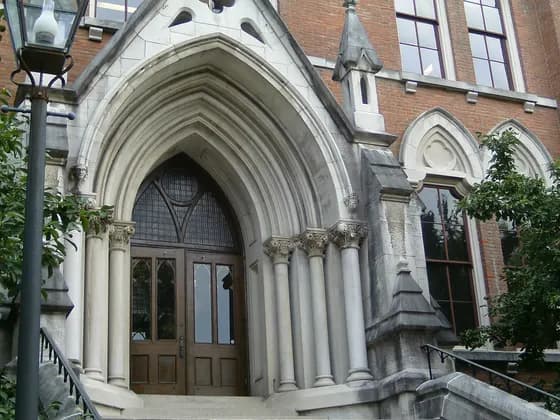
Photo: Stablenode · CC BY-SA 4.0 · cropped
Photo: Vortex895 ( talk ) · Public domain · Photo: Jbaker08 · Public domain · Photo: Warren LeMay from Chicago, IL, United States · CC BY-SA 2.0
The Vanderbilt University School of Medicine MD program at a glance (2027 entry)
Vanderbilt University School of Medicine's four-year MD is taught in Nashville. Classes meet in the Eskind Biomedical Library and Learning Center on the campus of Vanderbilt University Medical Center (VUMC), a short walk from its main hospitals. The school calls its curriculum the MD Curriculum on the web and C2.0 in its catalog; a 2024 school story spells this out as Curriculum 2.0, launched in 2013.
Foundations of Medical Knowledge, the pre-clerkship (pre-clinical) phase of mostly classroom and lab learning, lasts about 13 months and is taught largely through clinical cases in small groups. Foundations of Clinical Care (FCC), in year 2, holds the core clerkships, the full-time rotations in the main specialties. Years 3 and 4 are the Immersion Phase, a menu of advanced rotations, science courses and research that you schedule around your goals.
Patients appear early: within weeks you interview and examine hospital patients under a faculty teacher's supervision. A four-year doctoring course, Foundations of Physician Responsibility (FPR), runs alongside the science, built on four responsibilities: to your own development, to patients, to the health care team and to improving the health system.
Research runs through all four years, ending with at least three months of full-time mentored research. The first two phases are pass/fail, and most Immersion courses are graded Honors, High Pass, Pass or Fail. Throughout, a faculty portfolio coach helps you turn feedback and assessment results into your own learning goals.
| Degree | MD |
|---|---|
| Program length | 4 years in three phases; a research year or dual degree adds time |
| Entering class (2026) | 82 MD and 16 MD/PhD students entered in July 2026 |
| Main campus | Eskind Biomedical Library and Learning Center, VUMC campus, Nashville |
| Teaching style | Case-based groups of 8 or 9, with lectures, team-based learning and labs |
| Anatomy | Gross anatomy dissection in year 1 |
| First patient contact | First weeks of year 1, examining hospital patients with a faculty teacher |
| Clinical sites | VUMC hospitals, Nashville Veterans Affairs hospital, community clinics; travel up to 35 miles |
| Licensing exams (USMLE) | Step 1 or 2 CK before Immersion; the other by February 1, final year |
| Grading | Pass/fail in years 1–2; Honors, High Pass, Pass or Fail in most Immersion courses |
What makes the Vanderbilt University School of Medicine MD program different
Clerkships done in year 2, then two years to shape
With all six core clerkships finished in year 2, the Immersion Phase gives you two years to plan. It requires 15 four-week blocks of set types, but you choose the courses, their order and focus. Seven flex months cover study for the United States Medical Licensing Examination (USMLE), residency interviews and time of your own.
A required research path that ends in a paper
Every year includes research: Clinical Applications of Scientific Evidence (CASE) in year 1, Discovery in year 2, then a one-month planning course, PLAN. At least three months of full-time, graded research follow, ending in a paper ready to submit for publication.
Bedside coaching from Master Clinical Teachers
In every clerkship a Master Clinical Teacher, a physician selected for the role, watches you see a patient from start to finish every two to three weeks and gives immediate feedback. You can ask for help with whatever you find hardest, from the history to hearing heart murmurs. Three more sessions follow in years 3 and 4.
100 Vital Experiences logged on the way to graduation
The school lists 100 Vital Experiences, diagnoses, skills and procedures from a well-child visit to a vaginal delivery, and logging them is a graduation requirement. In year 2 you log at least 40 per eight-week block, and logging too few of a clerkship's own experiences can mean failing it.
Integrated science courses in the clinical years
At least four of your Immersion blocks are Integrated Science Courses, which pair foundational science with work on clinical teams. Critical Illness opens with a simulation-based Critical Care Skills Week and includes a week in an intensive care unit (ICU); Emergency Care adds cadaver-based procedure labs and ultrasound shifts.
How Vanderbilt University School of Medicine teaches medicine
Learning in the pre-clerkship phase centers on clinical cases. On Monday, Wednesday and Friday mornings your group of eight or nine students meets a faculty facilitator to review a case linked to the current block and discuss possible diagnoses and treatments. You research the gaps on your own, then piece the clues together to reach a final diagnosis.
Lectures, team-based learning and labs fill the other scheduled sessions. General lectures are optional unless a course says otherwise, but the school strongly encourages them, since many topics are taught only in lectures and many exam questions draw on them. Small groups, labs and exams are compulsory.
In year 2 teaching moves onto the wards, where each clerkship runs its own rounds, conferences and case discussions. Twice in every eight-week block the class reunites for an FCC Longitudinal Day. You spend 90 minutes in a small group on a patient case whose problems, such as housing insecurity, cross specialties, and hear a 60-minute talk. Then you debrief for 90 minutes with your college, one of four advisory groups you join at orientation.
In the Immersion Phase, Integrated Science Courses mix classroom and clinical learning and are expected to use active methods, such as simulation and team-based or case-based learning, rather than traditional lectures. Advanced clinical experiences (ACEs) are month-long rotations in one specialty. In an acting internship, also called a sub-internship, you work at the level of an intern, a doctor in the first year of residency.
The ways you will learn
| Team-based learning | You prepare beforehand, 30 minutes to an hour by the school's estimate, by reading, watching videos or completing online modules, then apply it in teams during the session. |
|---|---|
| Laboratory sessions | Each organ-system block includes labs on gross and microscopic anatomy and pathology, held in places such as Medical Center North and the Institute of Imaging Science building. |
| Simulation with standardized patients | In the Center for Experiential Learning and Assessment (CELA), standardized patients, people trained to portray patients and relatives, let you practice interviews and examinations, with recorded encounters you and your teachers can review. |
| Physical diagnosis | Part of FPR: Patient Care. You learn history-taking and examination system by system, in step with the science blocks, through guest experts' talks, simulation and supervised practice with patients. |
A typical week on the Vanderbilt University School of Medicine program
The school's sample first-year week runs 8 a.m. to noon and 1 to 5 p.m. Monday and Wednesday mornings open with your case-based group, then a large or medium group session or lab; on Friday the case group is followed by Learning Communities, discussions led by your college mentors. Tuesday and Thursday mornings hold group sessions or labs.
Afternoons in the sample: Monday is clinic, Tuesday starts with physical diagnosis, Wednesday and Thursday are for self-directed learning, and Friday has a group session or lab, then physical diagnosis. Clinic and hospital bedside sessions come about once a month each, not weekly (2025-26 faculty guide). Required first-phase activity is capped at 30 hours a week, counting preparation such as two hours for each case.
- About once a month, Wednesday afternoons bring interprofessional sessions with nursing, pharmacy, counseling, marriage and family therapy, and social work students (2025-26 faculty guide).
- Up to three personal days are allowed in the first phase, one per block at most, but not for exams, first days or the last class before a block exam.
- The Medical Scientist Training Program (MSTP), the MD/PhD program, posts a similar sample week with a Wednesday lunchtime seminar and a Thursday afternoon continuity clinic.
How anatomy is taught at Vanderbilt University School of Medicine
Anatomy is taught within the science blocks rather than as a separate course. Human Blueprint & Architecture introduces it. Homeostasis, Renal & Digestion and Reproduction & Endocrine include labs on the gross and microscopic anatomy of their organ systems, and Brain, Behavior & Movement covers the nervous system.
The Year 1 page names gross anatomy dissection as part of the first year, and anatomy faculty must have experience teaching in a gross anatomy lab. The MSTP's sample week shows two-hour anatomy or histology labs on Tuesday and Thursday mornings in groups of four or five. Cadavers for anatomical teaching come through Vanderbilt's Anatomical Donation Program, from donors in the middle Tennessee region.
The Gross Anatomy Lab, added in 2007 mainly for medical students' initial training, fills the tenth floor of the Vanderbilt Imaging Building. Each of its 27 workstations has lights, cameras and a 37-inch high-definition monitor, and demonstrations can be shown on every screen.
Anatomy returns later, starting with a neuroanatomy quiz in the neurology clerkship. Years 3 and 4 offer a Medical Imaging and Anatomy course, cadaver-based procedure labs in Emergency Care and, in an elective for future surgeons, operative anatomy through cadaveric dissection.
When you first meet patients at Vanderbilt University School of Medicine
Patient contact begins within weeks through FPR: Patient Care. With a Clinical Skills Teacher from the Department of Medicine, you interview and examine patients admitted to VUMC or the Veterans Affairs (VA) hospital. The 2025-26 faculty guide plans about a dozen two-hour sessions a year, plus practical exams in January and July.
You also have an outpatient clinical home, a preceptor's clinic that the same guide schedules about 12 times over the year. You start by shadowing, then take histories, examine patients, present your findings and join discussions about diagnoses and next steps. Standardized patients in CELA give you practice and feedback alongside.
Shade Tree Clinic, a free clinic that medical students have run since 2004 for uninsured and underinsured people in the Nashville area, offers more patient contact. Pre-clerkship students volunteer as interpreters and patient health educators; second- to fourth-years run the clinic and its outreach.
From year 2 you work full time on clinical teams. Required clinical and educational work is then capped at 80 hours a week, with one day off in seven, in line with national guidelines for residents.
Year by year at Vanderbilt University School of Medicine
- Year 1
Foundations of Medical Knowledge
In 2026-27 the phase runs from orientation on July 13, 2026 to July 23, 2027, with breaks; the catalog counts 49 weeks. Six science blocks follow one another, each ending in a pass/fail exam, with the first year of FPR (FPR1) and CASE, the first research course, alongside.
- Foundations of the Profession, in July: medicine's history and social context, its values and ethics, and challenges such as disparities, quality and safety, ending with the White Coat Ceremony.
- Human Blueprint & Architecture and Microbes & Immunity, about six weeks each: molecules, cells and tissues in health and disease, first steps in anatomy and pharmacology, then immunity and infection.
- Homeostasis (heart, lungs, blood), Renal & Digestion (kidneys, gut, liver) and Reproduction & Endocrine, including pregnancy: normal function, then disease, diagnosis and treatment.
- Brain, Behavior & Movement, the longest block, covers neuroscience and neuropsychiatric disorders and trains you in the psychiatric interview and neurological exam.
- On the 2026-27 calendar the blocks run about 6, 6, 8, 8, 8 and 12 weeks; the 2025-26 faculty guide describes them as 8 or 12.
- Year 2
Foundations of Clinical Care: the core clerkships
Year 2 opens with FCC Launch Week, a week of radiology and lab sessions, skills workshops and case competitions. Five eight-week blocks follow, holding the six core clerkships and two two-week electives, 41 weeks in total, all graded pass/fail.
- Internal medicine, 8 weeks at the Vanderbilt and VA hospitals: five inpatient weeks on general medicine or subspecialty teams, working as an apprentice physician, with daily rounds and weekly core lectures.
- Surgery, 8 weeks by the Year 2 page and the school's 2025 curriculum chart, which fits the 41-week phase; the catalog's course text, a 2017 record, still says 10. Most time is inpatient, on wards and in the operating room.
- Pediatrics, 6 weeks. The Year 2 page gives two weeks on the children's hospital wards, two outpatient (clinics, Meharry Hospital or community sites) and two mixed. A 2023 catalog text instead lists one week each of wards and newborn nursery, two of a subspecialty and two outpatient.
- Obstetrics and gynecology, 6 weeks: two on labor and delivery, including night shifts, two on a gynecologic surgical service and two in clinics, usually all at VUMC.
- Neurology and psychiatry, 4 weeks each, paired in one block. Neurology rotates through stroke, general and consult services and clinics; psychiatry has two two-week inpatient rotations, an outpatient experience and two 4-hour emergency psychiatry shifts.
- Two two-week electives share blocks with pediatrics and with obstetrics and gynecology. Family medicine and emergency medicine are not core clerkships. Both are optional two-week electives in year 2 and among the choices for the primary care and acute care blocks required in years 3 and 4.
- Year 3
Step study, then the Immersion Phase
Year 3 begins with a mandatory two-month Step study period in July and August. Across years 3 and 4 the Immersion Phase holds 15 required four-week blocks plus seven flex months, which count the two Step months and an interview month in December of year 4. In the school's 2025 example, year 3 holds three integrated science courses, three ACEs, PLAN and a long research block.
- Requirements (catalog, approved May 15, 2026): four ACEs, four integrated science courses, one acting internship, three research months and three rotations of your choice. One block must be in primary care and one in acute care.
- FPR3: Immersion Weeks in August and March on population health, patient safety and communication. Learning Communities continue as FPR: Self sessions with college mentors on some Monday afternoons, eight units across FPR3 and FPR4. Clinical Skills Anchors are CELA simulations on some Tuesday afternoons, six in all.
- Leading Systems Change 1, a self-paced project: you pick a problem, such as quality improvement in a specialty, education, policy or community health, and design solutions with systems thinking.
- The 2025 chart predates the 2026-27 catalog. Its separate Learning Communities and Foundations of Health Care Delivery courses now apply only to the class graduating in 2027; later classes cover that ground in FPR3, FPR4 and Leading Systems Change. You may register for up to 19 months of Immersion courses.
- Year 4
Acting internship, residency applications and graduation
In the school's example, year 4 holds the acting internship, an away rotation (a clinical rotation at another medical school or hospital), an ACE, a final integrated science course and flex months. You apply for residency in the fall and keep December free for interviews. In February the school certifies who can enter the Match, the national system that pairs graduating students with residency programs; commencement is in May.
- The acting internship, four weeks on an inpatient team between February and October. The course directors' handbook suggests building from two or three patients to six to eight; you write notes, enter orders under resident oversight, give handovers and take nights, weekends and holidays on call.
- FPR4 and Leading Systems Change 2: Immersion Weeks on residency readiness and on health economics and policy, more FPR: Self sessions and Clinical Skills Anchors, and a finished improvement project shown as a poster.
- Deadlines in the final year: the remaining Step exam by February 1, research finished by the end of February, and all 100 Vital Experiences covered before the end of block 2 of that year.
How you are assessed at Vanderbilt University School of Medicine
Assessment is competency-based across six domains: patient care, knowledge for practice, practice-based learning and improvement, interpersonal and communication skills, systems-based practice, and professionalism. Exams, observed encounters, narrative comments and workplace-based assessments, quick ratings you request from supervisors who watched you work, feed an electronic portfolio that you review with your portfolio coach.
The first two phases are pass/fail. In the Immersion Phase, ACEs, integrated science courses, acting internships and research immersions are graded Honors, High Pass, Pass or Fail, and advanced electives and PLAN are pass/fail. Serious concern in one domain that persists despite coaching can bring a failing grade even when the rest of your work is satisfactory.
Each year 1 block ends with a pass/fail exam, with self- and peer assessment and narrative feedback alongside. Each clerkship ends with a shelf exam, a standardized national subject test from the National Board of Medical Examiners (NBME). Near the end of year 2 you take an End of Clerkship Observed Structured Clinical Exam (OSCE) in CELA, where faculty observe you and give feedback on history-taking, communication and clinical reasoning.
The Liaison Committee on Medical Education (LCME) accredits MD programs in the United States; its directory, updated July 22, 2026, lists Vanderbilt with full accreditation and a next survey in 2028-29. For an MD program, LCME accreditation is what makes its students eligible for the USMLE. Step 1, on the sciences basic to medicine, has been pass/fail since January 26, 2022; Step 2 Clinical Knowledge (CK) tests clinical knowledge for supervised patient care.
Degree requirements approved June 25, 2026 say you take Step 1 or Step 2 CK, your choice, before the Immersion Phase orientation and the other by February 1 of your final year. You must take both to graduate. The catalog sets a mandatory two-month study period in July and August; the Milestones page instead describes a six-week Step 1 study period opened by a Boards Bash.
In August 2026 the USMLE program announced a move to designated testing dates from January 2029, with Step exams offered less often each year. The start date had already moved once, from 2028. On the current schedule, a 2027 entrant, due to graduate in 2031, would take the first Step in July or August 2029 and the second by February 1, 2031. Both fall after the switch. The school's 2027-28 catalog and calendars are not yet published.
- Year 2 also brings milestone ratings from residents and faculty, at least two workplace-based assessment requests a week, Vital Experience logs and simulations in CELA. Repeatedly falling short on requests or logs lowers your domain ratings.
- Immersion courses rate you against milestones: threshold means meeting some expectations but not all, target meeting all of them, and reach going further. Integrated science courses add test and project scores; you must pass both parts.
- Entrustable Professional Activities (EPAs) are core tasks, such as entering orders or handing over a patient, that you should manage without direct supervision on day one of residency; acting internships rate four.
- A week-long set of simulated scenarios with standardized patients in CELA assesses readiness for residency. The 2025-26 faculty guide describes a third-year EPA week in late February or early March: a four-hour simulated case admitting a patient from the emergency department.
- Professionalism changed for 2026-27. It had been rated on milestones like the other domains; a deans' message of August 4, 2026 replaced them with three yes-or-no questions on demeanor and duty, honesty and transparency, and respect and sensitivity. Any no needs a written note, and professionalism can no longer earn a reach rating.
- From the class entering in 2026, one promotion committee follows each class for four years, meeting three times a phase. It can require probation or remediation when a competency domain falls short, even if you pass every course.
Where you will actually train at Vanderbilt University School of Medicine
Every student is based in Nashville, with no regional campuses. VUMC's major facilities are within close walking distance of your classrooms, and other training sites are in the greater Nashville area. VUMC has been a separate not-for-profit corporation since 2016, clinically and academically affiliated with the university. Clerkships are block rotations, not a longitudinal integrated clerkship (LIC), in which students follow the same patients across specialties for months.
Clerkship and course directors assign sites, and for broader exposure to patients they may send you away from campus. Be ready to travel up to 35 miles each way, at most 70 miles a day, by your own transport and at your own cost. You can appeal an assignment in writing for extenuating circumstances, and some sites, such as the VA, have extra requirements.
Course descriptions name the core sites. Medicine and surgery use Vanderbilt University Hospital and the VA hospital, which sits alongside VUMC. Pediatrics is based at Monroe Carell Jr. Children's Hospital at Vanderbilt, with outpatient weeks at Vanderbilt, Meharry and community pediatrician clinics. Psychiatry uses Vanderbilt Psychiatric Hospital, consult services at VUMC and the children's hospital, and emergency psychiatry.
Rotations also run at Vanderbilt Health One Hundred Oaks, where students can request parking, and in community clinics such as Shade Tree, Siloam and Matthew Walker. The catalog's principal clinical education affiliates include the Vanderbilt Bedford, Clarksville (acquired in 2026), Tullahoma-Harton and Wilson County hospitals, Vanderbilt Health Williamson County and Vanderbilt Stallworth Rehabilitation Hospital. No clerkship description places students at these.
Named in the medicine, surgery, pediatrics and psychiatry course texts.
- Vanderbilt University Hospital
- Monroe Carell Jr. Children's Hospital at Vanderbilt
- Vanderbilt Psychiatric Hospital
Used for medicine, surgery and acting internships; VA rotations need VA computer access, arranged weeks ahead. The system's second hospital, the Alvin C. York Campus, is in Murfreesboro.
- Nashville Campus, alongside VUMC
Used for outpatient pediatrics, the required primary care block and Shade Tree's student-run clinic.
- Vanderbilt Health One Hundred Oaks
- Shade Tree Clinic
- Siloam
- Matthew Walker
- Meharry and community pediatrician clinics
Base for the optional two-week family medicine elective: a week on inpatient wards at a community hospital and a week in clinics.
- University of Tennessee Health Sciences Center Family Medicine Residency Program
Electives, selectives and away rotations at Vanderbilt University School of Medicine
Year 2 includes two two-week electives, and you can ask to skip one for a compelling reason. The 2026-27 catalog lists 40, from emergency medicine and point-of-care ultrasound to palliative care and wilderness medicine. A Careers in Medicine elective lets you shadow physicians of your choice for nine days, no more than three with any one.
In years 3 and 4 the Immersion Phase is largely elective within set requirements. Advanced electives are more classroom-based than ACEs and acting internships, and pass/fail. Three of your 15 blocks are interest-driven rotations of any type, including up to two away rotations, with at least one clinical.
Examples include integrated science courses in Cardiovascular Disease, Infectious Diseases, Clinical Informatics and How Doctors Think; ACEs from Undiagnosed Diseases to Trauma; and advanced electives such as Narrative Medicine and Students as Teachers. Your primary care block can be outpatient pediatrics, internal medicine, family medicine or internal medicine-pediatrics; your acute care block is emergency medicine or ICU-based.
You arrange away rotations through the Association of American Medical Colleges' Visiting Student Learning Opportunities (VSLO) service, and the host needs an affiliation agreement with Vanderbilt. They normally last four weeks; a three-week rotation counts only if no four-week one exists, after a petition and a grand rounds-style talk.
For global health, one integrated science course is spent entirely at a Vanderbilt partner site, in countries including Guatemala, Jordan, Kenya and Peru, or at one you propose. An advanced elective takes you to a site you arrange in a low- or middle-income country, and a telehealth elective links you with partner clinics in Kenya and nearby countries.
Dual degrees and research years at Vanderbilt University School of Medicine
Research is a graded part of the MD. CASE, in year 1, teaches you to appraise research papers in seven two-hour Friday sessions from mid-October to mid-December. In Discovery, in year 2, most students choose a mentor and project in one of four areas: Bench2Bedside lab research, community and global health, epidemiology and informatics, or ethics, education, policy and society.
To enter PLAN you need an approved proposal and IRB or IACUC approval, the ethics reviews for research with people or animals. PLAN turns the proposal into a full plan, and Research Immersion gives you three to six four-week blocks of full-time work, with weekly research-area meetings. Going beyond three months needs good standing and approval, and a sixth month also uses a flex month. A research director assesses your journal, abstract and poster or talk.
The Medical Scholars Program offers a competitive, fully funded 12-month fellowship with a $30,000 stipend (subject to change), health insurance and a $1,500 conference allowance, for research anywhere in the world. This research track makes the MD five years.
The Medical Scientist Training Program awards an MD and a PhD: two MD years, clerkships included, then three to four years of PhD research in one of 16 programs, then one Immersion year. The MSTP pages give a typical seven years and an average of 7.5; the catalog counts seven to eight. MSTP students take a Step exam within eight weeks of finishing their clerkships.
Other dual degrees add a master's or professional degree, usually after three MD years; you can apply at any point in those three years. The opportunities page lists the M.D./J.D., M.D./M.S. in Biomedical Informatics, M.D./M.Div., M.D./M.T.S., M.D./M.Ed., M.D./M.P.H., M.D./MBA, M.D./M.A. in Medicine, Health, and Society, and M.D./M.Eng. in Surgery and Intervention. Most take five years in all; the J.D. and M.Div. take six. The catalog's dual degree page, reviewed April 10, 2026, omits the M.D./M.A., which its June 2026 degree requirements still list.
The M.D./M.P.H. can start after year 2 or 3, and M.D./MBA students spend year 4 at the Owen Graduate School of Management and year 5 in both schools. The M.D./M.Eng. fills a gap year between years 3 and 4.
- Medical Innovators Development Program (MIDP): a four-year MD track in health care innovation, with weekly seminars throughout and an Innovation Activism course in year 2. In year 3 the IDEA Lab replaces PLAN and Research Immersion, and year 4 includes a September with an industry innovation team anywhere in the US.
- Graduate certificates, 2026-27 catalog: Biomedical Ethics, Community and Population Health, and LGBTQ+ Health, plus a Graduate School certificate in Global Health and the Vanderbilt Consortium Leadership Education in Neurodevelopmental Disabilities (LEND) program, pending funding. The school's web pages list slightly different sets.
Facilities and support at Vanderbilt University School of Medicine
Where you will learn
Since 2018 the MD program's classrooms, student lounge and first-year lockers have filled the second to fourth floors of the Eskind Biomedical Library and Learning Center. Light Hall, the school's home from 1977 to 2018, still hosts some MD sessions and houses CELA.
CELA combines standardized patients, technical simulation with manikins and training with donated bodies. Its Program in Human Simulation, founded in 2006, has 12 recorded exam rooms that faculty can watch through one-way mirrors or on video. The Simulation Technologies Program dates from 2005, and the Surgical and Anatomical Simulation program runs learning labs in Medical Center North.
Support while you study
Your college gives you faculty mentoring, advising and a peer community. An April 2026 Vanderbilt Health News article says the four colleges are named for former deans Batson, Chapman, Gabbe and Robinson, each with two faculty mentors plus faculty and senior-student affiliate advisers. College mentors lead your Learning Communities sessions, advise on wellness and careers, and do not grade you in that role.
Your portfolio coach follows a panel of about 12 students through medical school, reviewing your assessment data with you at set meetings and helping you set learning goals. Repeatedly missing coaching deadlines counts against you in the practice-based learning domain. Coaches attend promotion committee meetings but do not recommend for or against promotion.
You also have specialty advisers, peer tutoring, a second-year Big who mentors you from year 1, and a dean who manages formal advising and connects students to mental health care. Wellness retreats run every year, and a team helps with CVs, personal statements and letters for residency applications.
Is the Vanderbilt University School of Medicine program right for you?
This program may suit you if
- You want your core clerkships done early: they all fall in year 2.
- You learn well by working through clinical cases in a small group three mornings a week.
- You want two years to plan around your interests, with your own choice of rotations, science courses and flex months.
- You want research to be a real, graded part of the degree, ending in a paper ready to submit.
- You value close coaching from a portfolio coach, college mentors and Master Clinical Teachers.
Things to think about
- The pre-clerkship phase packs six science blocks, each ending in an exam, into about 13 months.
- Research is compulsory: at least three months of full-time work, finished by February of your final year.
- You need your own transport: sites can be up to 35 miles from campus, at your own cost.
- Your required clerkships are all in the Nashville area, with no regional campus or longitudinal integrated clerkship.
- Step dates may shift: from January 2029 the USMLE will offer Step exams less often each year, and the school's 2027-28 policies are not yet published.
Vanderbilt University School of Medicine MD program — frequently asked questions
Applying to Vanderbilt University School of Medicine?
How to get into Vanderbilt University School of Medicine
Prerequisites, MCAT, AMCAS personal statement, secondaries and interview, step by step.
Open the guide →Vanderbilt University School of Medicine admissions profile
MCAT and GPA profile, acceptance rate, interview format and key dates.
See the profile →Compare Vanderbilt University School of Medicine with other schools
Put the teaching style, anatomy teaching and clinical sites next to another school.
Open the comparison →Prepare for the Vanderbilt University School of Medicine interview
Format breakdown, school-specific sample questions and prep tips from tutors who interviewed here.
Read the guide →Where this Vanderbilt University School of Medicine program guide came from
This guide was written from 81 official sources — Vanderbilt University School of Medicine's own program pages and curriculum documents, plus the accreditor and the hospitals and health systems the school trains students in where they publish detail — read on 2026-10-10, then checked claim by claim against those sources.
- Vanderbilt School of Medicine: MD Curriculum (overview of the three phases)
- Vanderbilt School of Medicine: MD Year 1, Foundations of Medical Knowledge (sample week)
- Vanderbilt School of Medicine: MD Year 2, Foundations of Clinical Care (clerkships)
- Vanderbilt School of Medicine: MD Years 3-4, Immersion Phase
- Vanderbilt School of Medicine: Foundations of Physician Responsibility
- Vanderbilt School of Medicine: Student Research (four-year research path)
- Vanderbilt School of Medicine curriculum schematic, 2025 version
- MD Gateway: AY 2026-2027 Academic Calendar
- MD Gateway: MD Program Academic Calendars index (AY 2026-2027 is the latest listed)
- MD Gateway: Vital Experiences infographic, 2026
- MD Gateway: list of the 100 Vital Experiences, 2026
- Vanderbilt School of Medicine: Additional Education Opportunities (dual degrees)
- Vanderbilt School of Medicine: Medical Scholars Program
- Vanderbilt School of Medicine: Medical Innovators Development Program
- Vanderbilt School of Medicine: Medical Scientist Training Program overview
- Vanderbilt School of Medicine: MSTP Curriculum
- Vanderbilt School of Medicine: sample MSTP first-year weekly schedule
- Vanderbilt School of Medicine: Graduate Certificate Programs for MD students
- Vanderbilt School of Medicine: MD Student Support Services
- Vanderbilt School of Medicine: MD Student Life (Shade Tree Clinic)
- Vanderbilt School of Medicine: Medical Student Milestones and Events
- MD Gateway: Residency and Career resources (away rotations through VSLO)
- School of Medicine Catalog 2026/27: Doctor of Medicine Program Curriculum Requirements Policy
- School of Medicine Catalog 2026/27: Doctor of Medicine Program Degree Requirements Policy
- School of Medicine Catalog 2026/27: Doctor of Medicine Student Progress and Promotion
- School of Medicine Catalog 2026/27: Grading Policy
- School of Medicine Catalog 2026/27: Assessment Policy for the Doctor of Medicine Program
- School of Medicine Catalog 2026/27: Workplace-based Assessment Policy
- School of Medicine Catalog 2026/27: Student Assignment and Transportation to Clinical Sites
- School of Medicine Catalog 2026/27: Principal Clinical Education Affiliates
- School of Medicine Catalog 2026/27: Facilities (hospitals and clinics)
- School of Medicine Catalog 2026/27: Tennessee Valley Healthcare System of the VA
- School of Medicine Catalog 2026/27: Doctor of Medicine Major Learning Facilities
- School of Medicine Catalog 2026/27: About the School (history and buildings)
- School of Medicine Catalog 2026/27: Doctor of Medicine Dual Degree Programs
- School of Medicine Catalog 2026/27: School of Medicine Calendar 2026/2027
- Vanderbilt University Registrar: Catalogs index (School of Medicine catalogs through 2026/2027)
- School of Medicine Catalog 2026/27: Doctor of Medicine Graduate Certificate Programs
- School of Medicine Catalog 2026/27: Global Health certificate
- School of Medicine Catalog 2026/27: Vanderbilt Consortium LEND Program
- School of Medicine Catalog 2026/27: Student Duty Hours Policy
- School of Medicine Catalog 2026/27: Communication Policy During the Step Study Period and Flex Months
- School of Medicine Catalog 2026/27: Enrollment, Registration and Credit for Course Work Completed Away
- School of Medicine Catalog 2026/27: Attendance Policy
- School of Medicine Catalog 2026/27: Foundations of Medical Knowledge course descriptions
- School of Medicine Catalog 2026/27: Foundations of Clinical Care course descriptions (Launch Week, clerkships, electives)
- School of Medicine Catalog 2026/27: required Immersion Phase course descriptions
- School of Medicine Catalog 2026/27: selected Immersion Phase course descriptions
- School of Medicine Catalog 2026/27: Courses by Program, Doctor of Medicine subject lists
- School of Medicine Catalog 2026/27 course record data: Surgery Core Clerkship (record from 2017); also PED5020 and IDIS5500 records
- MD Gateway: Standard Operating Procedures for Workplace-based Assessment Requirements
- MD Gateway: Standard Operating Procedures for Vital Experiences, updated July 2026
- MD Gateway: Standard Operating Procedures for Portfolio Coaching
- MD Gateway: Standard Operating Procedures for three-week away rotation credit (Form 7100)
- VUSM update: revisions to assessment of the professionalism domain for AY 2026-27 (August 4, 2026)
- Office of Undergraduate Medical Education: Educator Roles and Opportunities, AY 2025-26
- MD Gateway: Acting Internship Student Handbook
- MD Gateway: Acting Internship Course Directors' Handbook
- MD Gateway: Integrated Science Course Directors' Handbook
- VUMC Center for Experiential Learning and Assessment (CELA): About
- CELA: Surgical and Anatomical Simulation and the Anatomical Donation Program
- CELA: SAS facilities and the Gross Anatomy Lab
- CELA: Program in Human Simulation (standardized patients)
- CELA: Program in Human Simulation facilities
- CELA: Simulation Technologies Program
- Vanderbilt Health News: So Much More Than Fun and Games (advisory colleges and College Cup), April 29, 2026
- Vanderbilt Health News: Ninety-nine medical students receive white coats (82 MD, 16 MSTP, 1 OMS), July 29, 2026
- Vanderbilt Health News: Faculty facilitators sought for VUSM small groups, October 18, 2024
- Vanderbilt School of Medicine: The Next Chapter of Curriculum 2.0 (school story, January 9, 2024)
- Owen Graduate School of Management: Joint Degrees (MBA/M.D.)
- Vanderbilt School of Engineering: Master of Engineering in Surgery and Intervention (MD-M.Eng.)
- Vanderbilt MPH Program: MD/MPH Dual Degree
- LCME: Accredited Programs directory (updated July 22, 2026)
- LCME: About the LCME
- USMLE: Designated Testing Dates Information Hub
- USMLE: Updated Timeline for Designated Testing Dates, transition in January 2029 (August 6, 2026)
- USMLE: Transition to Limited Testing Dates, original announcement of June 23, 2026
- USMLE: Common Questions (Step 1 pass/fail reporting)
- USMLE: Step 1 overview
- USMLE: Step 2 CK overview
- NBME: Subject Examinations
Curricula are restructured between cycles. Anything here that decides your application — how anatomy is taught, a clinical campus assignment, a required research year — should be confirmed against the official page for your entry year.
Applying to Vanderbilt University School of Medicine?
We help US applicants with MCAT strategy, the AMCAS personal statement, secondary essays and interview prep — everything you need for a competitive Vanderbilt University School of Medicine application.