
How to get into UQ Dental Dentistry
Your 2027 Entry step-by-step guide
University of Queensland School of Dentistry in Herston & St Lucia, QLD runs a school-leaver dentistry program for 2027 entry. Admission tests listed: UCAT-ANZ. Published hurdles: ATAR — 2026 entry: lowest rank offered 95.70 (unadjusted) → 99.00 (with adjustments).
- Interviews (2027 entry)
- No interview
- Decisions (2027 entry)
- January — QTAC offer round 14 January 2027 (UQ: offers to the main offer round in January 2027)
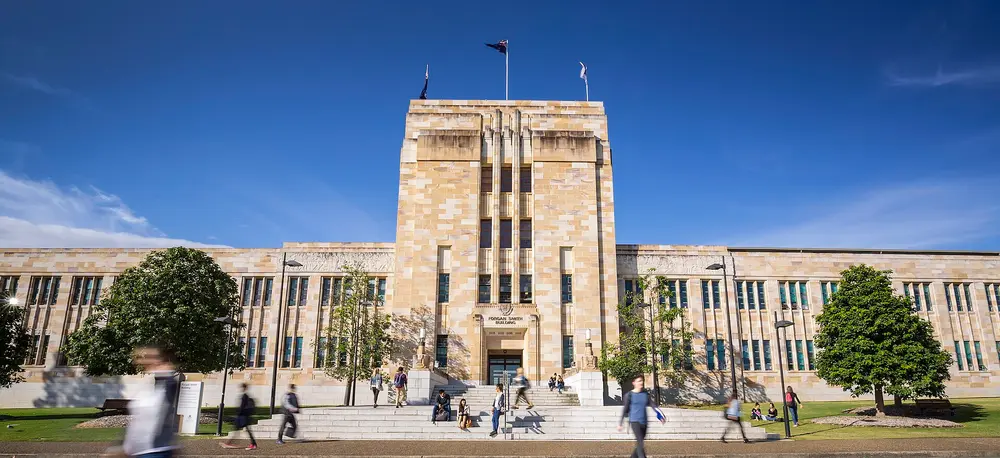
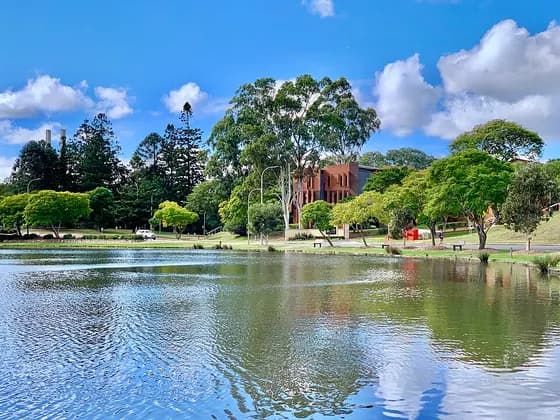
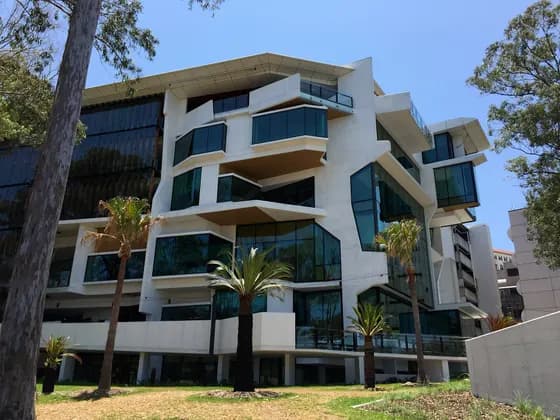

Photo: The University of Queensland · CC BY-SA 4.0 · cropped
Photo: Kgbo · CC BY-SA 4.0 · Photo: Kgbo · CC BY-SA 4.0 · Photo: Kgbo · CC BY-SA 3.0
Still deciding where to apply? Hear it from a student who's there
Honest student guides to dentistry universities
Current dental students at Australian universities are filming their guides right now: what the course and teaching are really like, the city they live in, the social side, and whether they'd pick it again.
Coming soonNot on sale yet — we'll open these up as soon as the first Australian videos land.
Filming now
UQ Dental expects Minimum adjusted ATAR 99.0 (or equivalent) plus UCAT ANZ from the year you apply — no interview. Prerequisites (QTAC): English, Literature, English and Literature Extension or English as an Additional Language (Units 3 and 4, C), and Chemistry (Units 3 and 4, C); Biology recommended. Domestic applications go through QTAC only (code 712002; UQ program code 2367).
UQ offers NO guaranteed-entry ATAR for this program — it is listed among UQ's programs with no guarantee — so reaching 99.0 makes you eligible, not admitted. for Dentistry (BDS/DMD) and uses No interview — ATAR threshold then UCAT-ANZ aggregate ranking for interviews in the 2027 Entry cycle.
Entry is undergraduate and selection uses UCAT-ANZ; applications close through GEMSAS or your state TAC (UAC, VTAC, QTAC, SATAC, TISC), and CSP, BMP and full-fee places are all capped, so treat the standard above as a threshold to clear rather than a target to aim at.
This guide is written for 2027 Entry applicants and updated annually before each GEMSAS / UAC cycle. Sources include University of Queensland School of Dentistry's official course page, GEMSAS, the UCAT-ANZ Consortium, ACER (GAMSAT), and direct conversations with current students. Read time: ~12 minutes.
Checked field-by-field against University of Queensland School of Dentistry's official course page on 11 September 2026.
UQ Dental at a glance
| ATAR | 2026 entry: lowest rank offered 95.70 (unadjusted) → 99.00 (with adjustments) |
|---|---|
| UCAT-ANZ | For calibration, official UCAT ANZ 2026 (2027-entry) Total Cognitive Scaled Scores are out of 2700: median 1,950, 8th decile 2,220, 9th decile 2,340 |
| Interview format | No interview — ATAR threshold then UCAT-ANZ aggregate ranking |
| Interviews (2027 entry) | No interview |
| Decisions (2027 entry) | January — QTAC offer round 14 January 2027 (UQ: offers to the main offer round in January 2027) |
UQ Dental entry requirements
| Pathway | Undergraduate (school-leaver) entry |
|---|---|
| ATAR floor | 2026 entry: lowest rank offered 95.70 (unadjusted) → 99.00 (with adjustments); median rank offered 99.30 (unadjusted) → 99.95 (with adjustments); highest rank offered 99.95. ATAR floor 99.00 adjusted for QLD Year 12 — one of the highest in Australian dentistry. |
| Contextual ATAR | UQ applies adjustments through QTAC and caps them: 'You may be eligible for multiple schemes, up to a maximum of 5 adjustment points in total.' The Rural Access Scheme gives 2 adjustments (1 rank each), the Educational Access Scheme up to 5, the School Opportunity Scheme up to 4, the Subject Incentive Scheme up to 3, and Aboriginal and Torres Strait Islander applicants 5 — but never more than 5 combined, so the lowest unadjusted ATAR that can reach the 99.0 adjusted minimum is 94.0. Important: for Dental Science the rural adjustment is NOT automatic — you must document 5 consecutive or 10 cumulative years of residence in a designated rural or remote area. For Semester 1, 2026 QTAC published a lowest offer of 95.70 excluding adjustment factors and 99.00 including them; these are two separate published statistics, not one applicant's measured adjustment. UQ also lists 'applicants without adjustments will be considered before applicants with adjustments' among the detailed measures it uses when applicants outnumber places. |
| Admission tests | UCAT-ANZ |
| UCAT-ANZ | Mandatory. All applicants at/above the ATAR floor are ranked directly on UCAT-ANZ aggregate — ATAR acts as a hurdle, not a differentiator. UCAT section scores may separate tied applicants. UQ has never published a UCAT cut-off or percentile for this program, and no Tier-1 source supports one — QTAC says only that 'entry to this course is highly competitive' and that 'UCAT scores are used for selection'. For calibration, official UCAT ANZ 2026 (2027-entry) Total Cognitive Scaled Scores are out of 2700: median 1,950, 8th decile 2,220, 9th decile 2,340. Treat any quoted 'UQ Dental UCAT percentile' as an estimate, never a published threshold — and note that UQ's published rule aggregates 'all 4 sections' of the UCAT, which it has not reconciled with the current three-subtest cognitive total. |
| Interview | No interview — ATAR threshold then UCAT-ANZ aggregate ranking |
| Place types | Semester 1, 2026 cohort (QTAC/UQ Student Profile): 111 students in total — 72 (64.9%) from recent secondary education admitted where both ATAR/rank and additional criteria were considered, and 24 international (21.6%). The total includes international students, leaving roughly 87 domestic commencers, all in Commonwealth supported places. Domestic places are all Commonwealth supported. QTAC's Feb 2027 intake listing shows a first-year student contribution of $10,140; UQ's own program page gives an indicative annual fee of $11,670 for 2026 and states that 2027 fee information is not yet available. The two official sources are on different bases, so treat both as indicative and check UQ's fee page before quoting a 2027 figure. |
| Indigenous pathway | Aboriginal and Torres Strait Islander applicants who apply through QTAC and identify automatically receive 5 selection-rank adjustments. On UCAT: UQ's program page states that applicants applying via the Aboriginal and Torres Strait Islander Admissions Scheme are not required to sit UCAT, while UQ's scheme page ties the dentistry exemption specifically to its separate Bachelor of Dental Science (Honours) admission pathway — complete UQ's admission pathway application form and email it to atsisaltentry@uq.edu.au, with applications closing 1 December in the year before you commence. Because UQ's two pages differ, lodge the pathway form by 1 December and confirm the exemption with UQ Admissions rather than relying on the QTAC application alone. |
| Bonded / rural | No bonded places and no rural quota for dentistry: UQ states all domestic places are Commonwealth supported, QTAC lists the fee as CSP only, and UQ's Rural Background Sub-quota is offered only to Doctor of Medicine (Provisional Entry) applicants. Rural applicants do get relief, because the 99.0 minimum is an ADJUSTED ATAR — UQ's Rural Access Scheme adds 2 adjustments (each worth 1 rank). For the Bachelor of Dental Science (Honours), however, that adjustment is not automatic: you must provide documents proving you lived in a designated rural or remote area for 5 years consecutively or 10 years cumulatively, submitted through QTAC. |
Minimum adjusted ATAR 99.0 (or equivalent) plus UCAT ANZ from the year you apply — no interview. Prerequisites (QTAC): English, Literature, English and Literature Extension or English as an Additional Language (Units 3 and 4, C), and Chemistry (Units 3 and 4, C); Biology recommended. Domestic applications go through QTAC only (code 712002; UQ program code 2367).
UQ offers NO guaranteed-entry ATAR for this program — it is listed among UQ's programs with no guarantee — so reaching 99.0 makes you eligible, not admitted.
Year 12 ATAR (or equivalent international qualification) plus the admission test are the academic gateway; interview performance then determines the final offer.
UCAT-ANZ
UCAT-ANZ is a 2-hour computer-based aptitude test (Verbal Reasoning, Decision Making, Quantitative Reasoning, and a separately-banded Situational Judgement Test). Sat between July and early August. The UCAT-ANZ Consortium operates separately from the UK UCAT — scores are NOT interchangeable.
Working towards the UCAT score UQ Dental expects? Build a week-by-week plan from your test date — free for the first two weeks.
Written submissions
Australia has no equivalent of the UK's single UCAS personal statement. GEMSAS graduate-entry applications use GAMSAT + GPA without a written component; most state-TAC undergraduate applications use ATAR + UCAT-ANZ without a written component. The schools that DO require written content (JCU portfolio, Notre Dame Sydney/Fremantle questionnaire, Wollongong short answers, Bond essays) each ask different, school-specific questions. Treat each school's prompt set as a discrete short-answer test - do not recycle a single document across multiple schools.
Limits are school-specific. JCU portfolio responses: typically 250-500 words per question. Notre Dame questionnaire: 250-400 words per response. Wollongong short answers: ~300 words each. Bond essays: 500 words. Read the current cycle's prompt brief for each school carefully - limits and prompts shift cycle-to-cycle.
Five things that win
Four things that lose
Worked-example opener (do not copy — for shape only)
"During my work-experience week at a community dental practice, I watched a hygienist coach a nervous teenager through her first scale and polish. The clinical work took ten minutes; the trust-building took the other twenty. That ratio - slow patient-facing care woven through technical skill - is what made me commit to dentistry…"
Notice: a specific scene rather than a cliché, a precise detail (the nine-minute conversation), and a closing sentence that bridges to the next paragraph. We have a step-by-step written-submissions service if you want a tutor to help shape yours.
How UQ Dental selects without an interview
UQ Dental selection: No interview — ATAR threshold then UCAT-ANZ aggregate ranking. For 2027 entry, interviews typically take place in No interview. Final decisions are released January — QTAC offer round 14 January 2027 (UQ: offers to the main offer round in January 2027).
At UQ Dental, expect the following from the selection process. Assessment / recorded-interview format - some Australian schools (JCU's Kira Talent recording, Notre Dame Modern Hire) ask one-way recorded responses; others combine panel interviews with practical tasks (group work, written exercises, presentations). Allow 60-90 minutes for a recorded interview or 4-6 hours for a full in-person assessment day.
How UQ Dental decides without an interview
UQ Dent does not interview. Step 1: applicants must hit adjusted ATAR ≥ 99.00. Step 2: all qualifying applicants are ranked directly on UCAT-ANZ aggregate; ATAR acts as a hurdle, not a differentiator.
UQ's published rule is precise: the UCAT aggregate is the first selection measure, applicants on the same aggregate are ranked by their UCAT ANZ section 4 score, and if that is also tied, by section 1. UQ also lists, among the detailed measures it applies when applicants outnumber places, that applicants without adjustments are considered before applicants with adjustments.
Note that UQ specifies 'the aggregate score from all 4 sections' for dentistry (versus 'the first 3 section scores' for Provisional Medicine); the current UCAT ANZ has four subtests — VR, DM, QR and Situational Judgement — so it is unclear whether UQ's dentistry aggregate now includes SJT.
UQ has not published a clarification, so confirm with UQ Admissions before targeting a specific total. Aboriginal and Torres Strait Islander applicants are not required to sit UCAT ANZ, with the dentistry exemption tied by UQ's scheme page to its separate admission pathway.
What they assess
What UQ Dental assessors are scoring: Multi-station assessment lets the school triangulate - assessors compare notes from each station to spot consistent strengths (and red flags).
What actually decides your application
- Group task observation (how you contribute, listen, lead)
- Written ethics scenario
- Panel interview or recorded one-way response
- Portfolio / personal-statement deep dive
- Hot topics in Australian healthcare (Medicare, rural workforce, Indigenous health)
- Academic curiosity questions
Questions to settle before you apply to UQ Dental
Why dentistry?
Tell us about your work experience.
In a group task, what role did you take and why?
How would you handle disagreement with a senior colleague?
Describe a recent biomedical news story and your view on it.
Where to put your preparation instead
Our panel-interview prep covers ethics frameworks (SPIES, the four pillars), structured behavioural answers (STAR), and live mock interviews with admissions specialists.
Planning around UQ Dental
UQ Dental selects without an interview in its standard entry routes, so there is no interview here to rehearse. Put the effort into where else you apply.
Build the rest of your list
UQ Dental ranks applicants without an interview, so your other choices carry the interview practice. Get a shortlist matched to your scores.
Plan where to applyTalk your choices through with an adviser
A 1-to-1 call on where UQ Dental fits in your application and which schools to pair it with.
Book a strategy callMonth-by-month timeline for 2027 Entry
The cycle runs roughly January 2025 (start of prep) through GEMSAS preference lock and state-TAC deadlines in September 2026, MMIs in October-December 2026, to first-round offers in December 2026 and course start in late January / early February 2027. Here are the milestones you cannot miss.
Decide and start work / clinical experience
Confirm medicine or dentistry as your career direction. Start banking clinical exposure (hospital volunteering, GP shadowing, aged-care or disability-support roles) and non-clinical experience (research assistant, peer tutoring, leadership). Australian schools weight reflection over hours - track what each placement taught you.
Begin UCAT-ANZ / GAMSAT prep
Open your prep window 6-9 months before the test sitting. UCAT-ANZ candidates focus on the 4 sub-tests (Verbal Reasoning, Decision Making, Quantitative Reasoning, Situational Judgement). GAMSAT candidates focus on Section I (Humanities), Section II (Written Communication) and Section III (Sciences) - the Section III sciences gap is the most common reason graduates under-perform.
GAMSAT March sitting
ACER GAMSAT March test date. Scores released early May. Most graduate-entry applicants sit GAMSAT in March of their apply year so results are available before GEMSAS preferences open.
UCAT-ANZ registration + GEMSAS portal info
UCAT-ANZ registration opens (test sat in July). GEMSAS portal information released for graduate-entry medicine. ATAR-tracking begins for current Year 12 applicants.
GEMSAS portal opens + UCAT-ANZ booking
GAMSAT March results released (late May). GEMSAS applications open 1 May and close 29 May across the ten consortium schools (ANU, Deakin, Griffith, Macquarie, Melbourne, Notre Dame Fremantle, Notre Dame Sydney, UQ, UWA, Wollongong). Sydney, Flinders and Monash are NOT in GEMSAS and need separate direct applications. UCAT-ANZ booking deadline is 15 May.
GEMSAS preference entry opens
Rank up to 6 preferences across the 8 GEMSAS schools. ACER GAMSAT September registration window opens (a second sitting option for applicants who under-performed in March).
UCAT-ANZ test window
Take UCAT-ANZ between early July and early August. There is one sitting per cycle - no retake until the following year. Results are released to state TACs (UAC, VTAC, QTAC, SATAC, TISC) in October. State TACs (UAC, VTAC, QTAC, SATAC, TISC) accept undergraduate medicine preferences from July onwards.
GEMSAS preferences lock + direct apps close
GEMSAS interview offers issued in early September; consortium interviews run September-October. ACER GAMSAT September sitting - too late for this cycle, results land mid-November. JCU QTAC + JCU-portal applications close 30 September. State-TAC medicine preferences close 25-30 September. (Bond's QTAC round does not open until January.)
MMI invitations issued
Most graduate-entry consortium schools issue MMI invitations through October. Bond runs its structured interview cycle. UCAT-ANZ results released to state TACs for undergraduate ranking. State TAC preference changes typically close late October.
MMIs run + ATAR results
MMIs run across consortium schools, Bond, JCU and Macquarie through October-December. ATAR results released to state TACs for school-leaver undergraduate applicants. GAMSAT September results released for applicants who sat the second window.
First-round offers
First-round offers released by GEMSAS, state TACs and direct-application schools. Acceptance deadlines are typically within 10 days of offer - reply on time or forfeit the place. Some schools release a second offer round in early January.
Late offers + course start
Late-round offers released through January. Deferral requests due. Orientation week is scheduled by most schools for late January or early February, with first-year teaching commencing late January / early February.
What makes UQ Dental different
UQ Dental sits at the very top of the Australian dental entry range: a minimum ADJUSTED ATAR of 99.0, a median adjusted offer rank of 99.95 at the Semester 1, 2026 intake, and no guaranteed-entry score at all — UQ lists Dental Science (Honours) among its programs with no ATAR guarantee. (We have not verified against every other Australian dental program that it is the single most ATAR-competitive; no admissions centre publishes that comparison.) No interview — selection runs on the ATAR hurdle + UCAT-ANZ aggregate. Co-located with the Oral Health Centre at Herston — Queensland's largest dental teaching facility.
Notable research areas
Curriculum (Integrated)
5-year undergraduate Bachelor of Dental Science (Honours). Students attend both the Herston and St Lucia campuses throughout the five years. Clinical skills begin in the first semester in UQ's simulation clinics and labs; students move into clinics treating patients in third year as part of UQ's oral health alliance with Metro North Hospital and Health Service; and the final year includes a 39-week placement at dental clinics throughout Queensland. Supervised clinical practice spans a range of settings including the UQ Oral Health Centre — which UQ describes as Australia's most advanced tertiary oral health facility — as well as Queensland government and Aboriginal and Torres Strait Islander Health Service clinics. No interview — final selection is ATAR threshold + UCAT-ANZ aggregate.
Location: Herston & St Lucia, Australia
Founded in 1936. Whether the city suits you matters - five or six years is a long commitment. Visit on an open day if you can; current students will be the most honest assessors of culture and clinical placement quality.
Read the full UQ Dental course guide — case-based learning, 5 years (undergraduate entry), with placements in Brisbane, Dalby, St George and other Queensland public clinics.
Application statistics for UQ Dental
UQ Dental intake
Semester 1, 2026 commencing cohort (QTAC/UQ Student Profile): 111 students in total — 72 (64.9%) from recent secondary education admitted where both ATAR/rank and additional criteria were considered, fewer than 5 admitted on other criteria only, higher-education-study entrants not published, and 24 international (21.6%). The 111 includes international students, so domestic commencers number roughly 87. International indicative tuition AUD $99,600 per year for 2027 — UQ's 'approximate yearly cost of tuition (16 units)', not a whole-of-program fee. UQ notes fees vary with study load and are reviewed each year and may increase, so the five-year total is not simply five times this figure. UQ also lists additional costs including dental instruments and equipment, practice teeth and annual CPR re-certification.
How UQ Dental selects, at a glance
Source: University of Queensland School of Dentistry admissions data; GEMSAS / state-TAC published statistics; ACER (GAMSAT) and UCAT-ANZ Consortium decile data; recent FOI responses.
Six mistakes that derail dentistry applications
UQ Dental — frequently asked questions
Sources for this UQ Dental guide
Apply to UQ Dental with confidence
We have helped hundreds of applicants turn their GAMSAT / UCAT-ANZ, portfolio and MMI prep into offers from UQ Dental and other Australian dentistry schools.