Melbourne offers a research-rich 4-year graduate-entry MD anchored across the Parkville hospital precinct with extensions to the Austin, Western, and St Vincent's clinical schools, distinguished by deep biomedical research integration and a teaching network spanning six metropolitan clinical schools and four Rural Clinical School sites. Note that international students are allocated only to the Metro region.
What makes Melbourne different
Melbourne runs Australia's flagship 4-year graduate-entry MD anchored across the Parkville biomedical precinct (Royal Melbourne, Royal Children's, Peter MacCallum) and extending to the Austin, Epworth, Northern, Royal Melbourne, St Vincent's and Western clinical schools. Pre-interview ranking weights GPA and GAMSAT equally; the recorded online MMI then carries 50% of the final offer composite against GPA 25% and GAMSAT 25%.
Strong Aboriginal and Torres Strait Islander entry stream via the Indigenous MD Student Entry Pathway, applied for directly through UoM rather than GEMSAS.
Melbourne course & teaching
Integrated curriculum. 4-year graduate MD. Year 1 foundations and clinical skills at Parkville. Years 2-3 clinical placements across Royal Melbourne, Austin, Western, St Vincent's, and Rural Clinical School sites (Shepparton, Ballarat, Echuca, Wangaratta). Year 4 is a research project in an area of interest plus a placement-based capstone learning as a trainee junior doctor.
Discovery is a separate individualised selective pathway offered at every level of the MD, with research-scholar and clinical-scholar streams in the final two years — not the research project itself. The MD is an ungraded, pass/fail course, and the annual MD Student Conference brings together all students in the program.
Guaranteed Entry pathway (for students completing an undergraduate degree at UoM, within 18 months of commencing the MD): Melbourne Chancellor's Scholars entered on an ATAR of 99.90+ and need no minimum WAM — domestic scholars are guaranteed a CSP, international scholars an international full-fee place.
Guaranteed Full Fee Entry students entered on an ATAR of 99.00-99.85 and must maintain a WAM of at least 75%. Both must pass the MMI and neither sits GAMSAT.
This pathway is now closed to students commencing undergraduate study from 2027, who instead apply via the new Australian Full Fee Priority Pathway: same ATAR 99.0+ basis but NOT a guarantee — applicants are ranked on MMI result alone (100%) and must reach a WAM of 75% to have an offer confirmed.
Melbourne research strengths
Melbourne is strong in these research areas:
- Cancer biology
- Neuroscience
- Cardiovascular disease
- Infectious disease and immunity
How the Melbourne interview runs
Format: Recorded Online Multi Mini-Interview (ROMMI) — 8 stations, ~5 minutes each, recorded and asynchronous with no live interviewer; Rural and North Western pathway applicants additionally sit a 3-station real-time online MMI
Melbourne's standard MMI is delivered online and asynchronously — a Recorded Online Multi Mini-Interview (ROMMI) with no live interviewer and nothing on campus. Candidates log into a recorded-interview portal, clear an administrative station (photo ID to camera, then pan the room to show they are alone), and work through 8 stations.
UoM's 2027 Admissions Guide puts each station at 5 minutes and the whole interview at approximately 50 minutes; its candidate brief for the 2026 intake describes stations of about 6 minutes with the interview to be completed inside a 90-minute portal window.
Each station opens with 30 seconds of instructions and a minute to review the scenario, then four questions, each answered as a 1-minute video recording after 15 seconds of preparation, with no going back to redo an answer. It must be sat on a desktop or laptop with a webcam under exam conditions.
Rural and North Western pathway applicants sit this ROMMI PLUS a separate 3-station real-time online MMI on another day, and must score satisfactorily in each of those three stations.
UoM lists the assessed domains only as examples, and its two published lists differ: the candidate brief gives interest in the course, aptitude for collaboration, capacity for establishing rapport, aptitude for decision making, communication skills and professional behaviour, while the 2027 Admissions Guide gives professionalism, motivation, communication skills, ability to empathise and provide support, attitude towards collaboration and aptitude for decision making.
The current published pass rule is a satisfactory standard in the overall interview score plus being above the cut-score in 5 of 8 stations; UoM no longer publishes a numeric percentage threshold.
Melbourne intake
2027 cycle (indicative): 179 CSP + 71 BMP (39 via GEMSAS + 32 via MD Rural Pathway) + up to 105 full-fee places shared between domestic and international applicants ≈ ~355 total (GEMSAS 2027 UoM entry). UoM's own 2027-intake Admissions Guide gives the same total, split 295 domestic / 60 international, and labels all quotas a guide only and subject to change. No earlier-cycle intake figures are published by UoM or GEMSAS in a form this entry can cite.
Where Melbourne is
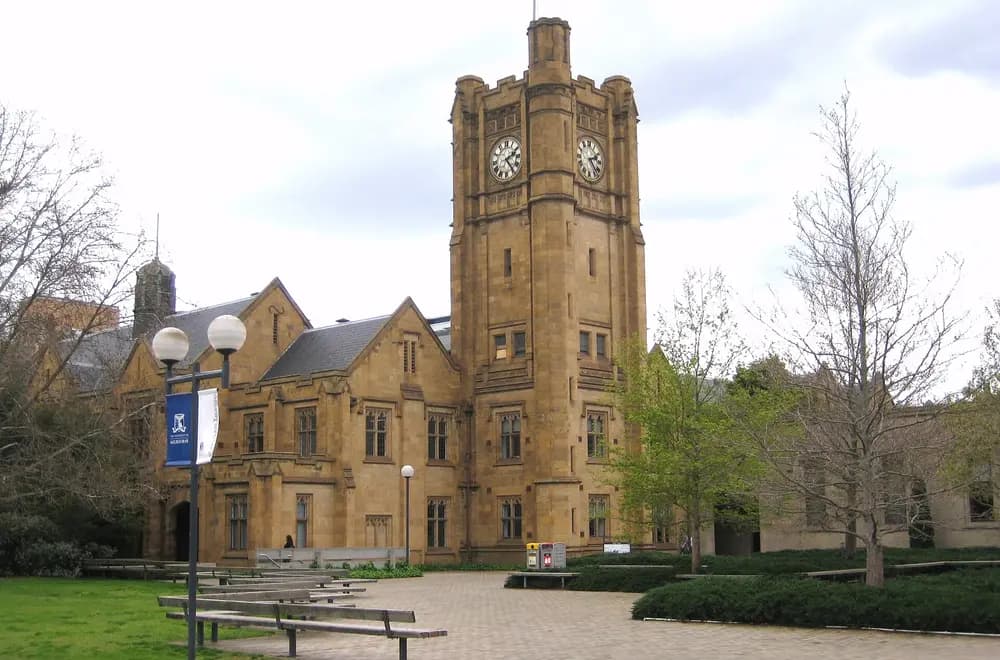
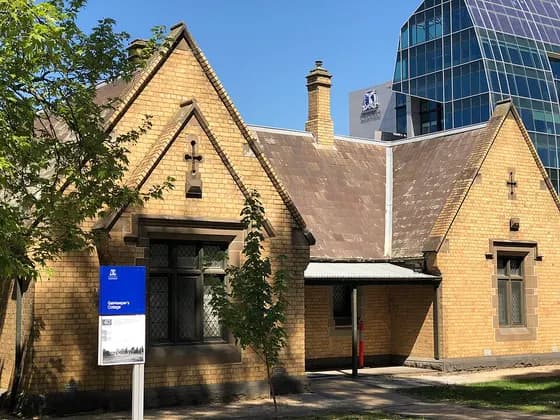
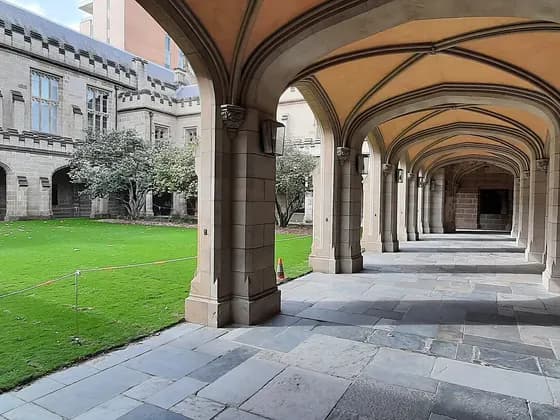
University of Melbourne Medical School was founded in 1862 and is based in Parkville.
Programmes offered:
- Clinical Research
- Oncology
- Neuroscience
- Global Health
- Indigenous Health