
MUSC College of Medicine Interview
Format, Questions & Prep Tips
MUSC College of Medicine medicine interviews for 2027 entry are a traditional interview. Published figures: Annual MD class size ~160; Interview format Traditional individual — 2 faculty sessions, ~20–30 min each; Founded 1824 — oldest medical school in the American South.
- Institution
- Medical University of South Carolina College of Medicine
- Interview (2027 entry)
- September through February; rolling invitations issued after secondary review
- Decisions (2027 entry)
- Rolling decisions through late March; waitlist movement continues through summer

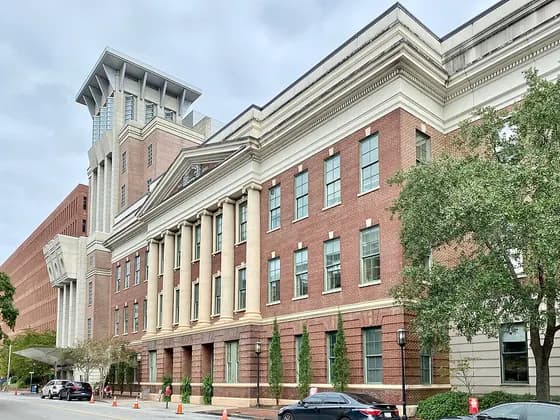


Photo: ProfReader · CC BY-SA 3.0 · cropped
Photo: w_lemay · CC BY-SA 2.0 · Photo: Bohao Zhao · CC BY 3.0 · Photo: NealVickers · CC BY-SA 4.0
How to get into MUSC College of Medicine (MD) medicine
Step-by-step: entry requirements, admission tests, personal statement, interview format and the key deadlines.
Open the guide →MUSC College of Medicine (MD) entry requirements
Admission profile, interview format, decision dates and what makes MUSC College of Medicine (MD) different.
See the profile →The MUSC College of Medicine (MD) medicine interview
Medical University of South Carolina College of Medicine uses a traditional individual interview format — applicants meet one-on-one with faculty members or admissions committee representatives on the Charleston campus. Typically two sessions of 20–30 minutes each; both interviewers have reviewed the full application.
MUSC is the oldest medical school in the American South (founded 1824) and serves a clear public health mission as South Carolina’s only academic medical center. Interviewers probe commitment to serving SC communities — especially rural and underserved areas — alongside academic preparation and personal fit.
Expect questions that probe the AAMC Premed Competencies; Service Orientation and Understanding Others receive particular weight given the school’s rural health mission and SC workforce mandate.
MUSC College of Medicine (MD) interview at a glance (2027 entry)
| Annual MD class size | ~160 |
|---|---|
| Interview format | Traditional individual — 2 faculty sessions, ~20–30 min each |
| Founded | 1824 — oldest medical school in the American South |
| Application system | AMCAS |
| Interview window | September–February |
| MCAT median (est.) | ~512 |
Interview format
- Two individual traditional interviews with faculty members or admissions committee representatives.
- Both interviewers are application-aware; expect specific follow-up on experiences, research, and secondary essays.
- Full interview day in Charleston includes MUSC Health hospital and campus tour.
- Group admissions information session and student lunch are part of the day.
- No MMI; conversational and application-focused throughout.
Working towards the MCAT score MUSC College of Medicine (MD) expects? Build a week-by-week plan from your test date — free for the first two weeks.
Sample interview questions
Why MUSC, and how do you envision contributing to South Carolina's healthcare workforce after you graduate?
Reference MUSC's rural SC network, the Hollings Cancer Center, Children's Hospital, or specific underserved regions you want to serve. A vague "I like Charleston" answer is a red flag.
Describe the clinical or community experience that best prepared you for the realities of practicing in a state like South Carolina with significant rural health disparities.
STAR structure with reflection on structural challenges — poverty, lack of transport, substance abuse, food insecurity — not just clinical procedures performed.
A patient in a rural area drives four hours to see you. They ask you to prescribe opioids for chronic pain, having exhausted non-opioid options. How do you approach this?
Address opioid prescribing guidelines, patient-physician trust, documentation, PDMP checks, alternative pain management, and the very real access barriers for rural patients that affect your decision calculus.
South Carolina has not expanded Medicaid under the ACA. As a future physician, what is your responsibility in this policy environment?
Demonstrate knowledge of the coverage gap (~120,000–150,000 uninsured SC residents caught between Medicaid and marketplace eligibility). Discuss physician advocacy, safety-net providers, and the limits of individual clinical action.
Tell me about a time you had to build trust with a patient or community member who was initially resistant or distrustful of the healthcare system.
Show patience, cultural humility, and understanding of why medical distrust exists (historical abuses, language barriers, systemic failures). Avoid heroic narratives where you single-handedly overcame resistance.
If you could conduct a research study at MUSC's Hollings Cancer Center or any MUSC research program, what question would you ask?
Show genuine intellectual curiosity and some knowledge of MUSC's research strengths (cancer, cardiovascular, neuroscience). Connecting to SC health disparities data makes the answer stronger.
A nurse on your team reports that a senior physician regularly dismisses nursing concerns in rounds. You have also observed this. How do you respond?
Address patient safety risks of communication failures, power dynamics, direct vs. escalated response, and when to involve the department chief or patient safety office.
What does it mean to you that MUSC was founded in 1824 — before anesthesia, germ theory, or antibiotics? How does that history inform how you think about medical education today?
This is an intellectual/reflective question. Show you have thought about the history of medicine and what it teaches about humility, iteration, and evidence-based practice.
A recently graduated medical student on your team makes a significant documentation error. How do you address it?
Balance accountability, mentorship, and patient safety. Show awareness of the learner's vulnerability, appropriate escalation thresholds, and constructive feedback framing.
Should medical schools in states with physician shortages be allowed to preferentially admit in-state applicants at the expense of a purely merit-based process?
Engage the tension between meritocracy and workforce planning. Reference the evidence that in-state students are more likely to practice in-state. Argue a clear position.
[Role-play] You are a MUSC student in a rural South Carolina clinic. A patient who drove a long way is frustrated that they have been told they need to travel to Charleston for specialist care they are not sure they can manage. Respond to the patient.
Acknowledge the real burden of rural access in SC. Lead with empathy, discuss telehealth and the genuine stakes of the referral, and use shared decision-making rather than insistence. Reflects MUSC's rural-health mission and statewide network.
An interviewer shows you the estimated size of South Carolina's Medicaid coverage gap and maps it against rural physician-shortage areas. How do you interpret this, and what would you want to know before drawing conclusions?
Connect the non-expansion coverage gap (roughly 120,000–150,000 residents caught between Medicaid and marketplace eligibility) to access in shortage areas; name confounders and avoid over-claiming from a single overlay. Show systemic awareness consistent with MUSC's workforce mandate.
Tell me about a time your curiosity about a clinical or public-health question led you to investigate it well beyond what was required. What did you do with what you found?
MUSC is research-intensive (Hollings Cancer Center, neuroscience, cardiovascular). Show genuine, self-directed inquiry rather than assigned work, and connect it where possible to SC health disparities or your area of interest.
On a busy rotation, a nurse pages you with a concern about a patient that you initially think is minor, but they are clearly worried. How do you respond and communicate?
Take the concern seriously, avoid dismissing nursing input, gather information, and demonstrate respectful interprofessional communication — exactly the team-safety dynamics MUSC's clinical environment depends on.
Tell me about a place or community you feel a genuine, lasting commitment to. How does that connect to your plan to serve South Carolina after training?
MUSC's in-state preference is among the strongest of public schools and it weights SC commitment heavily. Use a real, specific connection rather than 'I like Charleston,' and engage honestly with what would keep you practicing in the state.
Practise the MUSC College of Medicine (MD) interview
Rehearse the real format before the day — on demand with our AI interviewers, or live with a tutor.
Sit a mock with photoreal AI interviewers — any time
A timed MMI or panel interview on video — American & international voices — with interviewers who listen, react and press with follow-ups. Rubric-scored feedback and a replay the moment you finish.






Live mocks with a tutor who’s been in the room
A full MUSC College of Medicine (MD)-style mock with a medic or dentist tutor — honest scoring against real marking criteria, a station-by-station debrief and a written action plan.
Book a mock interviewHow to prepare for the MUSC College of Medicine (MD) interview
Common pitfalls to avoid
MUSC College of Medicine (MD) interview — frequently asked questions
Sources & official admissions information
Ready to nail your MUSC College of Medicine (MD) interview?
Book a mock interview with a tutor who knows the US interview formats, orpractice unlimited stations from our interview question bank.