
The BU Chobanian & Avedisian School of Medicine MD program
What you actually study, and where you will be
BU Chobanian & Avedisian School of Medicine's MD is a 4-year program taught through team-based learning in an integrated curriculum, with patient contact from Year 1 and clinical rotations in Boston, wider New England and Silicon Valley, California (2027 entry). BU's MD runs in three phases. About 18 months of pre-clerkship classes teach science, clinical skills and health equity side by side. The clerkship year starts in April of year 2 at Boston Medical Center, VA hospitals and sites around New England. You can instead spend half or all of it at Kaiser Permanente in Silicon Valley.
- Degree
- MD
- Length
- 4 years
- Teaching
- Integrated + Team-based learning
- Clinical contact
- Year 1

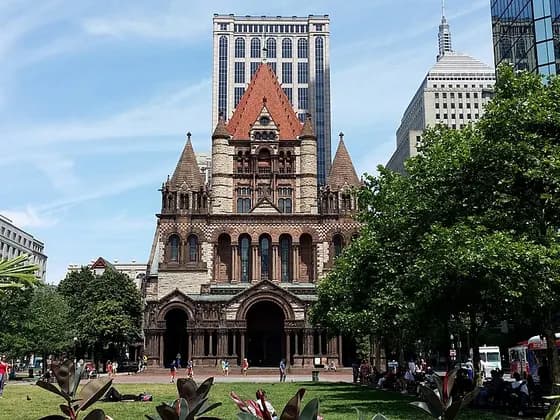


Photo: John Phelan · CC BY 3.0 · cropped
Photo: Eric Friedebach · CC BY 2.0 · Photo: Daderot · CC BY-SA 3.0 · Photo: Nick Ledford from Palm Harbor, United States · CC BY 2.0
The BU Chobanian & Avedisian School of Medicine MD program at a glance (2027 entry)
Boston University Chobanian & Avedisian School of Medicine teaches its four-year MD on the BU Medical Campus in Boston's South End, which it shares with Boston Medical Center (BMC), its primary teaching hospital. The school describes BMC as a 650-bed safety-net hospital, one that treats patients whatever their ability to pay. According to the school's By the Numbers page, 138 MD and MD/PhD students entered in fall 2025.
The curriculum was redesigned in 2022 and runs in three phases. The pre-clerkship phase is about 18 months of mostly classroom learning, from August of year 1 to February of year 2. It centers on one integrated course, Principles Integrating Science, Clinical Medicine and Equity (PISCEs), which works through the body system by system.
Alongside PISCEs run Doctoring, two years of clinical skills in small groups, and LEADS (Learn, Experience, Advocate, Discover and Serve), two years of health equity. Personal and Professional Development (PPD) lasts all four years.
Patients come early. The school says patient contact begins in your first week, and in year 1 you interview BMC inpatients and work with an outpatient preceptor, a clinician who supervises you. Lectures are recorded and optional, but team sessions, Doctoring groups and patient care are required, so the first two years reward preparation and teamwork.
Clerkships, the core clinical rotations, start in April of your second year, about 20 months after you arrive. Before them you sit Step 1 of the United States Medical Licensing Examination (USMLE), the national exam series for medical licensure. The third year is a fixed calendar of 48 weeks of blocks at BMC, Veterans Affairs (VA) hospitals and other sites around New England. Some students spend half or all of it at the school's Kaiser Permanente campus in Silicon Valley.
The fourth year is mostly electives, rotations you choose yourself. It also includes a sub-internship, in which you work at the level of an intern, a first-year resident in specialty training. A geriatrics clerkship and two weeks of science seminars complete the year, with graduation in May.
| Degree | MD |
|---|---|
| Program length | 4 years; clerkships begin in April of the second year |
| Class size | 138 MD and MD/PhD students entered in fall 2025 |
| Main campus | BU Medical Campus, South End, Boston, shared with Boston Medical Center |
| Teaching style | Integrated systems course with team-based learning; lectures recorded |
| Anatomy | Donor labs within PISCEs, plus virtual dissection and ultrasound tools |
| First patient contact | Year 1: interviewing BMC inpatients with a fourth-year student preceptor |
| Clinical sites | BMC, VA Boston, New England hospitals and health centers; Kaiser option |
| Step 1 timing | After classes end in mid-February of year 2, before clerkships |
| Grading | Pass/fail in years 1 and 2; Honors to Fail in clerkships |
What makes the BU Chobanian & Avedisian School of Medicine MD program different
Health equity as a required two-year course
LEADS sets aside five weeks in year 1 and four in year 2 for health equity, on top of content woven into PISCEs and Doctoring. You join a focus area, such as homeless health or disability and health, and finish with an advocacy piece in year 1 and a group project in year 2.
Near-peer teaching from fourth-year students
In year 1 a fourth-year student precepts you and a classmate as you interview BMC inpatients each week. In year 2, fourth-years join faculty to coach your full workups in Clerkship Prep. In the medicine and surgery clerkships, fourth-year students also help with orientation, simulation and exam preparation.
The option of a third year in Silicon Valley
Kaiser Permanente Northern California has been a BU regional campus since 2015. You can spend half or all of the third year at its San Jose and Santa Clara medical centers, doing the same core clerkships inside a nonprofit, integrated health system.
An advisor who also teaches your small group
Academy Medical Educators (AMEs), clinical faculty from the BMC health system or the VA, give one afternoon a week to teaching and advising. One AME leads your Doctoring 1 group and another your Doctoring 2 group. An AME advisor stays with you all four years and becomes your educational coach in the third year.
Back to the Classroom in the final year
In March of the fourth year you leave clinical work for two weeks of seminars, one topic a week, built on cases, readings and sometimes lab work. Past topics include surgical anatomy, genetics, neonatology, gender-affirming care and liver disease, each revisiting the science behind practice before residency.
How BU Chobanian & Avedisian School of Medicine teaches medicine
PISCEs combines foundational science, pathophysiology and disease management, with threads such as anatomy, pharmacology, pathology, microbiology, infectious disease and oncology running through every module. Drawing on learning research, topics are spaced out and interleaved, returning in later modules and integrated cases to help long-term retention. PISCEs and LEADS began in 2022-23. BU's physician assistant students take PISCEs with you.
Each module is divided into learning periods of two to three weeks. You start with guided self-learning and apply it in required sessions built on patient cases. A consolidation session then revisits the opening cases before a Learning Progress Assessment, a multiple-choice exam on applying the material. Running through every course is The Core, which the school's Core page lists as 41 common presenting complaints and 15 patient types.
Doctoring builds clinical skills, from interviewing and examination to documentation and clinical reasoning. LEADS adds health equity, advocacy and scholarly methods, and PPD, new in 2025-26, pairs you with a coach for learning strategies, teamwork, wellbeing and careers. In the clerkships, teaching moves to wards and clinics, with regular didactic days, simulations and small groups.
The ways you will learn
| Guided self-learning | Self-learning guides, videos and recorded lectures you work through before class, with timed self-assessment questions that count only for completion. Lecture attendance is optional. |
|---|---|
| Team-based learning | You sit with a team of eight all year. Each session opens with an individual readiness test (IRAT), then the same questions as a team (TRAT), both graded, before you apply the material to cases. |
| Large-group and integrated cases | The whole class works through faculty-led cases in teams. Integrated case sessions in LEADS weeks mix systems from earlier modules, and Advanced Integration cases start with a clinic or emergency visit and unfold over a week. |
| AME small groups | Each week in Doctoring you meet your AME in a group of 6 to 8 students to work through a case tied to The Core. You take the history from your AME or a standardized patient, an actor trained to play a patient. |
| Clinical skills sessions | In the clinical skills center you learn the physical exam on a classmate you choose as a partner. Heart sound simulators come in the cardiovascular module, and skills trainers for genitourinary and gynecologic exams in April. |
A typical week on the BU Chobanian & Avedisian School of Medicine program
In two sample pre-clerkship weeks posted on the Curriculum Overview page in 2022, days run from 8 am to 4:30 pm with an hour for lunch. The 2026-27 course guides use the same session types. Early in a learning period, mornings are for guided self-learning and recorded lectures, with knowledge self-assessments due before the sessions that use them.
Midweek mornings bring the required application sessions, team-based learning and small- or large-group cases, plus optional open discussion with faculty. At the end of a two-week period, a consolidation session on Thursday is followed by a Learning Progress Assessment on Friday morning.
Afternoons are less scheduled. Your Doctoring group meets on one of the Tuesday, Wednesday or Thursday afternoons, one afternoon is set aside for patient care, and the rest is self-study.
How anatomy is taught at BU Chobanian & Avedisian School of Medicine
Anatomy is not a stand-alone course but one of the threads woven through the PISCEs modules. What follows comes from school pages of different dates.
The most recent is the 2026 fourth-year elective catalog. It describes donor prosection, in which bodies are dissected in advance so structures are ready to study, for lab teaching in three PISCEs modules. These cover the head and neck in August, the thorax, abdomen and pelvis in September, and the back and limbs from late October to mid-November.
A 2022 school news story on the renovated 10th-floor Gross Anatomy Lab said up to 45 donor bodies were used each year by 309 to 370 medical and dental students. It said students used an Anatomage virtual dissection table, ultrasound units and a 3D program showing more than 2,000 structures to prepare before dissecting.
Fourth-year electives go further. A head and neck elective pairs morning classes with afternoon team dissections, and a Clinical Anatomy elective uses guided dissections based on real surgical approaches. Fourth-years can also earn credit helping prepare and teach the PISCEs labs. Some rising second-years prepare full-body prosections, usually in June, as Anatomy and Ultrasound Medical Educator Fellows.
When you first meet patients at BU Chobanian & Avedisian School of Medicine
Your first regular clinical work is the fourth-year preceptorship, 10 weekly sessions from August to November of year 1. With a first-year partner you interview patients admitted to BMC, discuss the topic of the week with your fourth-year preceptor and write notes for feedback.
From November to April you also practice with trained simulated patients, on skills such as dietary recall, screening for food insecurity and substance use, and focused histories. From February to May, the longitudinal preceptorship gives you 8 to 10 sessions, about 30 hours, in an outpatient practice with a faculty or resident clinician. Many are in family medicine, internal medicine, pediatrics or emergency medicine.
In year 2 you see your longitudinal preceptor again in the fall, for about 15 hours. In the winter you return to the hospital for Clerkship Prep, five or six half-day sessions in which you take a full history and exam, present the patient and write it up. The school says pre-clerkship clinical work is at BMC or at sites reachable by public transportation.
In the clerkships, supervisors are told to start you on four or five focused clinic visits a day in your first week, rising to 6 to 12. On the wards you start with one or two patients and build to three or four.
Year by year at BU Chobanian & Avedisian School of Medicine
- Year 1
Foundations, then the first organ systems
Year 1 runs from early August to mid-May. It opens with White Coat day, a week of orientation and Health Equity Week. PISCEs then starts with three Foundations modules before moving to the heart, lungs, kidneys, endocrine and reproductive systems and blood, with Doctoring 1, PPD and four more LEADS weeks alongside.
- Foundations 1 (2 weeks), Foundations 2 (4 weeks) and Foundations 3 (5 weeks: pharmacology, immunology, microbiology and infectious disease, genomic medicine and oncology), then cardiology (5 weeks).
- Pulmonary and renal (4 weeks each), endocrinology and reproduction (5 weeks) and hematology (2 weeks), ending in early May.
- Doctoring 1, in three modules from August to early May, built on weekly AME small groups.
- LEADS weeks in August, late September, January, March and May, ending with an individual advocacy project such as an op-ed, a narrative or graphic medicine.
- LEADS focus areas in 2026-27: addiction, community and environmental health, disability, LGBTQ+ health, global and refugee health, homeless health, perinatal and child health, racism, and social and structural drivers, plus a research track.
- Year 2
The remaining systems, integration and Step 1
Year 2 starts in mid-July with a LEADS week on health systems, then finishes the organ systems. The Advanced Integration weeks come next, built on real patient cases like those seen at BMC. Classes end in mid-February, and the weeks that follow are set aside for Step 1.
- Psychiatry (2 weeks), neurology (5 weeks), gastrointestinal (4 weeks) and dermatology, rheumatology and musculoskeletal (4 weeks), from late July to mid-November.
- The Advanced Integration Module, from late November to mid-February, revisits earlier science through week-long cases and builds toward Step 1. It runs nine weeks in 2026-27.
- Doctoring 2, July to February: hypothesis-driven history and exam, the electronic medical record, delivering bad news and teach-back, a brief intervention for substance use, and pediatric, eye and ear, nose and throat (ENT) sessions.
- LEADS weeks 5 to 7 in your focus area or research, with group projects presented as posters at the year-end LEADS Symposium.
- The Comprehensive Basic Science Self-Assessment (CBSSA), a practice exam, on the Monday after classes end, then an intensive study period of about five weeks before you sit Step 1.
- If you need more time for Step 1, a school policy lets you delay your first clerkship block and make up the missed rotation in the fall of year 4.
- Year 3
Core clerkships on a block calendar
The clerkship year opens in April of your second year with a mandatory two-week Transitional Clerkship on core skills and how clerkships work. Then come 48 weeks of 4-, 6- and 8-week blocks, with the same dates for everyone and 16 possible sequences. Each core clerkship ends with a shelf exam, a national subject exam from the National Board of Medical Examiners (NBME).
- Medicine (8 weeks, two 4-week halves at one or two sites) and surgery (8 weeks: 4 weeks of general surgery plus 2-week subspecialty rotations such as anesthesia, urology or ophthalmology).
- Family medicine, obstetrics and gynecology (OB/GYN), pediatrics and psychiatry (6 weeks each), and neurology (4 weeks).
- One 4-week selective, a rotation you choose: emergency medicine, radiology or research.
- Hours are capped at 80 a week, averaged over two weeks. Medicine, neurology and psychiatry have no overnight call; OB/GYN at BMC includes two overnight shifts on the labor floor, and surgery has two mandatory weekend call shifts.
- Your AME, or Kaiser faculty, observes you three times, reviews a write-up and a video of a standardized patient visit, and writes a narrative on your growth.
- The year ends with the End of Third Year Assessment in March and a week-long Transition to 4th Year; you also get one extra vacation week.
- Year 4
Sub-internship, geriatrics and your own electives
The fourth year runs from mid-April to graduation in mid-May of the following year, in 13 four-week blocks. You need at least 36 weeks of rotations, each week counting as 40 contact hours and one credit. You plan the schedule with your field-specific advisor or a Student Affairs dean, who signs it off.
- A 4-week sub-internship and a 4-week geriatrics clerkship, both at BMC and both assigned by lottery.
- Geriatrics, with clinical work Monday to Thursday and no nights or weekends: home visits, nursing homes, clinic, the Program of All-Inclusive Care for the Elderly (PACE) and the geriatrics consult service.
- A required study block for Step 2 CK, the USMLE exam on applying medical knowledge and clinical science to patient care. The 2027-28 calendar places it in one of blocks 9 to 11, between mid-April and early July.
- 28 weeks of electives and a longitudinal requirement of 20 or more hours of teaching, quality improvement, research or self-directed learning.
- Back to the Classroom, two weeks of science seminars in March, and PPD sessions through the year.
- Match Day, when residency places are announced, in mid-March.
How you are assessed at BU Chobanian & Avedisian School of Medicine
Courses in years 1 and 2 are graded pass/fail. To pass a PISCEs course you need 75 of 100 points from open-ended questions, the team-based learning tests and the Learning Progress Assessments, held every two to three weeks. Under 70% on any Learning Progress Assessment means a re-exam. You also need 80 of 100 points for finishing practice work on time, such as UWorld board-review questions and DxWisely cases.
Clinical skills are tested in OSCEs, observed exams in which you interview and examine standardized patients. Doctoring 1 has assessments in modules 1 and 3 and a head-to-toe physical exam in module 2 that needs 85% to pass. Doctoring 2 has communication stations in August, two patient stations plus a test on spotting findings such as murmurs in October, and a three-station summative exam in January or February. Your AME's evaluation carries the most weight in the Doctoring 2 grade.
BU's MD is accredited by the Liaison Committee on Medical Education (LCME), which accredits MD programs in the United States. The LCME directory lists the program as fully accredited, and the school's next survey visit is set for February 1 to 3, 2027. For MD students, that accreditation is what establishes eligibility to sit the USMLE.
Step 1 tests the science behind medicine and has been reported only as pass or fail since January 26, 2022. You must sit it before the Transitional Clerkship starts and pass it before the fourth year. If you fail, your clerkships pause until you retake it. The promotion policy lets you finish the rotation you are on, and the third-year page says you either step out of your first rotation or drop your second.
In August 2026 the USMLE program announced a move to designated testing dates from January 2029, with Step exams offered less often each year. On the current schedule, a student entering in 2027 would finish classes in about mid-February 2029 and sit Step 1 between about late February and early April 2029, after the switch. Step 2 CK, which the promotion policy requires you to take by November 1 of your final year, would be due by November 1, 2030. The USMLE's June 2026 announcement had named 2028.
Clerkships and fourth-year rotations are graded Honors, High Pass, Pass or Fail, though the emergency medicine and radiology selectives are pass/fail. Clinical evaluations make up 60% of the grade in five of the seven core clerkships. The NBME shelf exam on the last Friday counts for 25% in all of them, and most of the rest comes from clinical reasoning exams, OSCEs or presentations. Summary narratives go into your Medical Student Performance Evaluation, part of every residency application.
- End of Third Year Assessment, in March of year 3: you must complete it before any fourth-year course, and a fail means a retake and clinical coaching in the fourth year.
- Medicine: oral and written clinical reasoning exams (12% in all) and an observed history and physical exam (3%). Surgery: an OSCE with trained actors (10%) and a recorded presentation (5%).
- OB/GYN: an oral exam (10%) and an evidence-based medicine talk (5%). Pediatrics: an oral clinical reasoning exam (7%). Psychiatry: an OSCE (10%). Neurology: a written clinical reasoning exam (10%) and a short talk (4%).
- Family medicine: a group OSCE and a virtual telehealth OSCE with a progress note, plus an evidence question graded by the medical librarian.
Where you will actually train at BU Chobanian & Avedisian School of Medicine
Boston Medical Center is the hub. It hosts teaching in most clerkships, and the fourth-year sub-internship and geriatrics clerkship must be done there. BMC Brighton, formerly St. Elizabeth's Medical Center, and BMC South in Brockton, formerly Good Samaritan Medical Center, belong to the same health system.
Beyond BMC, students rotate through the VA Boston Healthcare System at West Roxbury, Jamaica Plain and Brockton, the Bedford VA hospital and the outpatient Manchester VA in New Hampshire. Shuttle buses run from the medical campus to the Jamaica Plain and West Roxbury VAs. Other students go to community and psychiatric hospitals around eastern Massachusetts, and family medicine and some pediatrics rotations are in community health centers and private practices.
Some sites are far enough away to come with housing. Roger Williams Medical Center in Providence, Rhode Island, 49.9 miles from campus, provides housing on the medicine clerkship. Psychiatry students at Berkshire Medical Center in Pittsfield, 137.6 miles away, live at BU's Tanglewood Mansion, and Fuller Hospital students can use housing in Providence. Neurology students at the Manchester VA stay there, with housing, for about two weeks of outpatient clinics.
Sites are assigned through the eValue lottery in December of the second year. For each clerkship and the selective you rank up to five preferences by site, block or both, and results come at the end of January. A comments box lets you note special circumstances, such as becoming a parent or a wish for a rural rotation in the Berkshires. Site changes afterward need a request at least 30 days ahead, or 75 days for a VA site.
You apply for the Kaiser campus in the fall of year 2. The program's FAQ, last updated in 2023, says a Kaiser committee selects students in good academic standing, giving full-year applicants preference, and that Kaiser students' orientation and end-of-year assessment are held in Boston. That FAQ said students arranged their own housing; the 2026-27 medicine syllabus says housing is provided and a car is required.
The primary teaching hospital. BMC says almost 30% of its patients speak a primary language other than English.
- Boston Medical Center
- Solomon Carter Fuller Mental Health Center
- Boston Healthcare for the Homeless (education partner)
Each is within about 10 miles of campus on the 2026-27 travel sheet.
- BMC Brighton
- VA Jamaica Plain
- VA West Roxbury
- Bournewood Hospital, Brookline
- Codman Square, DotHouse, Mattapan, South Boston and South End community health centers
Community, rehabilitation and VA hospitals in the suburbs, where several syllabi say a car is needed or required.
- Mount Auburn Hospital, Cambridge
- Lahey Hospital and Medical Center, Burlington
- Salem Hospital, Salem
- South Shore Hospital, Weymouth
- Beth Israel Deaconess Hospital Needham and Plymouth
- MetroWest Medical Center, Framingham
- Encompass Health Rehabilitation Hospital of Braintree
- BMC South and VA Brockton
- Edith Nourse Rogers Memorial VA, Bedford
About 47 to 138 miles from campus; several come with housing.
- Roger Williams Medical Center, Providence, Rhode Island
- Fuller Hospital, Attleboro
- Berkshire Medical Center, Pittsfield
- Manchester VA, New Hampshire
- Family medicine practices in Great Barrington, Rehoboth and Fall River
Regional campus for half or all of the third year. In 2026-27, medicine, family medicine, OB/GYN and psychiatry run at San Jose, pediatrics, surgery and radiology at Santa Clara, and neurology at both.
- Kaiser Permanente San Jose Medical Center
- Kaiser Permanente Santa Clara Medical Center
Electives, selectives and away rotations at BU Chobanian & Avedisian School of Medicine
The third-year selective is your first real choice. Emergency medicine is shift work in the BMC emergency department and runs only in certain blocks. Radiology, offered in every block, mixes reading-room observation, simulation and virtual PACS, the imaging software radiologists use. The research selective is four weeks of full-time, in-person work with a mentor and needs a separate application.
Beyond the sub-internship and geriatrics, the promotion policy and fourth-year guidelines require 28 weeks of electives, and at least 24 of the 36 required fourth-year weeks must be clinical. At least 8 weeks must come from the BU catalog and no more than 20 from outside it. No more than 12 weeks can be non-clinical, such as research or teaching, and no more than 16 can be in one subspecialty.
The catalog runs from anatomy and pathology to surgical subspecialties, global health, teaching, public health and Kaiser electives, and you can take an elective only after the core clerkship in that field. Sub-internships include family medicine, medicine, intensive care, gynecology, maternal-fetal medicine, pediatrics, neonatology, emergency medicine, several surgical services, orthopedics, ENT and neurosurgery.
Away rotations, electives at other schools, are arranged through the Visiting Student Learning Opportunities (VSLO) service of the Association of American Medical Colleges (AAMC) at LCME-accredited US schools, or with faculty approval outside it. Global health electives need Medical Education Office approval; recent options have included Ayurvedic medicine in Bangalore, India, and Tibetan and Himalayan medicine in Kathmandu, Nepal.
Dual degrees and research years at BU Chobanian & Avedisian School of Medicine
Research is optional at BU, according to its admissions FAQ, but scholarly work is built in: the LEADS advocacy piece in year 1, the year-2 group project and poster, and the fourth-year longitudinal requirement.
The LEADS Research Track selects students in the fall of year 1, with acceptances in December, and you need a BU faculty mentor before applying. You then research for about 10 to 12 hours a week through years 1 and 2 and form an advisory committee of three faculty. The track includes the seven-week summer research program and ends with a poster at the Medical Student Research Symposium.
Other options are the summer program on its own, the third-year research selective and fourth-year research electives of 4, 8 or 12 weeks. A research year at BU, between years 2 and 3 or years 3 and 4, adds a fifth year; you stay enrolled and a scholarship covers the research tuition. There is also a half-year program, and research years elsewhere are taken as a leave of absence.
The MD/PhD is BU's Medical Scientist Training Program (MSTP), which in 2025 won its first MSTP training grant from the National Institutes of Health. It takes at least seven years and eight on average. You complete the first two medical years and pass Step 1, do lab rotations and a PhD in one of 14 departments or programs, then take a transition course, MD800, before the clinical years.
The MD/MPH with the School of Public Health generally takes five years, with MPH courses between the third and fourth medical years. The MD/MSCR in clinical research also takes five, as does the MD/MBA in health sector management with the Questrom School of Business. MD/MBA students spend the fourth year full time on the MBA. The MD/JD with the School of Law takes six; the six-year MD-integrated oral and maxillofacial surgery program is for dental graduates.
Facilities and support at BU Chobanian & Avedisian School of Medicine
Where you will learn
The Rod Hochman Family Clinical Skills and Simulation Center fills 13,500 square feet on the sixth floor of the Instructional Building. It has four emergency and hospital rooms, 13 standardized patient exam rooms and 13 clinical skills labs, with high-fidelity manikins and ultrasound devices. Doctoring physical exam sessions and clerkship exams such as the surgery OSCE take place here.
Pre-clerkship written exams are taken in person in the L-11 testing center, and the emergency medicine selective holds its high-fidelity simulation in the Solomont Simulation Center in the Moakley Building basement.
Support while you study
Your core advisor is the AME assigned in year 1. They meet you individually at least once a semester, host a group meal for advisees each semester and help with research, summer plans and careers.
Student Affairs deans offer personal and career guidance, field-specific advisors guide you through choosing and applying to residency, and peer advisors from the class above help new students settle in.
The Academic Enhancement Office runs the board review program for Step 1 and Step 2, including review sessions, study schedules and the CBSSA. It also offers free peer tutoring, help with disability accommodations and study skills workshops. In every clerkship block, student-led Learning Environment Sessions pass anonymous feedback to clerkship directors, and mistreatment can be reported to the Appropriate Treatment in Medicine committee.
Is the BU Chobanian & Avedisian School of Medicine program right for you?
This program may suit you if
- You want to train at a large safety-net hospital and study health equity as a required subject.
- You learn well by preparing on your own from guides and recorded lectures, then applying it in required sessions with the same team of eight.
- You like the option of a third year at Kaiser in Silicon Valley, or rotations from Boston neighborhoods to the Berkshires.
- You want a flexible fourth year: 28 weeks of electives, up to 20 of them outside the BU catalog, plus two weeks back in the classroom.
- You want a faculty advisor who teaches your Doctoring group and coaches you through the clerkships.
Things to think about
- Plan on a car for the third year: many sites are outside Boston, and some are 47 to 138 miles away, with housing.
- Step 1 comes just before clerkships start in April of year 2; on the current schedule, 2027 entrants would sit it just after the USMLE's switch to designated testing dates.
- Years 1 and 2 are pass/fail, but clerkships are graded Honors to Fail, and the shelf exam is 25% of every core clerkship grade.
- Attendance is compulsory for team sessions, Doctoring and patient care; missing over 10% of required PISCEs sessions in a module, without notice or excuse, brings a professionalism notification.
BU Chobanian & Avedisian School of Medicine MD program — frequently asked questions
Applying to BU Chobanian & Avedisian School of Medicine?
How to get into BU Chobanian & Avedisian School of Medicine
Prerequisites, MCAT, AMCAS personal statement, secondaries and interview, step by step.
Open the guide →BU Chobanian & Avedisian School of Medicine admissions profile
MCAT and GPA profile, acceptance rate, interview format and key dates.
See the profile →Compare BU Chobanian & Avedisian School of Medicine with other schools
Put the teaching style, anatomy teaching and clinical sites next to another school.
Open the comparison →Prepare for the BU Chobanian & Avedisian School of Medicine interview
Format breakdown, school-specific sample questions and prep tips from tutors who interviewed here.
Read the guide →Where this BU Chobanian & Avedisian School of Medicine program guide came from
This guide was written from 81 official sources — Boston University Chobanian & Avedisian School of Medicine's own program pages and curriculum documents, plus the accreditor and the hospitals and health systems the school trains students in where they publish detail — read on 2026-10-14, then checked claim by claim against those sources.
- Curriculum Overview, with phase schematics and sample weeks
- Pre-Clerkship Phase
- Clerkship Phase
- Post-Clerkship Phase
- Academic Calendars 2026-27 and 2027-28
- The Core: core presentations and patient types
- Admissions landing page
- By the Numbers: fall 2025 entering class (data current as of January 2026)
- Education landing page
- BU Bulletin: Four-Year Program (MD)
- BU Bulletin: course descriptions
- BU Bulletin: M4 required rotations and modules
- Third-Year Student Information
- Class of 2028 Third Year Clerkship Scheduling Information
- Fourth-Year Student Information
- Fourth Year Elective Catalog
- USMLE Requirements and Registration (registrar)
- Medicine Clerkship
- Emergency Medicine Selective
- Radiology Selective
- Core Clerkship Year Guidelines and Policies 2026-27
- Medicine Clerkship Syllabus 2026-27
- Surgery Clerkship Syllabus 2026-27
- Pediatrics Clerkship Syllabus 2026-27
- Family Medicine Clerkship Syllabus 2026-27
- Neurology Clerkship Syllabus 2026-27
- Obstetrics and Gynecology Clerkship Syllabus 2026-27
- Psychiatry Clerkship Syllabus 2026-27
- Geriatric Clerkship Syllabus 2026-27
- Emergency Medicine Selective Syllabus 2026-27
- Radiology Selective Syllabus 2026-27
- PISCEs Course Information, Year 1, 2026-27
- PISCEs Course Information, Year 2, 2026-27
- Doctoring 1 Course Guidelines 2026-27
- Doctoring 2 Course Guidelines 2026-27
- LEADS Course Information 2026-27
- Personal and Professional Development Course Information, Year 1, 2026-27
- Fourth Year Schedule and Guidelines 2026-27
- Geriatrics and Sub-Internships Information, fourth year 2026-27
- M4 Academic Calendar 2027-28
- Distance to Sites 2026-27 (clerkship travel sheet)
- Clinical Affiliations
- BU Bulletin: Clinical Affiliates
- Affiliated Sites and maps
- Kaiser Permanente Regional Campus (Silicon Valley)
- Kaiser Program FAQ (last updated 2023)
- Kaiser Permanente Silicon Valley Medical Student Handbook 2026-27
- Boston Medical Center: About BMC
- Dual Degree Programs and Certificates
- BU Bulletin: MD/PhD Combined Degree
- MD-PhD Training Program (MSTP)
- MD-PhD Training Program: PhD years and MD800
- School news, June 2025: first NIH MSTP award
- BU Bulletin: Combined MD/JD
- BU Bulletin: MBA/MD Dual Degree Program
- BU Bulletin: MD/MSCR
- BU Bulletin: Medicine and Public Health (MD/MPH)
- Dental School: 6-Year MD-Integrated OMFS Program
- Medical Student Research
- LEADS Research Track
- Medical Student Summer Research Program
- Research Year and Half Year Programs
- Global Health Program
- Rod Hochman Family Clinical Skills and Simulation Center
- School news, August 2022: Gross Anatomy Lab renovations
- School news, May 2025: memorial service for anatomy donors
- Fourth-year anatomy electives
- Meet Your Academy Medical Educators (AMEs)
- Advisor Network
- Academic Enhancement Office
- Evaluation, Grading and Promotion of Students (revised July 2026)
- Medical Student Exam Policy
- Delay of First Clerkship Policy (revised April 2024)
- Admissions FAQ: research, advising and cars
- LCME directory of accredited programs
- About the LCME Accreditation Process (school page)
- USMLE Designated Testing Dates Information Hub
- USMLE, August 6, 2026: transition to designated testing dates in January 2029
- USMLE Designated Testing Dates FAQs
- USMLE Step 1 transition to pass/fail score reporting
- USMLE: Step 2 CK overview
Curricula are restructured between cycles. Anything here that decides your application — how anatomy is taught, a clinical campus assignment, a required research year — should be confirmed against the official page for your entry year.
Applying to BU Chobanian & Avedisian School of Medicine?
We help US applicants with MCAT strategy, the AMCAS personal statement, secondary essays and interview prep — everything you need for a competitive BU Chobanian & Avedisian School of Medicine application.