
The Pritzker School of Medicine, UChicago MD program
What you actually study, and where you will be
Pritzker School of Medicine, UChicago's MD is a 4-year program taught through team-based learning in an integrated curriculum, with patient contact from Year 1 and clinical rotations in Hyde Park, Evanston and clinics across the Chicago area (2027 entry). Pritzker's MD, based on the University of Chicago's Hyde Park campus, follows the three-phase Phoenix Curriculum introduced in 2023. A pass/fail Phase 1 of about 18 to 20 months pairs science with weekly clinical half-days from January of year 1. Core clerkships fill Phase 2 from late March of year 2, and a Phase 3 of about 14 months adds a sub-internship, electives and the end of a required research project.
- Degree
- MD
- Length
- 4 years
- Teaching
- Integrated + Team-based learning
- Clinical contact
- Year 1

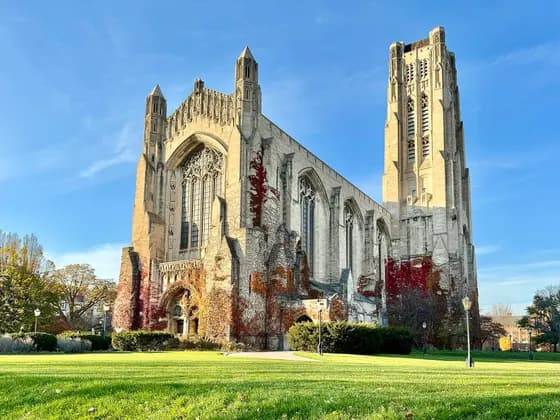
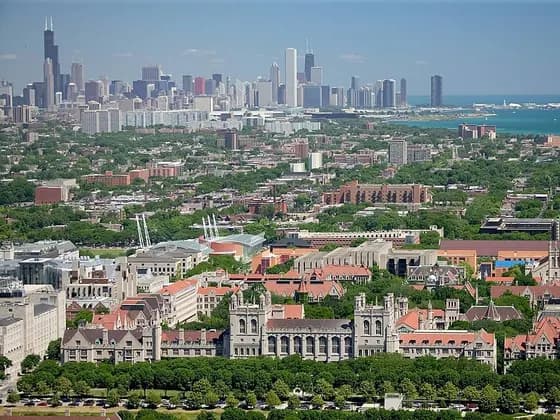
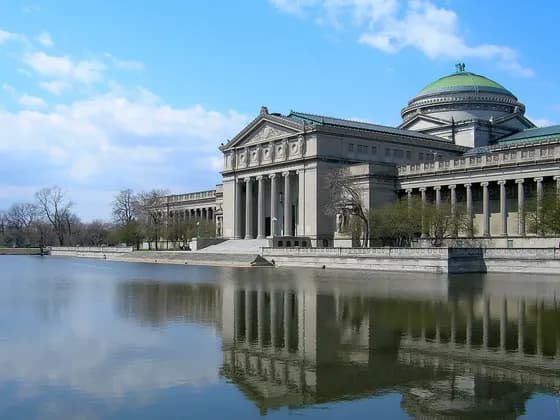
Photo: Warren LeMay from Chicago, IL, United States · CC BY-SA 2.0 · cropped
Photo: w_lemay · CC BY-SA 2.0 · Photo: Ibrahim Old at Arabic Wikipedia · Public domain · Photo: zooey from Chicago, Illinois USA · CC BY 2.0
The Pritzker School of Medicine, UChicago MD program at a glance (2027 entry)
The MD at the Pritzker School of Medicine is a four-year program run within the University of Chicago's Biological Sciences Division. The school sits on the university's main campus in Hyde Park, on Chicago's South Side, steps from the UChicago Medicine hospitals. The school puts classes at about 90 students; its own figures give 91 for the class that entered in 2024 and 100 for the class that entered in 2026.
You would follow the Phoenix Curriculum, which began with the class that entered in 2023 and was the school's biggest curriculum overhaul in about 15 years. Phase 1, the pre-clerkship (preclinical) phase, lasts about 18 to 20 months. Phase 2 is a year of clerkships, the core clinical rotations. Phase 3, about 14 months, adds advanced rotations, electives and preparation for residency, the specialty training doctors do after medical school.
Patient contact starts early. In Immersion Week, right after orientation, you interview standardized patients, people trained to play patients. From January of year 1, a weekly half-day of Ambulatory and Inpatient Mentoring (AIM) takes you into clinics and onto wards with preceptors, the doctors who supervise and teach you. Clerkships begin in late March of year 2.
Before clerkships you must pass Step 1 of the United States Medical Licensing Examination (USMLE), the national licensing exam series. Its clinical knowledge exam, Step 2 CK, follows in Phase 3. Through Scholarship and Discovery (S&D), every MD student completes a mentored research project in one of seven tracks. The school also offers five master's dual degrees and three MD/PhD programs.
| Degree | MD |
|---|---|
| Program length | 4 years in three phases (Phoenix Curriculum, from the 2023 entering class) |
| Class size | About 90; 91 entered in 2024 and 100 in 2026 |
| Main campus | University of Chicago main campus, Hyde Park, Chicago's South Side |
| Teaching style | Integrated; team-based learning, with problem-based groups in two courses |
| Anatomy | Cadaveric dissection in The Human Body, start of year 1 |
| First patient contact | Year 1: standardized patients in August, weekly AIM half-days from January |
| Clinical sites | UChicago Medicine in Hyde Park and Endeavor Health NorthShore, plus community sites |
| Step 1 timing | Pass before clerkships; sit it by early February of year 2 |
| Grading | Pass/fail, except honors to fail grades in the seven core clerkships |
What makes the Pritzker School of Medicine, UChicago MD program different
Core clerkships start in late March of year 2
The Phoenix Curriculum moved the start of clerkships from June to March of the second year. After the clerkship year, Phase 3 brings a sub-internship, or acting internship, where you admit and care for patients more independently.
The same clinical mentors from January of year 1
AIM begins in January of year 1, more than a year before clerkships, and runs to the following December. You are paired with one outpatient preceptor for the whole stretch and with an inpatient faculty preceptor.
Protected research time and a required project
Time for the required S&D project includes a five-week full-time block after Step 1 and usually one to three months in the final year. An optional 11-week summer research program follows year 1, and the school counts seven months available for full-time research.
Three routes to an MD/PhD, including social sciences
Besides the Medical Scientist Training Program (MSTP) for biomedical PhDs, MeSH (Medicine, the Social Sciences and Humanities) has paired the MD with a social sciences or humanities PhD since 1985. The Growth, Development and Disabilities Training Program (GDDTP) funds a PhD for students who choose one after starting medical school.
Health equity and South Side community care
HEAR (Health Equity, Advocacy and Outreach), a first-year course, examines health disparities in the US and in Chicago, and a health policy course covers insurance, cost and access. The six student-run free clinics serve uninsured patients under supervising physicians; in 2025 they ran 173 sessions, treated 731 patients and drew 302 student volunteers.
How Pritzker School of Medicine, UChicago teaches medicine
The school says its curriculum rests on three principles: active learning, integration among disciplines where possible and appropriate, and a scholarly project for every student. In Phase 1, a Scientific Foundations strand teaches the science, from anatomy to pharmacology, while a Physician Formation strand covers clinical skills, health equity, health policy, ethics, research methods and AIM.
The Phoenix Curriculum trimmed overlap to make room for earlier clinical time. The old Cell Pathology and Immunology course and the Microbiology course, for example, became one Host, Defense and Invasion course taught by both instructors. Planners also added more team-based learning in small groups after finding that passive lectures engaged students less. An optional Pritzker Morning Report, modeled on the morning case conferences of residency, lets you work through a real case.
From Phase 2 you learn mainly by working on clinical teams in hospitals and clinics. Phase 3 shifts toward preparing for internship, the first year of residency.
The ways you will learn
| Large-group teaching | Lectures and large-group sessions run through the science courses, from daily sessions in The Human Body to short topic introductions in Clinical Pathophysiology and Therapeutics. Guest experts from across the university teach in the health policy course. |
|---|---|
| Team-based learning (TBL) | In Methods of Inquiry you answer questions on a research paper alone, then refine the answers with your team and submit them together. The course teaches epidemiology, research design and how to judge published studies this way. |
| Problem-based learning (PBL) | A small group works through a clinical problem and decides what it needs to learn. Cell and Organ Physiology pairs lectures with small PBL sessions, and Clinical Pathophysiology and Therapeutics runs faculty-led problem-based groups every day. |
| Standardized patients and OSCEs | In Clinical Skills and Reasoning you practice interviews and examinations with standardized patients in workshops, with fourth-year students as peer educators. You also sit practice and graded objective structured clinical examinations (OSCEs), circuits of timed stations where you are scored as you interview or examine a patient. |
| Simulation | Surgery runs a simulation curriculum in its first few weeks, and pediatrics includes a simulation day at NorthShore. Emergency medicine uses immersive simulation, and the required Transition to Residency course has hands-on practice with central lines, lumbar punctures and intubation. |
| Teaching on clerkships | Internal medicine includes four days of case discussions and lectures and four small-group meetings with a faculty preceptor; pediatrics mixes in-person, live online and prerecorded teaching. |
A typical week on the Pritzker School of Medicine, UChicago program
In Phase 1, lectures are usually recorded, and attending them live is recommended but generally not required. Small groups and labs are different: you must attend at least 85 percent of each course's required sessions. Every clinical encounter, with standardized or real patients, is compulsory, and missing a summative exam without approval counts as a failed attempt.
Clerkships expect you every day, with attendance of at least 95 percent: you may miss at most one day of a four-week clerkship and two days of a six- or eight-week one. Duty hours are capped at 80 a week, averaged over four weeks, with eight hours off between shifts and, on average, one day in seven free. When on call, third-year students should be sent home by midnight.
How anatomy is taught at Pritzker School of Medicine, UChicago
Anatomy comes first. The Human Body, the opening course of the Scientific Foundations strand, follows Immersion Week at the start of year 1 and covers histology, the study of tissues under the microscope, and gross anatomy. You have large- and small-group teaching every day and dissect human cadavers, with sessions on physical examination, surgical approaches and radiologic imaging that tie the anatomy to clinical practice.
The school's technical standards require every student to take part in dissecting cadavers and in anatomy, pathology and neuroanatomy lab work. Practical exams use cadaveric specimens, and any retake must be done before December 1 of year 1. Neuroanatomy returns in Brain and Behavior in the spring.
When you first meet patients at Pritzker School of Medicine, UChicago
In Immersion Week you first meet standardized patients and learn to take a history and approach a clinical encounter. Clinical Skills and Reasoning (CSR) then runs through Phase 1, building communication, examination and clinical reasoning skills with standardized and real patients.
From January of year 1, AIM rotates a weekly half-day through four settings. One is an outpatient clinic such as primary care, family medicine or geriatrics. Another is interprofessional care, for example with physical or occupational therapists or a registered dietitian. The others are CSR workshops or OSCEs, and inpatient sessions where a faculty preceptor watches you assess and present a patient, then gives feedback.
Year by year at Pritzker School of Medicine, UChicago
- Phase 1, year 1
Immersion, anatomy and the body's systems
Year 1 opens in early August with orientation, the White Coat Ceremony and Immersion Week, then runs through the university's autumn, winter and spring quarters to late May.
- Immersion Week: patient-centered skills and an introduction to health disparities, advocacy for health equity and civil discussion of hard issues.
- The Human Body, then Cell and Organ Physiology through autumn and winter: the cardiovascular, respiratory, digestive, endocrine, kidney and reproductive systems in health and disease, with skills such as reading an electrocardiogram (EKG).
- Host, Defense and Invasion from winter, taught in two parts, cell pathology and microbiology: injury, tissue pathology, cancer biology, bacteria and viruses, with pharmacology and clinical genetics introduced.
- Brain and Behavior in spring: neuroanatomy and neurobiology, then neurologic and psychiatric disease, including schizophrenia and disorders of mood, anxiety, substance use and personality.
- HEAR in summer and fall, Foundations of Health Policy and the US Health Care System, and Clinical Medical Ethics in winter, covering consent, confidentiality, surrogacy and shared decision-making.
- Clinical Skills and Reasoning I to III and Methods of Inquiry through the year, AIM from January, and a required S&D elective in spring.
- Summer: the optional 11-week Summer Research Program, ending with a research forum.
- Phase 1, year 2
Disease, treatment, Step 1 and research
Year 2 restarts around the start of September with the last Phase 1 courses, which run until mid-December; Step 1 study and a research block follow before clerkships in late March.
- Clinical Pathophysiology and Therapeutics, organized by system (cardiovascular, endocrine, gastrointestinal, hematologic, musculoskeletal, obstetric and gynecologic, renal and respiratory), with inflammation, infection and cancer as common threads.
- Pharmacology and Therapeutics, mostly integrated with Clinical Pathophysiology: drug delivery and clearance, how drug classes work, pharmacogenomics (how genes shape drug response), and how medicines are studied, approved and monitored.
- Clinical Skills and Reasoning IV and the last months of AIM, through December.
- S&D: choose a mentor and project by early October, apply to the matching track, and receive confirmation before the winter break.
- The school's calendars list a required CBSE the day after the autumn quarter ends in mid-December. NBME, which co-sponsors the USMLE, uses CBSE for its Comprehensive Basic Science exam and publishes guidance on using it to gauge readiness for Step 1.
- Step 1 study block from the first week of January, with the school's deadline to sit Step 1 in the first week of February.
- S&D Block, about five weeks from early February to mid-March: full-time project work, track leader meetings, a progress report and an e-poster.
- Transition to Phase 2, a required program that starts in late March, about a week before Clerkship Block 1.
- Phase 2
Core clerkships
Phase 2 runs from late March of year 2 to late March of year 3 as four 12-week blocks of clerkships.
- Internal medicine, 8 weeks: 4 to 6 weeks on general medicine wards and 2 to 4 on hematology-oncology or cardiology services, at the University of Chicago Medical Center and NorthShore.
- Surgery and Perioperative Medicine and Pain Management is listed at 12 weeks. Its description adds up to less: four weeks of general surgery or trauma, two weeks on two specialty services and two weeks of anesthesiology.
- Ambulatory Medicine, 4 weeks: adult internal medicine, family medicine and geriatrics clinics at the medical center and in the community, including culinary medicine and end-of-life conversations with seniors at a retirement facility.
- Pediatrics, 6 weeks: one week on the nursery, then inpatient and outpatient sites, with the coordinator aiming to give you at least one of your top site choices.
- Obstetrics and gynecology, 6 weeks: mostly high-risk obstetrics at the University of Chicago or mostly low-risk obstetrics and general gynecology at NorthShore. Expect about 12-hour labor and delivery shifts and at least four clinic half-days with your own faculty preceptor.
- Psychiatry, 4 weeks: consultation-liaison work, advising on patients elsewhere in the hospital, at the University of Chicago (adult or child), the community inpatient service at NorthShore, or the academic inpatient service at Ingalls Memorial. Each includes weekly clinic time and a few calls.
- Neurology, 4 weeks at the medical center or NorthShore in Evanston, including an outpatient week. Both groups share orientation and teaching, and everyone sits the last-day exam at the medical center.
- Elective time, about four weeks in all: the Academic Guidelines list a 4-week elective and require two 2-week elective rotations. The 2025 curriculum map places electives in the surgery and medicine blocks and after psychiatry, and the Phase 2 page mentions increased elective time for specialty exploration.
- Phase 3
Differentiation and transition to residency
Phase 3 starts in late March of year 3 and runs about 14 months to graduation in early June of year 4. It opens with Step 2 CK study and preparation for your acting internship. Then come acute care rotations, selectives (required courses picked from a list), electives, residency applications, research and Match Day in March, when you learn where you will train in residency.
- A sub-internship, also called an acting internship: at least four consecutive weeks of direct patient care and admitting at UChicago Medicine or an affiliated hospital. The 2025-26 catalog lists 42, from general internal medicine to neurosurgery and neonatology, some at NorthShore.
- An emergency medicine clerkship, offered at the University of Chicago and at NorthShore, with immersive simulation, plus intensive care unit (ICU) experience.
- A basic science selective that refreshes the science after clerkships. 2025-26 examples include EKG Interpretation, Neuroscience of Pain and Opioids, and Sleep Disorders: Physiology and Clinical Considerations.
- Transition to Residency, a required April course on procedures, breaking bad news, leading family meetings, time and stress management, and patient safety.
- Credits in the 2026-27 Academic Guidelines: sub-internship 100, emergency medicine 100, clinical selectives 200, ICU selective 50, basic science selectives 50, S&D 100, Transition to Residency 100, Senior Scientific 100 and electives 200. All are due by April 30 of your final year.
- Older pages from the previous curriculum still describe a 1,350-unit fourth year, and the Phase 3 page mentions 50 to 150 units of basic science. The Guidelines say they take precedence over earlier versions.
How you are assessed at Pritzker School of Medicine, UChicago
Phase 1 is pass/fail and competency-based: you pass by reaching set standards, not by outscoring classmates. Course grades draw on in-house exams and quizzes, clinical performance checklists from standardized and real patient encounters, review of your clinical notes, narrative comments, small-group and team-based work, and project assessments. Phase 3 courses are also pass/fail and judged mainly on your clinical work.
The school's curriculum and admissions pages call the curriculum pass/fail, and the Academic Guidelines make one exception. The seven core clerkships are graded honors, high pass, pass or fail, and those grades go on your transcript. Each grade combines parts such as clinical performance, OSCEs, an oral exam, workplace-based assessments of your work with patients and a shelf exam, one of NBME's national Clinical Science Subject Exams. Each clerkship explains its breakdown at orientation, and its narrative summary feeds your Medical Student Performance Evaluation (MSPE), the school's letter to residency programs.
The USMLE has three steps. Step 1 tests your grasp of the basic sciences behind medicine and has been reported only as pass or fail since January 26, 2022. Step 2 CK tests your clinical knowledge and how you apply it to patient care. The Liaison Committee on Medical Education (LCME), which accredits MD programs in the United States, lists Pritzker as fully accredited, with its next survey in 2028-29. Students of LCME-accredited programs are eligible to take the USMLE.
You must pass both Step 1 and Step 2 CK to graduate. Step 1 must be taken by the school's deadline in early February of year 2 and passed before Phase 2 begins. If you fail the first attempt, you cannot start clerkships and take a year to pass before rejoining Phase 2. For Step 2 CK, the 2026-27 Academic Guidelines say to sit it by July 1 of your senior year, while the school's calendars give July 15.
In August 2026 the USMLE program announced a move to designated testing dates from January 2029, with Step exams offered less often each year. That replaced a start in 2028, announced in June 2026. The USMLE has also urged schools to review their rules on when students must take the Step exams.
On the current schedule, a student entering in August 2027 would start the Step 1 study block in about January 2029, the month designated testing dates begin. The school's deadline to sit Step 1 would fall in early February 2029, and the Step 2 CK deadline in July 2030. Step 2 CK will also move to designated dates; the USMLE says it will not be offered in some months, with dates published more than a year ahead. These dates are projections from the 2025-26 and 2026-27 calendars.
- Formal feedback comes by the midpoint of every course and clerkship. Each assessment allows two attempts; failing the retake fails the course, and failing a course twice can lead to dismissal.
- Catch-up deadlines: year 1 courses must be passed by August 1, and year 2 retakes finished before the Transition to Phase 2.
- Older lines on the school's site still give December 1 of the fourth year as the Step 2 CK deadline (policies page) and a 2020-21 accreditation review (About page). The USMLE requirements page keeps a December 1 heading but says the deadline moved to July 1 for students entering from 2020.
Where you will actually train at Pritzker School of Medicine, UChicago
Most clinical training happens on the UChicago Medicine campus in Hyde Park, steps from the medical school. Its core is the Center for Care and Discovery, a 10-story building, alongside Comer Children's Hospital, Mitchell Hospital and the Duchossois Center for Advanced Medicine. The school says most inpatient rotations are here or at Endeavor Health NorthShore, and outpatient work is concentrated at the University of Chicago's own clinics.
Endeavor Health, whose hospitals include NorthShore, describes itself as the school's primary teaching affiliate. Six of the seven core clerkships can place you at NorthShore: internal medicine, obstetrics and gynecology, pediatrics and psychiatry, plus surgery and neurology at its Evanston site. The course catalog also lists NorthShore versions of the emergency medicine clerkship and of several sub-internships.
You do not pick sites directly. Before Phase 2 you rank all 24 clerkship pathways, the possible schedules for the year, in a lottery that takes students in random order. Afterward you can swap a whole pathway with a classmate. Departments set each rotation's location, though some consider preferences, and if an assignment means living away from home you must be told at least a month ahead.
For off-site clerkships the school reimburses mileage if you drive, plus tolls and Chicago Transit Authority (CTA) or Metra fares, but not parking or cabs. If you live in Hyde Park or Kenwood and must reach the medical center before 7 a.m. for surgery, obstetrics and gynecology, pediatrics or internal medicine, half your Uber or Lyft fare is refunded.
- Center for Care and Discovery
- Comer Children's Hospital
- Mitchell Hospital
- Duchossois Center for Advanced Medicine
- University of Chicago outpatient clinics
Primary teaching affiliate.
- Endeavor Health NorthShore, Evanston (surgery and neurology)
- NorthShore services for internal medicine, obstetrics and gynecology, pediatrics and psychiatry
Owned by UChicago Medicine; hosts one of three psychiatry clerkship settings, an academic inpatient service.
- UChicago Medicine Ingalls Memorial Hospital
Pediatrics uses La Rabida and the Friend Health and Flossmoor clinics; the ambulatory clerkship uses community family medicine clinics.
- La Rabida Children's Hospital
- Friend Health
- Pediatric outpatient site in Flossmoor
- Community family medicine clinics
Volunteer clinics for uninsured patients, supervised by UChicago and NorthShore physicians. The free clinics page lists six; an older MSTP page says five.
- Bridgeport Free Clinic
- CommunityHealth
- Maria Shelter Medical Clinic
- SEVA Free Clinic
- South Side Free Clinic
- Washington Park Children's Free Health Clinic
Electives, selectives and away rotations at Pritzker School of Medicine, UChicago
Electives are rotations or courses you choose. Phase 1 has a required 50-unit S&D elective in spring: a track elective, preparation for the Summer Research Program, or independent study with a mentor. The Department of Family Medicine also runs a Culinary Medicine elective in Phase 1, and the Medical Education track's first-year elective is a 10-week primer on medical education.
Phase 3 holds most of the choice. A two-round lottery assigns its courses, and you can trade electives one for one before schedules are final. You can also design an independent study in research, basic science or clinical work with a faculty sponsor. Family Medicine's Phase 3 electives alone include sports medicine, integrative medicine and osteopathic manipulative medicine.
Away rotations are electives at other schools' hospitals, often a chance to see a residency program up close. The school says some specialties expect them, including dermatology, emergency medicine, neurosurgery, ophthalmology, orthopedic surgery, otolaryngology, plastic surgery, urology and vascular surgery. You can do up to three, with credit for two, and the Academic Guidelines allow up to two months of outside clinical electives for credit.
Many host schools take applications through the Association of American Medical Colleges (AAMC) Visiting Student Learning Opportunities service, with deadlines generally from February to April, and you need to have passed Step 1. International experiences for credit require the school's global health checklist six weeks before departure.
Dual degrees and research years at Pritzker School of Medicine, UChicago
Research is part of the MD through S&D, the school's scholarly concentration program. Every MD student completes a mentored project by graduation in one of seven tracks: Basic/Translational Sciences, Clinical Research, Health Services and Data Science, Community Health, Global Health, Medical Education, and Healthcare Delivery Improvement Sciences. S&D runs in years 1, 2 and 4, with no project requirement in the clerkship year. A sentence on several pages still mentions five fields, which is older wording.
Year 1 brings a research orientation, including a one-hour ethics lecture that counts as the university's human subjects training, and a letter suggesting mentors and projects. In the final year you file a Learning Plan by early July and complete at least 100 S&D units, up to 300. That usually means one to three months of project work, though a project-related non-clinical elective can also count. A 500-word abstract, e-poster and reflection are due in early spring.
The Senior Scientific Session, a judged research forum, is listed as required on the Phase 3 page, in the Guidelines' credit list and on the 2026-27 calendar. The S&D pages call it optional but encouraged, worth 100 extra units, and the scholarly opportunities page says nearly a third of each graduating class takes part. Pritzker, NorthShore and Kiphart Fellowships fund year-long research projects after the clerkship year, international ones included.
Five master's degrees can be added, each with its own admission. They are the MD/MBA (Booth School of Business), MD/MA in Public Policy (Harris School of Public Policy), MD/MPH, MD/MS in Biomedical Informatics (Graham School) and MD/MS in Applied Data Science. Both degrees take about five years in total, and the pages say students typically start the second degree after three years of medical school.
The MSTP, founded in 1967 and funded by the National Institutes of Health (NIH), pairs the MD with a PhD in the biological or physical sciences or molecular engineering. You take one year of medical school, four years of PhD work and three more years of medical school, about eight years in all. MSTP students start in June and must be US citizens or permanent residents.
MeSH pairs the MD with a social sciences or humanities PhD, usually starting with two years of graduate school. Former students have taken PhDs in anthropology, economics, public policy and philosophy, though the MeSH page notes a 2026-27 pause in Harris PhD admissions. The GDDTP is for current students who choose a PhD after year 1 or 2, preferably year 2, and offers NIH support for up to five years. It is open only to US citizens and permanent residents.
- Without adding a degree, Phase 1 students can apply in January for the Certificate in Healthcare Delivery Science and Innovation. It requires extra coursework, at least 16 events or lectures and a practicum, which an S&D project in a health services or healthcare delivery track can fill.
- Dated details: both dual-degree pages still show a January 15, 2021 deadline for the MD/MPH application.
- The MSTP page gives 84 current students in its figures and an MSTP student body of 80 in its text.
Facilities and support at Pritzker School of Medicine, UChicago
Where you will learn
The Clinical Performance Center, on the lower level of the Biological Sciences Learning Center at 924 East 57th Street, is the school's standardized patient and simulation center. Its web page still describes courses from the previous curriculum. It lists nine exam rooms with recording cameras and computers for reviewing encounters, a HARVEY cardiac patient simulator with 27 disease states, and task trainers for breast, pelvic and prostate exams.
Culinary medicine sessions in the Ambulatory Clerkship take place in a university kitchen. Pediatrics students and some obstetrics and gynecology students go to NorthShore for simulation, and Virtual Microscopy offers an online collection of pathology slides.
Support while you study
Every student joins one of four advising Societies, named after figures from the university's history: Coggeshall, Huggins, Lewis and Rowley. Each mixes students from all four classes, so advice passes between classes as well as from faculty. Each also has its own faculty career advisors, two or three per Society on the current list. In years 3 and 4 you meet your advisor one-on-one to steer you through the Match.
For academic help there is an associate dean for academic advising and fourth-year peer mentors who help younger students navigate the curriculum. The university's Academic Skills Assessment Program helps with study skills, exam preparation and test anxiety. Academic Progress Committees of course and clerkship directors meet each quarter to review progress and can recommend support such as a learning specialist.
Faculty ombudspersons, physicians with no role in grading students, and peer ombudspersons from the student leaders called Pritzker Chiefs help when problems arise. The school offers wellness grants, and a student Wellness Committee runs events. Health care through UChicago Student Wellness is confidential, and you will not be treated by anyone who supervises your clinical work.
Is the Pritzker School of Medicine, UChicago program right for you?
This program may suit you if
- You want full-time clinical work early: core clerkships start in late March of year 2.
- You want research built into the degree, with a required mentored project, a five-week research block and an optional summer program after year 1.
- You want regular patient contact during the science years, with the same outpatient preceptor for about a year through AIM.
- You are drawn to policy, economics or the social sciences: there is a health policy course, an MD/MA with Harris, an MD/MBA with Booth and the MeSH MD/PhD.
- You want to learn anatomy by dissecting human cadavers from the start of year 1.
Things to think about
- Step 1 is a firm gate: you must pass it before clerkships, and failing the first attempt costs a year before you rejoin Phase 2.
- Despite the pass/fail label, core clerkship grades, from honors to fail, go on your transcript.
- The research project is required even if you plan a purely clinical career.
- If you start in 2027, your Step 1 window would fall in early 2029 on the current schedule. That is when the USMLE's designated testing dates begin, so your Step 1 and Step 2 CK timing may shift.
- Clerkship sites come from a lottery and departmental assignment, so some rotations may be at NorthShore in Evanston rather than in Hyde Park.
Pritzker School of Medicine, UChicago MD program — frequently asked questions
Applying to Pritzker School of Medicine, UChicago?
How to get into Pritzker School of Medicine, UChicago
Prerequisites, MCAT, AMCAS personal statement, secondaries and interview, step by step.
Open the guide →Pritzker School of Medicine, UChicago admissions profile
MCAT and GPA profile, acceptance rate, interview format and key dates.
See the profile →Compare Pritzker School of Medicine, UChicago with other schools
Put the teaching style, anatomy teaching and clinical sites next to another school.
Open the comparison →Prepare for the Pritzker School of Medicine, UChicago interview
Format breakdown, school-specific sample questions and prep tips from tutors who interviewed here.
Read the guide →Where this Pritzker School of Medicine, UChicago program guide came from
This guide was written from 63 official sources — Pritzker School of Medicine (University of Chicago)'s own program pages and curriculum documents, plus the accreditor and the hospitals and health systems the school trains students in where they publish detail — read on 2026-10-11, then checked claim by claim against those sources.
- Pritzker School of Medicine: The Pritzker Curriculum (MD curriculum overview)
- Pritzker Phoenix Curriculum Map 2025 (image on the MD curriculum page)
- Pritzker: Phase One Courses
- Pritzker: Phase 2 Core Clerkships
- Pritzker: Phoenix Phase 3, Differentiation and Transition
- Pritzker Academic Guidelines, Academic Year 2026-2027 (published August 1, 2026)
- Pritzker Academic Calendar, AY 2026-27
- Pritzker Academic Calendar, AY 2025-26
- Pritzker Attendance and Participation Policy, August 2026
- Pritzker Student Assignment Policy, reviewed August 2026
- Pritzker Student Duty Hours Policy, reviewed August 2026
- Pritzker Evaluation and Feedback Policy, August 2026
- Pritzker and University Policies (includes older graduation requirements)
- Pritzker: USMLE Requirements (older page)
- Pritzker: Fourth Year Requirements for Graduation (older page)
- Pritzker: Away Rotations
- Pritzker: Funding for Off-Site Clerkship Travel
- Pritzker: Early Morning Transportation
- UChicago Department of Family Medicine: Phase Two Ambulatory Clerkship
- UChicago Department of Family Medicine: Medical Students
- Pritzker: Scholarship and Discovery
- Pritzker: Phase 1 M1 Scholarship and Discovery
- Pritzker: Phase 1 M2 Scholarship and Discovery
- Pritzker: Phase 3 Scholarship and Discovery
- Pritzker: Scholarship and Discovery Tracks
- Pritzker: Scholarly Opportunities
- Pritzker: Summer Research Program
- Pritzker: Dual Degrees
- Pritzker: Degree Programs
- Pritzker: Medical Scientist Training Program
- Pritzker MSTP: Program and Curriculum Overview
- Pritzker MSTP: Prospective Students
- Pritzker: MeSH, MD-PhD Program in Medicine, the Social Sciences and Humanities
- Pritzker: Growth, Development and Disabilities Training Program
- Pritzker: Certificate in Healthcare Delivery Science and Innovation
- Pritzker: Clinical Performance Center
- Pritzker: Career Advising and the Advising Societies
- Pritzker: Student Support and Wellness
- Pritzker: Community-Based Medical Education (older wording)
- Pritzker: Free Clinics
- About Pritzker
- Pritzker: Facts and Figures
- Pritzker: Entering Class Profile
- Pritzker news: the 100th class at the 2026 White Coat Ceremony
- UChicago Medicine news: new residencies at Ingalls Memorial in Harvey, September 2026
- UChicago Biological Sciences Division: Pritzker's new Phoenix Curriculum, May 2024
- Pritzker Course Catalog: sub-internships, 2025-26
- Pritzker Course Catalog: basic science selectives, 2025-26 (first page)
- Pritzker Course Catalog: emergency medicine clerkships, 2025-26
- Pritzker: Nutrition Curriculum Thread
- Pritzker Admissions: Why Pritzker
- Pritzker: Academics and curriculum principles
- Pritzker School of Medicine home page
- Endeavor Health: Academics and medical education (teaching affiliation)
- LCME Directory: Accredited Programs (updated July 22, 2026)
- LCME: About the School Directory
- USMLE Designated Testing Dates Information Hub
- USMLE: Updated timeline, designated testing dates transition in January 2029 (August 6, 2026)
- USMLE: Designated Testing Dates FAQs (updated August 6, 2026)
- USMLE: Examination Results and Scoring
- USMLE: Step Exams
- About NBME
- NBME: Comprehensive Subject Exams, including Comprehensive Basic Science and guidance on CBSE and Step 1 readiness
Curricula are restructured between cycles. Anything here that decides your application — how anatomy is taught, a clinical campus assignment, a required research year — should be confirmed against the official page for your entry year.
Applying to Pritzker School of Medicine, UChicago?
We help US applicants with MCAT strategy, the AMCAS personal statement, secondary essays and interview prep — everything you need for a competitive Pritzker School of Medicine, UChicago application.