
The University of Pittsburgh School of Medicine MD program
What you actually study, and where you will be
University of Pittsburgh School of Medicine's MD is a 4-year program taught through case-based learning in an integrated curriculum, with patient contact from Weeks 1-2 and clinical rotations in UPMC and VA hospitals and clinics across Greater Pittsburgh (2027 entry). Pitt's MD follows the Three Rivers Curriculum, introduced in 2023. Foundations, the pre-clerkship phase of about a year and a half, teaches science through case-based small groups, with clinical skills, a long-term patient partner and community work alongside. A year of clerkships, the core clinical rotations, starts in February of the second year. The 15-month Bridges phase adds an acting internship, electives and residency preparation. Every student also completes a four-year research project.
- Degree
- MD
- Length
- 4 years
- Teaching
- Case-based learning + Integrated
- Clinical contact
- Weeks 1-2

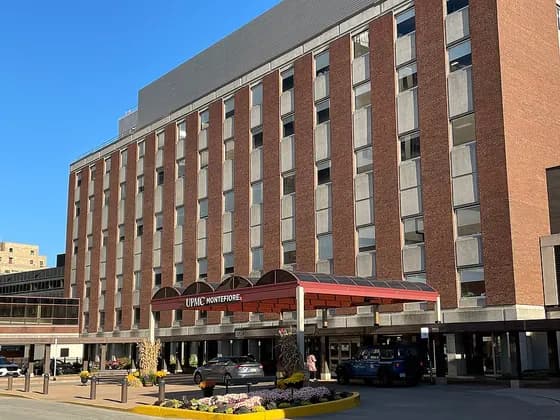


Photo: Tony Webster · CC BY-SA 2.0 · cropped
Photo: Varun Punnam · CC BY-SA 4.0 · Photo: Piotrus · CC BY-SA 3.0 · Photo: Dllu · CC BY-SA 4.0
The University of Pittsburgh School of Medicine MD program at a glance (2027 entry)
The University of Pittsburgh School of Medicine, often called Pitt Med, runs a four-year MD based in the Oakland neighborhood of Pittsburgh. Since 2023 it has followed the Three Rivers Curriculum, in three phases. Foundations is the pre-clerkship phase of about a year and a half. Clerkships is a year of core clinical rotations, and Bridges brings 15 months of advanced rotations and preparation for residency, the specialty training that follows graduation. The 2025 entering class had 151 students, according to the admissions office.
Foundations moves away from lectures toward small groups that work through clinical cases with a longitudinal educator, a faculty member who stays with your group for a whole semester. Science comes in integrated blocks, first Keystone Fundamentals and then 12 organ system courses, with frequent low-stakes quizzes. The phase is graded Satisfactory/Unsatisfactory, the school's pass/fail scale, and ends with about six weeks of study for Step 1, the first part of the United States Medical Licensing Examination (USMLE).
Patients appear early: panels of patients meet students in the opening course, interviewing practice starts in week 3, and you follow a local patient with a chronic illness until graduation. You and a small group of classmates also work with a Pittsburgh community organization for 15 months, and every student completes a four-year mentored research project.
Clerkships start in February of your second year. They run as blocks at hospitals and clinics of UPMC (the University of Pittsburgh Medical Center), the health system that is the school's main clinical partner. Some rotations also use the VA Pittsburgh Healthcare System, run by the US Department of Veterans Affairs. Sites are assigned by lottery.
Bridges then adds a four-week acting internship, also called a sub-internship, where you carry much of a first-year resident's workload. It also brings about 30 weeks of electives you choose yourself and a residency boot camp before graduation in May.
| Degree | MD |
|---|---|
| Program length | 4 years; 3 on the Primary Care Accelerated Track |
| Class size | 151 students entered in 2025 (Class of 2029) |
| Teaching style | Case-based small groups led by longitudinal educators, plus pre-recorded modules |
| Anatomy | Three-week immersion with human donor dissection, then anatomy within organ systems |
| First patient contact | Weeks 1-2: patient panels in the opening course; clerkships from February of Year 2 |
| Clinical sites | UPMC hospitals and clinics and VA Pittsburgh, assigned by lottery |
| Step 1 timing | Current policy: by January 15 of Year 2; Pitt will review it for 2029 |
| Grading | Pass/fail in Foundations; five levels, Honors to Unsatisfactory, in clinical rotations |
| Accreditation | Liaison Committee on Medical Education: full; next survey 2026-27 |
What makes the University of Pittsburgh School of Medicine MD program different
One patient with a chronic illness, followed for four years
In the Longitudinal Alliance Program you are paired with a local patient whose condition needs UPMC or VA visits every three to four months. You aim for six meaningful contacts in your first 15 months, by phone, video or in person, then four a year until graduation, and may join them at appointments. Debriefs with a faculty facilitator show how illness and care change over time.
A 15-month alliance with a Pittsburgh community organization
A group of 4 to 10 students partners with one community organization for the first 15 months; the 2025-26 list has 32 partners. You learn the partner's work, map the community's strengths and complete a service-learning project together, alongside small-group workshops. Assessment draws on feedback from the site and a final group presentation.
A mentored research project in every year
Every student completes the Longitudinal Research Project. You design, carry out and present an original project with a faculty mentor, prepared through the Evidence, Discovery and Reasoning courses, with a formal proposal due in December of your second year. Your final report, written as a manuscript, must be approved by February of your final year before you can graduate.
Six flex weeks you shape yourself
Spread through Foundations, they let you pick structured experiences or design your own: shadowing, research, community service, wellness, remediation, or Professional Enrichment Courses such as Medical Spanish or Culinary Medicine. Experiences are designed to average about two hours of scheduled activity and five hours of total work a day, and the only assessment is a self-assessment after each week.
A three-year route into UPMC primary care residencies
The Primary Care Accelerated Track, created in 2023 with UPMC's residency programs, lets selected students graduate in three years. You start on July 1 with a month-long course, return for two months the next summer and spend a weekly half-day at your future residency site from the start. Tracks lead to UPMC family medicine, pediatrics or internal medicine residencies if you meet the requirements.
How University of Pittsburgh School of Medicine teaches medicine
In Foundations, most learning is active rather than lecture-based, built around clinical cases worked through in small groups with your longitudinal educator. Medium and large group sessions and review sessions fill out each block, and organ system courses such as Cardiology add patient panels and clinical skills workshops.
Subjects are taught together. Keystone Fundamentals blends anatomy, histology, immunology, genetics, pharmacology, biochemistry, pathology, hematology and microbiology into one case-based course. Each organ system course then joins physiology, disease mechanisms, pharmacology and clinical medicine for one part of the body. Clinical skills, ethics and society, and research methods courses run alongside. Four threads return in sessions across three semesters: clinical reasoning, interprofessional education, social medicine and leadership.
From the clerkships on, teaching moves to wards and clinics. The school's 2024/25 Fact Book gave different, older figures: 1.5 years of clerkships, 1 year of Bridges and five flex weeks.
The ways you will learn
| Independent learning modules | Pre-recorded videos and web-based modules carry much of the core content in Keystone Fundamentals and the organ system courses. You work through them before small groups, so group time goes on applying the material to cases. |
|---|---|
| Small-group case sessions | Patient, Physician and Society adds team-based learning, where you prepare beforehand and solve problems as a team. Any small group of 12 or fewer that meets the same instructor four or more times brings you written narrative feedback. |
| Clinical skills with standardized patients | Patient Centered Care runs through all three Foundations semesters. Physical Examination is taught in groups of about five with a clinical skills preceptor, with practice on standardized patients, people trained to portray patients. Introduction to Clinical Medicine, the year-long capstone, adds real patients, point-of-care ultrasound and work with the electronic medical record. |
| Clerkship teaching | On rotations such as Adult Inpatient Medicine you are assigned your own patients and work under resident and faculty supervision, taking histories, examining, presenting and writing notes. Clerkships add lectures, conferences, case-based workshops, simulation and standardized patient sessions, and every required clerkship of four weeks or more includes a formal mid-clerkship assessment. |
A typical week on the University of Pittsburgh School of Medicine program
This picture is built from the school's draft first-year calendar for students entering in 2027 and its workload policy. In Keystone Fundamentals and the organ system blocks, mornings are block teaching. Most Wednesday mornings go to a rotating slot instead: Evidence, Discovery and Reasoning; Patient, Physician and Society; an alliance program session; or a thread session such as leadership or clinical reasoning.
Monday to Wednesday afternoons are either unscheduled or Patient Centered Care, such as interviewing, physical examination or, from January, Introduction to Clinical Medicine. Thursday and Friday afternoons are unscheduled. Most Fridays bring a formative assessment, a practice quiz that does not count toward your grade, and each block ends with a summative exam, usually on its last Friday.
The workload policy caps required scheduled sessions in Foundations at 25 hours a week, or 31 in progress-test weeks. It also guarantees at least two half-days of independent learning time during business hours. In the clerkships and Bridges, duty hours are capped at 80 a week, with at least one full day in seven free of all duties.
How anatomy is taught at University of Pittsburgh School of Medicine
Anatomy begins with the Medical Anatomy Immersion, an intensive three-week course in August of your first year, straight after orientation. It covers the gross structure of the body, from the organs of the thorax, abdomen and pelvis to the nervous system, cranial nerves, blood vessels and the bones of the head and trunk. Each day starts with a lab introduction that links your independent study to the session.
You learn through human donor dissection, with virtual dissection software on iPads and other augmented and virtual reality tools alongside. Clinicians from different specialties give demonstrations, and teaching assistants run review sessions and mock exams. Your group also agrees on a standard for treating donors with respect and reflects on it in writing. The admissions page places the anatomy lab on the seventh floor of Scaife Hall, and the 2024/25 Fact Book lists an Anatomage table and Microsoft HoloLens headsets for 3D views in the anatomy suite.
The immersion ends with a cumulative exam, part multiple choice and part lab practical, plus a written reflection. Anatomy then returns within the organ system courses. Examples include the thorax and heart in Cardiology, the upper airway in Pulmonology, joints in Rheumatology, the limbs in Musculoskeletal, the pelvis in Reproduction and the brain in Neuroscience.
When you first meet patients at University of Pittsburgh School of Medicine
Patients appear in your first two weeks: the opening course, Purpose and Practice of Becoming a Physician, includes patient panel encounters. Medical Interviewing begins in week 3 and ends with a Clinical Interview Assessment.
Physical Examination follows in the fall and ends with an OSCE, an objective structured clinical examination. You perform a full physical examination on a standardized patient, scored against a checklist, and must complete 90 percent of its items to pass. The curriculum page says these Patient Centered Care courses take place in hospital and clinic sites as well as classrooms. Full-time clinical work begins after Step 1, with the Preclerkship Course in late January of your second year and clerkships from February.
Year by year at University of Pittsburgh School of Medicine
- Year 1 (Foundations)
Orientation, anatomy and the first organ systems
On the school's draft calendar, the first year for students entering in 2027 runs from July 26, 2027 to about May 19, 2028. It opens with the two-week Purpose and Practice course and the three-week anatomy immersion, then Keystone Fundamentals from September to December. Six organ system courses fill January to May.
- Purpose and Practice of Becoming a Physician: the curriculum and school resources, professional identity and the doctor-patient relationship, with patient panels and Basic Life Support certification.
- Keystone Fundamentals, examined in two cumulative summative exams, in October and December.
- Cardiology, Nephrology, Pulmonology, and Digestion and Nutrition, each closed by its own summative exam, then Rheumatology and Dermatology, examined together with Patient, Physician and Society 2 in May.
- Medical Interviewing, then Physical Examination, then Introduction to Clinical Medicine 1, each ending in a clinical skills assessment.
- Patient, Physician and Society 1 and 2 (ethics, law, patient safety, health systems and racism in medicine) and Evidence, Discovery and Reasoning 1 and 2 (biostatistics, study design and a research proposal).
- Four flex weeks and progress tests in October and May.
- Year 2, August to January (Foundations)
The last organ systems and Step 1
On the current schedule, your second year starts in August 2028 with six more organ system courses, ending in late November. About six weeks of Step 1 study follow, split around winter recess, and the school expects you to take Step 1 by January 15, 2029.
- Endocrinology; Musculoskeletal; and Reproduction, Sexual Health and Gynecology, examined together in a combined summative exam in September.
- Neuroscience, Psychiatry and Hematology-Oncology through October and November.
- Introduction to Clinical Medicine 2, interpreting ultrasound findings in disease; Patient, Physician and Society 3; and Evidence, Discovery and Reasoning 3, on critical appraisal and AI in clinical care.
- Two more flex weeks and a third progress test in November, on the 2026-27 pattern.
- The Community Alliance Program closes with a retreat and final group presentations.
- Years 2-3, February to January (Clerkships)
The core clerkship year
After the two-week Preclerkship Course, the clerkship year runs in twelve four-week periods from early February: on the current schedule, February 2029 to January 2030. You take seven required clerkships as separate blocks, in an order that varies by student, rather than as a longitudinal integrated clerkship (LIC), where you would follow patients across specialties for months.
- Preclerkship Course: notes, orders and prescriptions, the electronic record, CPR, infection control and a pandemic simulation, graded Satisfactory/Unsatisfactory.
- Adult Inpatient Medicine (8 weeks): two four-week inpatient blocks at local hospitals.
- Surgery (8 weeks): a Launch Week of workshops, two three-week clinical rotations and a Wrap Up week.
- Pediatrics (8 weeks): three weeks with a hospital medicine team, one on a subspecialty team, and four ambulatory weeks, including one in the pediatric emergency department.
- Obstetrics and Gynecology (6 weeks): outpatient offices, labor and delivery and triage, and gynecology, including urogynecology and gynecologic oncology.
- Family Medicine, Neurology and Psychiatry (4 weeks each). Psychiatry centers on inpatient and partial hospital care, and Family Medicine includes a home visit.
- Up to six weeks of electives, and Discovery Weeks, five across the clerkship year and Bridges, when the whole class reconvenes for teaching, advising and near-peer mentoring.
- The Academic Calendars page says clinical blocks run from early May to the end of April; the block calendars, followed here, start period 1 in early February.
- Years 3-4, February to May (Bridges)
Acting internship, electives and the move to residency
The last 15 months run from February after the clerkship year to graduation in May: on the current schedule, February 2030 to May 2031. They combine required rotations, about 30 weeks of electives and whole-class courses, with eight weeks of vacation and interview time across the two clinical phases.
- Adult Outpatient Medicine (4 weeks): ambulatory internal medicine, with a half-day a week of outpatient psychiatry.
- Anesthesiology (2 weeks) and a four-week acute care selective in adult critical care, adult emergency medicine or pediatric emergency medicine.
- One four-week acting internship, which must be done at Pitt.
- A four-week study elective for Step 2 Clinical Knowledge (CK), the second USMLE exam, in about March, on the 2026-27 curriculum map.
- Integrated Life Science (4 weeks, in person, in February of your final year): basic and translational science applied to current therapies, diagnostics and procedures, with presentations to peers and faculty.
- Diagnostics, six sessions over the first 12 months of Bridges, on choosing and interpreting tests; more Discovery Weeks; and a four-week Get Ready for Residency boot camp in the spring.
How you are assessed at University of Pittsburgh School of Medicine
Foundations is graded Satisfactory/Unsatisfactory. Each block ends with a summative exam, preceded by regular formative quizzes whose results guide your study. Summative exams, OSCEs and other required tests count as benchmark assessments. You get one remediation attempt at each one you fail, may remediate no more than two in a semester, and are referred to the Student Progress and Promotions Committee if failures add up.
The university's 2026-27 catalog says clinical rotations and most electives are graded Honors, High Satisfactory, Satisfactory, Low Satisfactory or Unsatisfactory, with narrative comments. Most clerkship pages match, but the Family Medicine page lists four levels, without Low Satisfactory, and the Psychiatry page uses Honors, High Pass, Pass, Low Pass and Unsatisfactory. Clinical assessments carry the most weight, alongside quizzes and, in some clerkships, an OSCE, a written note, an essay or a project.
Every clerkship page lists an NBME subject exam, a standardized end-of-rotation test from the National Board of Medical Examiners often called a shelf exam, worth 25 percent of the grade. If you fail one, you receive an Incomplete; under the policy effective January 26, 2027, the retake must come within eight weeks, and passing it caps that clerkship at Satisfactory. An Unsatisfactory clerkship must be repeated in full.
The USMLE is the exam series state medical boards use for licensing. Step 1 has been pass/fail since January 26, 2022, and Step 2 CK follows the clerkships. In August 2026 the USMLE program announced a move to designated testing dates from January 2029, with Step exams offered less often each year. Its June 2026 announcement had named 2028.
Pitt's USMLE policy, approved August 17, 2026, makes passing both a graduation requirement, with at most three attempts at each. It expects you to take and pass Step 1 by January 15 of your second year; if you sit it by then, you may start clerkships while the result is pending. Step 2 CK must be attempted within 14 months of starting clerkships and passed before you can be certified for the residency Match.
On the current schedule, a 2027 entrant's Step 1 comes right at the January 2029 switch, with study weeks from late November 2028 into January 2029 and the school's deadline on January 15, 2029. Step 2 CK, due by about spring 2030, falls fully under the new model. Pitt's USMLE and Academic Progress policies both say the school will review its timelines before the change takes effect on January 1, 2029.
- Three progress tests during Foundations help you and your coach track learning and gauge readiness for Step 1.
- The Clinical Competency Assessment, the school's own clinical skills exam, is a graduation requirement; if you fail it, you remediate with the Assistant Dean for Human Simulation Education.
- Other graduation requirements include the Longitudinal Research Project and training in prescribing buprenorphine, a medication for opioid use disorder.
- The Liaison Committee on Medical Education (LCME) accredits MD programs in the United States. For MD students, LCME accreditation is what makes you eligible to sit the USMLE and to enter residencies accredited by the Accreditation Council for Graduate Medical Education (ACGME).
- The LCME directory (updated July 22, 2026) lists Pitt as fully accredited, with its next survey in 2026-27, and the school says its April 2019 visit led to full accreditation until 2026-2027. No outcome of the 2026-27 survey had been published by October 2026.
Where you will actually train at University of Pittsburgh School of Medicine
The whole program is based in Pittsburgh. The medical school sits in Oakland, physically attached to UPMC Presbyterian, UPMC Montefiore and UPMC Western Psychiatric Hospital, with UPMC Magee-Womens Hospital a few blocks away, according to the MD/PhD program's overview. UPMC and the school are legally separate organizations; UPMC says it runs more than 40 hospitals and 800 outpatient sites.
Three clerkship pages name their hospitals, grouped below: Adult Inpatient Medicine, Neurology, and Obstetrics and Gynecology, which is based at UPMC Magee-Womens Hospital with surgical and office sites around Greater Pittsburgh.
Family Medicine and Adult Outpatient Medicine use offices and clinics across the region, from hospital-based sites to community locations. The Pediatrics department says its student teaching is housed at UPMC Children's Hospital of Pittsburgh, though its undated pages still list pre-2023 clerkship names, such as Inpatient Pediatric Medicine. The consultation-liaison psychiatry elective sees patients at Presbyterian, Montefiore and Magee-Womens.
For each required rotation, coordinators publish site information and you rank your preferences; a standardized lottery then assigns sites at least two weeks before the start. Swaps are not allowed, but you can ask for a specific site for reasons such as a disability, and conflict-of-interest requests must be granted. You arrange and pay for your own transport, including gas, parking and fares, and car ownership plays no part in assignment; coordinators share low-cost travel and parking options and may help arrange carpools.
Montefiore: adult inpatient medicine and neurology. Presbyterian: neurology. Magee-Womens: obstetrics and gynecology, and neurology. Western Psychiatric: psychiatry electives.
- UPMC Presbyterian
- UPMC Montefiore
- UPMC Western Psychiatric Hospital
- UPMC Magee-Womens Hospital
Shadyside is an adult inpatient and neurology site, Mercy an adult inpatient site and Passavant a neurology site. Children's, on its Lawrenceville campus, hosts pediatric teaching and pediatric neurology.
- UPMC Shadyside
- UPMC Mercy
- UPMC Passavant
- UPMC Children's Hospital of Pittsburgh
An adult inpatient medicine and neurology site. The H.J. Heinz Campus is among the care sites of Longitudinal Alliance Program patients.
- VA Pittsburgh Healthcare System
- VA H.J. Heinz Campus
- Neurology Outpatient Clinic, Kaufmann Building
- UPMC Headache Center, University Center
- Family medicine and adult outpatient offices and clinics
Track students work at the clinic of their expected residency for all three years.
- UPMC St. Margaret Family Medicine
- UPMC Shadyside Family Medicine
- UPMC McKeesport Family Medicine
- UPMC Children's Hospital of Pittsburgh (pediatrics)
- Internal Medicine Residency Program of UPMC
Electives, selectives and away rotations at University of Pittsburgh School of Medicine
Electives fill 36 weeks across the two clinical phases: up to six in the clerkship year and the rest in Bridges. The school's online Course Catalog lists more than 250 clinical and non-clinical options. Two-week electives suit exploring a field, four-week ones go deeper with more rigorous assessment, and longitudinal electives keep you with the same mentors and patients over time.
The school strongly recommends at least one elective in each of four groups: medicine or neurology; a pediatric field; surgery, a surgical subspecialty or obstetrics and gynecology; and ambulatory care, community medicine or psychiatry. The Psychiatry department alone offers more than 20 fourth-year electives, from geriatric and child psychiatry to consult work in general hospitals.
The acting internship is a required four-week rotation on an inpatient service. You take coordinated responsibility for your patients, from assessment, diagnosis and tests to treatment, discharge plans, notes, handoffs and cross-cover, at a level close to a first-year resident. The current Bridges page and the 2027-28 block calendars list eight specialties. They are cardiothoracic surgery, family medicine, internal medicine, the medical and neonatal intensive care units (MICU and NICU), pediatrics, physical medicine and rehabilitation, and surgery.
Other documents differ. The 2026-27 catalog's Bridges section and the Class of 2028 checklist omit cardiothoracic surgery, and an undated note in the Course Catalog says only family medicine, internal medicine, pediatrics and surgery count.
The four-week boot camp has seven tracks on the Bridges page and in the catalog: anesthesiology, emergency medicine, internal medicine, obstetrics and gynecology, pediatrics, psychiatry and surgery. The Psychiatry department, though, calls its track one of six.
Away electives at other institutions are registered through the school's AMP-UP Course Catalog. International clinical or research electives need advance approval from the Associate Dean for Global Health Education or for Student Affairs, good academic standing, pre-travel training and State Department travel registration. Travel to places under a level 4 travel advisory is not allowed, and credit requires a passing evaluation and a two-page reflection.
Dual degrees and research years at University of Pittsburgh School of Medicine
For the Longitudinal Research Project, progress reports are due every quarter in the first year and early second year, then every four months in the clinical years. The optional Dean's Summer Research Project, eight weeks of full-time research in the summer after the first year with a poster symposium in September, can count toward it but cannot replace it.
Streams are optional minors that replaced the legacy curriculum's Areas of Concentration, a name some older pages still use. You choose one of four streams (Healer, Advocate, Innovator or Leader), each with focus areas called currents, such as global health or medical education, and apply by the end of the first year. Requirements include flex weeks or electives in the field, workshops, 40 hours of experiential learning in each of Foundations and Bridges, a capstone of at least 20 hours and 150 credits.
Completing a stream earns a mark of distinction on your Medical Student Performance Evaluation (MSPE), the dean's letter sent to residency programs. Separate school certificates recognize point-of-care ultrasound skills, 100 hours of community service or 20 hours of mentoring. The Social Medicine Fellows Program, started in 2018, selects first-year students to partner with an underserved community around Pittsburgh, such as Braddock or Homewood, on service learning, research and advocacy, with a three-year commitment.
The MD/PhD and Physician Scientist Training Program (PSTP) curriculum pages still describe the pre-2023 structure, with problem-based learning and Step 1 after the second year. The MD/PhD page and the 2024/25 Fact Book also put eight weeks of clerkships before the PhD. Current documents fit MD/PhD students into the three-phase curriculum instead. Their Class of 2028 checklist waives the Integrated Life Science course and the Longitudinal Alliance Program, and they attempt Step 2 CK within two months of finishing clerkship requirements.
- MD/PhD, the Medical Scientist Training Program: run with Carnegie Mellon University since 1983, linking the MD to 19 graduate programs in basic science or engineering, over about seven to eight years. The catalog says it admits only US citizens and permanent residents.
- Physician Scientist Training Program (PSTP), started in 2007: a five-year, non-degree track. It adds paid research in the summers before and after the first year, a research year between the second and third years, and research seminars.
- Clinical Scientist Training Program (CSTP): a research year between the third and fourth years, usually July to June, earning a Certificate or an MS in clinical research. You apply during medical school, not at entry.
- MD/MBA with the Katz Graduate School of Business: five years, with a year at Katz (33 credits, plus 12 shared with the MD) after two or three years of medicine.
- MD/MA in Bioethics: a 30-credit year away from the MD, usually between the second and third years, with core courses, a clinical practicum and a thesis.
- MD/MPH: the admissions page points to the Multidisciplinary MPH at the School of Public Health, 42 credits including a 200-hour practicum and a final essay.
Facilities and support at University of Pittsburgh School of Medicine
Where you will learn
Classes are held in Alan Magee Scaife Hall, whose West Wing opened as the new curriculum launched. It replaced rigid lecture rooms with smaller, flexible spaces suited to small-group work, and a wet lab spans the width of the building. Keystone Fundamentals and the organ system courses also use the Visual Human Atlas Laboratory for histology, pathology and radiology.
The Standardized Patient Program, based in Scaife Hall, supplies standardized patients for teaching and exams and builds hands-on clinical and communication practice into every year.
The Winter Institute for Simulation, Education and Research (WISER), founded in 1994 and accredited by the Society for Simulation in Healthcare, serves both Pitt and UPMC. Adult Inpatient Medicine students have four critical care simulation sessions there, treating acute heart and lung emergencies. The 2024/25 Fact Book adds WISER training in point-of-care ultrasound that uses HoloLens augmented reality and three-dimensional ultrasound probes.
Support while you study
Advising is organized around Advising Houses, Pitt's learning communities. At orientation a House Reveal sorts you into a house. A house dinner then introduces your advisory dean, your academic coach and your coaching cohort, and house lunches follow in the fall and spring.
According to the current advising page, you are assigned one of eight advisory deans for all four years. They meet you individually and in groups, help plan your clerkship and Bridges schedules, and guide your specialty choice and residency application, but play no part in grading or promotion. An older page still online in October 2026 says seven advisory deans and describes first-year FAST groups.
Since fall 2023, every entering student has been paired with a faculty academic coach, an MD or DO, for monthly meetings and as-needed check-ins through all four years. Coaches help with study plans, goals and balance; they are not content experts or therapists, and they do not grade you. In the BIG/Little program, which replaced FAST, one or two second-year students mentor each first-year coaching group.
If you struggle, the Academic Success Team, including learning specialists, builds study plans with you and can arrange tutoring and practice-exam vouchers. The school's Mental Health Program, running since 1980, offers free, confidential therapy and psychiatric care, with no insurance billed.
Before you start, the optional five-week Prologue to Medicine, from June to early July, introduces the curriculum, faculty and city. Admitted students with a mentor in the Pitt Schools of Health Sciences can apply to the Pitt Med Research Experience for Prematriculants, eight weeks of research before orientation.
Is the University of Pittsburgh School of Medicine program right for you?
This program may suit you if
- You learn best by working through cases in a small group with the same educator for a semester, rather than in lecture halls.
- You want to follow one patient with a chronic illness from your first year to graduation, and to work with a community group for 15 months.
- You want research built in: a four-year mentored project that ends in a manuscript-style report.
- You are set on primary care and would consider a three-year MD with a route into a UPMC residency.
- You like structured support: an advisory dean, an academic coach, an Advising House and second-year mentors from orientation.
Things to think about
- Clerkship sites are assigned by lottery, swaps are not allowed, and you arrange and pay for your own transport to every site.
- Clerkships start in February of your second year, after a January 15 Step 1 deadline that lands at the USMLE's 2029 change and may be revised.
- Clinical rotations are graded on five levels, and each shelf exam is a quarter of the clerkship grade.
- Some details differ between school documents, such as the acting internship list, so check the current rules when you enroll.
University of Pittsburgh School of Medicine MD program — frequently asked questions
Applying to University of Pittsburgh School of Medicine?
How to get into University of Pittsburgh School of Medicine
Prerequisites, MCAT, AMCAS personal statement, secondaries and interview, step by step.
Open the guide →University of Pittsburgh School of Medicine admissions profile
MCAT and GPA profile, acceptance rate, interview format and key dates.
See the profile →Compare University of Pittsburgh School of Medicine with other schools
Put the teaching style, anatomy teaching and clinical sites next to another school.
Open the comparison →Prepare for the University of Pittsburgh School of Medicine interview
Format breakdown, school-specific sample questions and prep tips from tutors who interviewed here.
Read the guide →Where this University of Pittsburgh School of Medicine program guide came from
This guide was written from 102 official sources — University of Pittsburgh School of Medicine's own program pages and curriculum documents, plus the accreditor and the hospitals and health systems the school trains students in where they publish detail — read on 2026-10-11, then checked claim by claim against those sources.
- Office of Medical Education: Three Rivers Curriculum (revised October 9, 2026)
- Office of Medical Education: Foundations Phase
- Office of Medical Education: Clerkships Phase
- Office of Medical Education: Bridges Phase
- Office of Medical Education: Flex Weeks
- UPSOM Curriculum Map, AY 2026-2027
- Office of Medical Education: Academic Calendars
- First-year daily calendar, Class of 2031 (AY 2027-2028), draft
- Second-year daily calendar, Class of 2030 (AY 2027-2028), draft
- Combined Clerkships and Bridges Phases Block Calendar, Class of 2029, AY 2027-2028
- Combined Clinical Years Block Calendar, Class of 2028 (Clerkship Phase), AY 2026-2027
- Combined Clerkships and Bridges Phases Block Calendar, Class of 2028 (Bridges Phase), AY 2027-2028
- Combined Clerkships and Bridges Phases Calendar, Class of 2027 (Bridges Phase), AY 2026-2027
- MS-1 Assessments Schedule, Class of 2030 (AY 2026-2027)
- MS-2 Assessments Schedule, Class of 2029 (AY 2026-2027)
- Office of Medical Education home page (older curriculum wording)
- Policy on USMLE Examinations (approved August 17, 2026)
- Policy on Academic Progress and Promotion (revisions approved July 6, 2026)
- Policy on NBME Subject Make-Up Exams in the Clerkships Phase (effective January 26, 2027)
- Policy on Clerkship Make-Up Exams (2023)
- Policy on Site Assignment and Transportation (approved July 6, 2026)
- Policy on Medical Student Workload (approved October 5, 2026)
- Policy on Formative Assessment and Feedback (approved October 5, 2026)
- Policy on Narrative Assessment in Courses and Clerkships
- Policy on International Educational Experiences
- Course page: The Purpose and Practice of Becoming a Physician
- Course page: Medical Anatomy Immersion
- Course page: Keystone Fundamentals
- Course page: Cardiology (organ systems)
- Course page: Medical Interviewing
- Course page: Physical Examination
- Course page: Introduction to Clinical Medicine 1 and 2
- Course page: Patient, Physician and Society 1, 2 and 3
- Course page: Evidence, Discovery and Reasoning 1, 2 and 3
- Course page: Professional Development Course (flex weeks)
- Course page: Community Alliance Program
- Office of Medical Education: Longitudinal Alliance Program
- Office of Medical Education: Threads
- Office of Medical Education: Streams
- Office of Medical Education: Certificate Programs
- Office of Medical Education: Dual Degree and Research Training Programs
- Office of Medical Education: Primary Care Accelerated Track
- The University of Pittsburgh Standardized Patient Program
- Course page: Preclerkship Course
- Clerkship page: Adult Inpatient Medicine
- Clerkship page: Adult Outpatient Medicine
- Clerkship page: Neurology
- Clerkship page: Family Medicine
- Clerkship page: Obstetrics and Gynecology
- Clerkship page: Pediatrics
- Clerkship page: Psychiatry
- Clerkship page: Surgery
- Course page: Discovery Weeks
- University of Pittsburgh 2026-2027 catalog: First Professional Program, MD Curriculum
- 2026-2027 catalog: Bioethics, MD/MA
- 2026-2027 catalog: Clinical Science Training Program, MD/MS
- 2026-2027 catalog: Medical Scientist Training Program, MD/PhD
- 2026-2027 catalog: Physician Scientist Training Five-Year Non-Degree Program
- AMP-UP Course Catalog index (acting internship note)
- Class of 2028 Graduation Requirement Checklist
- Class of 2028 MSTP Graduation Requirement Checklist
- Office of Student Affairs: Bridges to Residency Career Advising Program
- Office of Student Affairs: Career and Residency Advising (older page)
- Office of Student Affairs: Academic Coaches
- Office of Student Affairs: Peer-Mentoring
- Office of Student Affairs: Academic Success Resources and Services
- Office of Student Affairs: UPSOM Mental Health Team
- Pitt Med Magazine, Winter 2025: Whole doctors, and whole people (coaching program)
- School of Medicine: Accreditation
- School of Medicine Fact Book 2024/2025 (data as of November 1, 2024)
- Office of Admissions: Curriculum
- Office of Admissions: About UPMC
- Office of Admissions: UPSOM Programs
- Office of Admissions: Class Profile (2025 entering class)
- Office of Student Engagement and Enrichment: Engagement and Enrichment
- Office of Student Engagement and Enrichment: Social Medicine Fellows Program
- Medical Student Research: Longitudinal Research Project
- Medical Student Research: Dean's Summer Research Project
- Medical Student Research: Pitt Med Research Experience for Prematriculants
- Medical Scientist Training Program: Overview
- Medical Scientist Training Program: Curriculum (pre-2023 structure)
- Physician Scientist Training Program: Curriculum (pre-2023 structure)
- Pitt Business: MBA and Doctor of Medicine
- Pitt Public Health: Multidisciplinary Master of Public Health
- Department of Psychiatry: Medical student courses
- Department of Psychiatry: Electives
- Department of Pediatrics: Medical Student Education and Training
- UPMC Children's Hospital of Pittsburgh: Medical Student Education and Training
- UPMC: Facts and Stats
- VA Pittsburgh Healthcare System: About Us
- Winter Institute for Simulation, Education and Research (WISER)
- LCME: About the School Directory
- LCME: Accredited Programs (updated July 22, 2026)
- USMLE: Designated Testing Dates Information Hub
- USMLE: Updated Timeline for Designated Testing Dates, transition in January 2029 (August 6, 2026)
- USMLE: Transition to Limited Testing Dates Starting in 2028 (June 23, 2026, since updated)
- USMLE: Step 1 Transition to Pass/Fail Only Score Reporting
- First-year daily calendar, Class of 2030 (AY 2026-2027)
- AMP-UP Course Catalog introduction (older Areas of Concentration wording)
- Office of Admissions: Who We Are (older curriculum wording)
- Office of Admissions: Training in Primary Care (older curriculum wording)
- School of Medicine: A Century of Medical Excellence
Curricula are restructured between cycles. Anything here that decides your application — how anatomy is taught, a clinical campus assignment, a required research year — should be confirmed against the official page for your entry year.
Applying to University of Pittsburgh School of Medicine?
We help US applicants with MCAT strategy, the AMCAS personal statement, secondary essays and interview prep — everything you need for a competitive University of Pittsburgh School of Medicine application.