
University of Pittsburgh School of Medicine Interview
Format, Questions & Prep Tips
University of Pittsburgh School of Medicine medicine interviews for 2027 entry are a traditional interview, held October 2026 through February 2027. Published figures: Annual MD class size ~152; NIH funding rank Top 10 in the US (#7 overall, #8 among medical schools, FY2025); Tuition (2025–26) ~USD 63,000/year.
- Institution
- University of Pittsburgh School of Medicine
- Interview (2027 entry)
- October through February
- Decisions (2027 entry)
- Regular decisions by late March; waitlist through spring

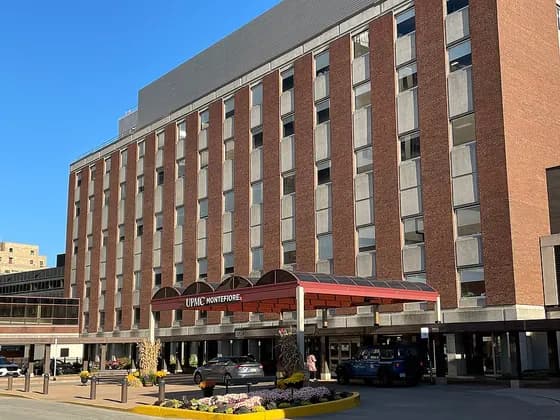


Photo: Tony Webster · CC BY-SA 2.0 · cropped
Photo: Varun Punnam · CC BY-SA 4.0 · Photo: Piotrus · CC BY-SA 3.0 · Photo: Dllu · CC BY-SA 4.0
How to get into University of Pittsburgh School of Medicine (MD) medicine
Step-by-step: entry requirements, admission tests, personal statement, interview format and the key deadlines.
Open the guide →University of Pittsburgh School of Medicine (MD) entry requirements
Admission profile, interview format, decision dates and what makes University of Pittsburgh School of Medicine (MD) different.
See the profile →The University of Pittsburgh School of Medicine MD program
Case-based learning + Integrated, 4 years, clinical rotations across UPMC and VA hospitals and clinics across Greater Pittsburgh.
See the program →The University of Pittsburgh School of Medicine (MD) medicine interview
University of Pittsburgh School of Medicine uses a traditional interview format — typically two one-on-one sessions (faculty/clinician and student). Pitt is one of the most NIH-funded medical schools in the US, and research productivity is a significant admissions criterion. Interviewers probe the depth and independence of research experience.
Pitt's UPMC health system is one of the largest and most integrated in the country, and Pitt trains physicians who operate across a vast clinical enterprise. Interview questions often probe applicants' comfort with large, complex health systems and their ability to navigate institutional hierarchies while maintaining patient-centered care.
Pitt is notable for its transplant medicine (Thomas Starzl joined Pitt in 1981 and established what became the world's leading liver transplant program at UPMC), organ bioengineering, and global health (Center for Global Health). Interviewers frequently probe interest in these signature areas.
University of Pittsburgh School of Medicine (MD) interview at a glance (2027 entry)
| Annual MD class size | ~152 |
|---|---|
| Interview format | Traditional — faculty + student, two sessions |
| NIH funding rank | Top 10 in the US (#7 overall, #8 among medical schools, FY2025) |
| Tuition (2025–26) | ~USD 63,000/year |
| Application system | AMCAS + Pitt secondary |
| Interview window | October–February |
Interview format
- Two one-on-one sessions: faculty/clinician (open-file) and student; 30–45 minutes each.
- No MMI; no structured stations.
Working towards the MCAT score University of Pittsburgh School of Medicine (MD) expects? Build a week-by-week plan from your test date — free for the first two weeks.
Sample interview questions
Pitt is one of the most research-intensive medical schools in the country, embedded in the vast UPMC system. Why is that environment the right fit for you?
Connect your goals to concrete Pitt assets: the depth of NIH-funded research, the scale of UPMC, and signature areas like transplant and organ bioengineering. A generic 'strong research school' answer will not distinguish you.
UPMC is one of the largest integrated health systems in the US. How does the scale of a system shape your thinking about caring for an individual patient?
Discuss trade-offs of large systems: specialization, coordination, and continuity versus the risk of depersonalization. Pair systems thinking with patient-centered values.
Pittsburgh is a former steel city that reinvented itself around health care and technology. How does that history of reinvention resonate with your own path into medicine?
Use the city's transformation as a lens on your own non-linear journey or resilience. Show you have thought about Pittsburgh as a place, including its post-industrial health legacy.
What sustains you through long, demanding, sometimes tedious work? Give a concrete example.
Pitt's research culture rewards stamina. Pick a real project and be honest about the unglamorous stretches and what kept you committed.
Organ allocation is governed by UNOS criteria. A patient of yours is waitlisted for a liver transplant but is socially isolated and may struggle to adhere to post-transplant protocols. Should social factors affect allocation?
Engage UNOS criteria, equity versus utility, the difference between social worth and clinical candidacy, and how teams support adherence rather than excluding for it. Pitt is the historic center of transplant medicine, so reason substantively.
A living donor wants to donate a kidney to a stranger, but the team worries about their motivations and capacity to consent. How should the team proceed?
Cover informed consent, donor autonomy, independent donor advocacy, psychological assessment, and protection from coercion. Transplant programs balance respecting altruism against safeguarding vulnerable donors.
A promising experimental therapy you are studying is far too expensive for most patients who might benefit. What responsibility, if any, do researchers and clinicians have here?
Discuss access, justice, the role of trials in generating evidence, and advocacy for affordability. Avoid both fatalism and the claim that cost is 'not a doctor's problem'.
Is it acceptable to use a patient's de-identified data and tissue for research they did not specifically consent to? Where is the line?
Address broad consent, de-identification, IRB oversight, and public trust. A strong answer recognizes both the scientific value of large datasets and the autonomy interests at stake.
Explain to a frightened patient and their family what being placed on a transplant waiting list means, including that an organ may not come in time.
Be honest about scarcity and uncertainty while preserving hope and dignity. Check understanding and leave space for the family's fear; clarity and compassion both matter.
Describe a time you had to coordinate with many people across different roles to get something done. What did you learn?
UPMC is a complex, hierarchical enterprise. Show you can navigate teams, defer to others' expertise, and keep the shared goal central without losing the human element.
Describe the most significant research question you pursued. What was genuinely your contribution, rather than a task you were assigned?
Pitt faculty are high-output investigators who probe depth. Demonstrate ownership of a question, command of the methods, and an honest grasp of what your work added.
Walk me through how an experimental finding moves from a Pitt laboratory toward a treatment a patient could receive.
Sketch the translational pipeline: discovery, preclinical work, trials, regulatory approval, and implementation. Pitt's bioengineering and transplant strengths make translation a natural theme.
How would you critique a study whose conclusion you wanted to believe? What would make you trust it?
Show you can resist motivated reasoning: design, sample, confounding, replication, and conflicts of interest. Evidence literacy is essential at a top NIH-funded school.
A patient on the transplant list is angry that someone listed after them appears to have received an organ first. Speak with them.
Acknowledge the frustration, explain matching and urgency factors without breaching others' confidentiality, and rebuild trust in the system. De-escalation and honesty come first.
A research mentee tells you they fabricated a data point because the experiment 'obviously should have worked'. Have the conversation with them.
Take integrity seriously without crushing the person: name why fabrication is unacceptable, understand the pressure, and insist on correction and disclosure. Research integrity is non-negotiable.
You're told that transplant waiting-list mortality differs sharply across regions of the US. How would you interpret that, and what would you want to investigate?
Consider organ supply, population need, allocation geography, and access to transplant centers. Name the further data — donation rates, listing practices, demographics — you would request before concluding.
Practise the University of Pittsburgh School of Medicine (MD) interview
Rehearse the real format before the day — on demand with our AI interviewers, or live with a tutor.
Sit a mock with photoreal AI interviewers — any time
A timed MMI or panel interview on video — American & international voices — with interviewers who listen, react and press with follow-ups. Rubric-scored feedback and a replay the moment you finish.






Live mocks with a tutor who’s been in the room
A full University of Pittsburgh School of Medicine (MD)-style mock with a medic or dentist tutor — honest scoring against real marking criteria, a station-by-station debrief and a written action plan.
Book a mock interviewHow to prepare for the University of Pittsburgh School of Medicine (MD) interview
Common pitfalls to avoid
University of Pittsburgh School of Medicine (MD) interview — frequently asked questions
Sources & official admissions information
Ready to nail your University of Pittsburgh School of Medicine (MD) interview?
Book a mock interview with a tutor who knows the US interview formats, orpractice unlimited stations from our interview question bank.