
Lewis Katz School of Medicine at Temple University Interview
Format, Questions & Prep Tips
Lewis Katz School of Medicine at Temple University medicine interviews for 2027 entry are a traditional interview. Published figures: Annual MD class size ~200; Applications received ~10,000–12,000 per cycle; Interview format Traditional one-on-one — 2 sessions, 30–45 min each.
- Institution
- Lewis Katz School of Medicine at Temple University
- Interview (2027 entry)
- October through February; rolling invitations
- Decisions (2027 entry)
- Rolling decisions; final decisions by March 30
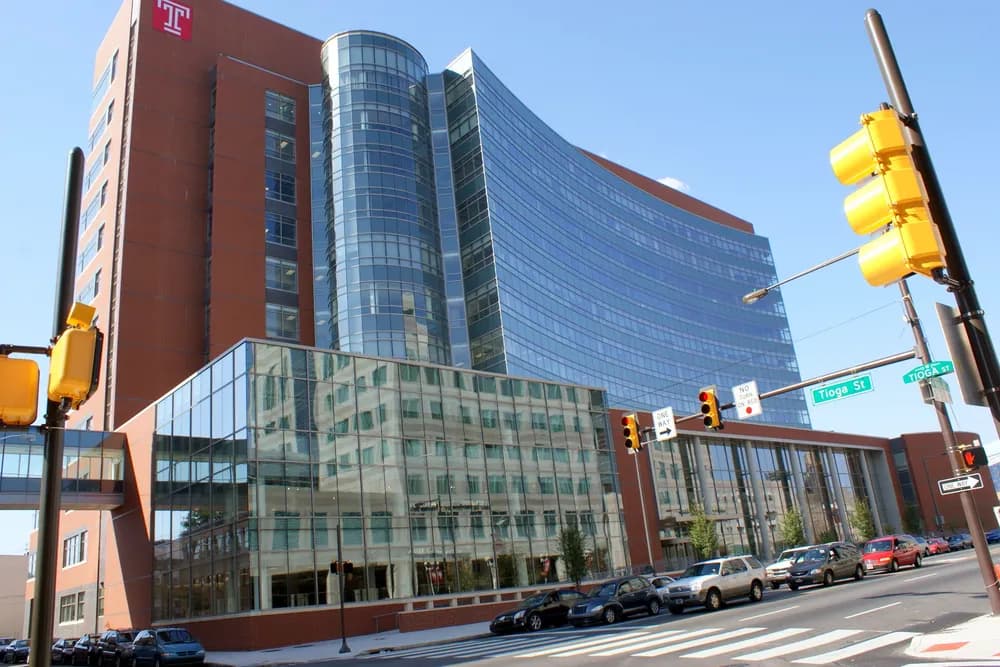
Photo: See below · CC BY-SA 3.0 · cropped
Photo: Jim.henderson · CC BY 4.0 · Photo: Famartin · CC BY-SA 4.0 · Photo: Daderot · Public domain
How to get into Lewis Katz School of Medicine at Temple University (MD) medicine
Step-by-step: entry requirements, admission tests, personal statement, interview format and the key deadlines.
Open the guide →Lewis Katz School of Medicine at Temple University (MD) entry requirements
Admission profile, interview format, decision dates and what makes Lewis Katz School of Medicine at Temple University (MD) different.
See the profile →The Lewis Katz School of Medicine at Temple University (MD) medicine interview
Lewis Katz School of Medicine at Temple University uses a traditional interview format — two one-on-one sessions of 30–45 minutes each with a faculty physician and a current medical student. The interview day is held at the Health Sciences Campus in North Philadelphia.
Temple’s North Philadelphia location is central to the interview experience. The school trains physicians at Temple University Hospital — a level I trauma center and one of Philadelphia’s largest safety-net hospitals, serving a predominantly uninsured and publicly insured patient population in one of the most socioeconomically challenged urban neighborhoods in the US. Interviewers probe whether applicants understand and are genuinely prepared for that clinical environment.
Expect questions that probe the AAMC Premed Competencies, with service orientation and urban health awareness weighted heavily.
Lewis Katz School of Medicine at Temple University (MD) interview at a glance (2027 entry)
| Annual MD class size | ~200 |
|---|---|
| Applications received | ~10,000–12,000 per cycle |
| Interview format | Traditional one-on-one — 2 sessions, 30–45 min each |
| Curriculum | Integrated organ-system MD |
| Tuition (2025–26) | ~USD 62,000/year |
| Application system | AMCAS + Temple secondary |
| Interview window | October–February |
Interview format
- Two one-on-one sessions with a faculty physician and a current medical student — each 30–45 minutes.
- Interviewers review the full application; expect targeted questions about urban health engagement and clinical experience depth.
- Tour of Temple University Hospital including trauma bays and clinical teaching areas.
- Informal lunch with current students; admissions information session.
- No MMI; no timed stations.
Working towards the MCAT score Lewis Katz School of Medicine at Temple University (MD) expects? Build a week-by-week plan from your test date — free for the first two weeks.
Sample interview questions
Temple University Hospital serves one of the most socioeconomically challenged communities in the US. What draws you to training in that specific environment, and what do you think you will learn there that you could not learn at a suburban academic center?
What they are listening for:
- High trauma volume
- complex social determinants
- undocumented patients
- uncompensated care
Be specific about what the North Philadelphia patient population and clinical environment offers your training that a different setting would not.
Philadelphia's Kensington neighborhood has one of the highest rates of opioid overdose deaths in the US. What is a physician's responsibility in a public health emergency of that scale?
Individual patient treatment (MAT, naloxone distribution, harm reduction) vs. systemic advocacy. The physician's role in the overdose prevention continuum: SBIRT, safe syringe programs, overdose education.
A patient in the ED waiting room has been waiting 4 hours and is threatening to leave. You have 8 minutes with them before you are called away.
AIDET communication framework. Validate the wait, explain what is happening (without HIPAA violations for other patients), negotiate a check-in timeline, and express genuine concern. Avoid defensive justification of the system.
Your attending physician uses a derogatory term for a patient group in the hallway after a frustrating encounter. How do you respond?
Microaggression and professional misconduct: in-the-moment vs. private conversation. The bystander effect in medicine, the effect on patient care, and the trainee's limited power but ethical obligation.
Many applicants want to train at Penn or Jefferson. Why Temple?
Avoid being defensive. Temple offers real advantages: level I trauma volume, complex social determinants exposure, lower-competition residency match environment, and a tight-knit class culture. Be honest about what you are choosing and why.
A patient is admitted for the third time in a month for decompensated heart failure. The root cause is medication non-adherence due to housing insecurity. The hospital social worker has done everything possible. What more can you do as a physician?
Chronic disease in the context of housing instability: SDOH documentation for quality metrics, the Medical-Legal Partnership model, and systemic advocacy beyond the individual encounter.
Tell me about a time your clinical experience challenged something you were taught in the classroom or read in a textbook.
Evidence-based medicine in real-world populations often diverges from trial populations. Show clinical epistemology: how do you reconcile textbook and bedside when they conflict?
A patient refuses a blood transfusion based on religious beliefs. Their hemoglobin is dangerously low. The family is pressuring you to override the patient's decision. How do you respond?
Patient autonomy in adults with decision-making capacity is near-absolute in US law. Jehovah's Witness context is not required — the principle applies broadly. Differentiate adults (strong autonomy) from minors (may require court intervention).
[Role-play] You are a medical student in Temple's emergency department. A patient who survived a gunshot wound is being discharged and is terrified about returning to the same neighborhood. They ask you what happens now. You have 8 minutes.
Acknowledge fear without false reassurance. Temple weights service orientation and urban-health awareness — discuss hospital-based violence-intervention resources, social-work linkage, and follow-up, while staying present with the patient's emotional state rather than rushing to logistics.
An interviewer shows you Philadelphia overdose-death data with Kensington far above every other neighborhood. What does the figure tell you, and what would you want to understand before proposing any response?
Read the data carefully; distinguish a geographic hotspot from its causes. Discuss supply factors (fentanyl), structural drivers (poverty, housing, the open-air drug market), and harm-reduction evidence. Avoid moralizing and avoid over-claiming from a single chart.
Trials often under-represent the populations Temple serves. Tell me about a time you questioned whether a general claim actually applied to a specific person or group in front of you.
Clinical epistemology — generalisability versus the individual patient. Show you can hold evidence and context together, and that you think critically about who studies include rather than applying findings uncritically to safety-net populations.
A non-English-speaking patient arrives at the clinic and no in-person interpreter is available for 40 minutes. The patient is anxious and a bilingual family member offers to help. How do you proceed?
Title VI language-access rights, the risks of ad hoc family interpreters (accuracy, privacy, the patient's own concerns), telephone/video interpreter services, and communicating that the patient will not be abandoned while you arrange proper interpretation.
Tell me about a time you stayed engaged with a community or cause through real difficulty rather than leaving when it got hard. How does that connect to wanting to train in North Philadelphia?
Temple interviewers hear a lot of stated 'commitment to the underserved.' Ground your answer in a concrete, sustained experience and connect it specifically to Temple's safety-net mission rather than generic urban-health enthusiasm.
An undocumented patient at Temple needs ongoing dialysis but does not qualify for the coverage that would fund routine outpatient treatment. The team can treat acute crises in the ED but cannot easily arrange standing care. How do you think about your obligations here?
Engage the real US tension between emergency-only coverage (e.g. emergency Medicaid/EMTALA) and the absence of routine coverage for undocumented patients. Discuss the human cost of 'crisis-only' care, physician advocacy, and charity-care pathways without pretending there is an easy fix.
Many applicants to a school like Temple plan to enter competitive specialties. How do you reconcile your specialty ambitions, whatever they are, with Temple's safety-net, primary-care-heavy mission?
Be honest about your interests while showing genuine alignment with Temple's mission — high-acuity exposure benefits every specialty, and a commitment to underserved populations is not specialty-specific. Avoid pretending to a primary-care plan you do not hold; interviewers value authenticity over a strategic answer.
Practise the Lewis Katz School of Medicine at Temple University (MD) interview
Rehearse the real format before the day — on demand with our AI interviewers, or live with a tutor.
Sit a mock with photoreal AI interviewers — any time
A timed MMI or panel interview on video — American & international voices — with interviewers who listen, react and press with follow-ups. Rubric-scored feedback and a replay the moment you finish.






Live mocks with a tutor who’s been in the room
A full Lewis Katz School of Medicine at Temple University (MD)-style mock with a medic or dentist tutor — honest scoring against real marking criteria, a station-by-station debrief and a written action plan.
Book a mock interviewHow to prepare for the Lewis Katz School of Medicine at Temple University (MD) interview
Common pitfalls to avoid
Lewis Katz School of Medicine at Temple University (MD) interview — frequently asked questions
Sources & official admissions information
Ready to nail your Lewis Katz School of Medicine at Temple University (MD) interview?
Book a mock interview with a tutor who knows the US interview formats, orpractice unlimited stations from our interview question bank.