
The Stanford University School of Medicine MD program
What you actually study, and where you will be
Stanford University School of Medicine's MD is a 4-year program taught through case-based learning in an integrated curriculum, with patient contact from Year 1 and clinical rotations in Palo Alto, Santa Clara County and the wider Bay Area (2027 entry). Stanford's MD begins with two years of pass/fail classroom courses: science blocks, mostly by organ system, run alongside a clinical skills course, and clinic visits start in year 1. You can apply to spread the second year's courses over two years to make room for research or a second degree. A two-year clerkship phase follows at Stanford's adult and children's hospitals and at veterans', county and Kaiser hospitals, and every student completes a research-based scholarly concentration.
- Degree
- MD
- Length
- 4 years
- Teaching
- Integrated + Case-based learning
- Clinical contact
- Year 1

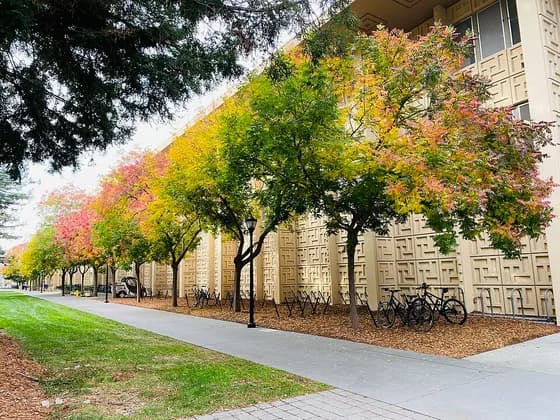
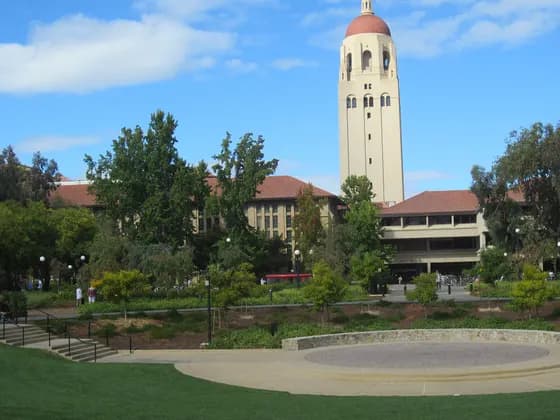
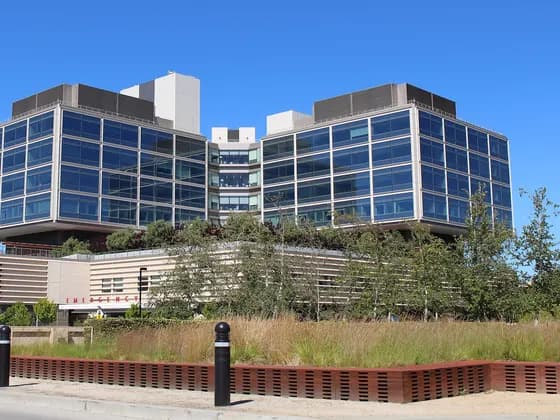
Photo: Jawed · CC BY-SA 4.0 · cropped
Photo: Suiren2022 · CC BY-SA 4.0 · Photo: Another Believer · CC BY-SA 4.0 · Photo: Coolcaesar · CC BY-SA 4.0
The Stanford University School of Medicine MD program at a glance (2027 entry)
Stanford University School of Medicine's MD is a four-year program on Stanford's campus in California. In its Discovery Curriculum everyone meets the same learning objectives, but you choose much of your pace, your research and the order of your clinical training. The school's April 2025 metrics report a class of 90 for students entering in 2024.
The program opens with the pre-clerkship phase, Stanford's term for the classroom years many schools call pre-clinical. It normally lasts two years, and every course is graded Pass or Fail. A two-year clerkship phase follows. Clerkships are clinical rotations, each in one specialty, on hospital and clinic teams: some required, some chosen from approved lists (selectives) and some free choice (electives).
Nothing has been published yet for the class entering in autumn 2027, so this guide describes the program as the MD handbook sets it out for 2026-27. The handbook says the pre-clerkship curriculum is in the middle of a redesign, so details for students starting in 2027 may change.
Day to day, science comes in Foundations of Medicine blocks, while the Practice of Medicine course trains you to interview, examine and reason about patients from your first week. In year 1 you also dissect in the anatomy lab, visit clinics with a preceptor (a clinician who hosts and supervises you) and explore the Scholarly Concentration, the research requirement every student completes.
The program is accredited by the Liaison Committee on Medical Education (LCME), the body that accredits MD programs. That accreditation lets graduates sit the national licensing exams and apply to accredited residency programs, the specialty training after medical school. The LCME lists Stanford as fully accredited, with its next survey in 2029-30.
| Degree | MD |
|---|---|
| Program length | 4 years, or 5 with the three-year pre-clerkship option |
| Class size | 90 in the 2024 entering class (school metrics, April 2025) |
| Teaching style | Integrated science blocks, mostly by organ system, plus a clinical skills course |
| Anatomy | Lectures and labs with dissection, first autumn quarter |
| First patient contact | Year 1: clinic visits with a preceptor, autumn and winter (2026-27 plan) |
| Clinical sites | Stanford, Packard Children's, Veterans Affairs Palo Alto, Santa Clara Valley, Kaiser Santa Clara |
| Step 1 timing | Study time at the end of year 2; deadline tied to your first clerkship |
| Grading | Pass or Fail in every pre-clerkship course and clerkship |
| Accreditation | Liaison Committee on Medical Education: full; next survey 2029-30 |
What makes the Stanford University School of Medicine MD program different
Two or three years before clerkships
Before year 2 you can apply to spread the remaining pre-clerkship courses over two years, for research, a dual degree or personal reasons. Courses, learning objectives and assessments are identical on both paths. Approval is selective, and the Stanford Bulletin, the university catalog that sets out degree requirements, expects most students to start on the two-year path.
Research is part of every student's degree
Every student completes a Scholarly Concentration: 12 units of coursework and a research project equal to a full-time quarter. The 2026-27 curriculum diagram in the MD handbook keeps the summer between years 1 and 2 free of coursework for research.
Clerkships across five different kinds of hospital
The school names five main clinical training sites: Stanford Health Care, Stanford Medicine Children's Health and three affiliates. These are the Department of Veterans Affairs (VA) Palo Alto Health Care System, Santa Clara Valley Medical Center (Santa Clara County's county hospital) and Kaiser Permanente Santa Clara. Internal medicine and surgery each run at four of them, so classmates on the same clerkship may be in very different settings.
You build your own clerkship schedule
You propose an order for the ten core clerkships in the Draw, an annual lottery. You then adjust it in the Shuffle, a weekly lottery every Monday where you also book selectives and electives.
One faculty mentor for all of medical school
Each student is matched with an Educators-4-CARE (E4C) faculty mentor for their whole time at the school. Your mentor guides five or six students in each class year, teaches you weekly in Practice of Medicine, leads Doctoring with CARE small groups during clerkships, gives regular feedback and can write reference letters.
How Stanford University School of Medicine teaches medicine
Two strands run side by side through the pre-clerkship years. Foundations of Medicine teaches the science in integrated blocks. After a first autumn of molecular and cellular science, later blocks work through the organ systems, taking each one's anatomy, tissue structure (histology), normal function, diseases including infection, and treatment together. Practice of Medicine (POM) teaches the clinical side, from taking a medical history and examining a patient to clinical reasoning.
POM also carries threads on ethics, health policy, epidemiology and biostatistics, evidence-based practice, nutrition, psychiatry and population health, including a year-long community-based project. You practice skills hands-on and are assessed in simulated encounters, interviewing, examining and managing patients in a mock clinic. From spring of year 1, clinical problem-solving sessions move you from complete examinations to focused ones built around a patient's problem.
Across the pre-clerkship years, some courses are taught mostly in lectures. Others rely on small groups of up to about 12 students, clinical reasoning sessions or team-based learning, in which teams apply material prepared beforehand; attendance at these is required.
The ways you will learn
| Foundations of Medicine I and II | Foundations I, in the first autumn, teaches through clinical cases, patient presentations, research papers and problem-based learning, where you work out from a patient case what you need to learn. Foundations II, in winter, uses clinical cases, lab sessions, pathology specimens, imaging and treatment-planning exercises to tie the science to patient care. |
|---|---|
| Practice of Medicine with your E4C mentor | Your E4C mentor coaches you on communicating with patients, physical examination, clinical reasoning and professionalism. |
| Standardized patients | People trained to portray a patient from a faculty-written case and to give you verbal and written feedback. Some are professional actors, and some cases use real patients with real histories and findings. |
| Clinical practicum and procedures | A half-day a week in a clinic with a clinical tutor, practicing interviews, examinations, oral case presentations and note-writing. Procedure training covers drawing blood, placing intravenous lines and recording electrocardiograms (ECGs), which you later practice in the emergency department. |
A typical week on the Stanford University School of Medicine program
In the pre-clerkship years, Wednesdays are kept free of required classes, apart from a few exceptions such as final exam week and the last spring quarter before clerkships. Courses may assign at most one hour of required work, such as videos, quizzes and reading, for each hour of class; your own study time is extra.
In the 2026-27 plan, Practice of Medicine meets on Monday, Tuesday and Friday afternoons in winter and spring of year 1. Once clerkships begin, your week follows your team. The duty-hours policy caps it at 80 hours averaged over four weeks, with one day in seven free and in-house call no more often than every third night.
How anatomy is taught at Stanford University School of Medicine
Dedicated anatomy teaching comes in one course, Clinical Anatomy (SURG 203), worth 13 units in the first autumn quarter. Lectures cover gross (macroscopic), microscopic, developmental and imaging anatomy. Labs include dissection of the human body, with imaging demonstrations, working through the thorax, abdomen, pelvis, back, upper and lower limbs, and head and neck. Clinical scenarios and interventional procedures are used to illustrate the anatomy.
The Clinical Anatomy Division of the Department of Surgery teaches introductory anatomy to medical students. It describes a traditional cadaver-based curriculum running alongside a digital anatomy program with 3D visualization and virtual and augmented reality. Its teaching tools include an Anatomage table, a touchscreen table that displays the body in 3D, and a prosection library of specimens already dissected by experts. The division runs its own Anatomical Gift Program for body donation and holds an annual memorial service for donors (in 2026, on November 19).
Anatomy returns in the later Foundations blocks, which review the anatomy of the organ systems they cover. Electives go further, including hands-on ultrasound on classmates and imaging anatomy of chest and abdominal emergencies taught with cadaver material and a 3D anatomy table.
When you first meet patients at Stanford University School of Medicine
Practice of Medicine starts with a week-one bootcamp, and in the 2026-27 plan the full history and physical examination is taught in the first quarter, practiced with standardized patients. Early Clinical Engagement (ECE) takes you into real clinics in year 1, paired with a preceptor; you list your top five specialty interests, but none is guaranteed. Visits are guided observation with set objectives, backed by seminars and small-group reflection. Before your first visit you complete mask-fit testing, sharps training and patient-privacy (HIPAA) training.
In the 2026-27 plan, ECE becomes part of Practice of Medicine in autumn and winter, and the clinical practicum starts in spring of year 1, a quarter earlier than before. The separate ECE course page, which still describes the earlier format, lists five four-hour clinic sessions and five two-hour seminars between autumn and spring, and its preceptor FAQ says six sessions.
Full-time clinical work starts with the clerkships after year 2. On clerkships you join hospital and clinic teams, and all the patient care you give is supervised by residents or faculty.
You can also volunteer at the Cardinal Free Clinics, run by the School of Medicine and staffed by volunteer physicians and students. Pacific Free Clinic gives free care to uninsured adults in East San Jose, with interpreters in Spanish, Vietnamese and Mandarin Chinese. Arbor Free Clinic closed in February 2026 and moved to supporting Samaritan House Free Clinic in San Mateo.
Year by year at Stanford University School of Medicine
- Year 1 (2026-27 plan)
Foundations, clinical skills and anatomy
Everyone takes year 1 at the same pace over three quarters: a 16-week autumn, then 11-week winter and spring quarters. In 2026, classes began on August 24, after orientation.
- Autumn: Foundations of Medicine I (12 units), covering molecular, cellular and genetic medicine, biochemistry, immunology, and introductory microbiology and pharmacology.
- Autumn: Clinical Anatomy (13 units) and Basic Life Support (1 unit), with certification due by the end of the quarter.
- Winter: Foundations of Medicine II (15 units), covering cancer biology and pathology, then the heart and lungs.
- Spring: Foundations of Medicine III (12 units), covering the kidneys, gastrointestinal tract, blood and liver.
- Practice of Medicine I to III (20 units), with Early Clinical Engagement in autumn and winter and the practicum from spring.
- Explore Scholarly Concentration areas and develop a course plan and project outline.
- Summer research quarter: no coursework, so you can work on your scholarly project.
- Year 2 (2026-27 plan)
The remaining systems, Step 1 and the move to clerkships
Two quarters of coursework finish the science. The winter quarter ends early to give protected study time for USMLE Step 1, the first of the United States Medical Licensing Examinations, which covers the science behind medicine.
- Autumn: Foundations of Medicine IV (14 units), on the nervous system, covering neuroscience, neurology, neuroanatomy and psychiatry, then endocrine and reproductive health.
- Winter: Foundations of Medicine V (12 units), on musculoskeletal medicine, pain and anesthesia, rheumatology and skin, then microbiology and pharmacology capstones and cumulative medical science.
- Practice of Medicine IV and V (14 units): clinical reasoning, the practicum and procedures, ending with a four-station objective structured clinical examination (OSCE), a circuit of timed stations that each test a clinical task.
- The Mini-CPX in March, a clinical skills exam with standardized patients that you must pass before clerkships.
- Transition to Clerkships (5 units, two weeks in spring): a review of clinical skills and clerkship responsibilities, with workshops and small groups on procedures, immersive rounds, radiology, ethics and a typical clerkship day.
- Year 3 (first clerkship year)
Core clerkships
Clerkship years run in twelve four-week periods, from late June to the following June, with a three-week winter break. Internal medicine and surgery, plus two other cores assigned through the Draw, must fall in your first twelve periods; you schedule the rest around deadlines in the final year.
- Ten cores: internal medicine, surgery and pediatrics (8 weeks each); obstetrics and gynecology, or OB/GYN (6 weeks); and critical care, emergency medicine, family medicine, ambulatory (outpatient) medicine, neurology and psychiatry (4 weeks each).
- The 2026-27 requirements table on handbook page 4.3 and section 4.7 both total 102 clerkship units (68 weeks): 54 weeks of cores, 10 of selectives and a four-week elective. A bullet on page 4.3 and the 2026-27 Bulletin still give 66 weeks (99 units), the total without Selective III.
- INDE 297 gives you structured time away from clerkships across both clinical years. It includes Reflection and Contextual Medicine days every eight weeks, on the third Friday of even-numbered periods, and a one-week clinical intersession between the two years.
- The statewide Clinical Performance Examination, which you can sit in the July after your first clerkship year.
- Year 4 (final clerkship year)
Selectives, residency applications and the capstone
The final year mixes the remaining cores with selectives and electives while you apply for residency. Periods 5 and 6 (October 19 to December 13 in the 2026-27 calendar) are kept free of core clerkships for residency interviews. Cores cannot be scheduled in Periods 11 and 12.
- Sources differ on start-by deadlines for the remaining cores. The 2026-27 requirements table lists internal medicine, OB/GYN, pediatrics and surgery by Period 7. Handbook section 4.7 and the 2026 scheduling rules list OB/GYN by Period 2B, the second two-week half of Period 2 (mid-to-late August), and pediatrics by Period 7.
- All versions require the six four-week cores to start by Period 10.
- Selectives I to III and electives, explained under Electives and selectives.
- Advanced Cardiac Life Support (ACLS) certification, which you can take in either clinical year.
- USMLE Step 2 Clinical Knowledge (CK), on the clinical knowledge needed for supervised patient care, by March 31 of your graduation year.
- MD Capstone Experience: Preparation for Residency, a one-week, simulation-heavy clerkship that rehearses first-year resident tasks such as cross-cover calls (answering calls about other doctors' patients) and handing over patients. In 2025-26 it ran in May.
How you are assessed at Stanford University School of Medicine
Every pre-clerkship course is graded Pass or Fail. Course directors announce passing criteria by the end of week two, and each course gives formal mid-quarter feedback on your progress. Small-group courses add narrative comments from faculty. Exams are closed-book, taken in assigned rooms under Stanford's Honor Code.
If you fail a course, you may be offered a remediation plan, normally finished within 45 days of the quarter's end, or be asked to retake the course the next year. Borderline results are tracked so support can start early. The Committee on Performance, Professionalism and Promotion (CP3) reviews every student before year 2, before clerkships, in January of the final year and before graduation.
Clinical skills are tested with standardized patients. Practice of Medicine I to III each end with a performance-based assessment of your interviewing and, from winter, your examination skills, and the winter quarter of year 2 ends with the four-station OSCE. The Mini-CPX in March lasts five hours: four 18-minute encounters with standardized patients plus four inter-station exercises, such as interpreting test results or examination findings. If you do not pass, you are coached through the Student Guidance Program and can start clerkships no earlier than Period 1.
The Clinical Performance Examination (CPX) is a statewide California exam, designed by a consortium of the state's medical schools and run at Stanford once a year, typically in July. You see eight standardized patients, taking a focused history and examination and explaining your thinking, with a clinical reasoning station after each. To graduate you must show minimum competence in history taking, examination, communication and clinical reasoning.
Clerkships are graded Pass or Fail, and since June 2026 none awards distinction on its own. Instead you collect feedback on forms covering 25 Everyday Physician Activities, Stanford's name for Entrustable Professional Activities (EPAs): core tasks a new doctor should be trusted to do. A competency committee can then note distinction in your Medical Student Performance Evaluation (MSPE), the dean's letter sent to residency programs in autumn of your final year.
Handbook section 5.4, updated August 2026, lists up to six domains for that distinction: clinical reasoning, teaming, advocacy, technical skills, adaptive expertise and physicianship. The handbook's MSPE section, last updated in August 2025, still describes three domains under the older Criterion-Based Evaluation System.
- USMLE Step 1 and Step 2 CK must both be passed to graduate. Step 1 has been reported only as pass or fail since January 2022.
- Step 1 timing: the 2026-27 Bulletin requires a pass within 12 months of starting clerkships.
- Handbook section 3.22 (August 2025) sets it as a deadline to sit the exam: one year from the first day of your first clerkship, and before you complete more than 72 clerkship units. If you fail it or miss the deadline, you are normally withdrawn from clerkships until you pass; pre-clerkship failures can bring an earlier deadline.
- In August 2026 the USMLE program announced a move to designated testing dates from January 2029, with Step exams offered less often each year. On the current schedule, students entering in 2027 would sit Step 1 and Step 2 CK under that model, so these deadlines may change.
- NBME subject exams (often called shelf exams) are written exams in each specialty set by the National Board of Medical Examiners. They are given in emergency medicine, family medicine, internal medicine, neurology, OB/GYN, pediatrics, psychiatry and surgery; each clerkship sets its passing score and may use its own exam instead.
- Fail a clerkship's written exam and you receive a Continuing grade and a retake; after a second failure you face an oral or other exam before the grade is settled.
Where you will actually train at Stanford University School of Medicine
All ten core clerkships are done at Stanford and its affiliated sites; you cannot take them at another school. Handbook section 4.7 names the settings: Stanford University Hospital, Stanford's ambulatory community clinics, Lucile Packard Children's Hospital, Santa Clara Valley Medical Center, the VA Palo Alto system and Kaiser Permanente Santa Clara. Sites vary by clerkship: internal medicine and surgery run at Stanford, the Palo Alto VA, Santa Clara Valley and Kaiser; pediatrics at Lucile Packard, Santa Clara Valley and Kaiser; emergency medicine at Stanford.
Each clerkship decides which of its sites you go to, and the school will not change a site for transportation reasons. You are responsible for getting to sites on time, which can take planning, and for travel costs within 50 miles each way. If a core clerkship assigns you to a site beyond that, it covers your housing and transportation.
The Draw, the annual lottery for students about to start clerkships, sets the order of your cores: you propose a schedule covering both clinical years. In 2026, requests for medicine, surgery, OB/GYN and pediatrics closed in January, and those for the other cores in February. Each clerkship caps its numbers per period, and you can hold up to two periods open in the first round and four in the second. The weekly Shuffle then lets you move a core into an open slot or join a waiting list.
Stanford Health Care is a Level 1 trauma center, the highest level of trauma care. Lucile Packard is at the center of a children's and obstetric network with more than 65 Bay Area locations. VA Palo Alto, primarily affiliated with Stanford, has about 600 beds across its divisions.
- Stanford University Hospital (Stanford Health Care)
- Lucile Packard Children's Hospital Stanford
- VA Palo Alto Health Care System, Palo Alto division
A Stanford residency page describes Valley Medical Center as Santa Clara County's county hospital, with 574 beds, a pediatric intensive care unit, a regional burn center and over 4,000 births a year. Kaiser's residency site lists its Santa Clara hospital as a core clerkship site for Stanford students.
- Santa Clara Valley Medical Center
- Kaiser Permanente Santa Clara Medical Center
The psychiatry core can send you to the Menlo Park VA or the Scrivner Center. One version of the critical care core includes El Camino Health's newborn intensive care unit, and Livermore hosts a VA ophthalmology clerkship.
- VA Palo Alto, Menlo Park division
- Scrivner Center at El Camino Health, Mountain View
- VA Palo Alto, Livermore division
Options for the four-week family medicine core, as the clerkship listing names them. Ambulatory medicine adds Kaiser Fremont and community clinics.
- Stanford family medicine clinics: Hoover, Portola Valley, Los Altos and Santa Clara
- O'Connor Family Medicine Residency
- Kaiser Santa Clara and Kaiser San Jose
- San Francisco Free Clinic
- Roots Community Health Clinic, San Jose
- Dominican Morehouse, Santa Cruz
- Rural sites
Further sites named in elective and selective listings.
- Stanford Health Care Tri-Valley
- Watsonville Community Hospital
- O'Connor Hospital
- Kaiser Milpitas
- Palo Alto Medical Foundation
Electives, selectives and away rotations at Stanford University School of Medicine
Beyond the cores you need three selectives and at least four weeks of electives. Selective I, Fundamentals of Clinical Care, is a month at least half in outpatient clinics, in an area the cores do not cover, such as dermatology, ophthalmology, urology or geriatrics. One option, the Continuity of Care clerkship, releases you one afternoon a week for nine periods to follow one faculty preceptor's patients over time.
Selective II is a subinternship, also called an acting internship: four weeks, at least three-quarters inpatient, doing much of the work of an intern, a doctor in the first year of residency. You work up new patients, write orders, do procedures, take night call and write discharge summaries. Options range from medicine and surgery to newborn intensive care and community hospital pediatrics in Watsonville.
Selective III, Fundamentals of Community Health for the Underserved, applies to students entering clerkships from 2026-27. It is two full-time weeks, or at least 14 weekly half-day sessions in its longitudinal form. You work at a federally qualified health center (a federally funded community clinic) or a clinic serving mainly underserved patients, with teaching sessions, reflection and a final case presentation.
For electives, the clerkships-by-department listing covers 19 departments. Each department's 398A Special Clinical Elective can be one you design with a faculty preceptor's consent, as long as it is clinical rather than research. Selectives and electives can also be taken at other schools, as away rotations. You apply to the host school, through the Association of American Medical Colleges' Visiting Student Learning Opportunities (VSLO) service where the school uses it.
Most away rotations count as electives; counting one as a selective needs approval before you start, and substitutions are rarely approved. International electives need your advising dean's approval, a letter from the host on supervision and safety, and a travel checklist at least four weeks ahead.
Dual degrees and research years at Stanford University School of Medicine
The Scholarly Concentration is required. You choose one of eight foundation areas: bioengineering; biomedical ethics and medical humanities; clinical research; community health; health services and policy research; medical education; molecular basis of medicine; and a computing area. The 2026-27 Bulletin calls that area Informatics and Data-Driven Medicine, and the concentrations page calls it AI and Computational Biomedicine. The concentrations page also lists ten application areas, such as cancer biology, global health, health equity and surgery.
To finish it you need 12 units of coursework beyond the required MD courses and clerkships, plus a research project equal to one full-time quarter. The project ends in a written report, an oral presentation and a summary letter from your mentor. Handbook section 4.4, updated August 2026, sets the declaration deadline at April 15 of year 1, and students who miss it may not be promoted to year 2. The 2026-27 Bulletin still gives September 1 of year 2.
The three-year pre-clerkship path creates room without stepping out of the curriculum. You apply in spring or summer of year 1 to split the second year's courses into two strands from that autumn. Research applicants need a longitudinal proposal and a mentor's statement, take INDE 267 (Planning and Writing a Research Proposal) in winter of year 1, and get priority if the project is funded. Dual-degree and personal reasons are also considered.
MedScholars fellowships have funded student research, including concentration projects, since 1980, and applications are reviewed competitively. The Physician-Scientist Training Program (PSTP) supports MD students doing laboratory or informatics research. Berg Scholars, a six-year route funded by a Burroughs Wellcome Fund award, adds an MS in Medicine in Biomedical Investigation. You apply once you are on the three-year path, typically at the end of year 2.
The Medical Scientist Training Program (MSTP), the MD/PhD, admits through the MD admissions process. Other dual degrees include an MD/MPH with a partner institution, MD/MS degrees in bioengineering and health policy, a five-year MD/MBA, an MD/JD and an MD/MPP. You need good academic standing and your advising dean's approval, and normally a Step 1 pass before stepping away. A Stanford graduate degree taken alongside the MD can also meet the concentration's coursework requirement.
The MSTP page says most Stanford students spend an extra year on research, public health or community service. The April 2025 metrics report 39.5% of MD students graduating with dual degrees. The handbook's standard time limits count from the day you start and include leaves and research time. They are three years for the pre-clerkship curriculum and six years for the MD, or eight with a master's and 11 with a PhD.
Facilities and support at Stanford University School of Medicine
Where you will learn
The hub for simulation is the Goodman Immersive Learning Center, a 28,000-square-foot space in the Li Ka Shing Center for Learning and Knowledge, run by the Center for Immersive and Simulation-based Learning. Its clinic suite has 10 exam rooms with video capture for standardized patient encounters, and the Mini-CPX and CPX are held there.
The center's simulation suite holds a simulated operating room, a three-bay emergency room or intensive care unit and two acute care hospital rooms. Mannequins range from newborn to adult, and there are skills classrooms and a wet lab.
The Clinical Anatomy Division's facilities include the Lawrence Mathers Main Dissection Lab, an open space with four bays, each with six to eight screens and recording equipment. There is also the 900-square-foot Roy B. Cohn BioSkills Lab with surgical lighting, and the Chase Hi-Tech Anatomy and Surgical Education Lab.
Support while you study
Besides matching you with a faculty mentor, Educators-4-CARE groups students into 18 learning communities, each led by a faculty member. You are also assigned a primary academic advising dean for all of medical school; you must meet at least twice a year, and you cannot switch deans.
Advising deans compile your MSPE, and the Center for Medical Student Career Advising offers specialty-specific faculty advisors and help with residency applications and away electives. The Associate Dean for Wellness and Student Life Advising is a confidential contact for personal matters.
If you struggle, the Stanford Student Guidance Program assesses your needs with your mentor, dean and course faculty, and coaches you in medical knowledge, clinical skills or professional development. A learning strategies specialist helps with study plans, time management and test-taking, including for Step 1.
The Mental Health Team gives School of Medicine students free mental health care, booked through Stanford's counseling service, and Ears for Peers offers confidential peer listening. Before classes start, SWEAT, a three-day camping trip run by second-year students, introduces you to your class. A retreat at the end of the pre-clerkship phase marks the move into clerkships.
Is the Stanford University School of Medicine program right for you?
This program may suit you if
- You want research built in: a required Scholarly Concentration, a summer research quarter after year 1 and the option of a three-year pre-clerkship phase.
- You want to train in very different settings: an academic hospital, a children's hospital, the VA, a county hospital and Kaiser.
- You like shaping your own schedule, from proposing your clerkship order in the Draw to designing a 398A elective with a faculty preceptor.
- You want one faculty mentor who teaches you weekly and follows you through all of medical school.
- You prefer pass/fail grading, with distinction based on feedback about everyday clinical tasks rather than clerkship grades.
Things to think about
- The pre-clerkship curriculum is being redesigned, so the version for 2027 entrants may differ from the 2026-27 plan described here.
- Each clerkship picks your site, and travel within 50 miles each way is at your own cost.
- Expect a possible fifth year: the MSTP page says most students spend an extra year, and the three-year path adds one.
- You need to settle on a Scholarly Concentration early: handbook section 4.4 sets April 15 of year 1 as the deadline.
- The dedicated anatomy course runs for a single quarter, the first autumn, alongside three other courses.
Stanford University School of Medicine MD program — frequently asked questions
Applying to Stanford University School of Medicine?
How to get into Stanford University School of Medicine
Prerequisites, MCAT, AMCAS personal statement, secondaries and interview, step by step.
Open the guide →Stanford University School of Medicine admissions profile
MCAT and GPA profile, acceptance rate, interview format and key dates.
See the profile →Compare Stanford University School of Medicine with other schools
Put the teaching style, anatomy teaching and clinical sites next to another school.
Open the comparison →Prepare for the Stanford University School of Medicine interview
Format breakdown, school-specific sample questions and prep tips from tutors who interviewed here.
Read the guide →Where this Stanford University School of Medicine program guide came from
This guide was written from 87 official sources — Stanford University School of Medicine's own program pages and curriculum documents, plus the accreditor and the hospitals and health systems the school trains students in where they publish detail — read on 2026-10-10, then checked claim by claim against those sources.
- Stanford MD Program: Discovery Curriculum
- Stanford MD Admissions home page
- Stanford Bulletin 2026-27: Medicine (MD) program requirements
- MD Handbook 4.1: Discovery Curriculum Schematic (2026-27)
- MD Handbook 4.5: Required Pre-Clerkship Curriculum and Pathways
- MD Handbook 4.3: Academic Requirements for Graduation
- Stanford MD Program: Early Clinical Engagement (INDE 268)
- ExploreCourses: SURG 203 Clinical Anatomy and anatomy electives
- Stanford Clinical Anatomy Division
- Clinical Anatomy Division: Lab Facilities
- Clinical Anatomy Division: Education
- ExploreCourses: Practice of Medicine I to III (INDE 201 to 203)
- ExploreCourses: Practice of Medicine IV-A (INDE 204A)
- ExploreCourses: Practice of Medicine V-A (INDE 205A)
- ExploreCourses: Transition to Clerkship (INDE 206)
- ExploreCourses: Foundations of Medicine I (INDE 243)
- ExploreCourses: Foundations of Medicine II (INDE 244)
- ExploreCourses: Foundations of Medicine III (INDE 245)
- ExploreCourses: Foundations of Medicine IV A (INDE 246A)
- ExploreCourses: Foundations of Medicine V A (INDE 247A)
- ExploreCourses: Basic Cardiac Life Support (EMED 201)
- MD Handbook 3.18: Student Duty Hours and Work Environment
- MD Handbook 4.7: Required Clerkship Curriculum
- 2026-27 Calendar of Clerkship Periods
- Clerkship Scheduling Process 2026
- 2026 Core Clerkship Draw Calendar
- School of Medicine Registrar's Office: Clerkship FAQs
- Clinical Clerkships by Department
- Clerkship Requirements: Selective I, Fundamentals of Clinical Care
- Clerkship Requirements: Selective II, Subinternship
- Clerkship Requirements: Selective III, Community Health for the Underserved
- Special Clinical Electives (398A Clerkships)
- MD Handbook 4.8: Selective Clerkship Requirement
- Preparing for an Away Rotation
- MD Handbook 4.11: Completing Clerkships at Other Institutions
- MD Handbook 4.12: INDE 297 Reflection and Contextual Medicine
- ExploreCourses: INDE 297 Clinical Intersession and Reflections and Contextual Medicine
- MD Handbook 4.13: Advanced Cardiac Life Support Requirement
- ExploreCourses: FAMMED 310A Continuity of Care Clerkship
- ExploreCourses: MED 310A The Community Health of the Underserved (longitudinal)
- ExploreCourses: MED 319E The Community Health of the Underserved Clerkship
- ExploreCourses: MED 397A MD Capstone Experience, Preparation for Residency
- MD Handbook 5.2: Assessment of Performance in Pre-Clerkship Courses
- MD Handbook 5.3: Exam Policy for Pre-Clerkship Courses
- MD Handbook 5.4: Assessment of Performance in Clinical Clerkships
- MD Handbook 5.5: Standardized Patient Teaching and Assessment Activities
- MD Handbook 5.6: Medical Student Performance Evaluation (MSPE)
- MD Handbook 4.14: Clinical Performance Examination (CPX) Series
- CISL: CPX Info and FAQs
- CISL: Mini-CPX Info and FAQs
- MD Handbook 3.22: USMLE Requirements, Step 1 and Step 2 CK
- USMLE: Step 1 Transition to Pass/Fail Only Score Reporting
- MD Handbook 6.2: Standards for Satisfactory Academic Progress
- MD Handbook 6.3: Promotion
- Stanford MD Program: Research and Scholarship
- Stanford MD Program: Scholarly Concentrations
- MD Handbook 4.4: Scholarly Concentration Requirement
- Medical Scholars Research Program (MedScholars)
- Stanford MD Program home page
- Stanford MD Program: Berg Scholars
- Stanford MSTP MD-PhD Program
- Stanford Medicine: Dual Degree Programs
- MD Handbook 3.29: Dual Degrees
- Educators-4-CARE: Program Description
- Educators-4-CARE: Learning Communities
- Stanford MD Program: Academic Advising
- MD Handbook 3.30: Academic Advising
- Stanford MD Program: Wellness and Learning Climate
- Stanford MD Program: Learning Strategies
- Stanford Student Guidance Program
- Cardinal Free Clinic Program: About CFC
- Center for Immersive and Simulation-based Learning: About
- CISL: Learn about Our Facilities
- CISL: Learning Spaces
- CISL: Mannequins and Trainers
- CISL: Standardized Patient Program
- Stanford Health Care: About Us
- Stanford Medicine Children's Health: About Us
- VA Palo Alto Health Care: About Us
- Stanford Pediatrics Residency: Santa Clara Valley Medical Center rotation
- Kaiser Permanente Northern California: Internal Medicine Santa Clara
- School of Medicine Academic Calendar 2026-27
- Stanford School of Medicine Performance Metrics, April 2025
- LCME Directory of Accredited Programs
- About the LCME
- USMLE: Updated Timeline for Designated Testing Dates, Transition in January 2029 (August 2026)
- USMLE: Designated Testing Dates information hub (dates the January 2029 timeline announcement August 6, 2026)
Curricula are restructured between cycles. Anything here that decides your application — how anatomy is taught, a clinical campus assignment, a required research year — should be confirmed against the official page for your entry year.
Applying to Stanford University School of Medicine?
We help US applicants with MCAT strategy, the AMCAS personal statement, secondary essays and interview prep — everything you need for a competitive Stanford University School of Medicine application.