
The David Geffen School of Medicine at UCLA MD program
What you actually study, and where you will be
David Geffen School of Medicine at UCLA's MD is a 4-year program taught through case-based learning in an integrated curriculum, with patient contact from Year 1 and clinical rotations in Los Angeles, wider Southern California and Bakersfield (2027 entry). UCLA's MD replaces the old two years of science and two of hospital work with three phases. Phase 1 teaches the science through patient cases alongside early clinical experience, and ends with USMLE Step 1, the first national licensing exam. Phase 2 is a year of core clerkships, the required clinical rotations, and Phase 3 pairs a mentored scholarly block, Discovery, with regular clinic sessions before advanced electives.
- Degree
- MD
- Length
- 4 years
- Teaching
- Case-based learning + Integrated
- Clinical contact
- Year 1


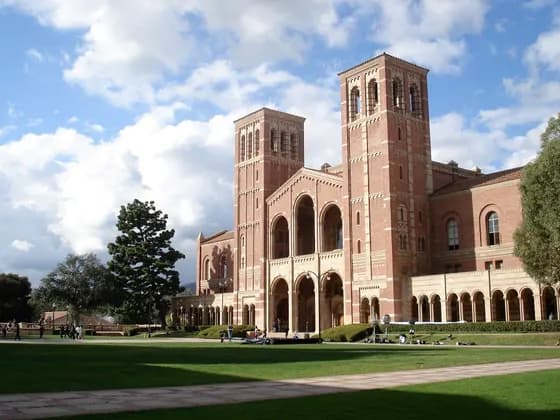

Photo: King of Hearts · CC BY-SA 3.0 · cropped
Photo: Cayambe · CC BY-SA 4.0 · Photo: Alton · CC BY-SA 3.0 · Photo: Daderot · CC0
The David Geffen School of Medicine at UCLA MD program at a glance (2027 entry)
The David Geffen School of Medicine at UCLA (DGSOM) runs a four-year MD program on the UCLA campus in Westwood, Los Angeles. Its curriculum, HEALS (Healer, Educator, Advocate, Leader, Scholar), began in August 2021. For the 2026-27 admissions cycle the school estimates 142 new MD students. Another 15 are expected in the UCLA-Caltech Medical Scientist Training Program (MSTP), its MD/PhD track, and 18 in PRIME-LA, a five-year MD and master's track.
HEALS replaces the old split of two years of classroom science and two of clinical training with three phases. Phase 1 is the pre-clerkship (pre-clinical) phase, where science, clinical skills and early clinical experience are taught together through patient cases. Phase 2 is a year of clerkships, the core clinical rotations, in which you work on hospital and clinic teams. Phase 3 pairs Discovery, a mentored scholarly block, with regular clinic sessions, then advanced electives and preparation for residency, the specialty training after medical school.
In the school's 2026-27 calendar, the Class of 2029, which started in August 2025, spends about 16 months in Phase 1 and begins required rotations in January 2027. The 2026 curriculum diagram puts Step 1 of the United States Medical Licensing Examination (USMLE) at the end of Phase 1. Step 2 Clinical Knowledge (CK), the second licensing exam, comes at the start of Phase 3. The school says HEALS is under continuous improvement and may change at any time.
Clinical training takes you to UCLA's own hospitals, Los Angeles County hospitals, the West Los Angeles Veterans Affairs (VA) Medical Center, Cedars-Sinai, Kaiser Permanente, community clinics and Kern Medical in Bakersfield. The MD is accredited by the Liaison Committee on Medical Education (LCME), which accredits MD programs in the United States; for MD students, that accreditation is what makes them eligible to sit the USMLE. The LCME lists it as fully accredited, with the next survey in 2028-29, and the school says full accreditation followed its 2021 survey visit.
| Degree | MD |
|---|---|
| Program length | 4 years; PRIME-LA takes 5, and the MD/PhD averages 8 |
| New students (2026-27 estimate) | 142 MD, 15 MSTP (MD/PhD) and 18 PRIME-LA |
| Main campus | UCLA campus, Westwood, Los Angeles |
| Anatomy | Mostly prosected cadavers, some dissection (undated department page) |
| First patient contact | Phase 1, through the Foundations of Medical Sciences Clinical Experience |
| Core clerkships | Eight, 40 weeks in total, starting in year 2 |
| USMLE timing | Step 1 before clerkships; Step 2 CK at the start of Phase 3 |
| Grading | Pass/fail in Phase 1 and clerkships; clinical electives Honors to Fail |
| Accreditation | LCME, full accreditation; next survey 2028-29 |
What makes the David Geffen School of Medicine at UCLA MD program different
Core clerkships start in your second year
HEALS moved the core rotations from the third year, where the pre-2021 curriculum placed them, into the second year. In the 2026-27 calendar, the Class of 2029 starts them in January of year 2, after about 16 months of Phase 1. The school says earlier clerkships and electives help you explore careers and strengthen residency applications.
A mentored scholarly block, with clinic time alongside
Discovery, a required part of the MD, is roughly full-time work on a project with a faculty mentor. Alongside it, the Longitudinal Clinical Experience (LCE) keeps you seeing patients in regular half-day sessions with a generalist and a specialist preceptor-coach, who supervise you and coach you toward your own learning goals.
Point-of-care ultrasound in every phase
Point-of-care ultrasound (POCUS) means scanning a patient yourself at the bedside. Phase 1 includes more than ten sessions covering all major organ systems, and on clerkships you use it on patients. Fourth-year electives and the Training in Medical Education and Practice (TMEP) course take it further.
A faculty coach and small group from the start
In Phase 1 you join a group of six to eight students with an Educator for Excellence, a faculty clinician who coaches you in interviewing, physical examination and clinical reasoning. The same faculty member keeps advising and mentoring your group throughout medical school.
Optional pathways in urban and global health equity
Two competitive pathways add a focus to the standard MD. The Urban Health Equity Pathway builds on the school's partnership with Charles R. Drew University of Medicine and Science (CDU) in South Los Angeles. Global Health Equity Pathway students spend at least four months of Discovery at a partner organization. Completing either is noted in your Medical Student Performance Evaluation (MSPE), the dean's letter for residency applications.
How David Geffen School of Medicine at UCLA teaches medicine
The school builds Phase 1 around case-based learning, so that you begin thinking like a physician from day one. It runs as one course, Foundations of Medical Sciences (FoMS), with three strands side by side. Scientific Foundations of Medicine (SFM) teaches the science, Foundations of Practice (FoP) the clinical skills, and the FoMS Clinical Experience takes you into clinical settings.
Content areas called threads run through all three phases in a planned order. The main one, Medicine and Society, covers teamwork across professions, leadership and advocacy, health equity, health systems, the structural and social drivers of health, ethics and integrative health, often through the medical humanities. Other areas of focus include LGBTQ+ health, team-based care and ultrasound.
In Phase 2 you learn mainly on clerkship teams, with intersessions, short teaching blocks between clerkships, for skills practice, simulation and more SFM. Phase 3 is largely self-directed: mentored scholarship in Discovery, coaching in the LCE, and electives chosen around your career plans.
The ways you will learn
| Small groups with an Educator for Excellence | Your group practices interviewing, examination and clinical reasoning, with specialists such as neurologists, geriatricians, pharmacists and psychiatrists joining some sessions as content experts. |
|---|---|
| Large-group sessions, labs and workshops | Required FoMS activities include labs, interactive large-group sessions, small groups and integration activities, plus SFM workshops on topics such as health equity, ethics and the humanities. |
| Simulation and standardized patients | At the UCLA Simulation Center you practice history-taking and examination with standardized patients, actors trained to play patients. You also train in life support, ultrasound, procedures such as intubation and suturing, and acute scenarios on high-fidelity manikins. Objective Structured Clinical Examinations (OSCEs), practical exams at timed stations, are held here too. |
| Clerkship teams | Each clerkship sets its own teaching. In neurology, for example, you join inpatient and outpatient teams, examine and present patients to residents and attending physicians, and write daily progress notes. Every clerkship includes online radiology modules. |
A typical week on the David Geffen School of Medicine at UCLA program
The school's faculty recruitment page shows how a Phase 1 week is laid out. FoP small groups meet on Monday and Thursday afternoons in Geffen Hall. Many SFM workshops run for 2.5 hours on Tuesday, Wednesday and Thursday mornings, and clinical experience visits fall on Tuesday or Wednesday afternoons at affiliated or community sites.
You must attend at least 90% of required sessions in each Phase 1 course, and missing 20% or more can mean an incomplete grade or repeating the course. The workload policy caps the estimated weekly load, including class time, assignments and study, at an average of 60 hours.
On clerkships, duty hours are capped at 80 a week, averaged over the rotation, with no shift over 28 hours and at least one day off a week on average. There is no overnight call before exams, and you have the Thursday off before each end-of-clerkship exam. An absence without notice can mean failing the clerkship.
How anatomy is taught at David Geffen School of Medicine at UCLA
Anatomy is one of the SFM sciences, and anatomy practical exams set by the FoMS teaching team are part of Phase 1 grading. Phase 1 ultrasound sessions are designed partly to deepen your grasp of anatomy and physiology. Before working in the Gross Anatomy Laboratory, every student reviews its safety procedures.
The fullest description comes from the Pathology department, which teaches gross anatomy, on an undated page that still uses the block numbers of the pre-2021 curriculum. It describes a lab in the Center for Health Sciences with 30 cadaver stations, using embalmed and unembalmed bodies. Sessions mostly use prosections, bodies already dissected by experts so the structures are ready to study, with several chances for first-year students to dissect certain structures.
A current page adds that Discovery students in the TMEP course, which trains them to teach anatomy and ultrasound, dissect cadavers weekly and produce prosections used by first-year students. They also lead tutoring sessions and teach small groups in Phase 1 courses and intersessions.
When you first meet patients at David Geffen School of Medicine at UCLA
Your first patient contact comes in Phase 1 through the FoMS Clinical Experience. It places you in real clinical settings, where you use your interviewing and examination skills and begin forming your identity as a doctor. Visits are compulsory: a missed session must be made up, and every site visit must be completed to pass FoMS.
A map of these sites labeled 2022-23 shows the range: AltaMed Health Services in Commerce, the Saban Community Clinic, Veterans Affairs programs in West Los Angeles, UCLA clinics and the LA County Fire Department. The current list may differ. Urban Health Equity Pathway students go to dedicated community-based sites in year one.
Many students also join the Student Run Homeless Clinics, a service-learning program begun by the Department of Family Medicine in 1990. Students run more than 40 clinics a year at shelters and other sites, serving up to 1,600 patients, supervised by UCLA faculty and community physicians.
Under a 2019 supervision policy you are always supervised, and invasive procedures and sensitive exams, such as pelvic and rectal exams, need a qualified supervisor present.
Year by year at David Geffen School of Medicine at UCLA
- Phase 1
Foundations of Medical Sciences
After Base Camp, Phase 1 runs as one pass/fail course, Foundations of Medical Sciences, in four numbered parts. It closes with Integration of Medical Sciences, a USMLE study block and Step 1.
- Base Camp, about three weeks before the main course (August 10 to 28, 2026 for the Class of 2030): social determinants of health, ethics and professionalism, introductory clinical skills and core science concepts.
- SFM: anatomy, physiology, biochemistry, pharmacology, genetics, microbiology, immunology and molecular and cell biology, plus newer areas such as mental health, prevention and nutrition.
- FoP: communication, the medical interview, clinical examination and clinical reasoning, plus social and structural determinants of health, population health, quantitative medicine, teamwork, bioethics and decision making.
- In the 2026-27 calendar, the Class of 2029 takes FoMS III in the summer of 2026 and FoMS IV until October 23, then USMLE Prep from October 26 to December 4.
- To start clerkships you must pass every FoMS exam. You must also reach a set threshold on an exam from the National Board of Medical Examiners (NBME), which writes standardized medical exams, given after Integration of Medical Sciences.
- Phase 2
Core clerkships and intersessions
Phase 2 is about a year of core clerkships, with short intersessions between them. You join inpatient and outpatient teams, log your patients against a required list, and get feedback halfway through each rotation.
- Emergency medicine, family medicine, neurology, obstetrics and gynecology, pediatrics and psychiatry, 4 weeks each.
- Internal medicine and surgery, 8 weeks each; the geriatrics division's undated page describes a two-week block on the inpatient geriatric medicine service at UCLA Santa Monica Medical Center within the internal medicine clerkship.
- Intersessions of one or two weeks, with physical exam and procedural skills practice and high-fidelity simulation. A separate intersession course, VISTA, covers value-based care, patient safety, teamwork, health systems, technology including artificial intelligence, and the arts and humanities.
- Patient logs: in 2025-26, internal medicine asked for at least 36 entries covering 22 diagnoses plus one ultrasound exam, and surgery and family medicine for 40 entries each.
- Ultrasound skills matched to clerkships, such as fetal heart rate checks in obstetrics and gynecology and lumbar puncture guidance in neurology.
- An NBME shelf exam, the national subject exam for that specialty, at the end of each clerkship, and the Clinical Performance Examination (CPX), eight cases with standardized patients, during the clerkship year.
- Phase 3: Discovery
Step 2 CK, Discovery and the LCE
Phase 3 opens with a dedicated exam study period for Step 2 CK, labeled USMLE Step 2 on the 2026 diagram. Then comes Discovery, with the LCE alongside to keep your clinical skills growing while you explore specialties.
- Discovery in one of eight Areas of Concentration, or the PRIME-LA concentration, ending in a final scholarly project (see Dual degrees and research years).
- LCE: 24 half-day clinical sessions, 12 with a generalist in internal medicine, emergency medicine, family medicine, pediatrics or medicine-pediatrics, and 12 with a specialist or subspecialist.
- A weekly half-day of self-directed learning, such as skill-building or career exploration with faculty.
- Before the LCE, a Clinical Advisor reviews your clerkship narratives, self-assessments, CPX results and goals with you in a 30-minute video call.
- The Transition to Sub-Internships course, covering skills such as life support, before your sub-internships: rotations in which you take on much of an intern's work under supervision.
- Phase 3: Electives
Advanced electives, residency interviews and Capstone
The rest of Phase 3 is advanced electives, taken while you apply and interview for residency. Match Day, when graduating students across the country learn where they will train, comes near the end, along with the Capstone course and graduation.
- 32 weeks of electives, including sub-internships at the 300 (outpatient) and 400 (inpatient) levels and intensive care rotations (see Electives).
- Interviews are not excused absences during electives, but you can use your scheduled days off, or swap them with approval.
- Capstone, held in March, in which faculty observe your core clinical skills, one of your last chances for feedback before residency.
- To graduate you must pass all coursework, the CPX, and USMLE Step 1 and Step 2 CK, within a maximum of six years.
How you are assessed at David Geffen School of Medicine at UCLA
Phase 1 is graded pass/fail. To pass FoMS you attend required sessions, complete the coursework and sit every exam: Pit Stop computer exams written by FoMS faculty, FoP knowledge checks, OSCEs, anatomy practicals and NBME exams. Each has a threshold score. Fall below it and you are directed to support, such as review sessions, coaching or the assistant dean who advises you, and written exams require a retest.
Missing the final retest threshold on a Pit Stop exam or the FoP knowledge checks delays your clerkship start, and four or more failed Pit Stop exams mean repeating Phase 1.
Core clerkships have been pass/fail since 2022-23. To pass, you need a satisfactory clinical evaluation, rated across 13 skills from history taking to systems-based practice, and a score above the 5th national percentile on the NBME shelf exam. A failed shelf exam can be retaken after two weeks of study; failing three times in one clerkship means repeating it. Each clerkship also has a radiology exam with a passing score of 70%.
Each CPX case is a focused work-up followed by a written exercise, with individual feedback, and you must pass the CPX to graduate. Faculty also write narrative assessments of skills such as communication, teamwork and professionalism, and representative comments can appear in your MSPE.
Under Phase 3 grading policies last reviewed in 2023, Discovery is pass/fail, judged on attendance, faculty evaluations, assignments and a final scholarly project, and the LCE is graded Pass or No Pass. Fourth-year clinical electives have no written exams and are graded Honors, High Pass, Pass or Fail from the evaluation score. Global health, research, special and non-clinical electives are pass/fail, as are away electives on your transcript.
Two national exams sit alongside this. USMLE Step 1 tests the sciences behind medicine and, according to usmle.org, has been reported only as pass or fail since January 26, 2022. Step 2 CK tests the clinical knowledge needed to care for patients under supervision. The school's USMLE policy, in effect since October 2020, says you must take Step 1 before Phase 3 advanced electives and pass both exams to graduate.
- You may not take time off in Phase 1, or take time off or drop a core clerkship, to prepare for a first attempt at Step 1 or Step 2 CK.
- You must pass both by an annual deadline for the school to verify your rank list for the National Resident Matching Program (NRMP), which runs the Match. Miss it and you can still graduate by passing before your final semester ends.
- A first Step 1 failure pauses further electives until you pass; a second means academic probation, and a third means referral for possible dismissal.
- In August 2026 the USMLE program announced a move to designated testing dates from January 2029, with Step exams offered less often each year (usmle.org). On the current schedule, a student entering in August 2027 would sit Step 1 after the USMLE Prep block in about December 2028, just before the change.
- On the current schedule, a 2027 entrant would sit Step 2 CK as Phase 3 opens, around the end of 2029, under designated testing dates. The USMLE program says Step 2 CK will not be offered in some months and encourages schools to review their rules on when students must sit the exams, so UCLA may adjust these dates.
Where you will actually train at David Geffen School of Medicine at UCLA
Classes are on the UCLA campus in Westwood, but clinical work takes you across the region. The school's clerkship map names 15 main affiliates, and departments add clinics and practices across Southern California, from Malibu to Pomona. The handbook requires every student to have reliable transportation, and absences caused by transport problems are not excused.
Under a handbook policy last reviewed in 2020, clerkship sites are first assigned by an electronic lottery based on your preferences. You can then ask for a different site, ideally at least 30 days ahead, for reasons such as personal circumstances, a disability accommodation or concerns about the learning environment. Not every request can be met.
Some affiliates, including Providence, Dignity Health and Adventist Health, restrict services such as abortion, contraception and gender-affirming care. Training at these covered affiliates is voluntary, and if you object, the school will try to find you another site. Los Angeles County and VA hospitals have their own onboarding steps, including fingerprinting.
The site lists below come from each department's page. Most are undated, so treat them as a guide rather than a fixed roster.
- Emergency medicine (7 sites): Olive View, Santa Monica, UCLA, West Los Angeles VA, Harbor, Kern and West Valley. The four-week core clerkship became required in October 2022.
- Obstetrics and gynecology (7 sites): Ronald Reagan UCLA Medical Center, Cedars-Sinai, Harbor-UCLA, Olive View-UCLA, Kaiser Permanente in Panorama City, Kern Medical Center and UCLA Santa Monica.
- Pediatrics (7 sites): Santa Monica UCLA with Cedars-Sinai (combined), Cedars-Sinai, Olive View-UCLA, Harbor-UCLA, Kaiser Permanente Sunset, UCLA Mattel Children's Hospital with Olive View-UCLA (combined), and Miller Children's Hospital (MemorialCare).
- Neurology (6 sites): Ronald Reagan, West Los Angeles VA, Olive View-UCLA, Santa Monica-UCLA, Harbor-UCLA and Cedars-Sinai, with two nights of long call and two weekend days over the four weeks.
- Psychiatry (5 sites): Resnick Neuropsychiatric Hospital, West Los Angeles VA, Harbor-UCLA, Olive View and Kedren Community Mental Health Center; the department also names site directors at Kern Medical. There is no overnight call.
- Family medicine (22 sites): among them Harbor-UCLA, MLK Community Hospital, Venice Family Clinic, Clinica Romero, three Kaiser sites and Pomona Valley Medical Center. UCLA Health practices run from Malibu and Santa Monica to the Central Coast.
On the UCLA campus. Ronald Reagan has 520 inpatient beds and a Level 1 trauma center, with the children's and psychiatric hospitals on specialized floors.
- Ronald Reagan UCLA Medical Center
- UCLA Mattel Children's Hospital
- Resnick Neuropsychiatric Hospital at UCLA
UCLA's 281-bed hospital in Santa Monica, used by several clerkships, plus a family medicine practice.
- UCLA Santa Monica Medical Center
- UCLA Health Santa Monica
Harbor-UCLA appears on all six department lists, and Olive View-UCLA, a major affiliate of the school, on five.
- Harbor-UCLA Medical Center, Torrance
- Olive View-UCLA Medical Center
- West Los Angeles VA Medical Center
- Cedars-Sinai Medical Center
- Kaiser Permanente Los Angeles Medical Center
- Miller Children's Hospital (MemorialCare)
- MLK Community Hospital
- Kedren Community Mental Health Center
- Venice Family Clinic
A teaching hospital in Kern County, on the emergency medicine and obstetrics and gynecology site lists, with an emergency medicine sub-internship.
- Kern Medical
Electives, selectives and away rotations at David Geffen School of Medicine at UCLA
Phase 3 includes 32 weeks of electives, 26 of them clinical; many students spend the other six on research, in Discovery or separately. A research elective can be one six-week block or split, such as three plus three weeks, and can overlap with residency interviews. The 2026 diagram says every type of elective is offered each semester, in any order.
Courses are numbered by type. In the 2026-27 catalog for visiting students, 100-level means non-clinical, 200-level a consult service, 300-level an outpatient sub-internship and 400-level an inpatient sub-internship or intensive care unit (ICU) rotation. The handbook's attendance policy refers to a required 12 consecutive weeks of sub-internship training in 300-level, 400-level or ICU electives.
Almost all electives last three weeks, and places are first allocated by lottery, with students choosing courses in December for the following year. The visiting catalog alone runs from burn medicine at West Valley and liver transplantation at UCLA to trauma surgery at Harbor-UCLA, and several departments offer ultrasound-focused electives.
Away rotations at other institutions are capped at 12 weeks, and away research counts toward that limit. Through the Global Health Program, fourth-year students can take clinical electives abroad, mostly in low- and middle-income countries; partner electives with UCLA course numbers do not count toward the cap. You must first complete the program's Fall Selective, an introduction to global health.
Dual degrees and research years at David Geffen School of Medicine at UCLA
Discovery is the school's required scholarly block, done with a faculty mentor in one of eight Areas of Concentration. These are basic, clinical and translational research; global health; healthcare improvement and health equity research; health justice and advocacy; informatics and data science; innovation and entrepreneurship; medical education; and social science and medical humanities. PRIME-LA students have their own.
Discovery is close to full time, 30 to 40 hours a week across the school's pages, with time kept free for the LCE. Your mentor helps define the project and track progress, meeting you two or three times a month, and students present at the annual Discovery Scholarship Day. In 2023-24, 90% of students joined an Area of Concentration, research being the largest at 35%.
After the core clerkships, students in good standing can add a master's from elsewhere at UCLA. Options are an MBA (Anderson School of Management), MPH (Fielding School of Public Health), MPP (Luskin School of Public Affairs), MS in Clinical Research, MLS (School of Law) or MA in Education. For the MBA, MPP and MPH, normally two-year degrees, the school's definitions page says the concurrent route adds one year, with both degrees awarded together.
PRIME-LA is a five-year track training leaders to improve health care delivery, research and policy for California's underserved communities. About 18 students join each year; the first 18 started in July 2008. You take the HEALS curriculum and must earn an accredited, in-person master's by graduation, at UCLA or elsewhere; past students have studied at Berkeley, Columbia, Harvard, Johns Hopkins and UCSF.
The MSTP, an MD/PhD program established in 1983 and funded by the National Institutes of Health (NIH), has 12 to 15 places a year. Two of those students can do their PhD at Caltech in Pasadena. You complete the first two years of HEALS, then the PhD, averaging four years and counting in place of Discovery, then the final year of medical school. The whole program averages eight years.
You can also apply for an academic leave of absence for research, a fellowship or another degree, such as the NIH Medical Research Scholars Program. That leave does not count toward the six-year limit for finishing the MD.
- Urban Health Equity Pathway: urban health with a focus on South Los Angeles, built with CDU. Its page says it launched in 2024, starting with the Class of 2028, and takes 8 to 12 students a year, though its FAQ also says nine are offered places. You do community service, research hours and a capstone project.
- The Charles R. Drew/UCLA Medical Education Program no longer accepts applications and hands over to the Urban Health Equity Pathway after the Class of 2027; CDU now runs its own MD program.
- Global Health Equity Pathway: a competitive track. You take the Fall Selective and a spring skills series in year one and plan a Discovery project with a partner organization. You then spend at least four months there and may return in your final year to hand the project over.
- Global Health Equity Concentration: a non-competitive option with a mentored global health project, no travel required, and an optional clinical global health elective in your final year.
Facilities and support at David Geffen School of Medicine at UCLA
Where you will learn
Simulation teaching is based in Rosenfeld Hall, which opened in 2023 across the street from Ronald Reagan UCLA Medical Center. Level A has five inpatient simulation rooms, four exam rooms, a classroom and an auditorium. Level 1 houses the Standardized Patient Program, with 16 exam rooms and four simulation rooms, and Level 2 holds the Center for Advanced Surgical and Interventional Technology.
The Simulation Center also runs a practice lab in Geffen Hall Room 301, with three rooms for simulation and procedure practice and smart lockers for borrowing task trainers. The Louise M. Darling Biomedical Library serves medical students, with more than 683,000 print volumes.
Support while you study
Every student belongs to one of four societies: Utilis, Caritas, Levamentum or Accendo. Societies are UCLA's version of learning communities, giving each student a consistent advisor and a community across class years. Each is led by an Assistant Dean for Student Affairs who advises about a quarter of each class from before orientation to graduation, helps in times of difficulty, and helps prepare your MSPE.
The Academic Support Office offers one-on-one help with study skills, time management and test taking, plus tutoring and review sessions in the first two years. Specialty Advisors for Career Exploration (ACEs), launched in 2021, are faculty who mentor students in their specialty, and the Career Development Office advises on residency applications.
The Behavioral Wellness Center, on the first floor of the Center for Health Sciences, offers confidential counseling for medical students, and the Well-Being Office runs workshops and support groups. The school's Director of Disability Services arranges exam accommodations and helps with requests for accommodations on USMLE exams, which it advises starting six to nine months ahead.
Is the David Geffen School of Medicine at UCLA program right for you?
This program may suit you if
- You want core clinical rotations to begin in your second year rather than your third.
- You want protected time for a mentored project in research, advocacy, teaching or innovation before you apply to residency.
- You want to learn ultrasound from your first year and use it on patients during clerkships.
- You want to train in very different settings, from UCLA hospitals to county, VA, Kaiser Permanente and community sites.
- You are drawn to urban health equity, global health or leadership for California's underserved communities, through a pathway or PRIME-LA.
Things to think about
- You will need reliable transportation: sites stretch across the region, Kern Medical in Bakersfield included, and transport problems do not excuse absences.
- Attendance rules are strict, from 90% attendance in each Phase 1 course to possible failure of a clerkship after an absence without notice.
- Step 1 comes before clerkships, and you cannot take time off in Phase 1 or drop a clerkship to prepare for a first attempt.
- The program is still changing: the 2026 diagram says HEALS may change at any time. The USMLE's move to designated testing dates in January 2029 will fall during your training; on the current schedule, your Step 2 CK would come under it.
David Geffen School of Medicine at UCLA MD program — frequently asked questions
Applying to David Geffen School of Medicine at UCLA?
How to get into David Geffen School of Medicine at UCLA
Prerequisites, MCAT, AMCAS personal statement, secondaries and interview, step by step.
Open the guide →David Geffen School of Medicine at UCLA admissions profile
MCAT and GPA profile, acceptance rate, interview format and key dates.
See the profile →Compare David Geffen School of Medicine at UCLA with other schools
Put the teaching style, anatomy teaching and clinical sites next to another school.
Open the comparison →Prepare for the David Geffen School of Medicine at UCLA interview
Format breakdown, school-specific sample questions and prep tips from tutors who interviewed here.
Read the guide →Where this David Geffen School of Medicine at UCLA program guide came from
This guide was written from 96 official sources — David Geffen School of Medicine at UCLA's own program pages and curriculum documents, plus the accreditor and the hospitals and health systems the school trains students in where they publish detail — read on 2026-10-10, then checked claim by claim against those sources.
- DGSOM: Medical School Admissions (MD, PRIME-LA and MSTP tracks)
- DGSOM: Preparing to apply (estimated new entrants by track, 2026-27 cycle)
- DGSOM: HEALS Curriculum
- DGSOM: HEALS curriculum schematic, 2026
- DGSOM: HEALS Phase 1, Medical Education Foundations
- DGSOM: HEALS Phase 2, Core Clerkships
- DGSOM: HEALS Phase 3, Discovery and Career Preparation
- DGSOM: Integrated Curriculum, threads and areas of focus
- DGSOM: Academic calendars, 2026-2027
- DGSOM: HEALS First Iteration Curriculum (phased out in 2025)
- DGSOM: HEALS First Iteration curriculum schematic (phased out in 2025)
- DGSOM: HEALS First Iteration, Year 4 (Match Day and Capstone)
- DGSOM: Legacy Curriculum, Human Biology and Disease (phased out in 2021)
- DGSOM: Teaching Opportunities in the HEALS Curriculum (faculty recruitment)
- DGSOM: POCUS Education
- DGSOM: POCUS Curriculum
- DGSOM: Training in Medical Education and Practice (TMEP)
- DGSOM handbook: Phase 1 Grading Policy, Pre-Clerkship (reviewed August 2026)
- DGSOM handbook: Phase 2 Grading Policy, Core Clerkships
- DGSOM handbook: Discovery Grading Policy
- DGSOM handbook: Elective Grading Policy
- DGSOM handbook: Longitudinal Clinical Experience Grading Policy
- DGSOM handbook: USMLE Requirements (effective October 2020)
- DGSOM handbook: Examination Policies (OSCE, NBME, CPX definitions)
- DGSOM handbook: Examination Procedures
- DGSOM handbook: Core Clinical Experiences and Mid-Clerkship Feedback
- DGSOM handbook: Narrative Assessment Policy
- DGSOM handbook: Graduation Requirements and Objectives
- DGSOM handbook: Definitions (dual degree programs, LCME, pathways)
- DGSOM handbook: Pre-Clerkship Workload Policy
- DGSOM handbook: Phase 1 Preclerkship Attendance
- DGSOM handbook: Phase 2 Clerkships Attendance
- DGSOM handbook: Phase 3 Discovery and Electives Attendance
- DGSOM handbook: Clinical Years Duty Hours Policy
- DGSOM handbook: Requesting an Alternative Site or Team (reviewed August 2020)
- DGSOM handbook: Transportation and Parking Requirement
- DGSOM handbook: Affiliate Hospital Requirements
- DGSOM handbook: Covered Affiliates
- DGSOM handbook: Clinical Supervision Policy (approved May 2019)
- DGSOM handbook: Leave of Absence Definitions, Policy and Procedure
- DGSOM handbook: Committees, Leadership and Medical Education Offices
- DGSOM handbook: Research Elective Opportunities
- DGSOM handbook: Occupational Risk Training, Prevention and Protocols
- DGSOM: Degrees and Programs
- DGSOM: About PRIME-LA
- DGSOM: PRIME-LA Concurrent Degree Programs
- DGSOM: PRIME-LA Program Curriculum (first-iteration wording)
- DGSOM: PRIME-LA Program FAQ
- DGSOM: Urban Health Equity Pathway
- UCLA-Caltech MSTP: Program Timeline
- UCLA-Caltech MSTP: Medical Training (first-iteration wording)
- UCLA-Caltech MSTP: Graduate Training
- UCLA-Caltech MSTP: Overview and History
- UCLA-Caltech MSTP: Admissions FAQ (positions per year)
- UCLA Global Health Program: Global Health Equity Pathway
- UCLA Global Health Program: Global Health Equity Concentration
- UCLA Global Health Program: Clinical Electives
- UCLA Global Health Program: Fall Selective
- Charles R. Drew University: CDU/UCLA Medical Education Program
- DGSOM: Research Opportunities for Medical Students
- DGSOM: The Four Societies
- DGSOM: Medical Student Resources
- DGSOM: Well-Being
- DGSOM: LCME Accreditation
- LCME: About the LCME (accrediting body for MD programs)
- LCME: Accredited Programs directory (updated July 22, 2026)
- DGSOM-Affiliated Hospitals for Clerkships (map on the HEALS Phase 2 page)
- DGSOM EACE Sites map, 2022-23 (linked from the Urban Health Equity Pathway page)
- UCLA Health Obstetrics and Gynecology: Medical Students
- UCLA Health Pediatrics: Medical Students
- UCLA Health Family Medicine: Clerkship Course
- UCLA Emergency Medicine: Core Emergency Medicine Experience
- UCLA Health Emergency Medicine: Medical Student Courses
- UCLA Health Neurology: Medical Students
- UCLA Semel Institute Office of Education: Medical Students (Psychiatry)
- UCLA Health Geriatrics: Medical Student Clerkship and Electives
- DGSOM: Required Clerkship Clinical Experiences, 2025-2026
- DGSOM MyCourses: Visiting Student Catalog, 2026-2027
- DGSOM: VSLO visiting student electives, 2026-2027 (three-week blocks)
- UCLA Health: Ronald Reagan UCLA Medical Center
- UCLA Health: UCLA Santa Monica Medical Center
- UCLA Health Pathology: Medical and Dental Education (undated)
- UCLA Health news release: DGSOM launches new educational curriculum (October 25, 2021)
- UCLA Simulation Center: Medical Students
- UCLA Simulation Center: Rosenfeld Hall facility
- UCLA Simulation Center: About
- Los Angeles County: Olive View-UCLA Medical Center
- UCLA Health Family Medicine: Student Run Homeless Clinics
- Kern Medical: Contact (Bakersfield address)
- USMLE: Updated timeline, Designated Testing Dates transition in January 2029 (August 6, 2026)
- USMLE: Designated Testing Dates Information Hub (dates the January 2029 update August 6, 2026)
- USMLE: Designated Testing Dates FAQs (updated August 6, 2026)
- USMLE: Step 1 transition to pass/fail only score reporting
- USMLE: Step 1 overview
- USMLE: Step 2 CK overview
- USMLE Bulletin of Information: Eligibility
Curricula are restructured between cycles. Anything here that decides your application — how anatomy is taught, a clinical campus assignment, a required research year — should be confirmed against the official page for your entry year.
Applying to David Geffen School of Medicine at UCLA?
We help US applicants with MCAT strategy, the AMCAS personal statement, secondary essays and interview prep — everything you need for a competitive David Geffen School of Medicine at UCLA application.