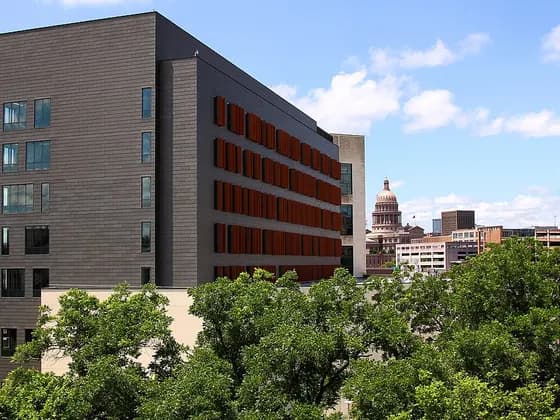
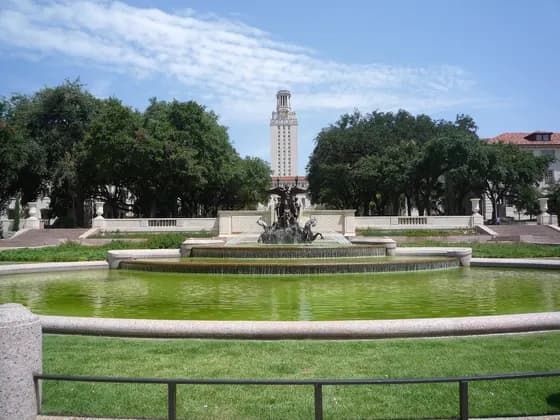
Dell Medical School at the University of Texas at Austin was founded in 2016. It is a public medical school created to redesign how physicians are trained and how healthcare is delivered. The school sits in Austin, one of the fastest-growing US cities. It produces physicians fluent in health systems science, value-based care, and community health, alongside clinical excellence.
Dell Med integrates clinical training at the adjacent Dell Seton Medical Center and leverages UT Austin's engineering, business, and public policy schools for interprofessional education. The school is public and applies through TMDSAS.
What makes Dell Medical School UT Austin (MD) different
Dell Medical School is the only medical school built from scratch in 50 years at a major US research university. Founded in 2016, it was explicitly designed around value-based healthcare, systems redesign, and community health rather than adapting a legacy curriculum. Its clinical home — Dell Seton Medical Center — was built alongside the school specifically for this integrated model.
The school emphasizes equity in healthcare and produces a high proportion of primary care and health policy-oriented physicians.
Dell Medical School UT Austin (MD) course & teaching
Integrated curriculum. 4-year MD. Year 1–2: "Fundamentals" curriculum integrating basic science with early clinical exposure, health systems science, and interprofessional education with UT Austin schools of nursing, pharmacy, and social work. Year 3–4: core clinical rotations at Dell Seton Medical Center and affiliated Austin Health community sites. All students complete a "Catalyze" health systems project.
Dell Medical School UT Austin (MD) research strengths
Dell Medical School UT Austin (MD) is strong in these research areas:
- Health systems innovation
- Value-based care
- Community health disparities
- Health equity
- Population health
How the Dell Medical School UT Austin (MD) interview runs
Format: MMI (multiple mini-interview stations) with value-based health systems emphasis
Dell Medical School uses an MMI format (the school does not publish a station count or station length), reflecting its core values of redesigning healthcare delivery and community health systems. Stations probe ethical reasoning, collaborative problem-solving, communication, and health systems thinking — particularly value-based care and social determinants of health.
The school opened in 2016 as the first new UT medical school in 50 years and was deliberately designed to produce physicians who will lead healthcare transformation. The interview day includes time with current students.
Dell Medical School UT Austin (MD) intake
Approximately 50 students per year.
Where Dell Medical School UT Austin (MD) is
Dell Medical School – University of Texas at Austin was founded in 2016 and is based in Austin, TX.
Programmes offered:
- Health Systems Science
- Primary Care
- Community Medicine
- Value-Based Care
- Health Equity