
Single station
One station, any stage.
$9
Each station $9
Buy one credit1 live station. Credits never expire.
OSCE practice for US MD and DO students
That is a real station. Take his history from a live AI standardized patient who answers only what you ask, on a strict clock. Then get the checklist back, scored line by line, with your own words as the evidence.
One live station is one credit: $9, or as low as $4.90 in a pack. Credits never expire. All 135 stations are free to read before you pay.


His checklist, after the station
Sample resultClerkship standardCredit packs
A single station is $9. In a pack it drops as low as $4.90. No subscription, and credits never expire.
One station, any stage.
$9
Each station $9
Buy one credit1 live station. Credits never expire.
Five stations: one of each type.
$34
Each station $6.80
Buy 5 credits5 live stations or 1 full mock OSCE. Credits never expire.
Fifteen stations, or five full mock OSCEs.
$81
Each station $5.40
Buy 15 credits15 live stations or 5 full mock OSCEs. Credits never expire.
Thirty stations for the run-up to your exam.
$147
Each station $4.90
Buy 30 credits30 live stations or 10 full mock OSCEs. Credits never expire.
What one credit covers
A full mock OSCE, several stations back to back, is 3 credits. Prices are in US dollars.
Not ready to pay? Every door note and checklist in the library is free to read, with no account. See what is free
AI OSCE simulator
Step 2 CS is gone, so the clinical skills exam that counts is your school’s. There, the SP scores you on a checklist you rarely get to see. Here is Trevor’s station exactly as it runs, checklist included.
1:00
Reading time
You get one minute with it before the clock starts, and it stays on screen once you are inside. The easy way to lose a station is to do more than the note asks, or less.
Doorway information
Chest pain history
Trevor Malone, 58, has presented to the emergency department with chest pain that began this morning. Take a focused history. You do not need to examine him. You have eight minutes. The examiner will then ask you to summarize and give a differential.
Scored at the Clerkship standard
8:00
In the room
Trevor is a real-time AI standardized patient with a face and a voice. He talks like a patient, not a textbook, and he reacts to how you speak to him. A classmate playing the patient already knows the case. Trevor holds back until you ask.
“Hey, doc. I’ve had this pain in my chest since this morning and, look, my wife wouldn’t let me go back to work till someone took a look at it.”
2:00
Examiner’s questions
An examiner sits in on history and communication stations. For the last two minutes they take over: summarize, then two or three questions. Time is called on time, whether you have finished or not. If you would rather keep all eight minutes with the patient, switch the questions off before you start.
The examiner’s questions
Clerkship standardAll of them are on his station page, free.
29
Lines, scored
Every line at your stage’s standard, scored one at a time. Nothing is graded on a feeling. Every point traces back to something you said, or something you left out.
 Chest pain historySample resultClerkship standard
And 21 more lines, scored the same way.
That is what one credit buys.Run Trevor live for $9
With an AI patient, and an examiner sitting in
With an AI examiner
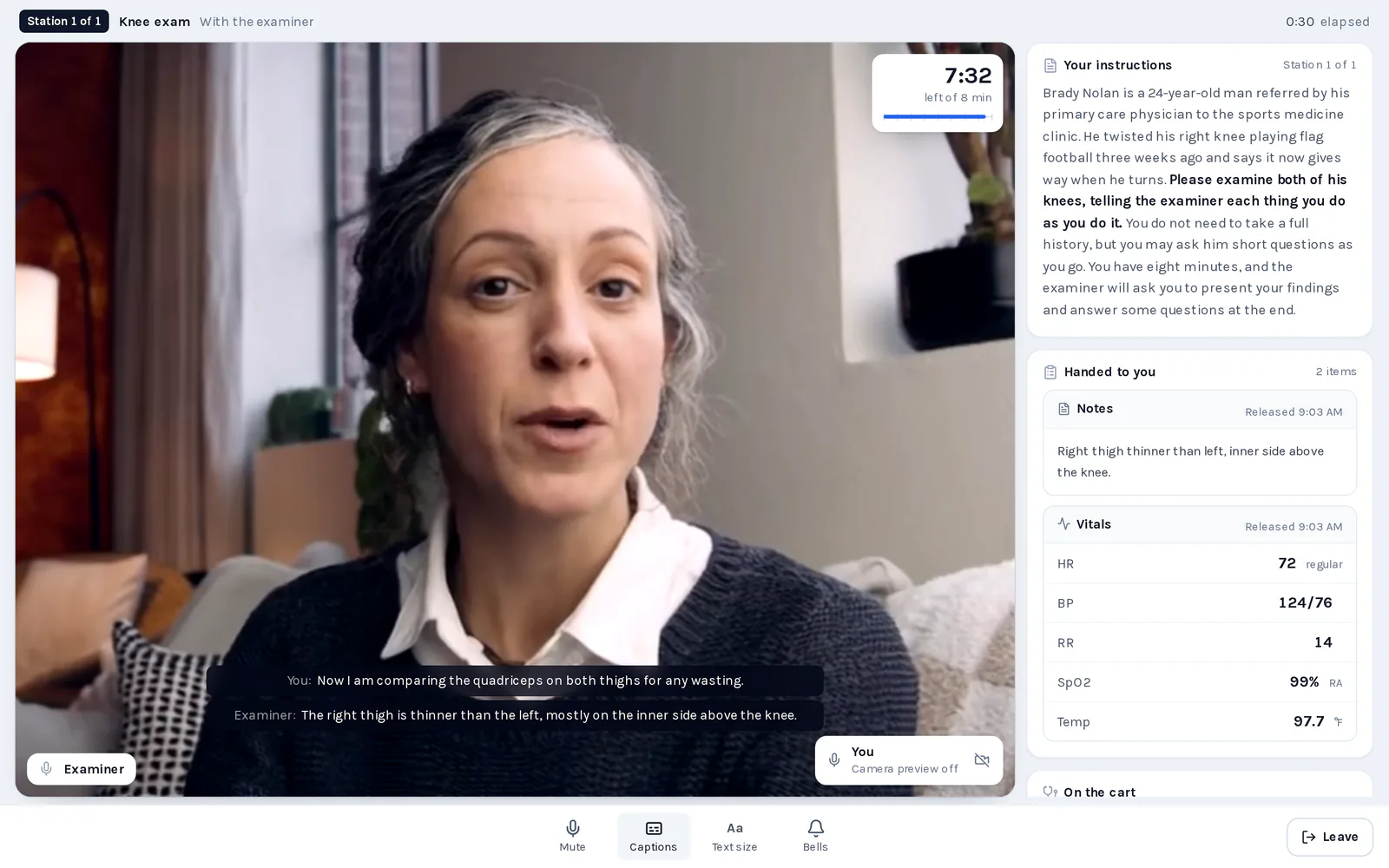
A physical exam station. Say what you are doing; the examiner tells you what you find and hands you the vitals.
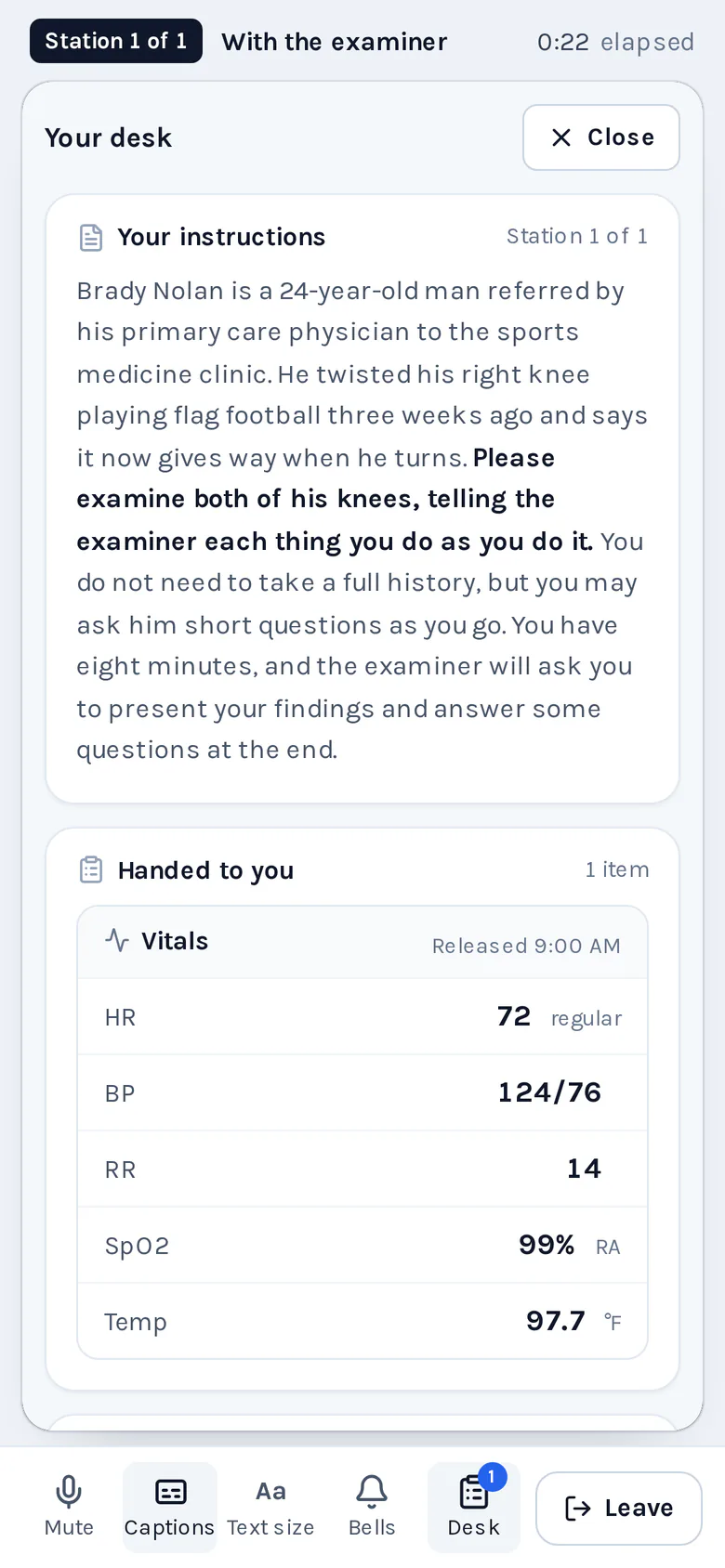
A knee exam: the vitals, handed over
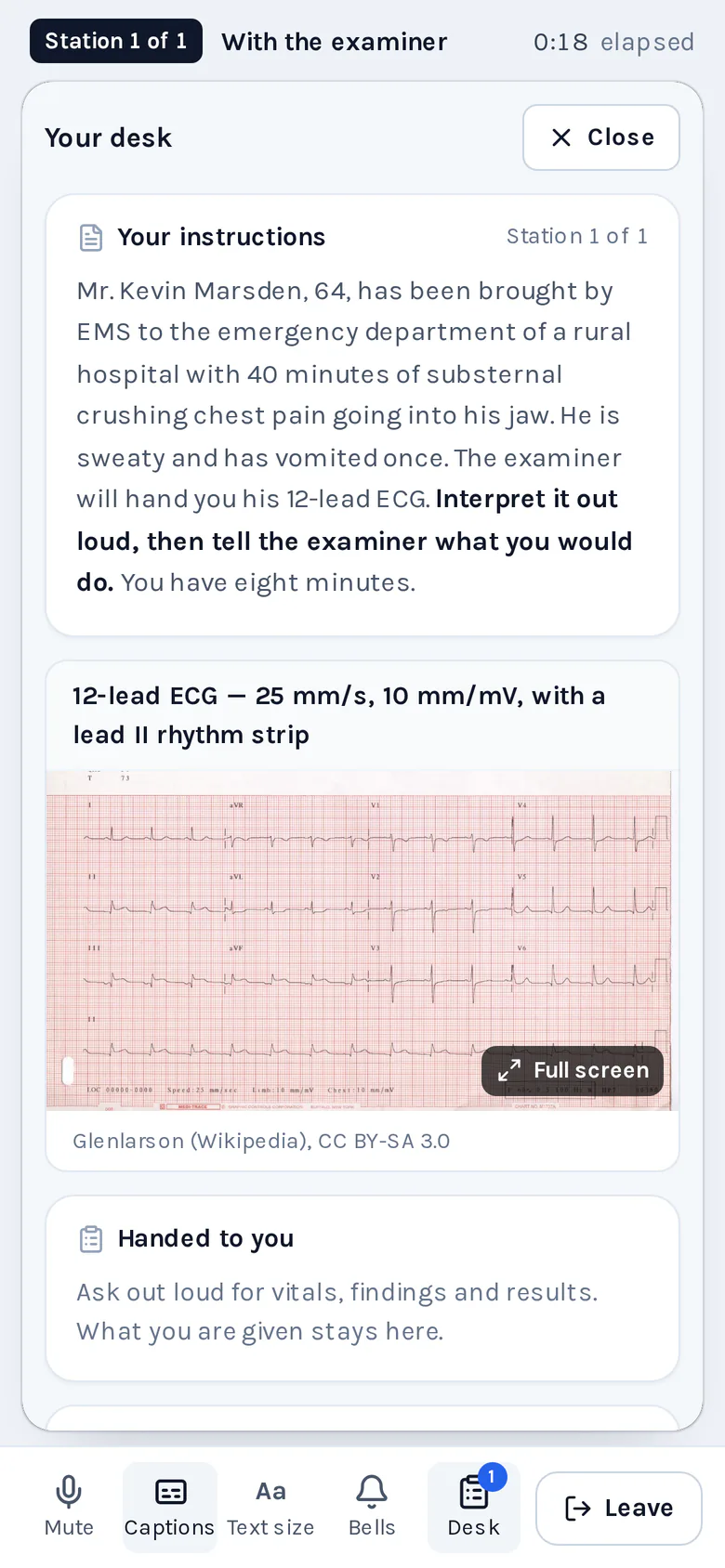
An ECG station: your desk, one tap away
Trevor’s door note reads the same at every stage. What changes is the checklist behind it.
Pre-clerkship21 lines
For the OSCEs in your clinical skills or doctoring course. Take the history well, and close with a clear summary.
Clerkship29 lines
For the OSCE in or at the end of a rotation. Adds clinical reasoning: the can’t-miss screens, the differential, the workup.
Final year32 lines
Pitched at what is expected of an intern on day one. Adds management, and telling the patient what happens next.
His whole checklist at Pre-clerkship21 lines, 25 points
His whole checklist at Clerkship29 lines, 36 points
His whole checklist at Final year32 lines, 40 points
Every station in the library is tiered this way. You pick your stage before you start, and the scoring follows it.
Station library
Practicing with classmates? One plays the patient from a script, another scores on their own phone. Also free.
The station library
FreeHistory47 stations
Chest pain · Shortness of breath · Abdominal pain · Headache · Weight loss and 42 more
Physical exam22 stations
Cardiovascular · Respiratory · Abdominal · Cranial nerve · Peripheral vascular and 17 more
Data interpretation24 stations
Chest X-ray · CT head · ECG · Arterial blood gas (ABG) and 20 more
Communication20 stations
Breaking bad news · Explaining a diagnosis · Consent for a procedure · Angry relative and 16 more
Procedures22 stations
Peripheral IV placement · Male urethral catheterization · Adult basic life support · Intramuscular injection and 18 more
Two clocks, drawn to the same scale: one notch a minute.
A station here
1:00 to read, 8:00 in the room
A school SP encounter
about 15:00, then usually a written task
A school SP encounter usually runs about 15 minutes. Trevor’s gives you 1 minute to read and 8 in the room. Most of ours run 8 minutes and none runs past 10. They are focused, timed reps of the encounter itself, the part you cannot practice alone.
Many school exams follow the encounter with a written note or a reasoning exercise. Nothing here asks for one, and nothing here scores one.
It cannot judge physical exam technique, hand hygiene, eye contact or body language. On physical exam and procedure stations you rehearse your sequence, your findings and your answers out loud. Practice the hands-on part on a classmate.
The cases and checklists are ours, written to US practice. Your school’s cases and rubric are its own, and no result here predicts a result there.
Clinical Years is independent. It is not affiliated with or endorsed by the USMLE, NBME, NBOME, AAMC or any medical school.
Necessary cookies keep the site working; analytics and marketing cookies run only if you allow them. Privacy