Clerkship plan · US

Clerkship OSCE stations. Reason to a differential.

Clerkship adds 70 stations to the 63 from the pre-clerkship stage, and every checklist now asks for interpretation and a differential.

  • 133 stations in scope
  • 70 new at the clerkship stage
  • 324 items that fail a station on their own

Which stage are you at?

  • Free to study, no account needed
  • Run it live: 1 credit, $4.90–$9
Chest pain historyNew at the clerkship stage
25 more items on this checklistRunning total3/36
What clerkship adds to the chest pain history checklist. Check off an item and the total adds up. Open the station

Start here

The clerkship plan

Five stations to start with, one of each type, all new at the clerkship stage. Then everything else the stage adds, a type at a time.

The starter mock OSCE

5 stations 45 min with reading time

One of each station type, all new at the clerkship stage, from five body systems.

  1. Dizziness and vertigo history1:00 + 8:00History taking Neurology New at the clerkship stageSandra Lomax, 55, has taken a same-day appointment at your primary care clinic with dizziness that began five days ago. Please take a focused history.
  2. Shoulder exam1:00 + 8:00Physical exam Musculoskeletal New at the clerkship stageMr. Wayne Duffy is a 55-year-old self-employed house painter who has come to your primary care clinic with three months of right shoulder pain, worse when he reaches overhead and when he lies on that side at night. Please examine his shoulders, telling the examiner each thing you do as you do it.
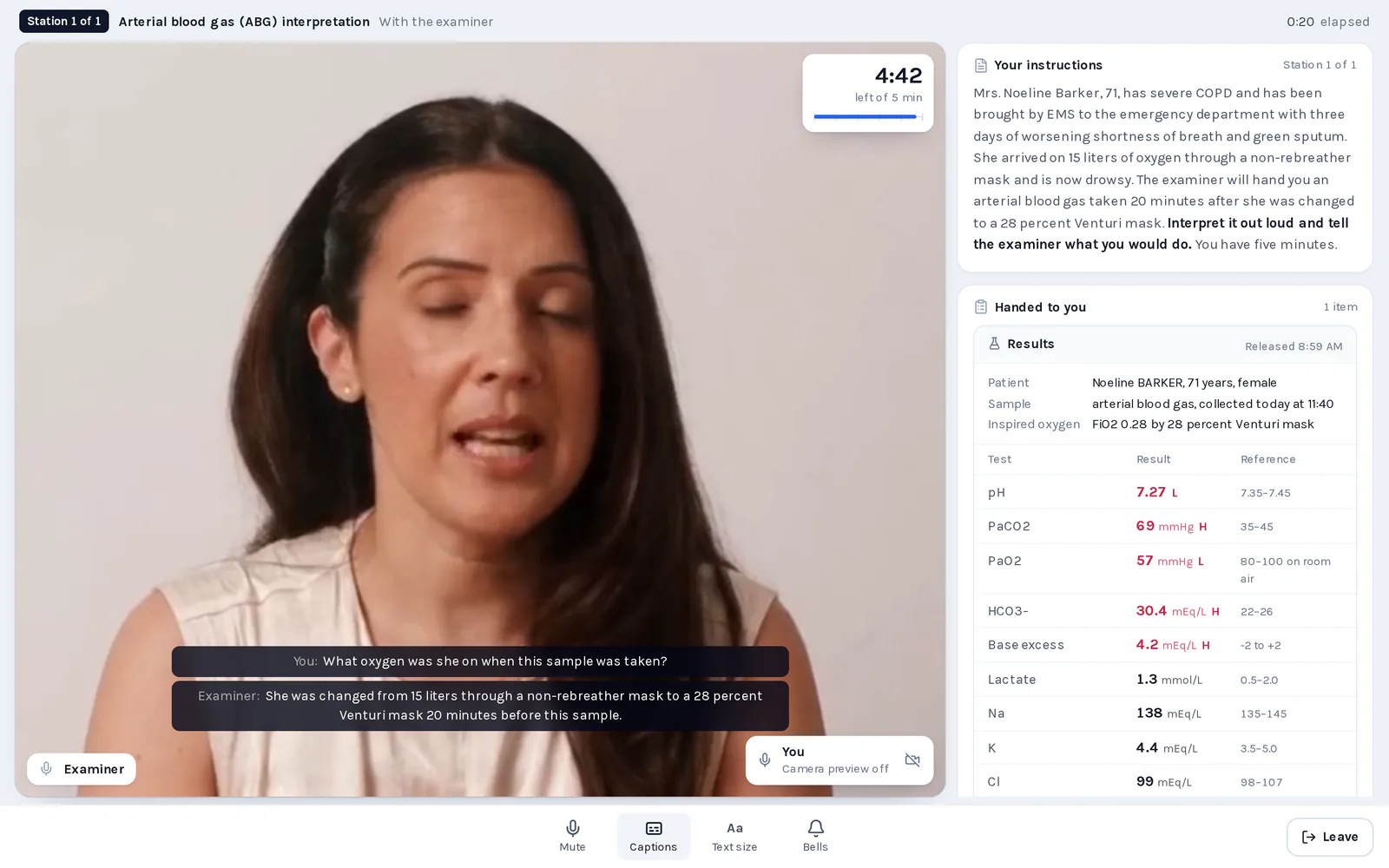
  3. Arterial blood gas (ABG) interpretation1:30 + 5:00Data interpretation Labs New at the clerkship stageMrs. Noeline Barker, 71, has severe COPD and has been brought by EMS to the emergency department with three days of worsening shortness of breath and green sputum. She arrived on 15 liters of oxygen through a non-rebreather mask and is now drowsy. The examiner will hand you an arterial blood gas taken 20 minutes after she was changed to a 28 percent Venturi mask. Interpret it out loud and tell the examiner what you would do.
  4. Consent for a procedure1:00 + 8:00Communication Surgery New at the clerkship stageMrs. Christine Pavlou, 58, has had four months of dyspepsia and has been found by her primary care physician to have iron-deficiency anemia with a hemoglobin of 9.6 g/dL. Her primary care physician referred her to the gastroenterology clinic at this Baltimore hospital. Her insurer has approved prior authorization for a diagnostic upper endoscopy (EGD), booked at the hospital’s outpatient endoscopy unit in two weeks. She is at the pre-procedure clinic today. She is not on anticoagulants. Your senior resident has asked you, the intern on the gastroenterology team, to go through consent with her, and hospital policy allows this. The endoscopist will confirm it on the day. She has been given the unit’s information sheet but says she has not read it. Please consent her for the procedure.
  5. Suturing a simple laceration1:00 + 10:00Practical skills Procedures New at the clerkship stageMr. Daniel Moretti, 34, has come to the emergency department with a cut to his left forearm and has been triaged to fast track. You are a medical student working with the emergency medicine attending, who has asked you to assess the wound and, if it is suitable, to close it with sutures. Please take a brief history, assess the wound and the arm, anesthetize and suture it, and give him aftercare advice, talking the examiner through each thing you ask, check and do, and why.
  • Run it with classmates, free

    One of you runs the station, one plays the patient from a script, and one scores on their own phone from a QR code. One clock for all of you.

    Run it with classmates
  • Or run the whole mock OSCE live

    The same five stations back to back, by voice, with an AI standardized patient or examiner. Each checklist comes back scored at the clerkship standard.

    Run the whole mock OSCE live, 3 credits

What clerkship adds, type by type

Read the guide for a type, then drill its stations. Every station here opens at the clerkship standard.

The standard

What changes from pre-clerkship to clerkship

Pre-clerkship points were mostly for doing. Clerkship points are mostly for thinking. Every technique item is still on the checklist. It is simply no longer where the station is won or lost, because by now everybody can do it.
Chest pain historyNew at the clerkship stage
25 more items on this checklistRunning total3/36
What clerkship adds to the chest pain history checklist. Check off an item and the total adds up. Open the station
The clerkship standardCore clerkships

What a passing student does at the clerkship stage

  • Technique fluent enough that it no longer costs time or attention
  • A prioritized differential stated out loud, with the reasoning that puts one diagnosis above another
  • First-line tests chosen and justified, with the result interpreted when it is handed over
  • Red flags actively screened for and named as reassuring or concerning
  • A structured spoken summary: chief complaint, key positives and negatives, assessment, plan

The follow-up questions

The questions push on the differential and the first test: “what else could this be?” and “what would you order first, and why?”

Global ratingClear failBorderlinePassGood passExcellent
  1. Every station now ends with a differential

    At the clerkship stage you are expected to name a differential and justify your first test. A pre-clerkship student can pass the chest-pain history by working through the pain questions; a clerkship student cannot pass it without saying this sounds like an acute coronary syndrome and that he needs a 12-lead ECG within ten minutes of first medical contact, continuous monitoring, a high-sensitivity troponin and the ED attending or senior resident told now. That last item is a critical fail if it never comes.

  2. Relevant negatives start earning points

    Screening out loud for what it is not becomes a checklist item of its own: pleuritic pain, hemoptysis and calf swelling for a pulmonary embolism, tearing pain radiating through to the back for a dissection, positional and reflux-related pain for the non-ischemic causes. Excluding the dangerous diagnosis out loud is what makes a history a clerkship history.

  3. Stations appear that do not exist at the pre-clerkship stage

    Head CT interpretation, arterial blood gases, breaking bad news, consent for a procedure, the angry family member and male urinary catheterization come into scope at this stage. Two of them are pure data interpretation and three are pure communication, and between them they are where most clerkship students lose points.

  4. Signs have to be named, not merely found

    On the cardiovascular station, auscultating correctly no longer earns the point on its own. You are scored on calling the pulse slow-rising and low volume, describing the murmur by timing, site, radiation, character and grade, checking for radiation to the carotids, and presenting a summary that ends in a differential and the echocardiogram you would order to confirm it.

AI OSCE simulator

Then run one live, at the clerkship standard

Read the door note and start when reading time ends. An AI standardized patient answers only what you ask; on a physical exam, data or skills station an AI examiner tells you what you find.
  • Every station on this page can be run live, by voice.
  • The checklist comes back scored at the clerkship standard, with your own words beside each item.
  • A microphone cannot see your hands, so practice the technique itself on a classmate.
Run a station live

1 credit a station, $4.90–$9

AI OSCE station · United StatesReal screen
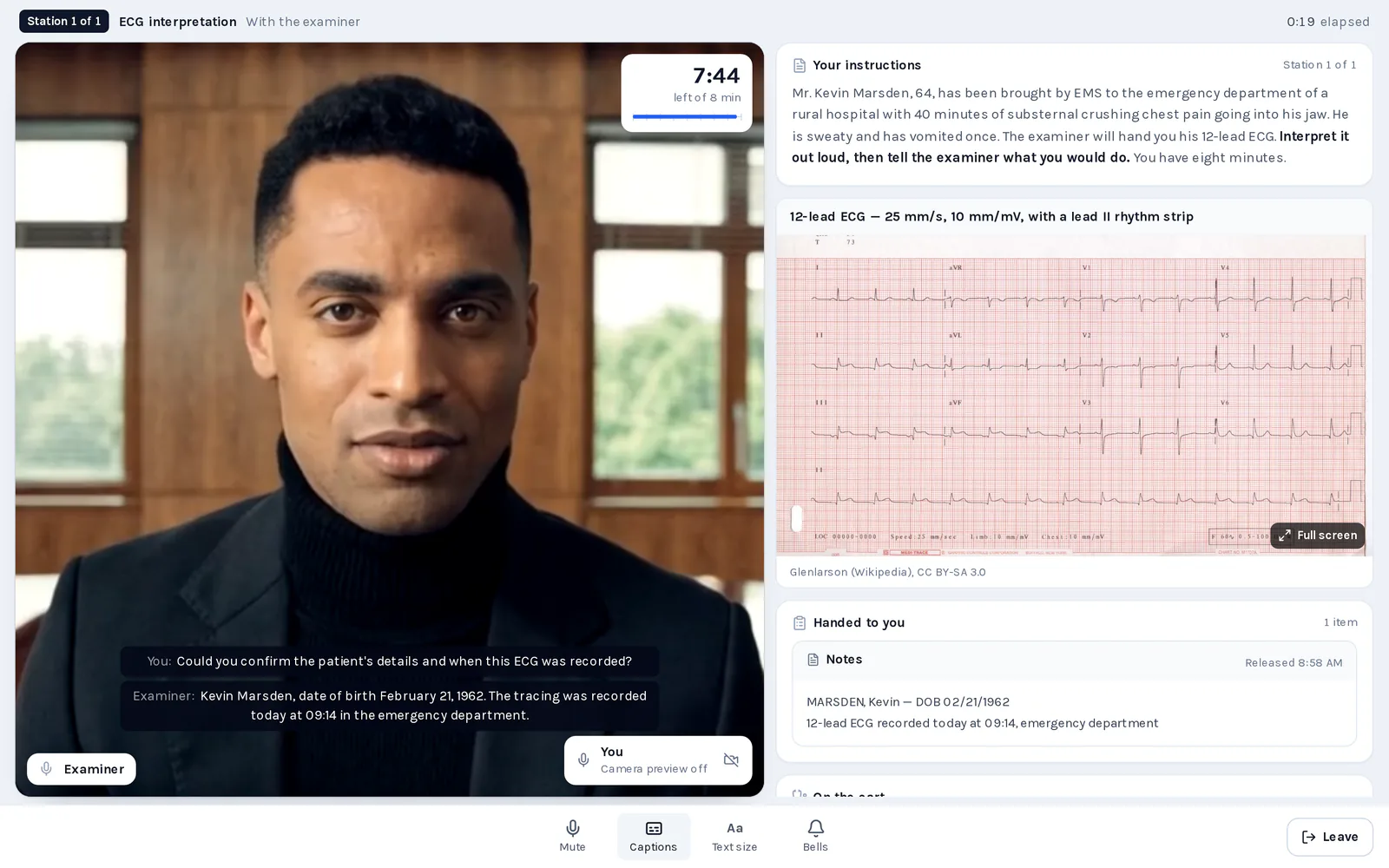
A live AI OSCE history station from the US library: the patient, a man with chest pain in the emergency department, is answering a question on screen with captions. The examiner sits in the corner, a clock shows the time left, and the student's desk holds the instructions and a sheet of scratch paper with notes.

Real screen
The same AI OSCE history station from the US library on a phone: the patient fills the screen, with the examiner's chair, the clock and the controls around him.
The patient, on your phone
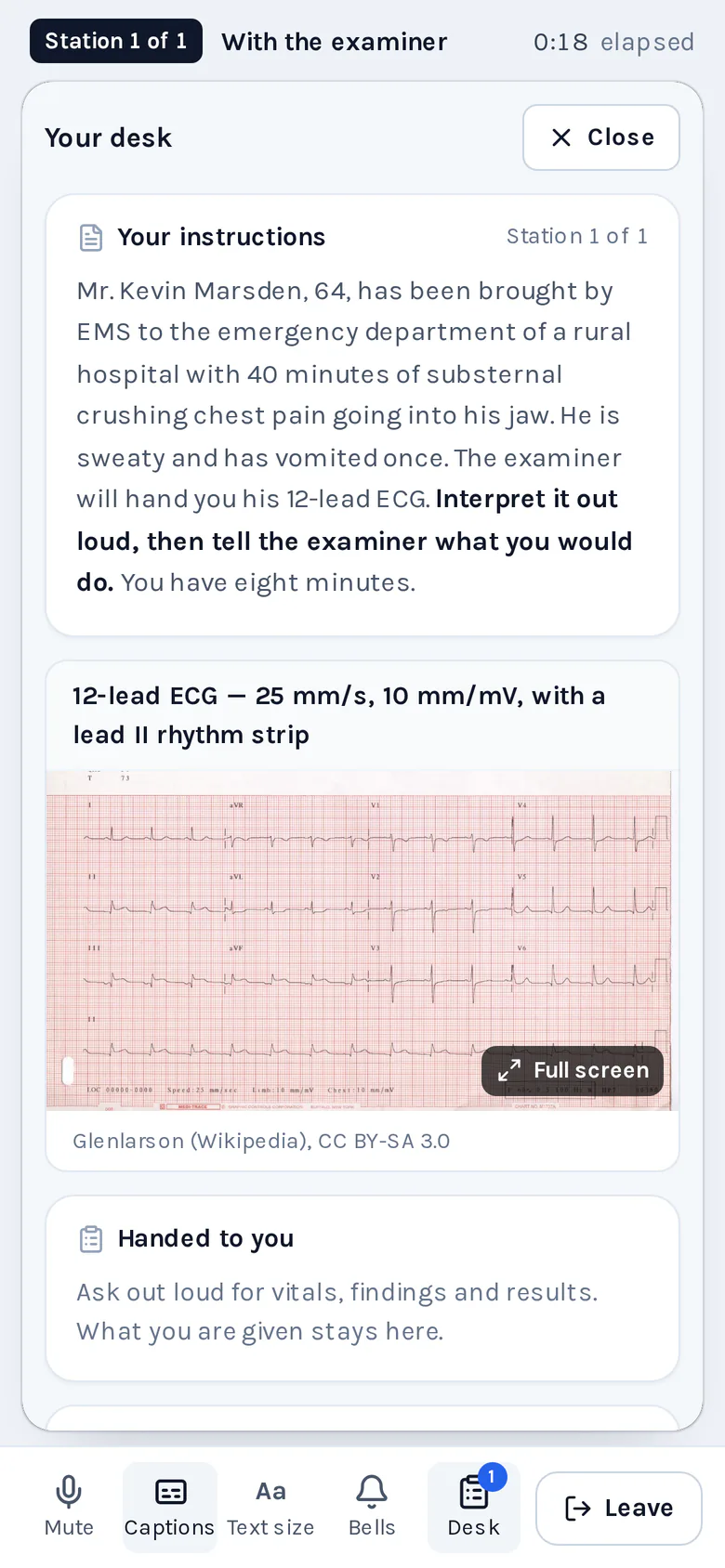
The student's desk on a phone during an AI OSCE data station from the US library: the instructions, the ECG and the space for what the examiner hands over.
Your desk, one tap away
Real screens of a live station, one of each kind. How the live room works

Start the clerkship mock OSCE tonight

Open the first station, run it out loud against the clock and check off your own checklist. It is free and needs no account.