Final year plan · US

Final year OSCE stations. Act as a new intern.

Final year adds 2 stations to the 133 from the earlier stages, and every checklist now asks for management, escalation and return precautions.

  • 135 stations in scope
  • 2 new at the final-year stage
  • 340 items that fail a station on their own

Which stage are you at?

  • Free to study, no account needed
  • Run it live: 1 credit, $4.90–$9
Chest pain historyNew at the final-year stage
29 more items on this checklistRunning total3/40
What final year adds to the chest pain history checklist. Check off an item and the total adds up. Open the station

Start here

The final-year plan

Five stations to start with, one of each type. Then the checklists that change most at the final-year stage, a type at a time.

The starter mock OSCE

5 stations 46 min with reading time

One of each station type: checklists that ask for more at the final-year stage.

  1. Falls history1:00 + 8:00History taking Care of the elderly From ClerkshipJoan Whitcombe, 82, has been brought to the emergency department by her daughter after a fall at home last night. X-rays of her right hip and left forearm show no fracture and her vital signs are stable. Please take a focused falls history.
  2. Diabetic foot exam1:15 + 8:00Physical exam Endocrine From ClerkshipMr. Vince Karagiannis is a 66-year-old man who has had type 2 diabetes for twelve years and has come to his primary care clinic for the foot exam at his annual diabetes visit. Please examine both of his feet, talking the examiner through each step as you do it.
  3. Thyroid function tests interpretation1:15 + 8:00Data interpretation Labs From ClerkshipYou are the intern in the endocrinology clinic at a large urban hospital. Ms. Elena Reyes, 28, has been referred from her primary care clinic with four months of weight loss, palpitations and a fine tremor. Her thyroid function tests are in front of you, and the examiner holds the rest of her results. Interpret them aloud for the examiner, say what you think is going on and outline your immediate management.
  4. Handling a complaint1:00 + 8:00Communication Professionalism From ClerkshipMr. Vaughn Steadman, 47, came to the ED of this Asheville, North Carolina, hospital two weeks ago after going over the handlebars of his mountain bike onto his outstretched right hand. His wrist radiographs were reported as showing no fracture and he was discharged with a splint and advice to take over-the-counter pain relief. He returned to the clinic today because the pain never settled. Repeat imaging this morning shows a fracture through the waist of the right scaphoid, and the original films have since been reviewed and the fracture is visible on them. He has asked to speak to a doctor and has said that he wants to make a complaint. You are the intern on the clinic team. Please speak with him.
  5. Acutely unwell with a fever1:00 + 8:00Practical skills Emergency medicine From ClerkshipMrs. Shirley Tranter, 82, has just been brought by EMS to the emergency department of a hospital in Pittsburgh, Pennsylvania. Her daughter, who is at the bedside, found her confused at home this morning and says she feels hot. You are a medical student with the ED team and a registered nurse is working with you. Assess Mrs. Tranter from A to E and start her treatment, talking the examiner through each thing you do, ask for and order.
Start with Falls history

Free. No account needed.

  • Run it with classmates, free

    One of you runs the station, one plays the patient from a script, and one scores on their own phone from a QR code. One clock for all of you.

    Run it with classmates
  • Or run the whole mock OSCE live

    The same five stations back to back, by voice, with an AI standardized patient or examiner. Each checklist comes back scored at the final-year standard.

    Run the whole mock OSCE live, 3 credits

Final year, type by type

Read the guide for a type, then drill its stations. Every station here opens at the final-year standard.

The standard

What changes from clerkship to final year

No new station types appear in final year. The same stations come back and every one of them is scored out of more, and the extra points are all in what you would actually DO about your findings: said out loud, in priority order, at the standard of an intern on their first night on call.
Chest pain historyNew at the final-year stage
29 more items on this checklistRunning total3/40
What final year adds to the chest pain history checklist. Check off an item and the total adds up. Open the station
The final-year standardLast year of medical school

What a passing student does at the final-year stage

  • A management plan stated out loud in intern terms: immediate actions, tests, escalation, disposition
  • Escalation done properly: a rapid response where the vitals warrant it, a structured handoff to your senior resident, and documentation
  • Return precautions and follow-up arranged: what the patient should watch for, when to come back, who follows them up
  • Communication scored to the same standard as clinical skill: plain language, checking understanding, honesty, cultural humility
  • Fluency under time pressure: the whole station, not most of it

The follow-up questions

The questions turn to management: “you are the intern: what do you do now, and who do you call?”

Global ratingClear failBorderlinePassGood passExcellent
  1. Reasoning is no longer the finish line

    At the clerkship stage you finished on “this is an inferior STEMI”. In final year you have to keep going: aspirin 162 to 325 mg chewed, analgesia with an antiemetic, oxygen only if the saturation is below 90 percent, and the cath lab activated for primary PCI within 90 minutes of first medical contact (120 with a transfer), or fibrinolysis, ideally within 30 minutes, where that cannot be achieved.

  2. You are scored on what you would NOT do

    The final-year tier of the ECG station carries a critical item for withholding nitrates when there is right ventricular involvement with hypotension, and giving a cautious fluid bolus instead. Knowing the standard bundle is the clerkship standard. Knowing when the standard bundle would harm this particular patient is the intern standard.

  3. Escalation is assessed as a skill in its own right

    A rapid response the moment the vitals breach the calling criteria, and a structured handoff to your senior resident (who you are, the situation, the background, your assessment and what you are asking for, with the time of onset and what you have already done) appear across the acute stations. Working steadily on alone without calling anybody is not caution; it fails the station.

  4. The conversation weighs as much as the clinical work

    Explaining what you think is happening in plain language, checking understanding, anticipating the complications you would watch for, and return precautions in words the patient would actually use are all final-year items, as is what happens after discharge: primary care follow-up, the medications and whether the patient can afford them, the summary that has to go out. The last points on the chest-pain history are for telling him what happens next and telling him to call 911 if the pain comes back.

AI OSCE simulator

Then run one live, at the final-year standard

Read the door note and start when reading time ends. An AI standardized patient answers only what you ask; on a physical exam, data or skills station an AI examiner tells you what you find.
  • Every station on this page can be run live, by voice.
  • The checklist comes back scored at the final-year standard, with your own words beside each item.
  • A microphone cannot see your hands, so practice the technique itself on a classmate.
Run a station live

1 credit a station, $4.90–$9

AI OSCE station · United StatesReal screen
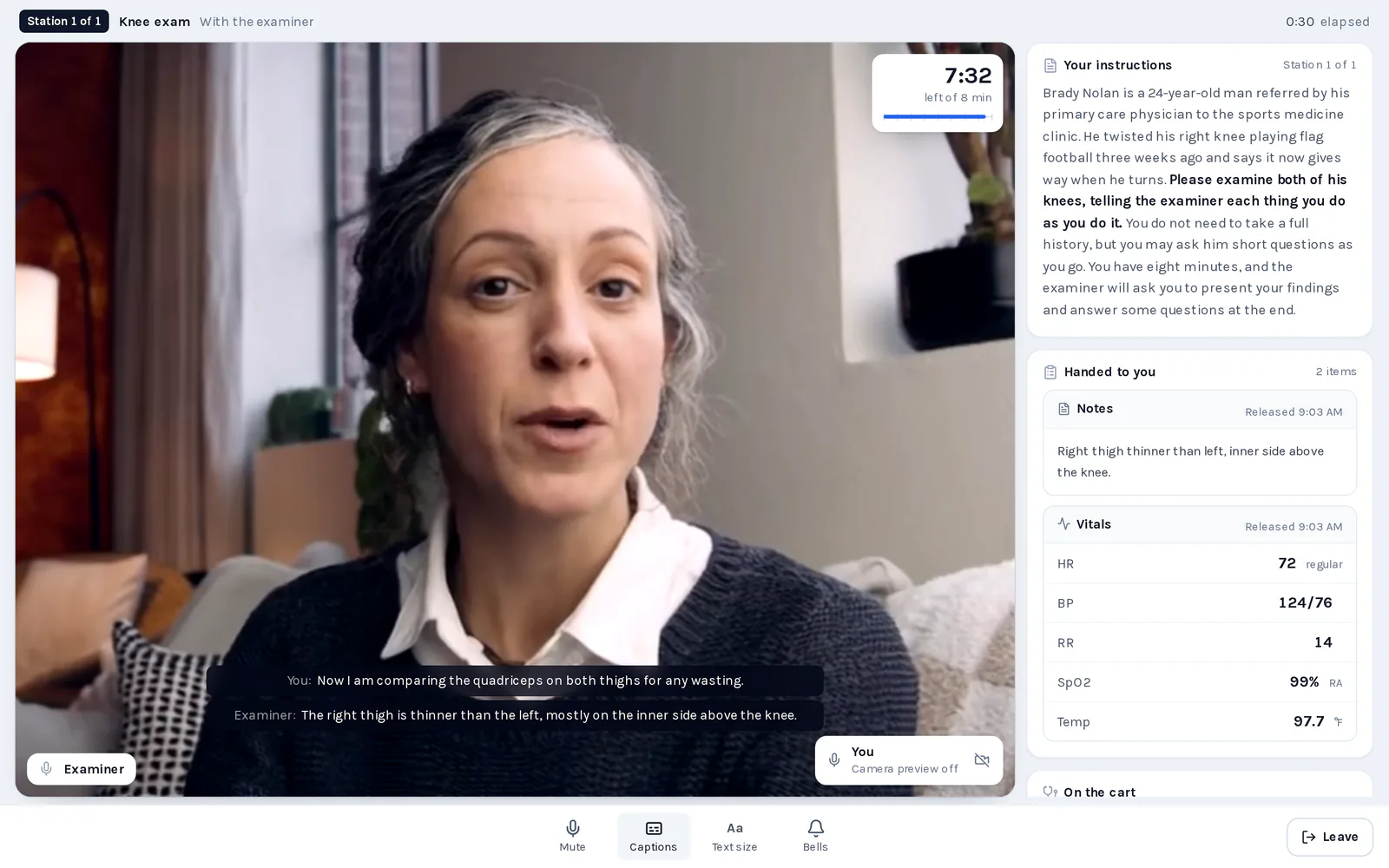
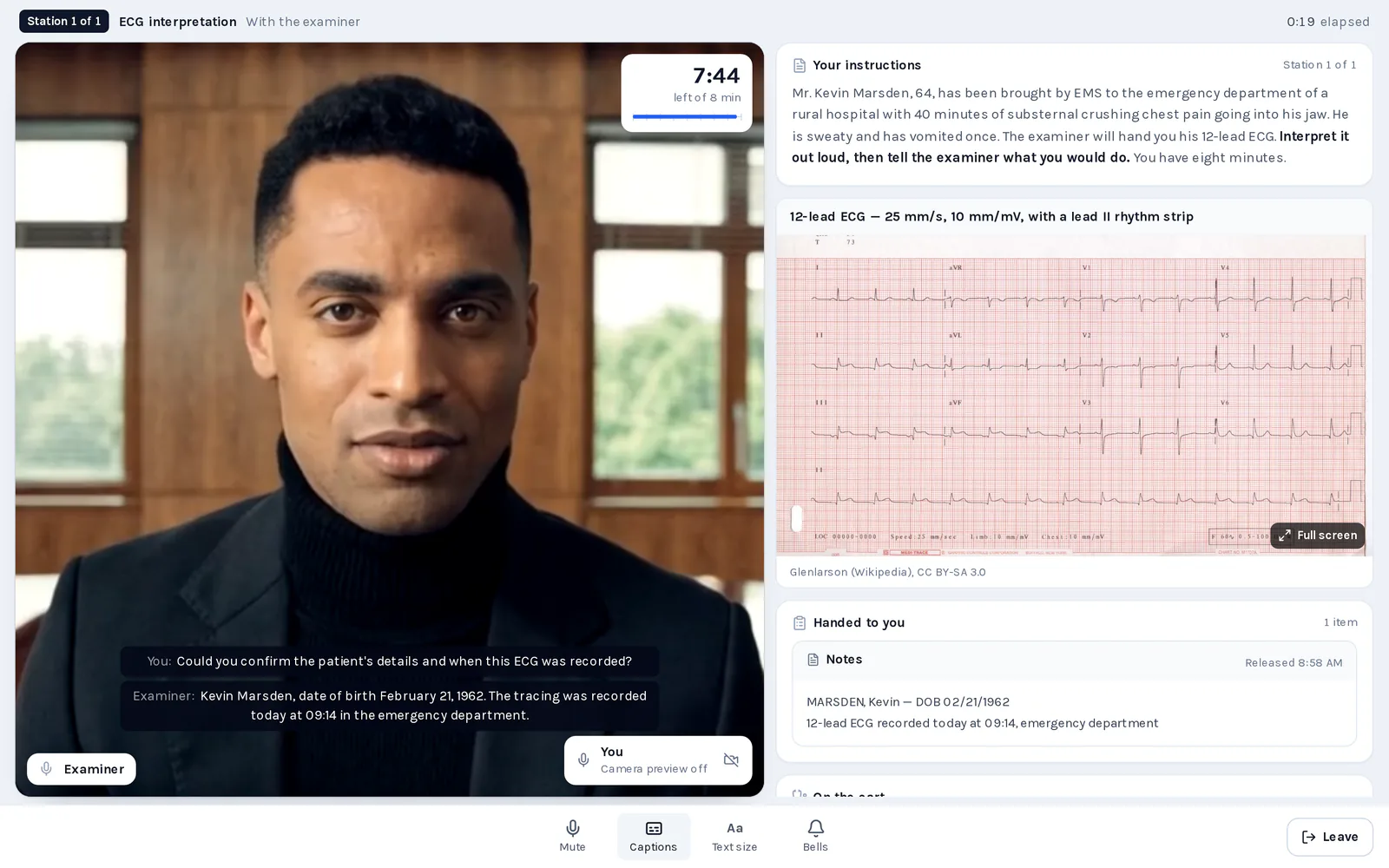
A live AI OSCE history station from the US library: the patient, a man with chest pain in the emergency department, is answering a question on screen with captions. The examiner sits in the corner, a clock shows the time left, and the student's desk holds the instructions and a sheet of scratch paper with notes.

Real screen
The same AI OSCE history station from the US library on a phone: the patient fills the screen, with the examiner's chair, the clock and the controls around him.
The patient, on your phone
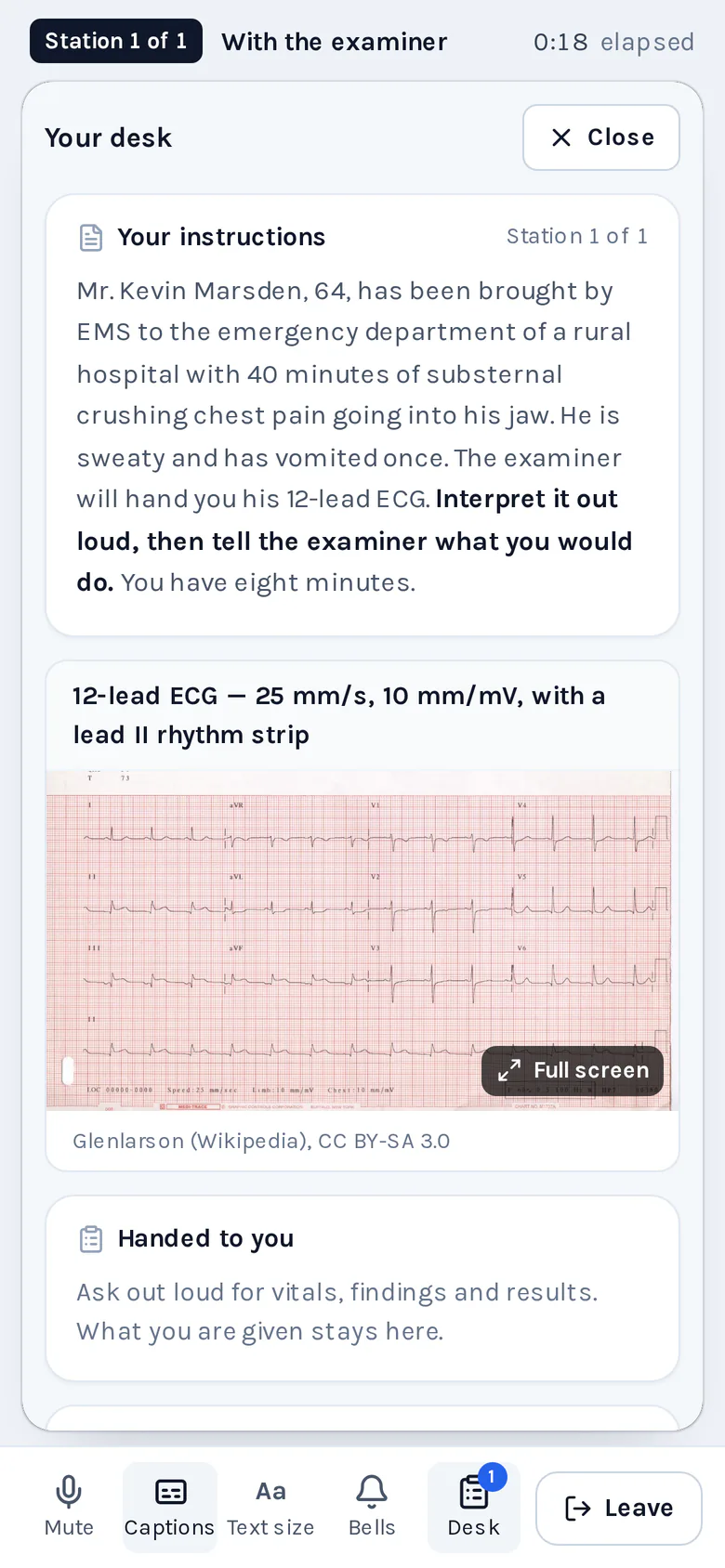
The student's desk on a phone during an AI OSCE data station from the US library: the instructions, the ECG and the space for what the examiner hands over.
Your desk, one tap away
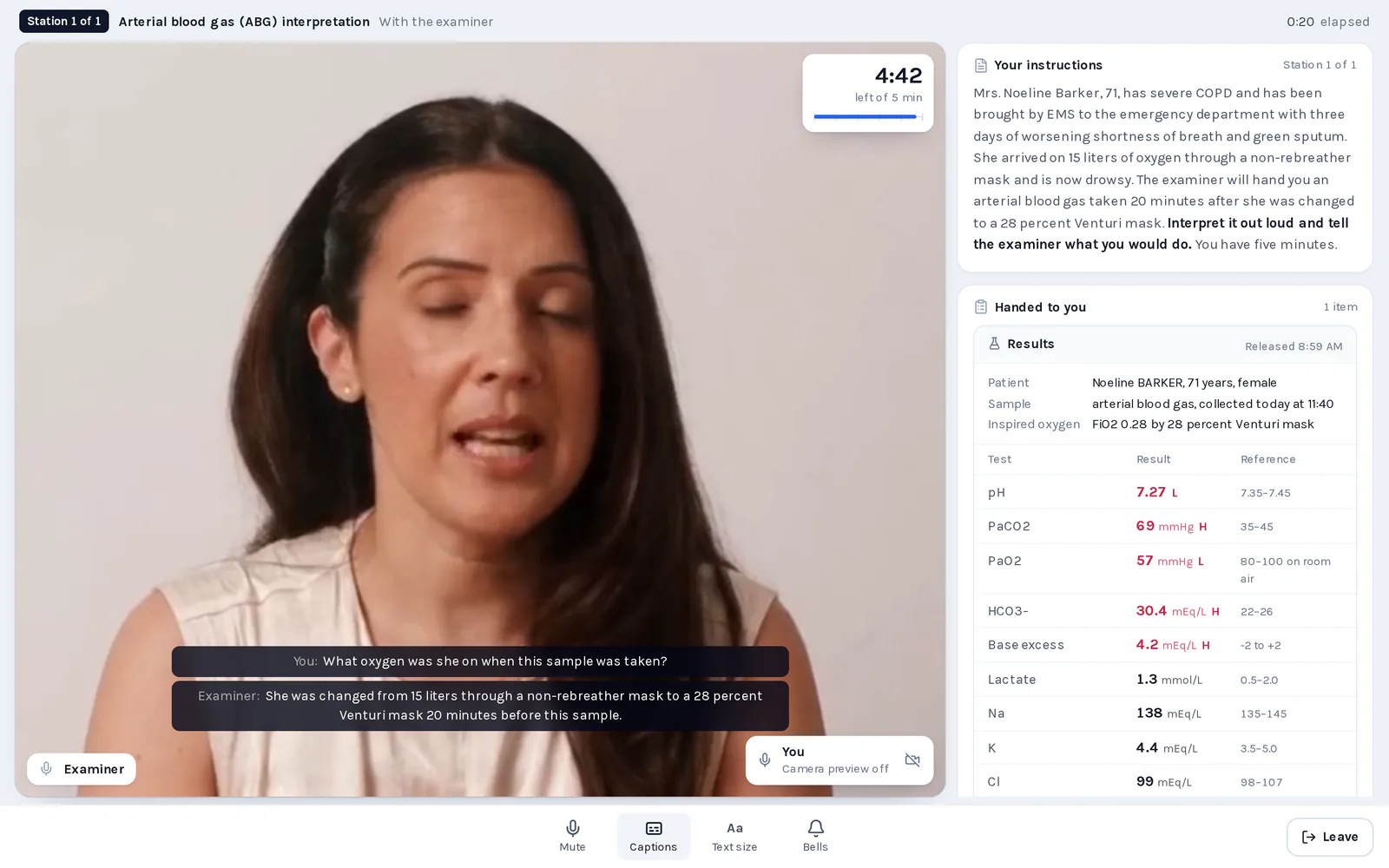
Real screens of a live station, one of each kind. How the live room works

Start the final-year mock OSCE tonight

Open the first station, run it out loud against the clock and check off your own checklist. It is free and needs no account.