
Physical exam · Musculoskeletal
Knee exam OSCE rubric, pre-clerkship
Look, feel and move the knee with the joint above and below, then the special tests: effusion, collaterals, cruciates and menisci.
Pre-clerkship is where this checklist starts: 20 lines and 21 points, most of them on systematic approach and professionalism.
- 1:30 + 8:00 reading, then the room
- 6 examiner questions
- From pre-clerkship
- Free to practice, no account needed
- Last updated

How do you want to practice?
Read the door note, run the clock, then score yourself on the real checklist.
One plays the patient from the brief, one scores on their own phone.
Their score lands on your screen.
An AI examiner runs the station by voice. It cannot see your hands, so practice the technique itself on a friend.
Door note
Read before you go in
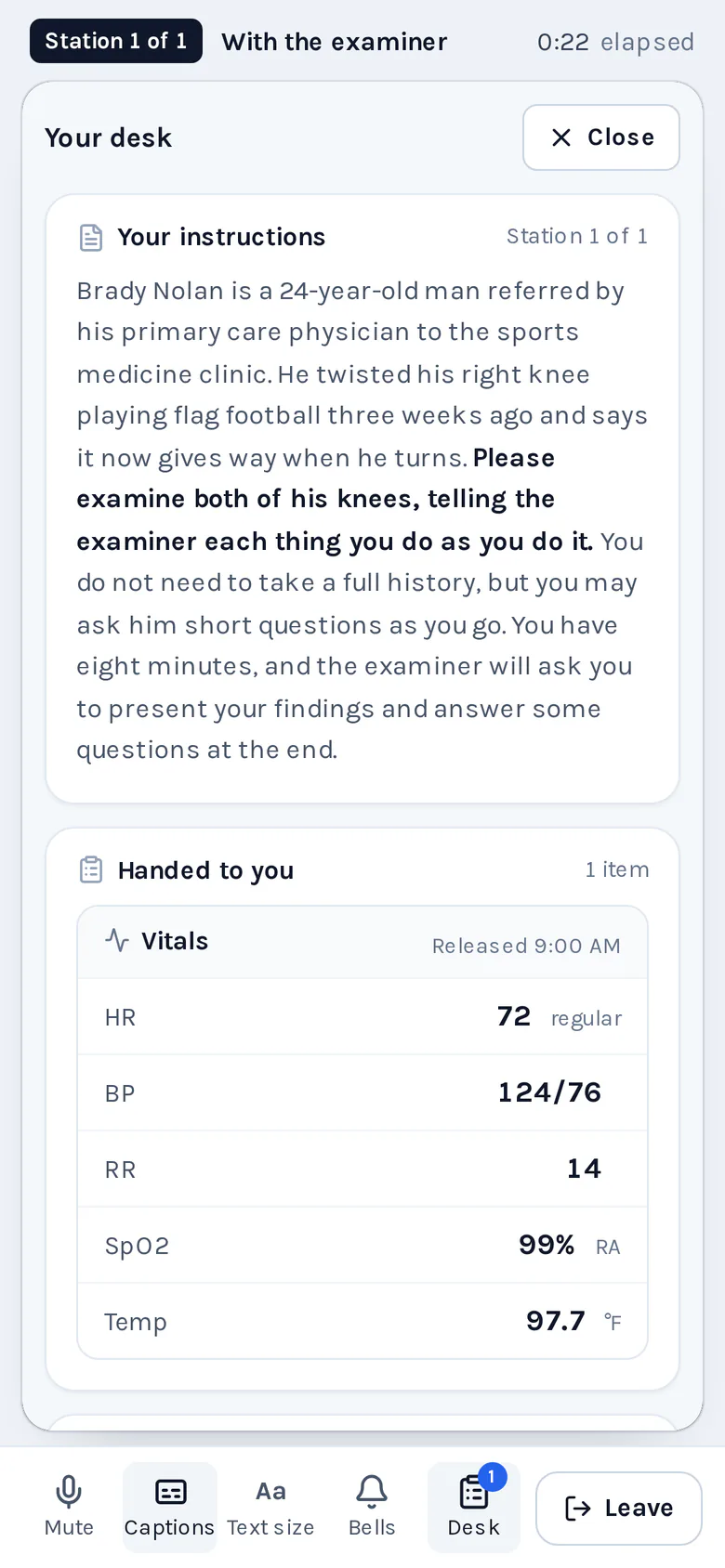
Brady Nolan is a 24-year-old man referred by his primary care physician to the sports medicine clinic. He twisted his right knee playing flag football three weeks ago and says it now gives way when he turns. Please examine both of his knees, telling the examiner each thing you do as you do it. You do not need to take a full history, but you may ask him short questions as you go. You have eight minutes, and the examiner will ask you to present your findings and answer some questions at the end.
90 sec reading, then 8 min in the station
On the cart
- Exam table
- Alcohol-based hand rub
- Shorts for the patient
- Tape measure
- Goniometer
- Pillow to support the knee
Your notes from reading time
Saved in this browser only.
Pre-clerkship is where this checklist starts: 20 lines and 21 points, most of them on systematic approach and professionalism.
Pre-clerkship standard. Performs a complete look, feel, move examination of both knees, includes the joint above and below, and describes the findings accurately.
1 critical line. Miss it and the station is failed, however well the rest goes.
Communication 0/2Systematic 0/13Clinical reasoning 0/1Professionalism 0/4Patient safety 0/1
Patient’s brief
Everything the patient knows, including what they will only say if asked. Best read after you have run the station once.
Brady Nolan
You are the patient · 24 · man
You are Brady Nolan, a 24-year-old plumber from Aurora, Colorado, who runs his own small business and plays in a weekend flag football league. You are chatty, quick and matter-of-fact, and you make light of pain because you were brought up to get on with things. You are wary of the right leg: you lower it with both hands, hold the bed when you turn and tense up when somebody takes hold of it. When a test makes you nervous you go quiet, say hang on a sec, then make a joke afterward. You fill silences with talk about the league and the job. You do everything asked and tell the doctor when something hurts rather than describing what the knee is doing. Under pressure you talk faster and ask how long you will be out and whether this needs surgery. You have no medical training, use words like popped and gave way, and never name a diagnosis. Speak plainly and in your own words.
Yeah, hey, doc. It is this one, the right. Three weeks later and it still goes out from under me every time I turn.
- That you have kept going to the league. You say you have been resting; asked directly, you admit you went back to play and it gave way inside ten minutes.
- How close you have come to falling. You play it down; asked kindly, you admit nearly going down the front steps with your tool bag.
Where do you want me, doc?
Am I good like this?
Is it all right if I hang on to the bed?
Sorry, give me a sec.
Run the station before you look
The answers are the most useful thing on this page once you have had a go, and the least useful before.
When the student asks for the vital signs
The vitals are: heart rate 72 and regular. Blood pressure 124 over 76. Respiratory rate 14. Oxygen saturation 99 percent on room air. Temperature 97.7 Fahrenheit.HR 72 regular | BP 124/76 | RR 14 | SpO2 99% RA | Temp 97.7 °F
When the student looks at the patient in general, or around the bed for aids or braces
He is sitting comfortably, with no cane, crutch or brace.Comfortable. No cane, crutch or brace.
When the student looks at the legs or the knees with the patient standing
Standing, the legs are in line, with no varus or valgus.Standing: legs in line, no varus or valgus.
When the student asks the patient to walk
He walks unaided. The right stance phase is short, and that knee stays slightly bent at heel strike.Walks unaided. Short right stance phase, right knee slightly bent at heel strike.
When the student asks the patient to squat or to step down on one leg
He gets two thirds of the way down, then stops with right knee discomfort.Two thirds of the way down, stopped by right knee discomfort.
When the student inspects, feels or palpates the left knee or both knees, or tests them for an effusion
The left knee has no swelling, warmth or tenderness.Left knee: no swelling, warmth or tenderness.
When the student inspects the knees, unless only the left
The right knee is fuller than the left, above and beside the patella. No redness, bruising or scar.Right knee fuller than left, above and beside the patella. No redness, bruising or scar.
When the student looks at or feels the back of the knees
There is no swelling behind either knee.No swelling behind either knee.
When the student looks at or compares the quadriceps or the thighs
The right thigh is thinner than the left, mostly on the inner side above the knee.Right thigh thinner than left, inner side above the knee.
When the student measures the thigh circumference
The right thigh measures 2 centimeters less than the left.Right thigh 2 cm less in circumference than the left.
When the student feels the temperature of the knee, unless only on the left
The right knee feels slightly warm.Right knee slightly warm.
When the student performs the patellar tap, unless only on the left knee
On the right the patella sinks, taps the femur and bounces back.Right: patella sinks, taps the femur and bounces back.
When the student performs the sweep, bulge or stroke test, unless only on the left knee
On the right a bulge of fluid refills the inner hollow within two seconds.Right: bulge refills the medial hollow within 2 seconds.
When the student palpates the joint lines, unless only on the left knee
The right medial joint line is tender. The lateral joint line is not.Right medial joint line tender. Lateral not tender.
When the student palpates the patella, the tendons, the tibial tuberosity, the fibular head or another landmark
There is no tenderness there.Not tender.
When the student tests movement of the left knee or of both knees
The left knee moves from zero to 140 degrees.Left knee: 0 to 140 degrees.
When the student tests active flexion or extension of the knee, unless only on the left
The right knee straightens to 5 degrees short of full and bends to 120, where it gets sore.Right, active: lacks 5 degrees of extension, flexion 120.
When the student moves the knee passively or pushes it toward full extension, unless only on the left
Passively the range is the same. The last 5 degrees feel soft and sore, with no spring.Right, passive: same range. Last 5 degrees soft and sore, no spring.
When the student feels for crepitus, or keeps a hand on the patella as the knee moves
There is no crepitus.No crepitus.
When the student asks for a straight leg raise
He lifts the straight leg off the bed, with no lag.Straight leg lifts off the bed, no lag.
When the student does a ligament or meniscal test on the left knee or on both knees
On the left there is very little movement, a firm stop and no pain.Left: very little movement, firm stop, no pain.
When the student tests the collaterals with valgus or varus stress, unless fully straight or only on the left
Neither side of the right knee opens, with firm endpoints. Valgus stress is a little sore medially.Right: no opening, firm endpoints. Valgus a little sore medially.
When the student applies valgus or varus stress with the knee fully straight, unless only on the left
Fully straight, neither side of the right knee opens, with firm endpoints.Right, full extension: no opening, firm endpoints.
When the student looks for a posterior sag
Neither tibia has dropped back, and both tibial steps are present.Neither tibia dropped back. Tibial step present both sides.
When the student performs the posterior drawer, unless only on the left knee
On the right the tibia does not move back. The stop is firm.Right: no backward movement, firm stop.
When the student performs the anterior drawer, unless only on the left knee
On the right the tibia comes forward about a centimeter, with no firm stop.Right: about 1 cm forward, no firm stop.
When the student performs the Lachman test, unless only on the left knee
On the right the tibia glides forward about a centimeter, with no firm stop.Right: glides about 1 cm forward, no firm stop.
When the student performs the McMurray test or another meniscal test, unless only on the left knee
He has pain along the right medial joint line, with no click or clunk.Right: medial joint-line pain, no click or clunk.
When the student examines or screens the hip, or offers to
The right hip moves fully and without pain.Right hip: full, painless movement.
When the student examines the ankle, or offers to
The right ankle moves fully, and nothing is tender.Right ankle: full movement, no tenderness.
When the student checks the pulses, capillary refill or neurovascular status of the foot
Both foot pulses are present, and capillary refill is under two seconds.Foot pulses present. Capillary refill under 2 seconds.
When the student tests sensation in the leg or foot, or its neurovascular status
Sensation is intact throughout the leg and foot.Sensation intact.
When the student tests strength at the ankle or toes, or the neurovascular status of the foot
Ankle and toe strength are full.Ankle and toe strength full.
- Confirms his name and date of birth before starting.
- Introduces themselves and explains they will look at, feel and move both knees, warns some tests may be uncomfortable, and asks permission.
- Asks where it hurts and whether it is all right to touch the knee before starting.
- Checks he is comfortable and asks him to lower the leg onto the bed with his hands rather than letting it drop.
- Explains that both legs need to be exposed from groin to ankle and offers shorts and a drape sheet.
- Warns him before the effusion, ligament and McMurray tests and asks him to say if he needs a moment.
- Explains each movement and checks the knee is relaxed before testing.
- Thanks him at the end.
Right anterior cruciate ligament rupture with a probable medial meniscal tear — a non-contact pivoting injury with an audible pop, swelling within two hours, ongoing rotational instability and no true locking.
Please present your findings. · Pre-clerkship
This is a 24-year-old man three weeks after a twisting injury to his right knee. On inspection there is mild wasting of the right quadriceps and a moderate effusion, with a positive patellar tap and a positive sweep test. The knee is not hot or red and he is afebrile. He lacks the last 5 degrees of extension and flexes to 120 degrees, against zero to 140 on the left. There is tenderness along the medial joint line only. The collateral ligaments are stable to valgus and varus stress both at 30 degrees and in full extension. There is no posterior sag and the posterior drawer is negative, but the anterior drawer is positive and the Lachman test is positive with a soft endpoint. The McMurray test is equivocal and painful medially. The hip and ankle are normal and the limb is neurovascularly intact. My diagnosis is a rupture of the right anterior cruciate ligament, with a possible medial meniscal tear.
What is the most likely diagnosis, and what else could it be? · Clerkship
The most likely diagnosis is a rupture of the right anterior cruciate ligament, probably with a medial meniscal tear. The mechanism fits, a sidestep on a planted foot with nobody touching him, and so does the knee: an effusion and quadriceps wasting three weeks on, extra forward movement of the tibia with a soft endpoint on both the anterior drawer and the Lachman test, and medial joint-line tenderness with a painful McMurray test. Of the two cruciate tests, the Lachman is the one to trust. It is done at 20 to 30 degrees of flexion, where the anterior cruciate is the main restraint to anterior translation, the hamstrings cannot splint the joint and the medial meniscus is not wedged against the femoral condyle. It is the most sensitive bedside test for an anterior cruciate rupture, of the order of 85 percent, with a specificity around 90 percent or better. The anterior drawer at 90 degrees is much less sensitive in a recently injured knee, often quoted at 50 to 60 percent, because pain and hemarthrosis stop the knee reaching 90 degrees and hamstring spasm holds the tibia back. It becomes more reliable once the knee settles, which is why it can be positive at three weeks. The pivot shift is the most specific of the three but is rarely positive in an awake, guarding patient, which is why it is often only convincing under anesthesia. The posterior cruciate is the alternative the examination has to exclude before either test means anything: a knee with a ruptured posterior cruciate rests with the tibia already dropped backward, so pulling it forward simply restores it to the neutral position and feels exactly like a positive anterior drawer. No posterior sag, a preserved tibial step and a firm posterior drawer are what make this anterior. The rest of the differential is an isolated meniscal tear, which would explain the joint-line pain and the catching but not the laxity; a medial collateral sprain, which the discomfort on valgus stress may represent, though with firm endpoints it is minor and does not explain the giving way; a patellar dislocation that reduced itself, which also follows a twist and swells within hours; and an osteochondral or tibial spine fracture, which is why the emergency department film is worth reviewing.
The knee swelled within a couple of hours of the injury. Why does that matter? · Final year
Swelling that fast is a hemarthrosis: blood in the joint from a torn structure that has a blood supply. That is a far narrower differential than an effusion which appears the next morning, which is usually a reactive synovial effusion and can follow almost any sprain. Around two thirds to three quarters of acute traumatic hemarthroses in a young adult are anterior cruciate ligament ruptures. The remainder are osteochondral fractures, tears of the peripheral vascular zone of a meniscus, patellar dislocation with rupture of the medial patellofemoral ligament, and intra-articular fractures such as a tibial spine avulsion. A posterior cruciate rupture or a capsular tear can also bleed, though a large capsular tear may decompress into the soft tissues and swell less than expected. Put the immediate swelling together with an audible pop, an inability to keep playing and later giving way, and an anterior cruciate rupture is the leading diagnosis before you lay a hand on the knee.
What imaging would you order, and what stands in the way of getting it? · Final year
Plain radiographs first if a fracture is possible. At the time of the injury the Ottawa knee rule applies: a radiograph is indicated if the patient is 55 or over, there is tenderness at the head of the fibula or isolated tenderness of the patella, the knee cannot be flexed to 90 degrees, or the patient could not weight-bear for four steps both immediately and at assessment. Three weeks on and weight-bearing he meets none of those, but a film is still worth reviewing for a Segond fracture, a small avulsion off the lateral tibial plateau strongly associated with anterior cruciate rupture, and for a tibial spine avulsion. The definitive test is MRI, which is roughly 90 to 95 percent sensitive and specific for anterior cruciate rupture and comparably good for meniscal tears, and which shows the classic bone bruising over the lateral femoral condyle and posterolateral tibial plateau. Practically, any treating physician can order it, but many insurers require prior authorization and may ask for a trial of physical therapy first, so a clear note documenting the positive Lachman, the instability and the mechanism helps it get approved, and he should ask what he owes under his deductible. The MRI is not making the diagnosis here, which the examination has already made; it defines the meniscal and chondral injury before any decision about surgery.
He asks whether he needs an operation. What do you tell him, and what does the decision rest on? · Final year
The honest answer is that the scan does not decide it, his knee does. Everyone with an anterior cruciate rupture starts with structured physical therapy aimed at restoring full extension, quadriceps and hamstring strength and neuromuscular control, with acetaminophen or an NSAID while the knee settles. The randomized evidence, principally the KANON trial, found that rehabilitation with the option of delayed reconstruction gave the same patient-reported outcomes at two and at five years as early reconstruction, and about half of that group never needed an operation. That evidence matters here because reconstruction is common in the US and a young athlete often arrives assuming surgery is automatic. The other half of the evidence is the UK ACL SNNAP trial (Lancet 2022): for a non-acute injury with ongoing symptoms, reconstruction gave better patient-reported outcomes at 18 months than rehabilitation, and about four in ten of the rehabilitation group went on to have surgery within that time. Reconstruction is offered to people whose knee keeps giving way in daily life despite good rehabilitation, those returning to pivoting sport such as football, soccer or basketball, and those with an associated injury needing surgery in its own right, such as a repairable bucket-handle meniscal tear, a truly locked knee, or a multi-ligament injury. In this man the giving way when he turns is the finding that matters. I would start physical therapy now, arrange the MRI, and refer him to a sports medicine physician or an orthopedic knee surgeon on the basis of his instability rather than on the report, warning him that he should check his plan's network and deductible first, and that the timing of any reconstruction is not urgent. To him, in plain words: one of the main ligaments inside the knee is torn, physical therapy comes first for everyone, and surgery is for a knee that keeps giving way or for someone going back to twisting sport. If he does have a reconstruction he should hear the timescale now. Return to pivoting sport is usually not before nine months, and the decision should be governed by objective criteria rather than by the date: symmetrical quadriceps and hamstring strength, hop testing within about 10 percent of the other leg, and genuine confidence in the knee. Returning earlier, and returning without meeting those criteria, both raise the re-injury rate, and the risk of a second anterior cruciate injury, either to the graft or to the other knee, is high in young athletes going back to pivoting sport, of the order of one in four in the published cohorts. An anterior cruciate rupture also raises the long-term risk of osteoarthritis in that knee whether or not it is reconstructed, and the risk is higher again if a meniscus has to be removed rather than repaired. Neuromuscular prevention programs of the kind run through school and club teams reduce both first and repeat injuries, and are worth him raising with his coach before he goes back.
Which findings in an injured knee would make you send the patient in urgently rather than refer routinely? · Final year
Three, and none of them is present here. The first is a truly locked knee: a springy block to full extension usually means a displaced meniscal fragment, usually a bucket-handle tear, is sitting in the joint, and it needs an urgent orthopedic evaluation because a meniscus that can be repaired early may have to be removed later. The second is a hot, swollen, painful joint with fever or a patient who is unwell: that is septic arthritis until proven otherwise, and it goes to the emergency department the same day for aspiration before antibiotics. The third is any suspicion that the knee dislocated and reduced itself: a high-energy mechanism, gross laxity in more than one direction or laxity in full extension, or a foot that is cool, pale, numb or weak. The popliteal artery and the common peroneal nerve are the structures at risk, an arterial injury can be present even when the foot pulses can be felt, and it needs an emergency vascular assessment, starting with an ankle-brachial index, where a value below 0.9 calls for CT angiography. I would add an extensor mechanism that has failed, shown by an inability to straight leg raise, and a suspected fracture on the Ottawa knee rule, both of which belong in the emergency department rather than in a clinic appointment weeks away. He has lost only the last few degrees of extension, with a soft end feel and no history of locking, his knee is barely warm and his temperature is 97.7 Fahrenheit, his collaterals are stable in full extension and his foot is intact, so his referral is prompt but not an emergency.
How it is scored
What this station is really testing
The US sees an estimated 100,000 to 200,000 anterior cruciate ligament injuries a year, driven by football, soccer, basketball and skiing, and the young athlete with an injured knee is one of the most reliably examinable musculoskeletal cases in the country. It turns up in OSCEs from the pre-clerkship years onward. It is examined like any other joint — look, feel, move, then the special tests, then the joint above and the joint below — but the special tests carry almost all of the diagnostic weight here. An examiner will forgive a student who is a few degrees out on the range of movement; they will not forgive one who never tested the cruciates.
Read the restShow less
This case is a young man three weeks after a twisting injury, and the examination has to answer three questions in eight minutes: is there an effusion, are the ligaments intact, and is there a meniscal tear. In the pre-clerkship years you are expected to run the routine cleanly on both knees and describe what you find. On clerkships you are expected to assemble it — quadriceps wasting, a moderate effusion, medial joint-line tenderness and a positive Lachman with a soft endpoint is not a list of signs, it is an anterior cruciate ligament rupture with a probable medial meniscal tear. In your final year, at the standard an intern is held to, you are expected to say what the timing of the swelling told you, what imaging you would order and what his insurer may want first, and whether this man needs an operation at all.
Two habits carry this station. The first is examining the uninjured knee first, so you know what this patient's normal feels like before you decide the other side is abnormal. The second is looking for a posterior sag before you pull the tibia forward — an anterior drawer performed on a knee that is already sagging backward is the classic way to diagnose an anterior cruciate rupture in a man who has actually torn his posterior cruciate.
Where the 21 points are at Pre-clerkship
- Communication2
- Systematic approach13
- Clinical reasoning1
- Professionalism4
- Patient safety1
1 critical line. Miss it and the station is failed, whatever the total.
What a pass looks like at each stage
Pre-clerkship
20 lines, 21 points
The checklist starts here.
Performs a complete look, feel, move examination of both knees, includes the joint above and below, and describes the findings accurately.
What lifts it to a clear pass
- Rehearse the order out loud until it survives the bell: look, feel, move, special tests, joint above and below, function.
- Always start on the uninjured knee. It costs twenty seconds and it is the only thing that makes your comparisons mean anything.
- Quantify everything. Say lacking 5 degrees of extension and flexing to 120, not reduced range of movement.
- Name each test as you do it and say the endpoint you feel, because an examiner cannot award a point for a maneuver they did not recognize.
- Expose properly. Both legs, groin to ankle, or you will never see the quadriceps wasting sitting in front of you.
Clerkship
28 lines, 30 points
Adds eight lines, most of them on clinical reasoning and systematic approach.
Performs the special tests correctly and in a safe order, and assembles the findings into a named ligamentous and meniscal diagnosis.
What lifts it to a clear pass
- Learn what each position isolates: 30 degrees for the collaterals, 20 to 30 degrees for Lachman, 90 degrees for the drawer tests.
- Practice Lachman until you can hold the femur still one-handed. Most failed Lachman tests are a grip problem, not a knee problem.
- Say the negatives out loud, because stable collaterals, no posterior sag and a non-tender lateral joint line are what narrow the diagnosis.
- Get comfortable describing an endpoint as firm or soft; that single word carries more information than the millimeters do.
- Remember that a swollen, guarded knee gives false negatives, so offer to recheck the knee once the effusion has settled.
Final year
33 lines, 36 points
Adds five lines, most of them on clinical reasoning and communication.
Interprets the pattern, explains what the swelling history and the imaging add, and outlines rehabilitation versus reconstruction, referral and return precautions at intern standard.
What lifts it to a clear pass
- Be ready for the hemarthrosis question: the timing of the swelling is the most useful single piece of history in an acute knee injury.
- Know that reconstruction is driven by instability and by sporting demand, not by the MRI report, and be able to say why.
- Know what stands between the order and the scan: prior authorization, sometimes a trial of physical therapy, and what he owes under his deductible, so write a note that documents the instability.
- Have the red flags ready: a truly locked knee, a hot swollen joint with fever, and any suspicion of a knee dislocation with a vascular injury, all of which go to the emergency department.
- Practice the plain-language explanation of a torn ligament, physical therapy first and surgery only if the knee keeps letting him down.
A system you can run under pressure
Look, feel, move — and the joint above and below
- Confirm two identifiers, expose both legs from the groin to the ankle, and examine the uninjured knee first so every comparison means something
- Look: standing and walking first, then lying — swelling, bruising, erythema, scars, alignment, quadriceps bulk, and the popliteal fossa from behind, because alignment and gait only show on his feet
- Feel: temperature with the back of the hand, then the effusion tests, then the joint lines at 90 degrees of flexion, the patellar borders, the tibial tuberosity, the femoral condyles, the fibular head and the patellar tendon
- Move: active before passive, quantify extension and flexion in degrees, keep a hand over the patella for crepitus, and confirm the extensor mechanism with a straight leg raise
- Special tests, in a fixed order: effusion, collaterals, cruciates, menisci — the painful meniscal tests come last so he stays relaxed for the ligaments
- Complete: examine the hip and the ankle, check the distal pulses and sensation, then assess function — hip disease refers to the knee, and a serious knee injury can damage the popliteal artery and common peroneal nerve
The special tests, in the order that keeps them honest
- Effusion: the patellar tap needs a moderate collection, so add the sweep test, which picks up a small effusion the tap will miss
- Collaterals: valgus and varus stress at 30 degrees of flexion isolates the collateral ligament; repeat in full extension, where laxity implies a cruciate or posterior capsular injury as well
- Cruciates: look for a posterior sag first, then the posterior drawer, then the anterior drawer at 90 degrees, then Lachman at 20 to 30 degrees — a sagging tibia makes an anterior drawer falsely positive
- Lachman is the most sensitive bedside test for the anterior cruciate, of the order of 85 percent, because it does not need the knee to reach 90 degrees and it defeats hamstring guarding
- Menisci: joint-line tenderness is the most sensitive sign; the McMurray test is more specific than sensitive and it hurts, so warn the patient and do it once
What the endpoint tells you
- A firm endpoint means the ligament caught the tibia, so it is intact
- A soft or mushy endpoint means it did not, so it is ruptured — whatever the absolute translation measured
- Grade the laxity by the difference from the other knee: grade 1 up to 5 mm, grade 2 from 6 to 10 mm, grade 3 more than 10 mm
- Pain and guarding cause false negatives, so a normal examination of a swollen, painful knee does not exclude a rupture — recheck the knee once it settles
The lines that earn points
Introducing yourself and gaining consent
Hi Brady, I am one of the medical students. I would like to look at, feel and move both of your knees, starting with the good one. Some of the tests might be uncomfortable, so tell me if you need a second. Is that okay with you?
Asking about pain first
Where does it hurt most right now, and is it all right if I touch the knee?
Reporting the effusion
He has a positive patellar tap and a positive sweep test on the right, which is a moderate effusion. The left knee is dry.
Checking for a sag before the drawer tests
I have both knees at 90 degrees and I am looking from the side first. There is no posterior sag and the tibial step is there, so an anterior drawer will mean what it says.
Show the other 4Show fewer
Warning before the Lachman test
I will hold your thigh still and gently pull your shin forward. Let the leg go completely floppy for me, and tell me if you want me to stop.
Reporting the endpoint
The right tibia comes forward about a centimeter, a lot further than the left, and the endpoint is soft, so the Lachman is positive. The left has a firm endpoint.
Warning before the McMurray test
This next one can be sore, so I will only do it once. Tell me right away if you get any pain or a click on the inside of your knee.
Explaining it to him
It looks like you have torn one of the main ligaments inside your knee, and maybe the cartilage on the inner side as well. Physical therapy comes first for everyone, and if the knee keeps giving way on you, we will talk about whether surgery makes sense for you.
How students lose points here
- Examining only the injured knee, so there is nothing to compare the translation, the range or the thigh circumference against.
- Pulling the tibia forward without first looking for a posterior sag, and calling a posterior cruciate rupture an anterior one.
- Relying on the anterior drawer alone, when it is the least sensitive cruciate test in a swollen, guarded knee and a negative result clears nothing.
- Testing the collaterals only at 30 degrees and never in full extension, so the laxity that signals a much more serious injury is missed.
- Describing an effusion after only one effusion test, so a small collection is missed and the size of a larger one is never stated.
- Repeating the McMurray test hard and often on a painful knee, which loses professionalism points and adds nothing to the first attempt.
- Stopping at the knee: the hip, the ankle, the distal pulses and the sensation are points that take fifteen seconds each.
Where to read more
- Anterior cruciate ligament tear — MRI signs, bone bruising and associated injuriesRadiopaedia · reference
- Clinical practice guidelines, including management of anterior cruciate ligament injuriesAAOS · reference
- Anterior cruciate ligament injuries — for the plain-language conversationAAOS OrthoInfo · guide
- ACL SNNAP trial — reconstruction versus rehabilitation for non-acute anterior cruciate injuryThe Lancet 2022, University of Oxford · reference
- Ottawa knee rules — deciding which injured knee needs a radiographWikEM · guide
Now run it live