
Physical exam · Neurology
Upper limb neurological exam OSCE rubric, pre-clerkship
Inspection, tone, strength by myotome on the MRC scale, reflexes, coordination and sensation in both dermatomal and peripheral-nerve maps, in a patient with tingling and numbness in one hand.
Pre-clerkship is where this checklist starts: 25 lines and 26 points, most of them on systematic approach and professionalism.
- 1:30 + 8:00 reading, then the room
- 5 examiner questions
- From pre-clerkship
- Free to practice, no account needed
- Last updated
How do you want to practice?
Read the door note, run the clock, then score yourself on the real checklist.
One plays the patient from the brief, one scores on their own phone.
Their score lands on your screen.
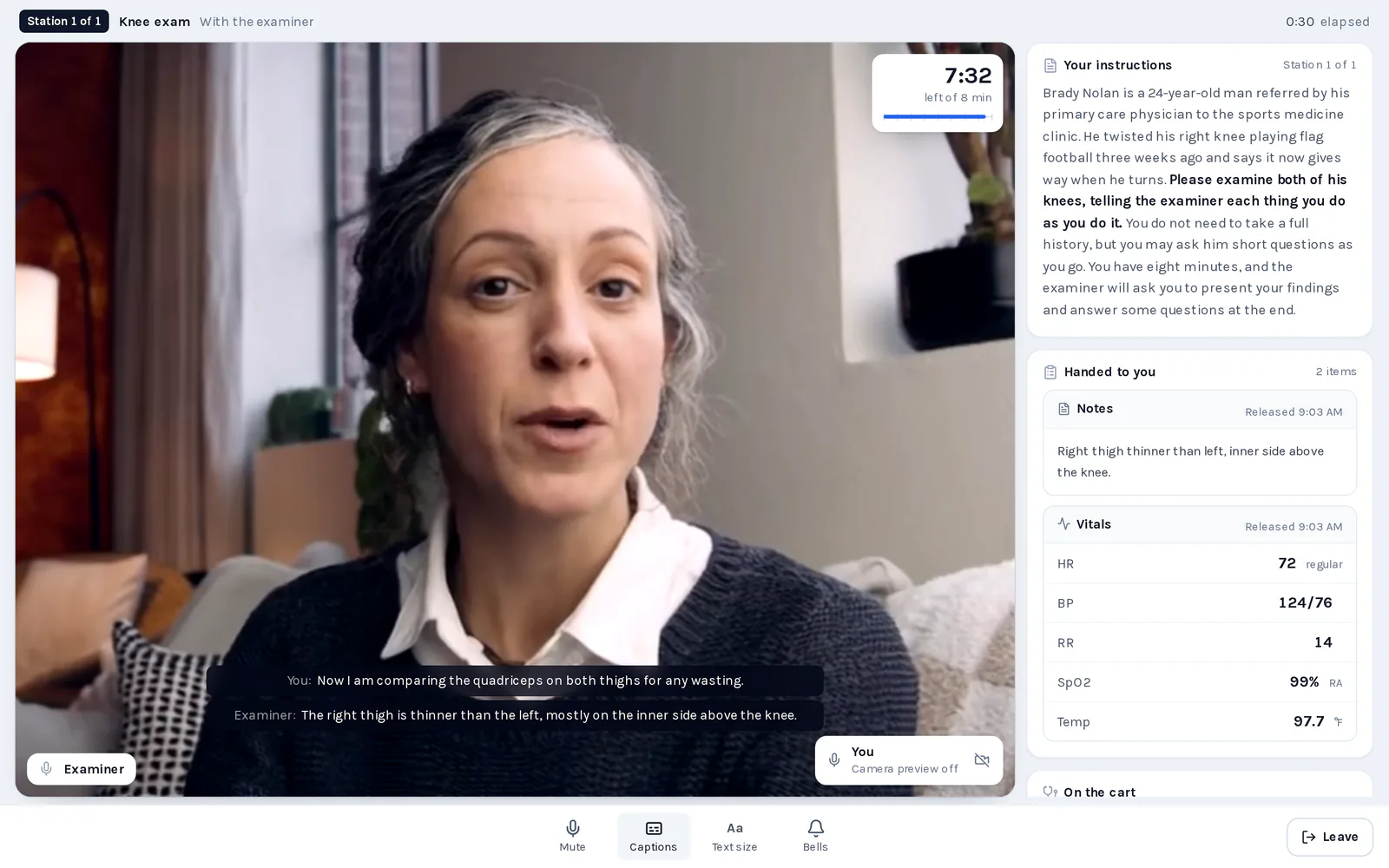
An AI examiner runs the station by voice. It cannot see your hands, so practice the technique itself on a friend.
Door note
Read before you go in
Mrs. Julie Marchetti is a 52-year-old office administrator who has been referred by her primary care physician to the neurology clinic with several months of tingling and numbness in her right hand. Please examine both of her upper limbs neurologically, talking the examiner through each step as you do it. The examiner will tell you what you find. You do not need to take a full history, though you may ask her short questions. You have eight minutes. The examiner will ask you to present your findings and may ask you to localize the lesion at the end.
90 sec reading, then 8 min in the station
On the cart
- Reflex hammer
- 128 Hz tuning fork
- Cotton ball
- Single-use neurological pin
- Chair and an exam table
- A button, a pen and a cup for functional testing
- Alcohol-based hand rub
Your notes from reading time
Saved in this browser only.
Pre-clerkship is where this checklist starts: 25 lines and 26 points, most of them on systematic approach and professionalism.
Pre-clerkship standard. Performs a complete, well-ordered upper limb neurological examination on both arms and reports the abnormal findings accurately without prompting.
1 critical line. Miss it and the station is failed, however well the rest goes.
Communication 0/2Systematic 0/20Professionalism 0/4
Patient’s brief
Everything the patient knows, including what they will only say if asked. Best read after you have run the station once.
Julie Marchetti
You are the patient · 52 · woman
You are Julie Marchetti, a 52-year-old office administrator at a plumbing supply wholesaler in Providence, Rhode Island. You are brisk, practical and faintly apologetic, the sort of woman who runs an office and hates making a fuss, and you say more than once that you are probably wasting everybody's time. You are very tired, because the hand has kept you awake at three in the morning for months, and it shows: you lose your thread mid-sentence and apologize, and you go quiet when the room goes quiet. While you talk you rub the fingers of your right hand with your left and shake the hand out without noticing. You do everything you are asked, holding your arms out and trying a movement a second time, and you say if anything is uncomfortable. You use ordinary words only: 'pins and needles', 'dead', 'burning', 'my grip goes'. You have no medical training and never name a condition. Speak in the first person as the patient.
Morning, doctor. Julie. Sorry, it is acting up already. Do you want the cardigan all the way off?
- How little sleep you are actually getting. You say you manage, and only if you are asked kindly how you are holding up do you admit you are awake from three, have cried on the back steps and fell asleep at your desk last week.
- What you have dropped. You say it is only a mug here and there, and only if you are asked what actually happened do you tell them about the full mug of coffee that went on the floor with your grandson Leo nearby.
Where do you want me?
It is the right one that is the trouble, if that helps.
Sorry, am I supposed to be doing something?
Is there anything else you need me to do?
Run the station before you look
The answers are the most useful thing on this page once you have had a go, and the least useful before.
When the student inspects the patient or looks around the bedside
She sits comfortably. There is no collar, sling, splint or walking aid.Comfortable at rest. No collar, sling, splint or walking aid.
When the student asks for the vital signs
The vitals are: heart rate 72 and regular. Blood pressure 124 over 78. Respiratory rate 14. Oxygen saturation 98 percent on room air. Temperature 97.7 Fahrenheit. Fingerstick glucose 97 milligrams per deciliter.HR 72 regular | BP 124/78 | RR 14 | SpO2 98% RA | Temp 97.7 °F | Glucose 97 mg/dL
When the student inspects the hands or arms
There is mild wasting of the right thenar eminence. Nothing else is wasted, and there is no fasciculation, scar or tremor.Mild wasting of the right thenar eminence. No other wasting, no fasciculation, no scars.
When the student tests for pronator drift, or asks the patient to hold the arms out
Both arms stay level and still, and neither palm turns over.Arms stay level and still. Neither palm turns over.
When the student assesses tone in the arms
Both arms move freely, with no stiffness and no catch.Both arms move freely. No stiffness, no catch.
When the student tests strength at the shoulder, elbow, wrist or fingers
Every movement you test there is strong and equal on both sides.Shoulder, elbow, wrist and finger movements strong and equal.
When the student tests thumb abduction
The right thumb pushes back against you but gives way. The left holds firm.Right thumb abduction gives way against resistance. Left holds firm.
When the student tests finger abduction or adduction
The fingers spread and close strongly on both sides.Fingers spread and close strongly, both sides.
When the student performs the Froment test
She grips the paper with a flat thumb on both sides.Paper gripped with a flat thumb, both sides.
When the student elicits the reflexes in the arms
Each reflex you test is present and equal on both sides, and not brisk.Reflexes present and equal on both sides, not brisk.
When the student tests for a Hoffmann sign
The thumb does not flick on either side.When the student performs the finger-nose test
Each finger lands on target, with no tremor.Finger lands on target each time, no tremor.
When the student tests rapid alternating movements
The movements are quick and regular on both sides.When the student tests for rebound
Neither arm overshoots.When the student tests light touch or pinprick in the arms or hands
She feels it less on the palm side of the right thumb, index and middle fingers and the thumb side of the ring finger. Everywhere else you test, it feels the same on both sides.Feels it less: palm side of the right thumb, index and middle fingers and the thumb side of the ring finger. Same on both sides elsewhere.
When the student tests sensation over the thenar eminence or the palm
She feels it fully there, the same on both sides.Thenar eminence and central palm: felt fully, same on both sides.
When the student tests vibration sense
She feels the vibration in both hands.Vibration felt in both hands.
When the student tests joint position sense
She names every movement correctly on both sides.Joint position: every movement named correctly.
When the student performs a Tinel test, or taps over the wrist
Tapping the right wrist sends tingling into her thumb, index and middle fingers. The left does nothing.Tapping the right wrist: tingling in thumb, index and middle fingers. Left nothing.
When the student performs a Phalen test, or holds the wrists in flexion
After about forty seconds her right thumb, index and middle fingers tingle. The left hand does not.Wrist flexion: right hand tingles at about 40 seconds. Left does not.
When the student examines the neck, moves it through range or performs a Spurling test
Her neck moves fully without pain, and nothing changes in her arm.Neck moves fully without pain. Nothing changes in the arm.
When the student assesses hand function, for example grip, pincer grip, undoing a button or picking up a cup
With the right hand she is slower and fumbles. The left manages easily.Right hand slower and fumbling. Left manages easily.
- Identity: the student confirms the patient name and date of birth before starting.
- Introduction: the student gives their own name and role.
- Consent: the student explains that they will look at, feel and move both arms, and asks permission.
- Pain: the student asks whether anything is painful before touching the arms or neck.
- Comfort: the student asks her to say if anything is uncomfortable or if she needs a break.
- Dignity and exposure: the student exposes both arms to the shoulders, offers a cover and maintains her dignity.
- Explanation: the student demonstrates the sensory testing before asking her to close her eyes.
- Thanks: the student restores her clothing, thanks her and performs hand hygiene.
Carpal tunnel syndrome — compression of the median nerve at the right wrist, with several months of nocturnal tingling and numbness in the thumb, index and middle fingers, sparing the little finger and the thenar skin, mild thenar wasting, thumb abduction 4/5, positive Tinel and Phalen tests, and full painless neck movements.
Please present your findings. · Pre-clerkship
Open with one summary sentence, then the positives that localize, then the negatives that exclude. For example: this 52-year-old woman has mild wasting of the right thenar eminence with weakness of right thumb abduction at four out of five, and reduced light touch and pinprick over the right thumb, index, middle and radial half of the ring finger. Sensation over the thenar eminence itself is preserved. Tone is normal, every other myotome is five out of five, reflexes are present and symmetrical, coordination is intact, and vibration and joint position sense are normal. Tinel and Phalen tests are both positive on the right, and neck movements are full and painless. These findings localize to the median nerve at the wrist, and my diagnosis is right carpal tunnel syndrome.
Where is the lesion? Work through nerve, root, plexus and cord for me. · Clerkship
This is a peripheral nerve lesion — the median nerve at the wrist. The sensory deficit follows a peripheral nerve territory rather than a dermatome, and the only weak muscle is abductor pollicis brevis, supplied by the recurrent motor branch of the median nerve. Against a root lesion: a C6 radiculopathy would give sensory change running up the lateral forearm rather than stopping at the digits, would usually weaken elbow flexion and wrist extension, would depress the biceps and brachioradialis reflexes, and would typically bring neck pain with symptoms reproduced by neck movement or a Spurling maneuver. She has none of that and her reflexes are normal. Against a lower brachial plexus or T1 lesion: that wastes all the small muscles of the hand rather than the thenar eminence alone, gives sensory loss over the medial forearm, and may carry a Horner syndrome — think Pancoast tumor, or true neurogenic thoracic outlet syndrome, which is a genuine mimic because it preferentially wastes abductor pollicis brevis. Against a cord lesion: cervical myelopathy produces upper motor neuron signs, so increased tone, brisk reflexes, a Hoffmann sign, a sensory level and often a change in gait, and her tone, reflexes and coordination are all normal. A proximal median lesion at the elbow would also numb the thenar skin and weaken the long flexors, which hers does not.
What tests would you order, and what would they show? · Final year
Carpal tunnel syndrome is a clinical diagnosis and a textbook history with these signs does not strictly need confirming. I would still order nerve conduction studies here for three reasons: she has objective motor loss, the study grades severity, and hand surgeons and many insurers will generally want one before surgery. They are performed by a neurologist or a physiatrist. The findings would be a prolonged distal motor latency to abductor pollicis brevis and slowed sensory conduction across the wrist with normal conduction proximal to it; in severe disease the sensory response is absent and needle electromyography shows denervation in abductor pollicis brevis. The study also does the work of excluding a cervical radiculopathy, a proximal median lesion or a polyneuropathy. Ultrasound is increasingly available and shows an enlarged median nerve at the tunnel inlet, with a cross-sectional area above roughly ten square millimeters taken as abnormal. Alongside that I would screen for treatable secondary causes: thyroid function, a hemoglobin A1c or fasting glucose, a question about pregnancy in a younger woman, and an examination for rheumatoid arthritis and acromegaly.
How would you manage her, and what would you tell her? · Final year
The AAOS carpal tunnel guideline supports a well-established ladder — but her thenar wasting means she should not spend long on the bottom rung. Step one is conservative: a wrist splint holding the wrist in neutral worn at night for at least six weeks, ideally fitted by a hand therapist, plus a workplace ergonomic review of her keyboard and wrist posture. Because she is an office worker, ask whether she considers this work-related, since that opens a workers' compensation claim, whose rules vary by state, and changes who pays for treatment. Step two is a corticosteroid injection into the carpal tunnel, for example methylprednisolone 40 milligrams, often given under ultrasound guidance; it works well in the short to medium term but a substantial proportion of patients relapse within a year. The definitive treatment is carpal tunnel release — division of the flexor retinaculum, open or endoscopic, as outpatient surgery under local anesthetic by a plastic or orthopedic hand surgeon — and it is more durable than splinting or injection. The point that matters for her is that established thenar wasting with measurable weakness means axonal loss, and axonal loss may not fully recover even after a good decompression, so I would refer her to a hand surgeon now and flag the motor deficit in the referral so she is seen promptly rather than waiting for a routine slot, and check that the surgeon is in her network and whether her plan requires prior authorization. I would give return precautions: come back sooner if the numbness becomes constant, the hand becomes clumsier or the wasting visibly worsens.
Suppose sensation over the thenar eminence is normal while the fingers are numb. What does that tell you, and why? · Clerkship
That the lesion is inside the carpal tunnel, because the nerve that supplies that skin never enters it. The palmar cutaneous branch of the median nerve arises about five centimeters proximal to the wrist crease and travels superficial to the flexor retinaculum to reach the skin over the thenar eminence and the radial side of the palm. Everything else in the median distribution goes under the retinaculum: the sensory fibers to the palmar surface of the thumb, index, middle and radial half of the ring finger, and the recurrent motor branch to abductor pollicis brevis, opponens pollicis and the superficial head of flexor pollicis brevis. Compression inside the tunnel therefore takes out the digits and the thenar muscles but leaves the thenar skin working. That dissociation is close to diagnostic, and it cuts both ways: numbness that does include the thenar skin should make you look for a more proximal median lesion, a C6 root problem or a generalized polyneuropathy instead.
How it is scored
What this station is really testing
US medical school OSCEs run this station because it is the purest test there is of whether a student can examine to a routine instead of hunting for the answer. The routine is six parts long — inspection, tone, strength, reflexes, coordination, sensation — and it is done on both arms, in that order, narrated as you go. Students who follow it walk away with a complete data set and a comment on every modality. Students who go straight for the wasted muscle they noticed from the doorway have one sign, no comparison and no way of answering the question that is coming.
Read the restShow less
That question is anatomical: where is the lesion? The sensory examination decides it, and only if you test against two maps rather than one. The dermatomes belong to the nerve roots C5 to T1; the median, ulnar and radial territories belong to the peripheral nerves. A deficit that follows a dermatome sends you to the root, the plexus or the cord. A deficit that follows a nerve territory sends you to the nerve. This patient has the second kind, and the most valuable square of skin on her arm is the one over the thenar eminence — its nerve supply peels off the median nerve well above the wrist and passes over the flexor retinaculum instead of under it, so a compression inside the tunnel leaves it untouched.
Watch the clock. Eight minutes has to buy you both arms, six modalities, the provocation tests at the wrist and something on function, so the sequence has to run at pace. The two things that get dropped when you are behind are the tests that actually reproduce her symptom and any question about what the hand can no longer do at work or at home — and in a case like this, the functional loss is what decides how quickly she is referred. In the pre-clerkship years, run the routine on both arms and report the signs. On clerkships, localize the lesion and argue against the root, plexus and cord. In your final year, add the workup and say why the wasting makes the referral prompt.
Where the 26 points are at Pre-clerkship
- Communication2
- Systematic approach20
- Professionalism4
1 critical line. Miss it and the station is failed, whatever the total.
What a pass looks like at each stage
Pre-clerkship
25 lines, 26 points
The checklist starts here.
Performs a complete, well-ordered upper limb neurological examination on both arms and reports the abnormal findings accurately without prompting.
What lifts it to a clear pass
- Drill the six-part order until it survives adrenaline: inspection, tone, strength, reflexes, coordination, sensation — then function.
- Learn the MRC scale properly and say the numbers out loud; the examiner cannot award the grading point for the word weak.
- Examine both arms every time. Almost every finding here is a comparison, and thenar wasting is invisible without the other hand beside it.
- Practice thumb abduction with the hand palm up and the thumb pointing at the ceiling; any other plane recruits muscles the median nerve does not supply.
- Demonstrate every sensory stimulus on the sternum before you start, then ask the patient to close her eyes.
Clerkship
31 lines, 33 points
Adds six lines, four on clinical reasoning and two on communication.
Assembles the motor and sensory findings into an anatomical localization and defends it against the root, plexus and cord alternatives.
What lifts it to a clear pass
- Learn the two maps side by side — dermatomes C5 to T1 and the median, ulnar and radial territories — and say which one the deficit respects.
- Rehearse the sentence that separates carpal tunnel syndrome from a C6 radiculopathy: thenar skin spared, reflexes normal, neck movements painless.
- Say the negatives out loud. Normal tone and normal reflexes are what let you exclude a cord lesion, so they carry points.
- Know what wasting of every small hand muscle would mean, and be ready to name a Pancoast tumor and true neurogenic thoracic outlet syndrome.
- Offer the neck examination even when time is tight; saying you would do it, and why, still earns the reasoning point.
Final year
33 lines, 36 points
Adds two lines, one on communication and one on patient safety.
Grades severity, chooses the right tests and outlines the management ladder and referral pathway at the standard an intern is held to.
What lifts it to a clear pass
- Be able to say what nerve conduction studies would show, who performs them and why you are ordering them in this particular patient.
- Know the ladder in order — night splint fitted by a hand therapist, corticosteroid injection, surgical release — and roughly how durable each step is.
- Learn the line that changes the plan: established thenar wasting means axonal loss, and axonal loss may not recover, so put it in the referral.
- Ask whether the problem is work-related; workers' compensation changes the pathway for an office worker, and the rules vary by state.
- Practice the plain-language explanation of a pinched nerve and an outpatient surgical release; you may be asked to give it as the station closes.
A system you can run under pressure
The sequence
- Opening: hand hygiene, introduce yourself, confirm two identifiers, gain permission, expose both arms to the shoulders and sit the patient on a chair or the edge of the bed
- Inspection: posture, scars, bulk at the thenar and hypothenar eminences and the first dorsal interosseous, fasciculation, tremor and abnormal movements — then pronator drift, arms out, palms up, eyes closed
- Tone: take the weight of the arm and move the elbow and wrist passively at varying speeds, feeling for spasticity, rigidity and clonus — raised tone moves the lesion from the nerve to the cord
- Strength: shoulder, elbow, wrist, fingers and thumb, one myotome at a time against resistance, always compared with the other side and graded on the MRC scale — a myotome pattern points to a root, and a single-nerve pattern to the nerve
- Reflexes: biceps (C5, C6), brachioradialis (C5, C6) and triceps (C7), with reinforcement before any reflex is reported as absent — normal reflexes argue against both a root and a cord lesion
- Coordination: finger-to-nose at full stretch, rapid alternating movements and rebound — clumsiness from numb fingers must not be mistaken for a cerebellar sign
- Sensation: light touch and pinprick in both maps, then vibration with a 128 Hz fork and joint position sense — the map the deficit follows is the localization
- Finish: provocation tests at the wrist, neck movements, hand function, then present to the examiner — these reproduce the symptom, clear the neck and show what she has lost
Strength by myotome, graded on the MRC scale
- Shoulder abduction C5 (axillary nerve); elbow flexion C5 and C6 (musculocutaneous); elbow extension C7 (radial)
- Wrist extension C6; finger extension C7 (posterior interosseous); finger flexion C8; finger abduction and adduction T1 (ulnar)
- Thumb abduction T1, abductor pollicis brevis, supplied by the recurrent motor branch of the median nerve — the cleanest bedside test of median motor function
- MRC grading: 0 no contraction, 1 flicker, 2 movement only with gravity eliminated, 3 movement against gravity, 4 movement against resistance but reduced, 5 normal
- Grade 4 spans almost the whole range of useful weakness, so split it into 4 minus, 4 and 4 plus if your school uses that, and always name the side you are comparing against
Sensation: two maps, not one
- Dermatomes: C5 over the lateral upper arm, C6 the thumb, C7 the middle finger, C8 the little finger, T1 the medial forearm
- Peripheral nerves: median to the palmar surface of the thumb, index, middle and radial half of the ring finger; ulnar to the little finger and ulnar half of the ring; radial to the dorsal first web space
- Light touch with a cotton ball and pinprick with a single-use neurological pin, demonstrated on the sternum first and then repeated with the eyes closed
- Vibration with a 128 Hz fork at the interphalangeal joint of the thumb, moving proximally if it is not felt; joint position sense at the distal interphalangeal joint of the index finger
- The thenar eminence decides the case: its skin is supplied by the palmar cutaneous branch, which leaves the median nerve roughly five centimeters above the wrist and runs superficial to the flexor retinaculum, outside the carpal tunnel
The lines that earn points
Introducing yourself and gaining consent
Hi Mrs. Marchetti, I am one of the medical students. I would like to have a look at both arms and check the strength and the feeling in them. Could you slip your cardigan off so I can see both arms up to the shoulders? Is that okay with you?
Asking about pain first
Before I touch anything, do you have any pain in your neck, shoulders or arms?
Demonstrating the sensory test
This is what the cotton ball feels like on your breastbone. Now shut your eyes and say yes each time you feel it, and tell me if one side feels different from the other.
Testing thumb abduction
Rest your hand palm up and point your thumb at the ceiling. Hold it there and do not let me push it down.
Show the other 4Show fewer
Testing the thenar skin
Now I am touching the fleshy pad at the base of your thumb and the middle of your palm. Does that feel the same on both sides?
Performing the Phalen test
Put the backs of your hands together with your wrists fully bent and hold them there. Tell me as soon as you get any tingling, and where.
Localizing to the examiner
The sensory change follows the median nerve and spares the thenar skin, thumb abduction is the only weak movement, and tone and reflexes are normal, which puts this at the median nerve at the wrist.
Explaining it to her
A nerve is being squeezed in a tight tunnel at your wrist. It is not your neck and it is not spreading. Because the muscle at the base of your thumb has started to waste, I will flag that in the referral so a hand surgeon sees you soon rather than at the next routine opening.
How students lose points here
- Examining only the symptomatic arm, so there is nothing to compare the wasting, the strength or the sensation against.
- Testing sensation in dermatomes only, and never touching the skin over the thenar eminence — the one patch that localizes this lesion.
- Reporting strength as weak or reduced instead of grading it on the MRC scale.
- Testing thumb abduction with the thumb sliding across the palm rather than lifted perpendicular to it, which no longer isolates abductor pollicis brevis.
- Calling a reflex absent without ever trying reinforcement.
- Running out of time before the Tinel and Phalen tests and the neck, so the presentation cannot argue against a radiculopathy.
- Naming carpal tunnel syndrome and then saying nothing about what the hand can no longer do at work or at home.
Where to read more
- Clinical practice guidelines, including management of carpal tunnel syndromeAAOS · reference
- Carpal tunnel syndrome — for the plain-language conversationAAOS OrthoInfo · reference
- Carpal tunnel syndrome — overview for patients and cliniciansNIAMS · reference
- Carpal tunnel syndrome — median nerve imaging and cross-sectional areaRadiopaedia · reference
- Carpal tunnel syndrome — bedside assessment and provocation testsWikEM · reference
Now run it live