
UQ Medicine Interview
Format, Questions & Prep Tips
UQ medicine interviews for 2027 entry are multiple mini interviews (MMI), held September 2026 (online). Published figures: 2027 intake (graduate) Up to 340 (107 CSP + 43 BMP + up to 190 international); MMI 8 online stations × 7 mins (+ 2 min reading); Average GAMSAT (domestic, 2023–2025 intakes) 65.33 (GPA average 6.66).
- Institution
- University of Queensland Medical School
- Interview (2027 entry)
- September 2026 (online)
- Decisions (2027 entry)
- November 2026, with a small number of later offers in December and January
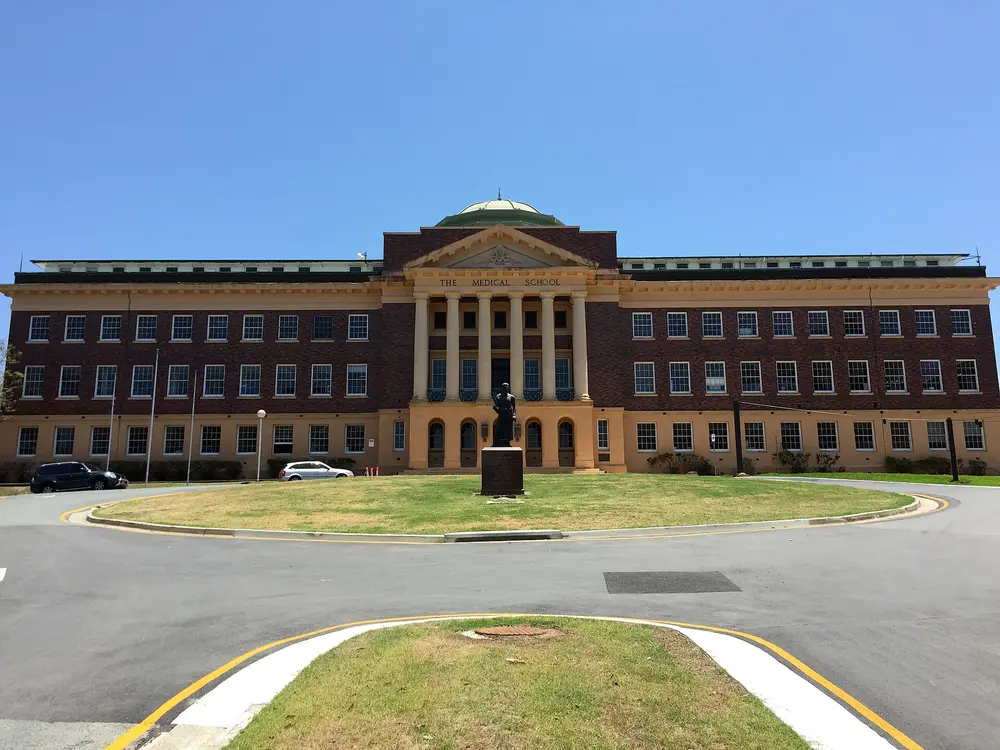
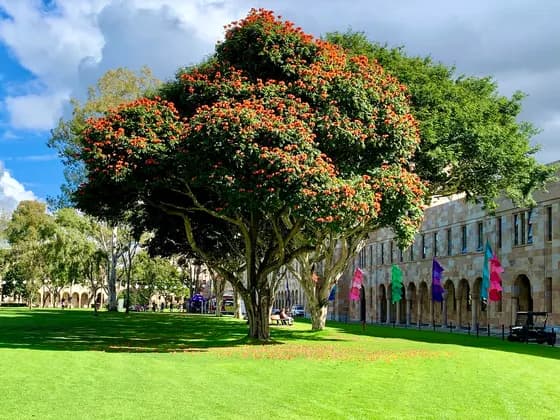
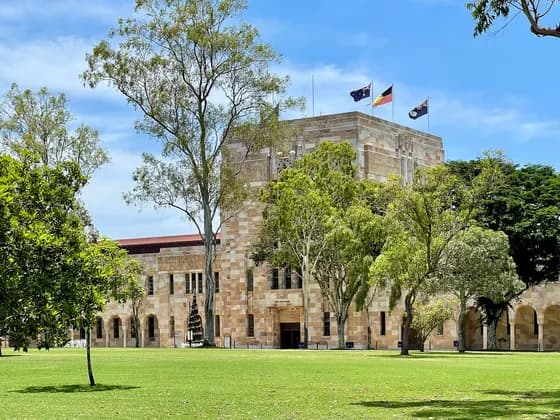
Photo: Kgbo · CC BY-SA 4.0 · cropped
Photo: Chris Olszewski · CC BY-SA 4.0 · Photo: Kgbo · CC BY-SA 4.0 · Photo: Kgbo · CC BY-SA 3.0
How to get into UQ medicine
Step-by-step: entry requirements, admission tests, personal statement, interview format and the key deadlines.
Open the guide →UQ entry requirements
Admission profile, interview format, decision dates and what makes UQ different.
See the profile →The UQ medicine course
Integrated + Team-based learning, 4 years (graduate entry), placements across Greater Brisbane, regional and rural Queensland, and New Orleans.
See the course →The UQ medicine interview
UQ's 4-year graduate-entry MD is one of the largest in Australia, and GEMSAS lists up to 340 graduate-entry places for 2027 (107 CSP + 43 BMP + 190 international, including UQ-Ochsner) — numbers it describes as indicative only. The school is anchored across the Herston Health Sciences precinct and the Princess Alexandra, Royal Brisbane, Mater, and Gold Coast clinical schools.
The selection process is distinctive: an 8-station online MMI held over Zoom, with 2 minutes to read each scenario and 7 minutes to respond to a single interviewer. UQ does not currently use acting or role-play stations.
UQ examiners value range — one of the largest medical intakes in Australia draws from a broad applicant pool, and pulling examples across teaching hospitals, rural placements, and international health plays well. The Ochsner Clinical School pathway in New Orleans gives an internationally co-badged route distinctive among Australian MDs.
Graduate entry requires GAMSAT with a minimum of 50 in each section (or MCAT 504) and a GPA of at least 5.0; UQ reports an average GAMSAT of 65.33 and GPA of 6.66 for its 2023–2025 domestic intakes.
UQ also runs a separate Provisional Entry (school-leaver) pathway with UCAT ANZ — for the 2026 intake the lowest UCAT ANZ score invited to interview was 2290, or 1960 for the Rural Background Sub-Quota. Rural reservation is 28.5% across pathways. Aboriginal and Torres Strait Islander entry uses a bespoke MMI.
UQ interview at a glance (2027 entry)
| 2027 intake (graduate) | Up to 340 (107 CSP + 43 BMP + up to 190 international) |
|---|---|
| MMI | 8 online stations × 7 mins (+ 2 min reading) |
| Average GAMSAT (domestic, 2023–2025 intakes) | 65.33 (GPA average 6.66) |
| Provisional Entry lowest UCAT ANZ invited (2026 intake) | 2290 / 1960 Rural Background Sub-Quota |
| Rural reservation | 28.5% across pathways |
Interview format
- Multiple Mini Interview with 8 stations: 2 minutes reading, then 7 minutes to respond.
- Each station has a single interviewer; UQ currently uses no acting or role-play stations.
- Held online via Zoom (September 2026 for 2027 entry), with ID and room checks at the first station.
- Stations cover ethics, communication, motivation, teamwork, current-issue debates.
- Examiners include UQ clinicians and academics across the Brisbane and Gold Coast networks.
- Ochsner Clinical School pathway (years 3–4 in New Orleans) available as a separate stream.
Sample interview questions
Why UQ specifically? What attracts you to Australia's largest MD intake?
Engage with the breadth of clinical schools (Herston, PA, Royal Brisbane, Mater, Gold Coast), the tropical health link, and the Ochsner pathway. Scale isn't a virtue on its own; explain why it serves your learning.
Would you consider the Ochsner Clinical School pathway? Why or why not?
Defensible. Engage with the international training perspective, the financial reality, and the post-graduation pathway implications. Don't be performative.
A patient in a Mount Isa rotation needs urgent care that's only available in Brisbane. The retrieval will take 4 hours by air. How do you communicate?
Plain language. Time-critical without panic. Engage the patient. Reference RFDS/Retrieval Services Queensland.
Voluntary assisted dying has been legal in Queensland since 2023. How does the Queensland framework compare with other Australian jurisdictions?
Engage with the QLD VAD Act's eligibility criteria, the institutional objection provisions, and how the QLD VAD Review Board works.
Role-play: explain to a worried patient at Princess Alexandra why their elective surgery has been postponed for resource reasons.
Acknowledge. Apologise for inconvenience. Explain triage briefly. Concrete next steps.
What does tropical medicine mean to you? Why does UQ's tropical-health link matter?
Engage with the QIMR-Berghofer link, Pacific health partnerships, and tropical disease epidemiology. Concrete engagement.
Explain Medicare and bulk-billing to a young patient who has just moved to Australia.
Plain language. Concrete dollar example.
Closing the Gap targets continue to lag in regional Queensland. What role can a UQ graduate play?
Concrete actions:
- ACCHO partnerships (e.g., Apunipima Cape York Health Council, Wuchopperen)
- cultural safety
- racism in clinical encounters
Describe a time you delivered difficult news in a personal or professional setting.
STAR with reflection.
A patient at PA Hospital asks for an experimental treatment that's only available in a clinical trial in Melbourne. What do you do?
Engage with research ethics, equipoise, equity of access, financial considerations, and the role of treating clinician vs investigator.
Why graduate medicine at UQ rather than a Brisbane-based dental or alternative health pathway?
Engage honestly with the medical role's specific scope.
Describe a time you worked in a large team. What was your role in maintaining cohesion?
UQ's scale means team-based work matters. Process focus.
Should rural-bonded graduates be able to fulfil their service in metropolitan Indigenous health services?
What they are listening for:
- Workforce intent
- service equivalency
- MM2-7 vs DPA definitions
Balanced reasoning.
Tell us about a non-academic interest you'd want to continue developing during medical school.
Authentic. UQ's scale means peer community matters; show sustainable lives.
A teammate has been making concerning comments about a particular cultural group. Address it.
Specific behaviour. Private conversation first. Escalation if needed.
What can an MMI reveal about an applicant that GAMSAT and GPA cannot?
Engage with the value of written reflection — depth of structured thinking, ability to organise an argument, evidence of clinically-aware reasoning.
Describe a time you reflected on feedback and changed your approach.
Authentic reflection.
Practise the UQ interview
Rehearse the real format before the day — on demand with our AI interviewers, or live with a tutor.
Sit a mock with photoreal AI interviewers — any time
A timed MMI or panel interview on video — Australian & international voices — with interviewers who listen, react and press with follow-ups. Rubric-scored feedback and a replay the moment you finish.






Live mocks with a tutor who’s been in the room
A full UQ-style mock with a medic or dentist tutor — honest scoring against real marking criteria, a station-by-station debrief and a written action plan.
Book a mock interviewHow to prepare for the UQ interview
Common pitfalls to avoid
UQ interview — frequently asked questions
Sources & official admissions information
Ready to nail your UQ interview?
Book a mock interview with a tutor who knows the Australian interview formats, orpractise unlimited stations with Prometheus.