
The University of Auckland Medicine course
What you actually study, and where you will be
University of Auckland's MBChB is a 6-year (incl. first-year pathway) course with an integrated curriculum, with patient contact from Year 2 and placements in Auckland, Northland, Waikato, Bay of Plenty, Rotorua and Taranaki (2027 entry). Auckland's MBChB starts with a first year of set courses in a health sciences, biomedical science or science degree at the University, then five years of medicine if you are selected. Graduates may join at Year 2. Years 2 and 3 are taught at Grafton Campus, body system by body system alongside clinical skills. Years 4 to 6 are clinical attachments across the upper North Island, including a full year outside Auckland. Year 6 is the trainee intern year, when you work in clinical teams.
- Degree
- MBChB
- Length
- 6 years (incl. first-year pathway)
- Teaching
- Integrated
- Clinical contact
- Year 2

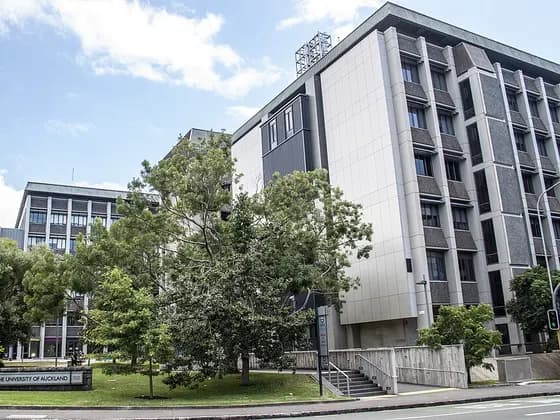

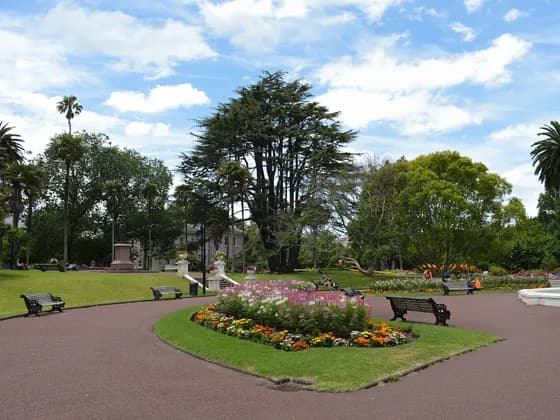
Photo: possumgirl2 · CC BY-SA 2.0 · cropped
Photo: Own work · Public domain · Photo: Jorge Royan · CC BY-SA 3.0 · Photo: Francisco Anzola · CC BY 2.0
The University of Auckland medicine course at a glance (2027 entry)
The University of Auckland's Bachelor of Medicine and Bachelor of Surgery (MBChB) is a six-year degree run by the Faculty of Medical and Health Sciences. You cannot start it straight from school. You first spend a year in an eligible Auckland degree, taking set courses that count as Part I of the MBChB, and apply for Year 2 during that year. Graduates may enter Year 2 directly.
Years 2 and 3, called Phase 1, are based at Grafton Campus, opposite Auckland City Hospital. You study the body system by system through clinical scenarios (short patient cases), lectures and labs, while learning to take a history and examine, first with classmates and trained actors. Hauora Māori, meaning Māori health and wellbeing, is one of five domains, or strands, that run through the whole course.
Years 4 and 5 (Phase 2) and Year 6 (Phase 3) are spent on clinical attachments across the upper North Island, from Northland to Taranaki. An attachment is a block of weeks with a hospital or community team. Every student spends at least one full clinical year outside Auckland, and Year 5 offers year-long regional and rural options.
Year 6 is the trainee intern (TI) year, when you join clinical teams and care for patients under supervision. After graduating you apply for provisional registration with the Medical Council of New Zealand (MCNZ), which regulates doctors. Two years of prevocational training follow, starting with postgraduate year 1 (PGY1), when you work as a junior doctor, often called a house officer.
The Australian Medical Council (AMC) accredits the degree on the MCNZ's behalf. In February 2026 it renewed accreditation until 31 March 2032, noting that a programme-wide curriculum review is imminent, so some details below may change.
| Degree | MBChB (Bachelor of Medicine and Bachelor of Surgery) |
|---|---|
| Course length | 6 years including the first year; graduates may enter at Year 2 |
| Places | 317 domestic a year; up to 30 international in 2027 |
| Main campus | Grafton Campus for Years 2 and 3; first-year courses mostly City Campus |
| Teaching style | Integrated body-system modules with clinical scenarios, laboratories and clinical skills |
| First patient contact | Year 2 clinical skills with simulated patients; ward learning from Year 3 |
| Clinical placements | About 90 weeks over Years 4 to 6, including a year outside Auckland |
| Rural options | Year 5 regional-rural cohorts (including Pūkawakawa) or a Rural Medical Immersion town |
| Final year | 44-week trainee intern year with an optional elective or research block |
| Research degree | Optional BMedSc(Hons) research year after Year 3 |
What makes University of Auckland medicine different
Year-long regional or rural placements in Year 5
In Year 5 you can join a year-long regional-rural cohort, such as Pūkawakawa in Northland, a programme local iwi (tribes) helped set up, the AMC says. The Rural Medical Immersion Programme, begun in 2025, instead places small groups in rural towns for the whole year.
Hauora Māori woven through the course
Te Kupenga Hauora Māori, the faculty's Māori health unit, is involved throughout the course. You must pass a Waipapa Taumata Rau course in your first year, and the Year 2 Māori Health Intensive includes a visit to a marae, a Māori community meeting place. A Hauora Māori assessment is a fifth of the Year 4 grade. The AMC found clinical supervisors assess it unevenly and set conditions on training them.
A humanities course in the middle of medicine
In Year 3 you choose one Medical Humanities course from up to 17 options, such as Queering Health. You study a medical issue the way a humanities discipline does, through reading, debate and a research essay, judged on the quality of your argument rather than on experimental method.
Five weeks of rural, interprofessional learning
The Rural Health Interprofessional Programme, in Whakatāne and the Hokianga, is open to up to 20 Year 5 students, the AMC says. For five weeks you live and learn with students of nursing, pharmacy, midwifery and other professions, in free housing, with a focus on Māori models of health care.
A final year that rehearses the house officer job
Year 6 puts you in clinical teams for 44 weeks, with a long day each week, weekend shifts, patient admissions and ward calls. The AMC commended this pre-internship year for preparing graduates for work as doctors.
How University of Auckland teaches medicine
The curriculum spirals through five domains: Applied Science for Medicine, Clinical and Communication Skills, Personal and Professional Skills, Hauora Māori and Population Health. The same strands return in each phase at greater depth. The AMC's 2026 report describes it as integrated across subjects within a year and from one year to the next. It says the basic structure has been broadly the same since 2013.
In Phase 1 most teaching is grouped into modules by body system. Clinical scenarios tie lectures and labs to real presentations. The faculty keeps a bank of 192 mapped case studies, recently adding scenarios on menopause, family violence and gender-affirming care. Year 3 adds problem-solving sessions. Clinical pharmacology runs through the course, starting from an early list of essential medicines.
In the clinical years you learn on attachments, with four campus teaching weeks in Year 4 and three in Year 5. Responsibility grows until Year 6, which the AMC describes as an apprenticeship within clinical teams. At its 2025 visit, some students at regional sites reported fewer structured tutorials than in Auckland, though the AMC noted that smaller sites often give more hands-on experience.
The ways you will learn
| Lectures | Lectures carry much of the Phase 1 science, backed by tutorials, and some small-group sessions run live online. |
|---|---|
| Laboratories | Practical classes in anatomy, physiology, pathology and medical imaging run alongside each body-system module. |
| Clinical skills sessions | In the Clinical Skills Centre you practise history taking and examination on classmates, simulated patients and trained actors, who give feedback on your communication and bedside manner. |
| Clinical attachments | From Year 4, rotating blocks with hospital and community teams, where clinicians supervise you, watch you with patients and report on your progress. |
| Intensives | Short compulsory blocks on one theme, such as the Year 2 Māori Health Intensive and the Year 5 Population Health Intensive, often shared with students of other health professions. |
A typical week on the University of Auckland course
Year 2 is a full-time, 120-point course with a weekly timetable, and the catalogue expects about 40 hours of work a week. Lectures are recorded, but labs, tutorials and clinical skills sessions must be attended, and module tests are sat on campus. In Year 3 expect at least 30 hours a week on the main course, plus about 3 hours of Medical Humanities lectures and the reading that goes with them.
Year 2 runs on its own calendar. In 2026 it began on 23 February, a week before the University's Semester One, and ended on 16 November. It also had three compulsory progress tests, written tests that every year group sits three times a year. Two of them, on 17 April and 17 July, fell in University breaks; the third was on 27 October.
The clinical years start in January: in 2026, Year 6 began on 12 January, Year 5 on 19 January and Year 4 on 26 January. Years 4 and 5 mean 35 to 45 hours a week in clinical settings. In Year 6 you work weekdays from about 8am to 4pm, with one long day a week until 10pm on most attachments, one weekend per attachment and, on some, nights.
How anatomy is taught at University of Auckland
Anatomy is taught within the body-system modules of Years 2 and 3, alongside physiology, pathology and medical imaging. The Department of Anatomy and Medical Imaging lectures in four Year 2 modules: respiratory, digestive, cardiovascular and genitourinary. In Year 3 it teaches in the Nervous System and Special Senses module, which it coordinates, and in Reproduction and Endocrinology. It also runs the Radiology Weeks.
Donated bodies are part of this teaching. Bodies given through the Human Body Bequest Programme, which the department has run since 1968, are used to teach medical students and other health professionals, under the Human Tissue Act 2008. The faculty describes its Human Anatomy Laboratory as a place to learn anatomy through cadaver-based dissection, used by medical and science students, surgeons and researchers.
Before working with donated bodies, second-year students take part in a whakanoa, a spiritual clearing ceremony. Kaumātua (elders) lead karakia (prayers) and waiata (songs) in te reo Māori to honour the donors and lift tapu, the sacred restrictions that tikanga Māori (Māori custom) places on the body. The University reported that more than 340 second-years took part in February 2025. The ceremony began in the 1990s for Māori students and is now held every year for all medical students.
When you first meet patients at University of Auckland
You first practise clinical skills in Year 2, examining classmates and simulated patients, including trained actors, in controlled settings. Patients also take part in some clinical lectures. The AMC notes that you must show competence in these sessions before moving on to real patients. The general practice department says Year 2 also includes one observational visit to a practice.
Year 3 adds ward-based learning with real or simulated patients, and an OSCE (objective structured clinical examination), where you rotate through timed stations, each testing one task.
From Year 4 you are on full-time attachments. The AMC commended one community placement, at Turuki Health in Māngere, a Kaupapa Māori (Māori-led) provider. There students join community initiatives and see consultations in te reo Māori, Samoan and other languages.
Year by year at University of Auckland
- Year 1
The first-year pathway (Part I)
You enrol in an eligible Auckland degree and take eight set courses full time, applying for Year 2 during the year. From 2027 you can do this in the new Bachelor of Biomedical Science (BBiomedSc), the Bachelor of Health Sciences (BHSc) or a Bachelor of Science (BSc) health major.
- Four core courses. BIOSCI 107 (cell and tissue biology), CHEM 190 (chemistry for the medical and life sciences) and POPLHLTH 111 (population health) come in Semester One, and MEDSCI 142 (human organ systems) in Semester Two.
- A Waipapa Taumata Rau course, which you must pass: WTRMHS 100 in the BBiomedSc or BHSc, or WTRSCI 100 in the BSc. Both explore why place and knowledge systems matter; WTRMHS 100 also covers Te Tiriti o Waitangi (the Treaty of Waitangi) and study skills.
- Three more 15-point courses from your degree, such as HLTHPSYC 122 Behaviour, Health and Development, BIOSCI 106 Molecules of Life or STATS 101.
- Eligible majors: Community Health or Health Systems and Data Analytics in the BHSc; Cell and Molecular Bioscience, Exercise Sciences, Medicinal Chemistry, Nutrition, Pharmacology or Physiology in the BSc.
- Before 2027 the first year was the BHSc or BSc (Biomedical Science) only, with CHEM 110 instead of CHEM 190 and a fixed list of eight courses. Students who began in 2026 and apply for 2027 entry follow those rules.
- Graduates may be admitted straight to Year 2, or may first have to pass some or all of the Part I courses, depending on their previous study.
- Year 2
Phase 1: health, disease and the first body systems
MBChB Part II is one 120-point course, MBCHB 221A and 221B, taught at Grafton Campus across both semesters. It introduces human health and how diseases develop, then works through the musculoskeletal, digestive, genitourinary, cardiovascular and respiratory systems. Practical anatomy, physiology, pathology and imaging, and professional, clinical and communication skills, run alongside.
- Modules named by the teaching departments include Principles of Medicine and the respiratory, digestive, cardiovascular and genitourinary system modules.
- Pharmacology is one of the sciences you learn to apply to the body systems, alongside anatomy, physiology, pathology and biochemistry.
- Human Early Life Development (HELD), the paediatrics module, runs through both Year 2 and Year 3.
- The compulsory Māori Health Intensive: four days in the mid-year break (13 to 16 July in 2026) at the City and Grafton campuses and Waipapa Marae. Te Kupenga Hauora Māori runs it, and it includes a marae visit.
- Week one is compulsory: for 2026 entry, missing it meant forfeiting your place to an applicant on the waitlist.
- Year 3
Phase 1: more systems, wards and Medical Humanities
MBCHB 321A and 321B (105 points) explore the nervous system; blood, immunity and infection; reproduction, development and ageing; and how body systems are regulated. Teaching combines clinical scenarios, lectures, labs and problem-solving sessions with ward-based learning. Medical Humanities (MBCHB 311A and 311B, 15 points) runs alongside.
- Modules named by the departments include Nervous System and Special Senses, Reproduction and Endocrinology, and Blood, Immunity and Infection.
- Medical Humanities: one course chosen from up to 17 options, such as Queering Health, studied through reading, class debate, a seminar and a research essay.
- A Nursing Experience and a Quality and Patient Safety Workshop, both built around learning with other professions.
- Year 4
Phase 2: core clinical attachments
Year 4 is the first year of full-time clinical work. Most of it is spent on attachments in hospitals and general practice, where you take histories, examine patients and work out diagnoses and treatment plans under guidance.
- Eight attachments over 33 weeks, covering emergency medicine, anaesthesiology, musculoskeletal, surgery, general and specialty medicine, geriatrics and general practice.
- Four weeks of topic teaching on campus and a compulsory Māori and Pacific Health module.
- General practice, as the department describes it: a week of General Practice Observed Practice Simulations (GPOPS) at the Grafton or Waikato campus. There is also a two-week placement in a community hospital, rural practice or urban accident and medical clinic.
- Year 5
Phase 2: specialties, a selective and regional options
Year 5 runs for 41 weeks, 31 of them on placements in general practice, obstetrics and gynaecology, psychiatry, paediatrics, specialty surgery and a selective. Three campus weeks include a Population Health week, alongside projects and self-paced online learning. You can instead join a year-long regional-rural cohort, such as Pūkawakawa in Northland, or spend the whole year in a Rural Medical Immersion town.
- A selective of your choice, which can be taken overseas.
- Paediatrics, including an online neonatology course on the myNeonates website.
- General practice, which the department describes as four weeks in an urban practice.
- A Population Health Intensive with other health students, and a day of Pacific health teaching on migration and the effects of colonisation.
- Optional five-week Rural Health Interprofessional Programme placements in the Hokianga or Whakatāne.
- Year 6
Phase 3: the trainee intern year
Year 6 is a 44-week, full-time year in clinical settings. You care for patients under supervision in general practice, medicine, surgery, emergency medicine, psychiatry, paediatrics, and obstetrics and gynaecology. As the year goes on, you take on more of the work of a PGY1 doctor.
- A week of clinical imaging, a compulsory core resuscitation skills course and a revision course in procedural skills.
- General practice, which the department describes as six weeks in rural practices, where you have your own room to see patients before your GP reviews them.
- An elective of your choice, or a substantial research project in its place.
- Advanced cardiac life support simulation training run jointly with nursing students.
- Domestic students receive the Medical Trainee Intern Grant, a government stipend, during this year.
How you are assessed at University of Auckland
Auckland uses programmatic assessment: instead of resting on one big exam, the course gathers many lower-stakes results over time. A Board of Examiners for each phase reviews every student's results twice a year and judges progress in each of the five domains. Each Part must be passed before you move on, and failing the same Part twice ends your enrolment in the degree.
Progress tests run from Year 2 to Year 6. Every year group sits the same test, with questions built on clinical scenarios, so you can watch your knowledge grow. An online dashboard compares your results with your cohort, though students told the AMC in 2025 that they wanted more detailed individual feedback.
Clinical skills are tested in OSCEs and through workplace-based assessment on attachments. That includes Mini-CEX observations, where a clinician watches you with a patient and gives feedback, plus electronic supervisor reports covering professionalism and Hauora Māori, and logbooks. Year 6 adds long case assessments, where you assess one patient in depth, with feedback straight afterwards.
If you fail one or more components in Years 2 to 5, the examiners can withhold your result until you complete extra work or another exam. If the weakness is too serious for that, you fail the Part. In Year 6 they can require extra time in a department, which delays graduation. Students told the AMC in 2025 that feedback was sometimes months late and varied between sites.
- Year 2 (MBCHB 221): end-of-module tests 57 per cent, progress tests 15, professional and clinical essays, journals and participation 15, labs and integrated learning activities 10, Māori health activities 3.
- Year 3 (MBCHB 321): end-of-module tests 47 per cent, progress tests 32, labs and coursework 12, OSCE 9. Medical Humanities: research essay 35, critical review 30, seminar 25, participation and attendance 10.
- Year 4: progress tests, clinical attachments, clinical and communication skills observations, a personal and professional skills portfolio and a Hauora Māori assessment, 20 per cent each.
- Year 5: progress tests carry all of the percentage weighting; the other components are listed without a weighting.
- Year 6: you must pass every assessment, including progress tests, supervisor reports, clinical skills assessments, a case report, a project, the elective report and interview, and a clinical imaging test.
Where you will actually be at University of Auckland
In Years 4 to 6 you have year-long placements at one of eight upper North Island hospitals, plus short general practice placements. Every student must spend at least one full clinical year outside Auckland; if too few volunteer to go, a binding ballot decides, and once placed you cannot swap. Students can choose a cohort location each year, but some told the AMC in 2025 that missing out on a preferred site added costs.
The Medical Programme Directorate names eight clinical sites: Northland, Waitematā, Auckland City, South Auckland, Waikato, Bay of Plenty, Rotorua/Lakes and Taranaki. The faculty has agreements with the eight main districts of Te Whatu Ora (Health New Zealand), which runs the public hospitals. South Auckland, Waitematā, Waikato and Bay of Plenty are led by a Clinical Campus Dean, the others by an academic coordinator.
In Phase 1 the Rural Stream is open to Regional Rural Admission Scheme (RRAS) students and anyone else interested in rural medicine. It offers early clinical exposure in rural hospitals, tutorials, a dedicated pastoral staff member and support from past Rural Stream students. At the end of Year 3 you can apply for a limited place in its Phase 2 cohort, which gives priority for rural placements.
Pūkawakawa, in Northland, is one of several year-long regional-rural cohorts in Year 5. The University's 2027 prospectus lists four such options, and the AMC's 2026 report also names regional-rural programmes in Waikato, Lakes and Whakatāne. Pūkawakawa students spend most of the year in regional-rural Northland, which the Year 5 catalogue entry allows. In January 2025, Health NZ Te Tai Tokerau said the programme, a partnership begun in 2007, had 24 students, each placed at Whangārei Hospital and a rural Northland hospital.
The Rural Medical Immersion Programme began in 2025, with about a dozen Year 5 students living in groups of three in Wellsford, Thames, Te Kūiti and Hāwera; Taupō joins in 2027. Students work in rural general practices and hospitals, mentored by community health providers and visiting specialists, with two residentials a year in Auckland. There are no extra assessments, but you spread the usual ones across the year.
Help with costs varies. At the AMC's 2025 visit, students placed away from home received $25 a night towards accommodation and a fuel allowance. Rural Medical Immersion students have subsidised or provided housing, the interprofessional programme offers free houses, and some of the Waikato, Lakes and Whakatāne programmes fund accommodation. An accreditation condition requires a consistent approach to placement accommodation by 2028.
Opposite Grafton Campus. Much of the obstetrics and gynaecology teaching in Years 5 and 6 happens here and at Middlemore.
- Auckland City Hospital
A clinical campus.
- North Shore Hospital, Takapuna
- Waitākere Hospital, Henderson
A clinical campus.
- Middlemore Hospital
- Turuki Health, Māngere
Home of Pūkawakawa, which local iwi helped set up and still help deliver, the AMC says. Its students visit a marae, try waka ama (outrigger canoeing) and attend Waitangi Day events. A new Year 4 cohort based here from 2026 takes over the on-site accommodation in Whangārei that Pūkawakawa used until 2025.
- Whangārei Hospital
- Rural hospitals in Kaitaia, the Bay of Islands, Dargaville and Rawene (Pūkawakawa, 2025)
- Hauora Hokianga (Te Takapau Wānanga)
A clinical campus and a base for the Year 4 general practice simulation week.
- Waikato Hospital, Hamilton
Tauranga is a clinical campus. Whakatāne is a clinical site and has hosted the interprofessional programme since 2013.
- Tauranga Hospital
- Whakatāne Hospital
A clinical site.
- Rotorua Hospital
A clinical site. Hāwera is also a Rural Medical Immersion town.
- Taranaki Base Hospital, New Plymouth
- Hāwera
Year-long Year 5 placements. The AMC visited Whangamatā Medical Centre, one of the programme's practices, in 2025.
- Wellsford
- Thames (Hauraki-Coromandel)
- Te Kūiti
- Hāwera
- Taupō (from 2027)
Electives, selectives and options at University of Auckland
The Year 5 selective is a placement you choose to pursue an interest, though the school can direct a student's selective towards remediation. MBChB students cannot take an exchange semester, so the selective and the Year 6 elective are when you can study overseas. Rural Medical Immersion students can take a rural selective in their region: a rural hospital, rural emergency medicine with the Hato Hone St John ambulance service and retrieval helicopter services, or rural general practice.
Sources differ on the Year 6 elective. The AMC's 2026 report describes an eight-week elective of your choice, and a 2024 University story followed one student through eight weeks in two hospitals in Malawi. The Year 6 catalogue entry describes an optional 10-week block for the elective or a substantial research project. Either way, you write an elective report and have an interview about it.
The paediatrics department offers Year 6 research elective modules, where students work with academic staff on projects that can lead to presentations and publications. The University provides free travel insurance for registered overseas selectives and electives.
Intercalation and research degrees at University of Auckland
Intercalating means pausing your degree to complete another. At Auckland it is optional: after Year 3 you can defer the clinical years to take the Bachelor of Medical Science (Honours), BMedSc(Hons), then return and graduate with both. The AMC describes it as a deferred year taken between Years 3 and 6.
The BMedSc(Hons) is a 120-point research degree based at Grafton. You either complete a 90-point supervised research project with 30 points of taught courses, in areas such as clinical education, digital health or Māori health, or write a 120-point thesis. It takes a year full time or up to two years part time.
You need at least a B average in Part III (Year 3), meaning a grade point average of 5.0 or more. You also need a confirmed supervisor and topic, and the Dean's approval. MBChB students taking it can be considered for University postgraduate scholarships, including Māori and Pacific ones.
Facilities and support at University of Auckland
Where you will learn
Grafton Campus covers 2.75 hectares on Park Road, opposite Auckland City Hospital. Set up for the School of Medicine in 1968, it holds the Philson Library, the specialist medical library, plus a Student Hub, an Information Commons and study spaces. The AMC noted in 2025 that space at Grafton is already tight as the intake grows.
The Clinical Skills Centre, on the ground floor of Building 502, has a learning space, a ward room and a seminar room. The Simulation Centre for Patient Safety, run by the Department of Anaesthesiology, uses high-fidelity simulators and a fully equipped operating room. It teaches cannulation, blood taking, airway skills, resuscitation and team scenarios. The Advanced Clinical Skills Centre teaches procedural skills within the core curriculum.
Whakaaro Pai, the Auckland Medical Research Foundation (AMRF) Medical Sciences Learning Centre, combines the school's anatomy and pathology museums. It holds hundreds of anatomical models, over 1,100 pathology specimens and an online database of pathology and radiology images with clinical descriptions. Visits are booked and start with a staff induction.
The AMC found the clinical sites it visited well set up, with internet, computers, libraries, meeting spaces and areas to prepare meals.
Support while you study
Support starts in Year 2, when the whole class is at Grafton, with wellbeing events and SAFE-DRS, a wellbeing curriculum that covers the doctor as patient and colleague. The Directors of Medical Student Affairs arrange adjustments and particular support. Students with a disability meet them in their first year, and there is a Disabled Students Support Space at Grafton.
Māori and Pacific students can draw on the student support advisors of the Māori and Pasifika Admissions Scheme (MAPAS), whom the AMC commended, and on MAPAS House on the main campus. Tuākana offers Māori and Pacific students topic tutorials, one-on-one sessions and test preparation.
On placement, site staff and coordinators are the first point of contact. Some sites have Clinical Medical Education Fellows, who give extra clinical skills teaching and meet students with unsatisfactory progress test results. Each site offers counselling through an Employee Assistance Programme. In Years 4 to 6, a six-monthly anonymous survey called HOTSPOTS flags rotations where students report bullying, harassment or discrimination.
Year 4 includes bystander training and a Health and Wellbeing Day. From your first semester you need professional indemnity cover through the Medical Protection Society or a similar provider, free for students. The Grassroots Rural Health Club runs activities for students interested in rural health.
Is the University of Auckland course right for you?
This course may suit you if
- You want the option of a whole year in a regional or rural community, through a regional-rural cohort such as Pūkawakawa or the Rural Medical Immersion Programme.
- You want Māori health built into the course, from a first-year course you must pass to an assessment worth a fifth of Year 4.
- You like learning the body one system at a time, through lectures, labs and clinical scenarios, before full-time clinical work.
- You would welcome a humanities course in the middle of your medical training.
Things to think about
- School leavers start in a first-year degree and apply for Year 2 during it. These are full degrees, which you continue if you are not selected.
- A full year outside Auckland is compulsory, with a binding ballot if too few volunteer, and students told the AMC that placement rent and travel costs were a strain.
- A programme-wide curriculum review is imminent and general practice and rural teaching are being reviewed, so Years 4 to 6 may change before you reach them.
- Year 2 is demanding, at about 40 hours a week, and some compulsory activities and progress tests fall in University breaks.
University of Auckland medicine course — frequently asked questions
Applying to University of Auckland?
How to get into University of Auckland
Entry requirements, admission tests, written application and interview, step by step.
Open the guide →University of Auckland entry requirements
UCAT ANZ, academic thresholds, interview format and equity pathways.
See the requirements →Prepare for the University of Auckland interview
Format breakdown, school-specific sample questions and prep tips from tutors who interviewed here.
Read the guide →Where this University of Auckland course guide came from
This guide was written from 66 official sources — University of Auckland's own course pages and programme documents, plus the Medical Council of New Zealand or Dental Council and the health services the school places students with where they publish detail — read on 2026-10-10, then checked claim by claim against those sources.
- University of Auckland: Bachelor of Medicine and Bachelor of Surgery (MBChB) course page
- Curriculum Catalogue: MBChB programme and regulations, version 3.4 (2026)
- Curriculum Catalogue: MBChB programme and regulations, version 4.5 (2027)
- Curriculum Catalogue: MBChB programme and regulations, version 5.0 (2028), first-year schedule and degree plan
- Curriculum Catalogue: MBCHB 221A MBChB Part II
- Curriculum Catalogue: MBCHB 221B MBChB Part II
- Curriculum Catalogue: MBCHB 311A Medical Humanities
- Curriculum Catalogue: MBCHB 321A MBChB Part III
- Curriculum Catalogue: MBCHB 321B MBChB Part III
- Curriculum Catalogue: MBCHB 401A MBChB Part IV
- Curriculum Catalogue: MBCHB 501A MBChB Part V
- Curriculum Catalogue: MBCHB 551A MBChB Part VI
- Curriculum Catalogue: WTRMHS 100 Foundations for Effective Health Practice in Aotearoa
- Curriculum Catalogue: WTRSCI 100 Contemporary Science in Aotearoa New Zealand
- Faculty of Medical and Health Sciences: Health study is changing in 2027
- University news, May 2026: new undergraduate health programmes
- AskAuckland: pathways to first-year clinical programme entry
- AskAuckland: available places in medicine, 2027
- Faculty of Medical and Health Sciences Undergraduate Prospectus 2027
- Enrolling and studying in the MBChB (2026 entry to Part II)
- Māori Health Intensive
- Immunisation requirements for clinical programmes
- IT requirements for clinical programmes
- Faculty of Medical and Health Sciences: Rural health programmes
- University news, November 2025: the first Rural Medical Immersion Programme year
- University news, June 2026: Rural Medical Immersion Programme expands to Taupō in 2027
- Rural Medical Immersion Programme (Canvas): introduction
- Rural Medical Immersion Programme (Canvas): assessments
- Rural Medical Immersion Programme (Canvas): residentials
- Rural Health Interprofessional Programme (Canvas): overview
- Rural Health Interprofessional Programme (Canvas): Te Takapau Wānanga, Hokianga
- Rural Health Interprofessional Programme (Canvas): accommodation and travel
- Health NZ Te Tai Tokerau news, 30 January 2025 (archived copy): Year 5 Pūkawakawa students welcomed to Northland
- University Calendar 2026: campuses, including the clinical campuses and sites
- University Calendar 2026: MBChB examination regulation
- Medical Programme Directorate: teaching and learning, the eight clinical sites
- Department of General Practice and Primary Health Care: community-based teaching programme
- Department of Medicine: teaching and learning
- Department of Obstetrics and Gynaecology: teaching and learning
- Department of Paediatrics: Child and Youth Health, undergraduate teaching
- Department of Paediatrics: Child and Youth Health, clinical teaching sites
- Department of Anatomy and Medical Imaging: undergraduate teaching
- Department of Molecular Medicine and Pathology: undergraduate teaching
- The Human Anatomy Lab
- The Human Body Bequest Programme
- University news, February 2025: whakanoa for second-year medical students
- AMRF Medical Sciences Learning Centre, Whakaaro Pai
- Grafton Campus amenities
- Clinical Skills Centre: location and rooms
- Simulation Centre for Patient Safety
- Advanced Clinical Skills Centre
- Faculty of Medical and Health Sciences: travel abroad, selectives and electives
- University news, October 2024: a sixth-year elective in Malawi
- Bachelor of Medical Science (Honours) study option page
- Curriculum Catalogue: BMedSc(Hons) programme and regulations
- AskAuckland: postgraduate scholarships for MBChB students taking the BMedSc(Hons)
- Australian Medical Council: University of Auckland accreditation report, decision of February 2026
- Medical Council of New Zealand: accredited medical schools
- Medical Council of New Zealand: PGY1 and PGY2 prevocational training
- Faculty of Medical and Health Sciences: Medicine
- Tertiary Education Commission: Medical Trainee Intern Grant
- Health New Zealand: hospitals in Auckland
- Health New Zealand: hospitals in Waikato
- Health New Zealand: hospitals in the Bay of Plenty
- Health New Zealand: hospitals in Rotorua and Taupō
- Health New Zealand: hospitals in Taranaki
Courses are restructured between cycles. Anything here that decides your application — an anatomy offer, a placement city, a compulsory intercalated year — should be confirmed against the official page for your entry year.
Applying to University of Auckland?
We have helped hundreds of applicants turn their UCAT ANZ, written application and interview prep into offers from University of Auckland and other New Zealand medicine schools.