
UC Irvine School of Medicine Interview
Format, Questions & Prep Tips
UC Irvine School of Medicine medicine interviews for 2027 entry are a traditional interview. Published figures: Annual MD class size ~104; Applications received ~5,000–6,500 per cycle.
- Institution
- University of California, Irvine School of Medicine
- Interview (2027 entry)
- October through February; rolling invitations after secondary review
- Decisions (2027 entry)
- Primary decisions by March 30; waitlist movement through May–August


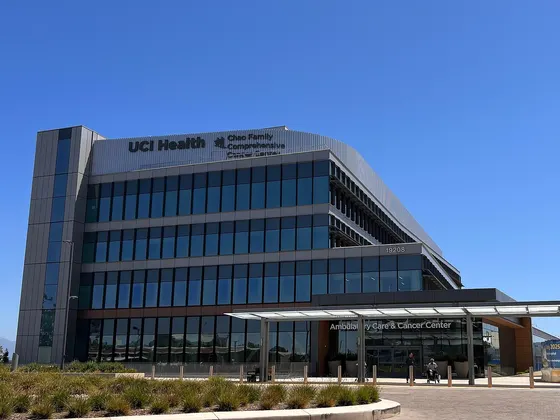

Photo: David Eppstein · CC BY-SA 3.0 · cropped
Photo: CeruleanFilms · Public domain · Photo: Alexliwiththe3 · CC BY-SA 4.0 · Photo: NorbertNagel · CC BY-SA 4.0
How to get into UC Irvine School of Medicine (MD) medicine
Step-by-step: entry requirements, admission tests, personal statement, interview format and the key deadlines.
Open the guide →UC Irvine School of Medicine (MD) entry requirements
Admission profile, interview format, decision dates and what makes UC Irvine School of Medicine (MD) different.
See the profile →The UC Irvine School of Medicine MD program
Integrated, 4 years, clinical rotations across Orange County and Long Beach, California.
See the program →The UC Irvine School of Medicine (MD) medicine interview
UC Irvine School of Medicine interviews online through separate one-on-one conversations with a faculty member and a current medical student, alongside a required asynchronous Kira Talent structured video assessment completed before interview day. The pre-COVID 8-station campus MMI has been retired.
Applicants receive a written prompt outside each station door, then respond to an interviewer or trained actor inside. Stations run approximately 8 minutes each. The interview day also includes an informational session, campus tour, and an informal lunch with current students.
UCI places strong weight on cultural competency and service to underrepresented communities in keeping with the UC public mission and Orange County’s demographics.
UC Irvine School of Medicine (MD) interview at a glance (2027 entry)
| Annual MD class size | ~104 |
|---|---|
| Applications received | ~5,000–6,500 per cycle |
| Interview format | Two virtual one-on-ones (faculty + student) + asynchronous Kira video assessment |
| Curriculum | Integrated + PRIME track |
| Application system | AMCAS + UCI secondary |
| Interview window | October–February |
| Notable program | PRIME underrepresented communities track |
Interview format
- Separate one-on-one online interviews with a faculty member and a current medical student.
- Required asynchronous Kira Talent structured video assessment before interview day.
- The pre-COVID 8-station campus MMI has been retired.
- Kira responses are timed and recorded — practice answering to camera under the clock.
Working towards the MCAT score UC Irvine School of Medicine (MD) expects? Build a week-by-week plan from your test date — free for the first two weeks.
Sample interview questions
Why UC Irvine — how does the school's population health emphasis and Orange County setting align with your goals as a physician?
Reference UCI's diverse patient population, PRIME program, and public health mission. Be specific about what draws you to population-level thinking versus individual patient care.
An undocumented patient needs a costly surgery that is not covered by any insurance program. Your hospital's ethics committee has declined to fund it from the charity care pool. What do you do?
Explore patient advocacy, community resource navigation, legal protections (EMTALA), and systemic advocacy. UCI is in a region with a large undocumented population — this scenario is highly relevant.
Role play: You are a clinic volunteer. A patient who speaks limited English is upset that she has been waiting over two hours. The interpreter is unavailable. How do you handle this? (Actor plays the patient.)
Use reassuring body language, simple words, acknowledge frustration, seek a professional interpreter or phone interpretation service. Do not attempt to deliver clinical information without proper interpretation.
California recently passed legislation expanding preventive care access via community health workers who are not licensed physicians. What are the benefits and risks of expanding the scope of practice for non-physician providers?
Balance physician oversight with access expansion. Reference HRSA workforce data, quality evidence for community health workers, liability issues, and the role of supervision.
Tell me about an experience that showed you the limits of what individual clinical care can accomplish. What did it teach you about the role of public health?
Show systems-level thinking. UCI values physicians who understand that clinical care alone cannot address health inequity — connect personal experience to structural insight.
Obesity rates in Orange County vary dramatically by zip code. What structural factors explain this, and what interventions have the best evidence base?
Reference food deserts, walkability, income inequality, agricultural policy, and evidence-based interventions (SNAP improvements, community gardens, built environment changes).
You are on a team and a fellow student is consistently late, which slows the group's work. Other team members are frustrated. How do you address this?
Show you can navigate conflict constructively — private conversation first, explore underlying reasons, propose solutions, escalate if patterns continue. Avoid triangulation.
Should physicians be required to refer patients to services that conflict with the physician's personal religious beliefs (e.g. contraception, abortion referral)?
Balance conscientious objection with professional duty not to abandon patients. Reference AMA Code of Ethics — physicians must refer patients elsewhere if they cannot provide standard care.
Describe a time you made a significant mistake in an academic or professional context. How did you handle it and what did you learn?
STAR structure. Show honest self-assessment, accountability, and demonstrable change in behavior. Avoid trivializing the error or overclaiming the lesson.
A pharmaceutical company offers to pay for your medical school debt in exchange for agreeing to prescribe their products as a physician. Would you accept? Why or why not?
Clear conflict of interest. Reference AMA ethics guidance, evidence-based prescribing, patient harm potential. Decline — but explain your reasoning carefully and without moralizing.
A station shows Orange County diabetes and obesity prevalence broken down by zip code, with several-fold variation between affluent coastal areas and inland immigrant communities. What do you examine before attributing the gap to behavior?
Look past individual behavior to structural drivers: food environment, walkability, income, insurance, and language access. Question the data too — self-report versus measured, denominators, and whether undocumented residents are undercounted. UCI's population-health emphasis rewards structural reasoning over blaming patients.
UCI's PRIME track prepares physicians for under-represented communities, including immigrant, LGBTQ+, and veteran populations. Whether or not you apply to PRIME, what draws you to caring for populations that mainstream care often serves poorly?
Be specific and grounded in experience. Reference Orange County's large Vietnamese, Korean, and Latino communities and connect your interest to concrete encounters or work, not abstract altruism. Knowing what PRIME actually involves signals genuine research into UCI.
A Vietnamese-speaking elder is accompanied by his adult daughter, who answers all your questions and asks you not to tell her father his serious diagnosis directly. How do you handle this?
Balance cultural respect with the patient's autonomous right to information. Check privately (via a professional interpreter) what the patient himself wants to know — many cultures practice family-centered disclosure, and a competent patient can choose to defer. Honor his wishes either way; never collude to deceive him if he wants to know.
Role play: You are a clinic volunteer. A young uninsured patient is in tears because she was told her visit will cost more than she can pay and is about to leave without being seen. (The interviewer plays the patient.)
Respond with empathy and concrete help: reassure her she will not be turned away from emergency care (EMTALA), and connect her to financial counseling, sliding-scale or charity-care options, and community clinics. Don't make promises outside your role, but don't let her leave without options.
California is expanding the role of community health workers and scope of practice for non-physician providers to widen access. As a future physician, where do you stand on team-based scope expansion?
Argue a balanced position. Acknowledge the access and equity benefits and the evidence behind community health workers, while engaging legitimate questions about training, supervision, and liability. Frame physicians as leaders of collaborative teams rather than gatekeepers protecting turf — consistent with UCI's population-health model.
Practise the UC Irvine School of Medicine (MD) interview
Rehearse the real format before the day — on demand with our AI interviewers, or live with a tutor.
Sit a mock with photoreal AI interviewers — any time
A timed MMI or panel interview on video — American & international voices — with interviewers who listen, react and press with follow-ups. Rubric-scored feedback and a replay the moment you finish.





Live mocks with a tutor who’s been in the room
A full UC Irvine School of Medicine (MD)-style mock with a medic or dentist tutor — honest scoring against real marking criteria, a station-by-station debrief and a written action plan.
Book a mock interviewHow to prepare for the UC Irvine School of Medicine (MD) interview
Common pitfalls to avoid
UC Irvine School of Medicine (MD) interview — frequently asked questions
Sources & official admissions information
Ready to nail your UC Irvine School of Medicine (MD) interview?
Book a mock interview with a tutor who knows the US interview formats, orpractice unlimited stations from our interview question bank.