
The Emory University School of Medicine MD program
What you actually study, and where you will be
Emory University School of Medicine's MD is a 4-year program with an integrated curriculum, with patient contact from Year 1 and clinical rotations in Atlanta and the surrounding metro area (2027 entry). Emory's MD runs in four phases: 18 months of Foundations science, mostly in organ-system blocks, then a 12-month clerkship year that starts about March of year 2. Five months of full-time research, called Discovery, and a nine-month Translation phase of senior rotations and electives complete it. Clinical exposure begins in your first weeks, and you keep one small group and faculty advisor for all four years.
- Degree
- MD
- Length
- 4 years
- Teaching
- Integrated
- Clinical contact
- Year 1

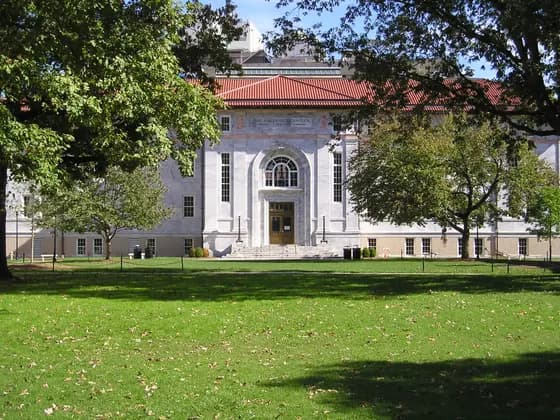


Photo: Sinan · CC BY 2.0 · cropped
Photo: Revesq · Public domain · Photo: Haha169 · CC0 · Photo: Mike Schinkel · CC BY 2.0
The Emory University School of Medicine MD program at a glance (2027 entry)
Emory University School of Medicine's MD is a four-year program based on the Emory campus in Atlanta's Druid Hills area, with clinical training across metro Atlanta. It runs in four phases: Foundations of Medicine (18 months), the pre-clerkship, or preclinical, phase; Application of Medical Sciences (12 months); Discovery (5 months); and Translation of Medical Sciences (9 months). The admissions pages give 138 places in the first-year class; the 2026 class profile counts 140 first-year students, including MD/PhD and MD/MPH students.
Patients appear early. Clinical exposure starts in your first weeks, and within months you begin a year of outpatient clinic afternoons. Science is taught alongside clinical skills, first in Healthy Human, a study of the normal body, then in organ-system blocks. Throughout, you belong to one of four societies and a small group led by a faculty advisor.
Clerkships, the full-time core clinical rotations, begin about March of your second year, and you must first pass Step 1 of the United States Medical Licensing Examination (USMLE), the national licensing exam series. You finish every core rotation before you apply for residency, the specialty training after medical school. Next come Discovery, five months of full-time research, and Translation, which includes electives and a sub-internship, where you act as an intern. Every phase is graded pass/fail.
The school's strategy page and an August 2023 recommendations report say the MD curriculum was last revised in 2007. The strategy page calls reimagining the curricula of all its degree programs the top priority of its education strategic plan. This guide describes the curriculum in the 2026-27 catalog; later classes may see changes.
| Degree | MD |
|---|---|
| Program length | 4 years in four phases; most dual degrees take five years |
| Class size | 138 places on admissions pages; 140 first-year students in the 2026 profile |
| Main campus | Emory campus, Druid Hills, Atlanta |
| Teaching style | Integrated: organ-system blocks, twice-weekly small groups, early clinic work |
| Anatomy | Faculty-guided dissection of human donors in year 1 |
| First patient contact | Year 1: clinical exposure in your first weeks, clinic afternoons within months |
| Clinical sites | Grady, Emory's hospitals, Atlanta Veterans Affairs Medical Center and Children's Healthcare of Atlanta |
| Step 1 timing | End of Foundations, in year 2; you must pass before clerkships begin |
| Grading | Satisfactory or unsatisfactory (pass/fail) in every phase, clerkships included |
What makes the Emory University School of Medicine MD program different
Five months of full-time research built into the MD
Discovery sets aside five months after the clerkship year for a hypothesis-driven project with a faculty mentor. You write it up as a scientific manuscript, which a faculty committee scores, and present it at Medical Student Research Day.
One small group and advisor for all four years
At orientation you join one of four societies and a small group led by a Small Group Advisor, one of 16 practicing physicians assigned to each class. You meet twice a week in Foundations and keep meeting through the clerkship year.
Clerkships begin about March of your second year
Foundations lasts 18 months and ends with about two months of Step 1 study, so clerkships start halfway through year 2.
A year of clinic afternoons from your first months
For 12 months, starting within your first few months, you spend one afternoon every other week in an outpatient clinic, building a relationship with one clinical preceptor.
Core training at Grady, a public safety-net hospital
Grady Memorial Hospital is a publicly owned safety-net hospital with one of Atlanta's two Level 1 trauma centers. At least one internal medicine rotation, the medicine sub-internship and psychiatry emergency call happen there.
How Emory University School of Medicine teaches medicine
In Foundations most science comes in courses of two to five weeks, first on normal function in Healthy Human, then on disease, organ system by organ system. Biochemistry, immunology, microbiology, pathology and pharmacology run through the blocks as threads, not separate courses.
Small groups carry the clinical side. In Essentials of Patient Care, a course spanning all four years, your Small Group Advisor teaches professionalism, communication, physical examination and diagnostic thinking, along with ethics, preventive medicine and wellness. Sessions use discussion, case analysis and role play, and you practice on classmates, standardized patients (actors trained to play patients) and real patients. Some problem-based learning, where a group works through a case together, happens here too.
Several strands run across the four years. The current chart lists six longitudinal threads: diversity, equity, inclusion and racial advocacy; climate change and environmental health; clinical reasoning; interprofessional education; ethics in medicine; and quality and safety. Community Learning and Social Medicine adds 18 months of classroom work on health equity, climate justice and the social determinants of health, the living and working conditions that shape health.
From the clerkship year, teaching moves to the wards and clinics. You learn on teams of residents led by attending physicians, the senior doctors responsible for patients, and most rotations add weekly conferences or case sessions. Your small group keeps meeting, and three Integration weeks gather the class for topics beyond any one clerkship, such as patient safety, communication and service learning.
The ways you will learn
| Organ-system blocks | Each covers one part of the body in health and disease, with end-of-course exams on the ExamSoft testing software. |
|---|---|
| Standardized patients | You interview and examine trained actors in one of 16 exam rooms while physicians observe and tutor you, with video recordings for feedback. |
| Simulation | Patient simulators for suturing, resuscitation, intubation, IV placement and delivering a baby, plus team-training exercises with nurses, physician assistants and therapists. |
How anatomy is taught at Emory University School of Medicine
Anatomy is taught by dissection. The 2026-27 catalog describes a first-year course, shared with physician assistant students, in which you learn regional anatomy through faculty-guided dissection of human donors, case-based discussion and independent study. The dean calls the shared course new in fall 2026, and the catalog lists it at five weeks. The chart for the Class of 2028, who entered in 2024, instead spreads anatomy lab across roughly November to April of year 1.
The lab has 24 dissection tables, each with a computer that displays cross-sectional imaging, study guides, lecture notes and other references at the table. The school provides lab coats for anatomy, and the catalog's supply list asks you to bring nitrile or latex gloves.
Anatomy has its own exams. It is not graded as a separate course, but you must reach the standard in the anatomy syllabus. Each failed anatomy exam is remediated individually, with a first attempt within two weeks of notice. The 2025-26 catalog also listed a senior elective, Surgical Anatomy, Embryology and Operative Techniques, that takes students heading for surgery or obstetrics and gynecology back to dissection.
When you first meet patients at Emory University School of Medicine
Your first clinical exposure comes at the very start. Since 2026, orientation has been Crossing the Threshold, a two-week course that the dean's May 2026 message calls new. The 2026-27 catalog says it combines clinical exposure, skills training, reflection and community building, partly shared with other health science students. The Four Phases and Clinical Experience pages still describe the earlier format, Week on the Wards, a week of shadowing before Healthy Human that the 2025-26 catalog paired with orientation.
Clinical skills then start in your small group: communication, history taking and examination, practiced on standardized patients while physicians observe. In the spring of year 1, according to the obstetrics and gynecology department, you learn breast and pelvic examinations with standardized patients.
Within the first few months you begin the Outpatient Experience (OPEX): one afternoon every other week, for 12 months, in an outpatient clinic. You learn from a clinical preceptor, the healthcare team and the patients you see over time. In the same year, Community Learning and Social Medicine places your small group with one of more than 50 Atlanta community partner organizations.
Second-year electives can add clinical time, such as emergency department shadow shifts. Outside the curriculum, students run clinics such as the Harriet Tubman Women's Clinic, which serves low-income and uninsured women.
Year by year at Emory University School of Medicine
- Phase 1 (18 months)
Foundations of Medicine
Foundations opens with Healthy Human, about four months on how the normal body works (five months in the 2025-26 catalog). From about five months in, disease is taught in organ-system blocks with anatomy lab alongside, while small groups, clinic afternoons and community learning continue. Once the formal courses end, you get about two months to study for Step 1.
- The catalog orders the first four Foundations courses as From Cells to Humans (5 weeks) and Systemic Control of the Nervous and Endocrine Systems (4 weeks). Then come Nutrition, Physiology and Metabolism (5 weeks) and Genetics, Epidemiology and Risk Assessment (4 weeks).
- They run from cell and molecular biology and embryology, through nerve and hormone signaling, metabolism and nutrition, to epidemiology, biostatistics and genetic testing, including how to judge a medical study.
- Introduction to Human Disease (4 weeks): infection and the body's defenses, inflammation, blood flow and clotting, how drugs work, and how cancers develop.
- Organ-system blocks: skin, bones, muscles and joints (3 weeks); pulmonary, cardiovascular, gastrointestinal, and renal and genitourinary (4 weeks each); endocrine and hematology (3 each); reproductive health (2); neuroscience (4.5); infectious disease (3).
- Behavioral Science (4 weeks) covers psychiatry, psychology and psychopharmacology through lectures, small-group problem-based learning, live patient interviews and reflective writing. Aging and Dying (3 weeks) covers geriatric medicine and end-of-life care.
- Alongside: Essentials of Patient Care, Ethics in Medicine, Community Learning and Social Medicine, OPEX, and Interprofessional Education and Public Health Leadership, shared with students from other health professions.
- Two review courses, Review Human Disease (3 weeks) and Review and Self Study (4 weeks). In the 2026-27 calendar, dedicated Step 1 study runs from November 30, 2026 to January 29, 2027, around the winter break.
- Phase 2 (12 months)
Application of Medical Sciences: the core clerkships
In the 2026-27 calendar the Application phase begins in mid-February 2027 with an Integration week and an orientation to the clinical years, and clerkships start on March 1, 2027. The Four Phases page lists 12 required rotations; the MD landing page speaks of 14 disciplines before residency applications. Department pages call this the M3 or third-year clerkship, though at Emory it starts halfway through year 2.
- Internal medicine (8 weeks): two four-week ward rotations, at least one at Grady and the other at the Atlanta VA, Emory University Hospital or Emory University Hospital Midtown. You work up two to three new patients a week, about 18 in all.
- Surgery (8 weeks): four weeks of general adult or pediatric surgery and two weeks each in two subspecialties chosen by preference sheet, with suture labs and a vascular access lab on simulators.
- Pediatrics (6 weeks): two weeks inpatient at Children's Arthur M. Blank or Hughes Spalding hospitals, two with a general pediatrician, one in a subspecialty, and one split between the emergency department and Grady's newborn nursery.
- Obstetrics and gynecology (6 weeks): two weeks on labor and delivery at Grady or Emory University Hospital Midtown, two on a gynecology service and two in outpatient clinics, with teaching every Wednesday.
- Psychiatry (6 weeks): inpatient, consultation or outpatient work at sites such as Grady, the Atlanta VA, Emory University Hospital, Skyland Trail and the DeKalb Crisis Center, with emergency call at Grady's Crisis Intervention Service.
- Neurology (4 weeks): two two-week blocks on wards, consult services, clinics or pediatric neurology.
- Ambulatory Care Block (12 weeks): six weeks at one adult primary care practice, seeing one to four patients each half-day. The rest covers pediatric primary care and clinics in dermatology, ophthalmology, orthopedics, otolaryngology (ear, nose and throat), palliative care and urology, with a quality improvement project.
- The catalog also lists short required courses in anesthesiology (airway management and perioperative care), dermatology (one week of clinics, mainly at The Emory Clinic) and ophthalmology. A palliative care course covers symptom management, advance care planning and serious-illness conversations.
- Radiology is a virtual clerkship spread across the year: about 40 hours of teaching and shadowing, 16 computer modules and 22 must-not-miss imaging findings, such as a collapsed lung.
- Ethics in Medicine II continues through the year.
- Phase 3 (5 months)
Discovery: a full-time research project
Discovery is five months of full-time, hypothesis-driven research under a faculty mentor, with no other commitments beyond occasional seminars. The calendar runs Discovery and Translation as one period from March of year 3 to graduation, and the current chart draws Discovery first, through spring and summer.
- Projects can be clinical, basic or translational science, health services research, quality improvement, medical education, public health, artificial intelligence, medical history or health policy, and can fold in interests such as creative writing.
- Most students join an Emory faculty member's ongoing research, found through a mentor database. You can also work with a mentor elsewhere in the US or abroad who meets the program's publication and grant criteria.
- You submit a research proposal for approval beforehand, file a mid-Discovery progress report and meet your mentor regularly.
- The final paper takes the form of a scientific manuscript; the Medical Student Research Committee reviews it, returns comments and gives a numerical score. Publication is encouraged but not required.
- Every student presents the project as a talk or poster at Medical Student Research Day in the fourth year.
- Phase 4 (9 months)
Translation of Medical Sciences
The final phase prepares you to work as a resident. Required senior rotations sit alongside electives and time for away rotations at other schools and residency interviews. Translation closes with a month-long Capstone in April. The 2025-26 catalog gave this phase seven months; the current pages say nine.
- A four-week sub-internship, or acting internship, with an intern's responsibilities: medicine at Grady, surgery on one of almost a dozen services, or the pediatric general wards, with night call or night float.
- Critical care (4 weeks) in an intensive care unit at one of seven hospitals, with simulation exercises in the Emory Center for Experiential Learning (ExCEL) and teaching on ethics in intensive care.
- Emergency medicine (4 weeks) as a sub-intern in a high-volume, inner-city emergency department, with the chance to ride with Grady's ambulance crews, Grady EMS.
- Three four-week electives.
- Step 2 CK, the USMLE exam on clinical knowledge, and residency interviews: on-schedule students have four weeks for each. In the 2026-27 calendar, Match Day, when students learn where they will train as residents, falls on March 19, 2027.
- Capstone (4 weeks): lectures, workshops, panels and exercises on the practical skills residents need; the 2025-26 catalog adds case-based small groups, standardized patients, skills labs and well-being.
How you are assessed at Emory University School of Medicine
Under the 2026-27 catalog, every course and clerkship is graded satisfactory or unsatisfactory (S/U), the school's pass/fail scale. In Foundations you pass a course if your total score is no more than two standard deviations below the class mean, or above 68.2%. You must pass all Foundations courses before clerkships. A few department pages and course records still mention letter grades, but the catalog's policy is S/U throughout.
On clerkships, National Board of Medical Examiners (NBME) subject exams, often called shelf exams, are national end-of-rotation tests used across the Application phase as part of clerkship evaluations. Most clerkships add their own assessments: oral exams in internal medicine, pediatrics, psychiatry and adult primary care, standardized patient exams in internal medicine, and online Aquifer cases in pediatrics. Fail any required part and you receive a U and repeat the whole clerkship, and the first U stays on your transcript.
After the clerkship year you take the End of Applications OSCE. An OSCE (objective structured clinical examination) is a practical exam of timed clinical encounters, usually with standardized patients. Emory's is comprehensive, sits outside the clerkships and tests clinical and diagnostic reasoning. You book your own date across spring and summer, and you must pass it to graduate.
Step 1 tests the science behind medicine and has been reported pass/fail since January 26, 2022. Emory requires a pass before clerkships, and you may sit it only after passing two NBME practice exams. The catalog sets the deadline three weeks before the Application phase; the 2026-27 calendar puts it on February 9, 2027, with clerkships from March 1, 2027.
The catalog asks you to take Step 2 CK as soon as feasible after the clerkship year and by October 1 of your final year, and you must pass both exams to graduate. In August 2026 the USMLE program announced a move to designated testing dates from January 2029, with Step exams offered less often each year. The date had already moved once, from 2028.
On the current schedule, a student entering in 2027 would study for Step 1 from about December 2028 to late January 2029. The school deadline would fall in early February, with clerkships from about March 2029, so depending on your test date you could sit Step 1 just before or just after the change. Step 2 CK would follow in about March 2030 if you match the chart's March block, and by October 1, 2030 at the latest.
- These 2027-entry dates are worked out from the 2026-27 calendar, the latest the school has published. The USMLE says it will publish each year's dates more than a year ahead and that Step 2 CK will not be offered in certain months. It has also asked schools to review rules that restrict when students must test.
- The Liaison Committee on Medical Education (LCME) accredits MD programs in the United States, and its accreditation is what makes students at an MD program like this one eligible to sit the USMLE. Its directory, updated July 22, 2026, lists Emory as fully accredited, and the school reports keeping full accreditation after a survey visit in March 2024.
- The school's LCME timeline lists a limited survey visit on March 16-17, 2026, the 2025-26 survey shown in the directory. A Department of Medicine page calls it the culmination of a 24-month effort that produced a 120-page action plan, drawing on improvement work begun after the 2024 visit. No outcome has been published.
- Foundations remediation: you are told within three weeks of an exam, agree a tailored plan with the course director, and must finish any outstanding work by December 31 of year 2.
- Graduation also requires mastering the school's 24 Student Physician Activities, its list of a doctor's core tasks. You must also show five technical procedures, including basic life support, defibrillator use and drawing venous blood, and finish within six academic years.
Where you will actually train at Emory University School of Medicine
All required rotations take place at Emory and Emory-affiliated facilities across the Atlanta area. Besides Emory Healthcare's own hospitals and clinics, the school trains students in three affiliated systems: the Atlanta Veterans Affairs Medical Center, Children's Healthcare of Atlanta and Grady Memorial Hospital. The Clinical Training page counts more than 3,000 patient beds in more than half a dozen hospitals.
Grady, a publicly owned safety-net hospital with one of Atlanta's two Level 1 trauma centers, is staffed mainly by Emory faculty, about 80% of its physicians by the school's count. The Atlanta VA partnership dates back to 1946. Pediatric rotations use Children's Arthur M. Blank Hospital, Hughes Spalding Hospital and Center for Advanced Pediatrics; Children's patients come from every county in Georgia.
Some school pages still use older site names. The Four Phases page and the 2026-27 catalog's site list name two of them: Children's Healthcare of Atlanta at Egleston, and Wesley Woods Center and Geriatric Care Hospital. A few course records still say Egleston. Children's says Egleston's clinical services moved to its new Arthur M. Blank Hospital on September 29, 2024, and the 2025-26 catalog lists Emory Wesley Woods Center.
How you are assigned varies by clerkship: adult primary care, for example, places you at one family medicine or internal medicine practice in metro Atlanta. Duty hours follow the rules of the Accreditation Council for Graduate Medical Education (ACGME), which accredits residencies, and are capped at 80 hours a week. You get a day off each week and, on rotations of four weeks or more, a required wellness half-day each month, no questions asked.
At least one internal medicine rotation and the medicine sub-internship, plus options across obstetrics and gynecology, psychiatry, pediatrics, neurology and critical care.
- Grady Memorial Hospital
- Grady Crisis Intervention Service
- Grady newborn nursery
- Grady EMS
Emory's own system, with seven hospitals in metro Atlanta, used across medicine, surgery, obstetrics and gynecology, neurology, psychiatry, dermatology and critical care.
- Emory University Hospital
- Emory University Hospital Midtown
- Emory St. Joseph's Hospital
- Emory Decatur Hospital
- Emory Johns Creek Hospital
- The Emory Clinic (multiple sites)
- Emory Wesley Woods Center
Internal medicine, psychiatry, neurology and gynecology rotations; more than 300 Emory faculty and residents work there.
- Atlanta Veterans Affairs Medical Center
Pediatric inpatient, emergency and subspecialty weeks, the pediatrics sub-internship, and child psychiatry, neurology and critical care options.
- Arthur M. Blank Hospital (North Druid Hills campus)
- Hughes Spalding Hospital
- Center for Advanced Pediatrics
Adult and pediatric primary care, psychiatry rotations and the first-year community learning course.
- Adult primary care practices across metro Atlanta
- Community general pediatrics offices
- Skyland Trail
- DeKalb Crisis Center
- More than 50 community partner organizations
Electives, selectives and away rotations at Emory University School of Medicine
The catalog requires a Foundations elective of at least 15 contact hours, taken as a group experience or a directed study. The chart places an M2 elective in the fall of year 2. The emergency medicine elective, for instance, meets on Friday afternoons from August to November for skills labs in airway management, suturing, splinting, IV access, code simulation and ultrasound, plus at least four shadow shifts. Radiology offers at least one second-year elective each year.
Clinical Perspectives in Global Health, a second-year elective since fall 2017, teaches medical students alongside nursing students and Emory College students minoring in global health. It uses didactic sessions, skills workshops and clinical experiences, with an emphasis on the global burden of disease, ethics and health equity.
In Translation you take three four-week electives, chosen from more than 100 offerings. If nothing fits, you can design one with a faculty preceptor, with advance approval from the Associate Dean of Clinical Education. The 2025-26 catalog adds that proposals are due 90 days ahead, that international experiences can qualify, and that no more than one elective may be a research project.
The 2025-26 elective list shows the range. In emergency ultrasound you perform 100 scans that faculty review, and medical toxicology includes follow-up calls on cases reported to the Georgia Poison Center. Others include forensic pathology at the Georgia Bureau of Investigation's medical examiner's office and Law and Medicine, alongside law students serving low-income clients. Medicine, Compassion and the Arts includes a 10-day trip to northern Italy.
Translation also leaves room for away rotations at other schools, which you apply for through the Association of American Medical Colleges' Visiting Student Learning Opportunities (VSLO) service. Career advising runs a VSLO information session in January of your third year, and the 2025-26 catalog says applications can begin in March, once the Application phase ends.
Dual degrees and research years at Emory University School of Medicine
The MD page lists six dual degrees: MD/PhD, MD/MA in bioethics, MD/MPH, MD/MBA, MD/MSCR and MD/MS in robotics. A second degree that takes an extra year usually replaces Discovery, because it carries its own research. The exceptions are the MD/MBA, whose students complete four of Discovery's five months, and MPH programs that end in a capstone instead of a thesis.
The MD/PhD is Emory's Medical Scientist Training Program (MSTP), which has held a National Institutes of Health (NIH) training grant continuously since 1987. You complete Foundations, Step 1 and the clerkship year, take Step 2 CK, then earn a PhD through Emory's Laney Graduate School or Georgia Tech, returning for Translation after a two-week clinical refresher course. One program page gives seven to eight years; another gives an average of 8.2. Its sequence page still lists Step 2 CS, a clinical skills exam the USMLE discontinued in 2021.
The MD/MPH, with the Rollins School of Public Health, and the MD/MBA, with the Goizueta Business School, each take five years, with the extra study following the clerkship block. MD/MBA students choose a one-year or two-year MBA format. The MD/MA in bioethics also takes five years: most students begin some Translation rotations, then step out in the fall after year 3. The 2026 class profile counts 9 MD/PhD and 10 MD/MPH students in the first-year class.
The MD/MSCR adds a Master of Science in Clinical Research between years 3 and 4, with at least 30 credit hours, including classes, a thesis and a grant proposal. MD/MSCR students also complete five extra research electives and apply early in year 3. The MD/MS in robotics, built with Georgia Tech, starts with a year of robotics coursework there before four years at Emory, where your Discovery project doubles as the Georgia Tech capstone.
Beyond these six, the catalog describes an MD/MLS: you apply in year 3 to Emory Law School's Master of Legal Studies. Any other degree, at Emory or elsewhere, needs an academic plan agreed beforehand with the Dean of Medical Education.
Without a second degree, you can still ask for more research time. Extended Discovery needs a formal written request to the Director of Discovery. The catalog lists a year on a scholarly project among the planned reasons for taking longer than four years, with approval.
Facilities and support at Emory University School of Medicine
Where you will learn
Clinical skills teaching centers on the Human Simulation Education Center (HSEC), on the third floor of the School of Medicine Building. It has four suites, each with a central debrief room with projection and four exam rooms fitted with an exam table and standard clinic equipment. It hosts standardized patient sessions and clinical skills and physical diagnosis teaching.
The Emory Center for Experiential Learning (ExCEL), in the building's basement, is the school's high-fidelity simulation center, about 6,000 square feet. It holds patient simulators, task trainers for specific procedures, space for hybrid simulations that pair simulators with standardized patients, and basic and advanced life support training. Scenarios range from team resuscitation and emergency obstetric care to large-scale disasters.
Support while you study
The society system anchors support. There are four societies, named after four historic physicians; a 2021 faculty essay linked from the Societies page names one of them the Osler Society, after Sir William Osler. Your Small Group Advisor teaches you, supports you and, at Commencement, hoods you.
The school's student success center (CHSS) offers one-to-one academic coaching, learning specialists, expanded tutoring, help with accommodations and access to mental health resources. Its USMLE support includes a Step 1 guide, workshops, tutors and one-to-one planning sessions. Peer tutors are available throughout, and the EMPACT program matches students with physician mentors.
During the clerkship year you choose a faculty advisor to help plan residency applications and your senior schedule, and you meet the associate dean for student affairs. In the final year, the career advising program holds four class meetings to help you carry out your post-graduation plan. Student Health and Counseling and Psychological Services (CAPS) serve all medical students.
Peer support starts early: the Big Sib/Little Sib program pairs each incoming student with a rising second-year. Students also sit on the subcommittees of the curriculum committee, which oversees and revises the program.
Is the Emory University School of Medicine program right for you?
This program may suit you if
- You want five protected months of full-time, mentored research.
- You would value the same small group and faculty advisor from orientation to Commencement.
- You want to start clerkships about March of year 2 and finish every core rotation before residency applications.
- You want guaranteed time at Grady, a public safety-net hospital with a Level 1 trauma center, alongside Emory's hospitals, the VA and Children's.
- You are drawn to public health, research or engineering and might add an MD/MPH, MD/PhD or MD/MS in robotics.
Things to think about
- You must pass Step 1 before clerkships, and on the current schedule a 2027 entrant's Step 1 window falls right at the USMLE's January 2029 switch to designated testing dates.
- Foundations covers the preclinical sciences in 18 months, with most organ-system blocks lasting three or four weeks.
- Every required rotation is in the Atlanta area; time elsewhere depends on electives or your Discovery project.
- Pass/fail does not mean low stakes: failing any required part of a clerkship means repeating it, and the first U stays on your transcript.
- The school calls curriculum reform its top education priority, so details may change for later classes.
Emory University School of Medicine MD program — frequently asked questions
Applying to Emory University School of Medicine?
How to get into Emory University School of Medicine
Prerequisites, MCAT, AMCAS personal statement, secondaries and interview, step by step.
Open the guide →Emory University School of Medicine admissions profile
MCAT and GPA profile, acceptance rate, interview format and key dates.
See the profile →Compare Emory University School of Medicine with other schools
Put the teaching style, anatomy teaching and clinical sites next to another school.
Open the comparison →Prepare for the Emory University School of Medicine interview
Format breakdown, school-specific sample questions and prep tips from tutors who interviewed here.
Read the guide →Where this Emory University School of Medicine program guide came from
This guide was written from 62 official sources — Emory University School of Medicine's own program pages and curriculum documents, plus the accreditor and the hospitals and health systems the school trains students in where they publish detail — read on 2026-10-11, then checked claim by claim against those sources.
- Emory School of Medicine: Four Phases in Four Years, the MD curriculum
- Emory School of Medicine: MD Curriculum
- Emory School of Medicine: curriculum chart, The MD Curriculum, Class of 2028
- Emory School of Medicine: Clinical Training
- Emory School of Medicine: Societies and Small Group Learning
- Emory Medicine Magazine, Summer 2021: Shades of Gray, an essay by an Osler Society small group adviser
- Emory School of Medicine: Discovery Phase
- Emory School of Medicine: Discovery welcome letter
- Emory School of Medicine: Discovery faculty mentor eligibility criteria
- Emory School of Medicine: Non-Emory Discovery mentors
- Emory School of Medicine: Doctor of Medicine (MD) program page
- Emory University School of Medicine Catalog 2026-2027: Doctor of Medicine (MD) curriculum, grading, board exams, enrollment and graduation policies
- Emory University School of Medicine Catalog 2026-2027: MD course descriptions
- Emory University School of Medicine Catalog 2026-2027: History
- Emory University School of Medicine course catalog 2025-2026 (PDF)
- Emory School of Medicine: MD Program Academic Calendar 2026-27
- Emory School of Medicine: Assessments
- Emory School of Medicine: Curricular Oversight
- Emory School of Medicine: LCME Accreditation
- Emory School of Medicine: LCME Accreditation Timeline/Process
- Emory Department of Medicine: LCME site visit recap
- Emory Department of Medicine: Clerkship Programs
- Emory Department of Pediatrics: Pediatrics Clerkship 2024-2025
- Emory Department of Gynecology and Obstetrics: Medical Students
- Emory Department of Psychiatry and Behavioral Sciences: Medical Student Education
- Emory Department of Radiology and Imaging Sciences: Medical Students
- Emory Department of Emergency Medicine: M2 Elective
- Emory School of Medicine: Where We Work
- Emory School of Medicine: Clinical Experience
- Children's Healthcare of Atlanta: Arthur M. Blank Hospital
- Emory School of Medicine: Simulation Program
- Emory School of Medicine: Simulation Program Centers
- Emory School of Medicine: Global Health and Equity Office
- Emory Global Health Institute: Clinical Perspectives in Global Health course
- Emory School of Medicine: Global Health Research Funding, Summer 2026
- Emory School of Medicine: Student Organizations and Activities
- Emory School of Medicine: student success center (CHSS)
- Emory School of Medicine: EMPACT Mentorship Program
- Emory School of Medicine: Academic Advising
- Emory School of Medicine: M3 Resources for Career and Specialty Choice
- Emory School of Medicine: M4 Resources for Career and Specialty Choice
- Emory School of Medicine: MD/PhD program
- Emory School of Medicine: MD/PhD welcome and typical sequence
- Emory School of Medicine: Features of the Emory MD/PhD Program
- Emory School of Medicine: MD/PhD welcome from the director
- Emory School of Medicine: MD and Bioethics (MA) Dual Degree
- Emory School of Medicine: MD and Public Health (MPH) Dual Degree
- Emory School of Medicine: MD and Business (MBA) Dual Degree
- Emory School of Medicine: MD and Master of Science in Clinical Research (MSCR) Dual Degree
- Emory School of Medicine: MD and Robotics (MS) Dual Degree
- Emory School of Medicine: M1 Class Profile 2026
- Emory School of Medicine: Transforming Education in the School of Medicine
- Emory School of Medicine: Education Transformation Recommendations Report, August 2023
- Emory School of Medicine: Dean's Educator Appreciation Day message, May 22, 2026
- LCME: Accredited Programs directory (updated July 22, 2026)
- LCME: About the LCME
- USMLE: Updated Timeline for Designated Testing Dates, transition in January 2029 (August 6, 2026)
- USMLE: Designated Testing Dates Information Hub
- USMLE: Transition to Limited Testing Dates Starting in 2028 (June 23, 2026, since updated)
- USMLE: Designated Testing Dates FAQs (updated August 6, 2026)
- USMLE: Common Questions (Step 1 pass/fail reporting)
- USMLE: Work to relaunch USMLE Step 2 CS discontinued (January 26, 2021)
Curricula are restructured between cycles. Anything here that decides your application — how anatomy is taught, a clinical campus assignment, a required research year — should be confirmed against the official page for your entry year.
Applying to Emory University School of Medicine?
We help US applicants with MCAT strategy, the AMCAS personal statement, secondary essays and interview prep — everything you need for a competitive Emory University School of Medicine application.