
The UC San Diego School of Medicine MD program
What you actually study, and where you will be
UC San Diego School of Medicine's MD is a 4-year program with an integrated curriculum, with patient contact from Year 1 and clinical rotations in La Jolla, Hillcrest and sites around the San Diego region (2027 entry). UC San Diego's MD follows the C.O.A.S.T. curriculum, first taught to the class that entered in fall 2023. Two pre-clerkship (classroom-based) years, ending with USMLE Step 1, the first national licensing exam, pair organ-system science blocks with one- or two-year courses in anatomy, clinical skills, health systems and compassion. Year 3 brings seven core clerkships, the required clinical rotations, and Year 4 adds electives, a capstone project and two campus courses.
- Degree
- MD
- Length
- 4 years
- Teaching
- Integrated
- Clinical contact
- Year 1

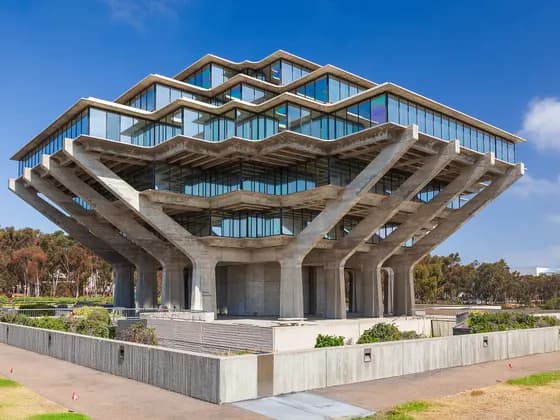


Photo: TritonsRising · CC BY-SA 4.0 · cropped
Photo: Stephen Bay · CC BY 4.0 · Photo: Stephen Bay · CC BY 4.0 · Photo: FeldBum · CC BY-SA 4.0
The UC San Diego School of Medicine MD program at a glance (2027 entry)
UC San Diego School of Medicine's MD is a four-year program on the university's La Jolla campus in San Diego. The Liaison Committee on Medical Education (LCME), which accredits MD programs in the United States, lists the school's first accreditation year as 1968. The school reports 140 students matriculating in its incoming class of 2026, and a university story from October 2024 described 152 new medical students.
If you start in 2027, you join the C.O.A.S.T. curriculum, introduced for the class entering in fall 2023, so it is still new. Years 1 and 2 form the pre-clerkship phase: classroom, lab and clinical skills teaching in organ-system blocks, with longitudinal courses (ones that run for a year or two) alongside. The phase ends with United States Medical Licensing Examination (USMLE) Step 1.
Years 3 and 4 are the clerkship years. A clerkship is a required clinical rotation in a core specialty, in which you work as part of a hospital or clinic care team. Year 3 holds seven core clerkships plus three selectives, short rotations you choose from a set list. Year 4 is mostly electives, a capstone project and two campus courses that prepare you for residency, the specialty training after medical school.
Compassion and equity run through the program. Anatomy treats the body donor as your first patient; two years of courses cover health systems, equity and compassion; and most first-year students work at the Student-Run Free Clinic. The first two years are based in La Jolla, and clerkships then take you to hospitals across San Diego, from La Jolla to Hillcrest.
| Degree | MD |
|---|---|
| Program length | 4 years; requirements must be met within six years of starting |
| Class size | 140 matriculants in the incoming class of 2026 (school figure) |
| Curriculum | C.O.A.S.T., since fall 2023: organ-system blocks plus longitudinal courses |
| Anatomy | Year-long donor dissection lab; four or five students share each donor |
| First patient contact | Year 1: clinical shadowing and Student-Run Free Clinic electives |
| Core clerkships | Seven in Year 3 (39 weeks), plus three 3-week selectives |
| USMLE Step 1 | End of Year 2; must be passed to start Year 3 |
| Grading | Pass/fail pre-clerkship; core clerkships Honors, Near Honors, Pass or Fail |
| Accreditation | LCME, Full; directory lists next survey as 2025-26 |
What makes the UC San Diego School of Medicine MD program different
Your first patient is an anatomy donor
In Humanistic Anatomy, nicknamed Compassionatomy, the body donor is treated as your first patient. The school's aim is to build the empathy you will need with living patients while you learn the body's structure.
A clinical coach who never grades you
Through the Mentor Clinician Program, an experienced faculty member observes you with patients at least weekly in Year 3 and gives you feedback. Nothing from these sessions goes to grading committees or residency applications. Founded in 2016, the program had coached more than 1,300 UC San Diego students by early 2026.
Free clinic work from your first year
The Student-Run Free Clinic Project gives priority to people who qualify for no other health care programs, at four sites around San Diego. A university story reported that more than 80% of first-year students took part in 2023.
Two years of systems science and compassion training
Equity in Systems Science meets twice a week in small groups that work through real-life cases on health care delivery, teamwork and quality improvement. CARE (Compassionate Action and Real Engagement) teaches evidence-based empathy and compassion skills, linked to clinical shadowing and community service.
Border and global health within reach
Health Frontiers in Tijuana, a binational student-run clinic set up in 2011 with the Universidad Autónoma de Baja California (UABC), is an elective in fall, winter and spring. Another elective spends three days in San Quintin, Baja California, and the Global Health Academic Concentration takes five students a year for work abroad.
How UC San Diego School of Medicine teaches medicine
The pre-clerkship years are built from Foundational Sciences blocks of two to five weeks, each on one organ system. In Year 1 most blocks cover how a healthy system works and the drugs that act on it. In Year 2 you return to the same systems for disease and early treatment, so the Year 1 Cardiovascular System block is followed by Cardiovascular System II.
Longitudinal courses run beside the blocks, so each week mixes science with skills. Humanistic Anatomy fills Year 1 and gives way in Year 2 to Clinical Decision Making, a weekly course built on clinical cases. Diagnostics, Practice of Medicine, Equity in Systems Science (ESS) and CARE run through both years, with concentration electives alongside. The school has also approved a nutrition and culinary medicine thread across the four-year curriculum, and in October 2026 it was recruiting a director to introduce it in stages.
The current course page says ESS meets twice a week and CARE five or six times a quarter throughout Years 1 and 2. The schematics show both running through Year 1 and the fall and winter of Year 2, before Step 1 study. The school's 2023 and 2025 slides described ESS as a 15-month course of four hours a week and CARE as five quarters of three to four hours a week.
From Year 3 you learn mainly on inpatient and outpatient care teams. Year 4 adds two four-week courses back on campus.
The ways you will learn
| Organ-system blocks | The science core, from Foundations of Human Biology to Multi-Organ System Disorders. In the school's January 2025 timetable, block sessions mixed in-person teaching with self-paced (asynchronous) work. |
|---|---|
| Small-group self-directed learning (ESS) | At each meeting your group works through a patient case or scenario and decides what should happen next, with facilitators who guide but do not supply answers. In one case, feedback between a third-year student and an attending physician (the senior doctor in charge) breaks down, and groups design a better feedback process. |
| Practice of Medicine | Every other week, on Wednesday afternoons, small groups led by physicians and psychologists practice history-taking, examination, communication and professionalism. The course also runs Objective Structured Clinical Examinations (OSCEs): timed stations where you interview or examine a standardized patient, a person trained to play a patient, while being observed and scored. |
| Diagnostics labs | Weekly across both years, mixing large-group discussions with small-group labs. You study tissue under the microscope (histology) alongside radiology, first normal structure and then disease. In Year 2 the course tracks the organ blocks, and pathology labs add glass slides, organ specimens and cases. |
| CARE sessions and shadowing | Large- and small-group sessions focused on your identity as a future physician, plus observational shadowing each quarter. Service electives count toward the course's community engagement part. |
A typical week on the UC San Diego School of Medicine program
This timetable comes from school slides of October 2023 and January 2025, since removed from the school's site (archived copies survive), so treat it as a guide. In the Year 1 week they show, the day ran from 8 a.m. to about 5 p.m. with a lunch hour at noon, and most teaching sat in the mornings.
Organ-block sessions ran on Monday, Tuesday, Thursday and Friday mornings, and many were self-paced: Monday's was in person only on the first day of a block, and Thursday's was always self-paced. ESS took the late morning on Tuesdays and Fridays, and anatomy lab took Wednesday morning.
Afternoons had no scheduled teaching except CARE on Tuesday and, on Wednesday, Practice of Medicine and Diagnostics in alternate weeks. The slides called Diagnostics an every-other-week course; the current course page says it meets weekly. Year 2 followed a similar pattern, with Clinical Decision Making on Wednesday mornings and CARE on Thursday afternoons.
How anatomy is taught at UC San Diego School of Medicine
Anatomy is taught through Humanistic Anatomy, known as Compassionatomy, which every first-year student takes. It meets weekly through Year 1 and treats the body donor as your first patient. A 2024 university story describes groups of four or five students sharing one donor for the whole course.
This is hands-on, donor-based dissection. The current course page says you study anatomy through surgical exposures, the approaches surgeons use to reach a structure, with constant care to keep the donor's body intact. The anatomy lab page names anxiety about performing dissection as one reason the lab can be hard.
Compassionatomy was developed with the Sanford Institute for Empathy and Compassion and the Compassion Institute. Each session opens with about ten minutes of guided meditation, storytelling or discussion. Each group receives a sheet with its donor's age, occupation and cause of death, and the face stays covered until much later in the course.
Each student writes a private letter of thanks to the donor at the start of the year; at the end, the class burns the sealed letters on a La Jolla beach. First-year students also organize a memorial service for donor families. Donors come through the school's Body Donation Program, which began when the school opened in 1968 and receives about 550 donors a year.
Histology and radiology run alongside in the Diagnostics course, with pathology added in Year 2. Every student's iPad comes with the Complete Anatomy 3D app.
When you first meet patients at UC San Diego School of Medicine
You meet real patients in Year 1, mostly as an observer at first. Through CARE, clinical preceptors (practicing clinicians who supervise students) host first- and second-year students for eight hours of observational shadowing each quarter. For 2026-27 the school was recruiting more than 300 preceptors. The school's Standardized Patient Program supplies trained actors and non-actors for clinical skills practice and assessment.
The Student-Run Free Clinic's introductory course, Community Advocacy (Free Clinic I), is for first-year students only, runs in fall and winter and fills by lottery. At clinic, each patient is paired with a medical student and an interpreter. First-year students work with fourth-year students, then present to resident and attending physicians to agree on a treatment plan.
Free Clinic II lets first- and second-year students take on leadership or continuity-of-care roles. Other electives add patient contact. You can spend a half-day a week in a Reproductive Medicine preceptor's office, follow one patient through pregnancy and delivery, or take an eight-week emergency medicine elective that mixes clinical shifts with teaching. Health Frontiers in Tijuana (MED 239) puts you on mixed teams with UABC students, caring for people facing poverty, homelessness and barriers to care.
Year by year at UC San Diego School of Medicine
- Year 1
Normal function, anatomy and first patients
On the 2026-27 calendar, Year 1 runs from orientation in late August to mid-June, in three quarters of organ-system blocks on normal function. Each quarter ends with a Progress Week. The summer after is free, or used for optional research or clinical outreach.
- Fall: Foundations of Human Biology, then the Cardiovascular, Pulmonary and Gastrointestinal Systems.
- Winter: Renal System I; Epidemiology, Biostatistics and Informatics; and Mind, Brain and Behavior I.
- Spring: Endocrinology, Reproduction and Metabolism; Immunology; Hematology; and Microbiology.
- Humanistic Anatomy, Diagnostics and ESS every week, Practice of Medicine every other week, and CARE five or six times a quarter.
- Pre-clerkship electives of one or two units each toward your Elective Concentration.
- Year 2
Disease, clinical reasoning and Step 1
Year 2 starts in late August and revisits the organ systems with a focus on disease and early treatment, with Clinical Decision Making in place of anatomy. After the winter blocks, spring is for Step 1 preparation, the exam and Clinical Transitions Week.
- Fall: Principles of Clinical Oncology; Arthritis, Rheumatology and Dermatologic Disorders; Gastrointestinal Disorders; Endocrinology, Reproduction and Metabolism II; and Cardiovascular System II.
- Winter: Mind, Brain and Behavior II; Pulmonary Disease; Renal Disease; and Multi-Organ System Disorders.
- Clinical Decision Making each week: cases on differential diagnosis (the list of possible causes), diagnostic strategy and early treatment, as low-stakes practice for clerkships.
- Two suture workshops taught by surgery faculty, in classes of no more than eight.
- Step 1 study: six weeks from late March to mid-May on the 2024-25 to 2026-27 calendars; the school's 2023 and 2025 slides showed five.
- Clinical Transitions Week in mid-May, a week-long program that includes the Student Clinicians Ceremony.
- Year 3
Core clerkships and selectives
Year 3 starts in mid-May, right after Clinical Transitions Week, and runs about a year. You complete seven core clerkships totaling 39 weeks, plus three selectives, in an order that varies from student to student.
- Internal medicine, 9 weeks (called Medicine on the schematics).
- Surgery, pediatrics, psychiatry, and obstetrics and gynecology (Reproductive Medicine on the schematics), 6 weeks each.
- Family medicine and neurology, 3 weeks each.
- Three 3-week selectives chosen from more than 60, graded pass/fail.
- From department pages: OB/GYN covers labor and delivery, inpatient gynecology and clinics at Jacobs and Hillcrest, and pediatrics includes a week on the newborn service.
- Weekly Mentor Clinician coaching, and choosing a Senior Faculty Advisor midway through the year.
- Year 4
Electives, capstone and the move to residency
On the 2026-27 calendar, Year 4 runs from mid-May to late May of the next year, in 4-week blocks: six clinical electives, two capstone blocks, three vacation blocks and two required campus courses.
- Summer quarter: four clinical electives back to back on the current schematic.
- Fall: two Research/Concentration Capstone blocks around a vacation block, in residency interview season.
- Winter: Principles to Practice, four weeks applying basic science to advanced clinical cases.
- Spring: the Residency Transition Course, four weeks of skills sessions in specialty-based tracks to prepare you for internship, the first year of residency.
- At least ten months of work, six of them clinical, and enrollment in all eight quarters of Years 3 and 4.
How you are assessed at UC San Diego School of Medicine
Grades follow the Academic Senate's grading rule for the School of Medicine, Regulation 503, last amended in April 2021. Pre-clerkship core courses, Year 3 selectives, Principles to Practice and the Residency Transition Course are pass/fail. Core clerkships are graded Honors, Near Honors, Pass or Fail, and so are fourth-year electives unless a course has approved pass/fail or satisfactory/unsatisfactory grading. Pre-clerkship electives are graded satisfactory or unsatisfactory, and no grade points are given.
A committee called CLEAR, short for Comprehensive Longitudinal Equitable Assessment and Reporting, reviews students' academic records and professional behavior every quarter. It sets standards for commendation, identifies students at risk and designs remediation. The school's 2023 and 2025 slides said it draws on every assessment, from multiple-choice questions to peer evaluations and reflective writing. The slides also tied it to your Medical Student Performance Evaluation (MSPE), the school's summary letter for residency applications.
Practice of Medicine includes OSCEs. To graduate you must also pass the UC San Diego Clinical Practice Examination (CPX) when the curriculum schedules it.
The United States Medical Licensing Examination (USMLE) is the national exam series that MD students take toward medical licensure, and students at LCME-accredited schools are eligible to take it. Step 1 checks that you understand and can use the core sciences behind medicine, and since January 26, 2022 it has been reported only as pass or fail. Step 2 CK (Clinical Knowledge) tests whether you can apply clinical knowledge to supervised patient care.
You must take Step 1 before orientation for the core clerkships and pass it to enter Year 3. Step 2 CK must be passed within three months of finishing Year 3; the four-year chart marks it as flexible timing between Years 3 and 4. The 2027-28 calendar is not yet posted. On the current schedule, a student entering in August 2027 would sit Step 1 in about April or May 2029 and Step 2 CK by about August 2030.
In August 2026 the USMLE program announced a move to designated testing dates from January 2029, with Step exams offered less often each year. The date had already moved once, from 2028. USMLE says it will publish dates more than a year ahead and will not offer Step 2 CK in some months. It has also urged schools to review rules on when students must test, so the school's timing rules may change before your exams.
Where you will actually train at UC San Diego School of Medicine
All the hospitals the school names are in the San Diego area; there is no separate regional campus. The school sits on UC San Diego's La Jolla campus, with the VA hospital next door and Jacobs Medical Center also in La Jolla. The school calls UC San Diego Medical Center in Hillcrest, central San Diego, the first of its two primary hospitals, and places Rady Children's Health between Hillcrest and La Jolla.
Core clerkships put you on inpatient and outpatient teams at UC San Diego Health sites and, according to the Core Curriculum page, at Rady Children's Hospital, Scripps Health and the VA. On department pages, OB/GYN students rotate through Jacobs and Hillcrest, and pediatrics uses general pediatrics clinics in Kearny Mesa and La Jolla. Fourth-year emergency medicine students work in the Hillcrest and La Jolla emergency departments.
The university catalog adds private practices, community clinics and home visit programs, in neighborhoods of San Diego and in Tijuana, Mexico. The school's January 2025 slides counted more than 100 ambulatory sites, including the free clinic, the San Diego Department of Health, Donovan State Prison and Lincoln High School. The introductory free clinic course strongly recommends your own transportation.
The school's pages do not all list the same hospitals. The Clinical Training Sites page leaves out Scripps, but the MD/PhD program's page names Scripps Green and Scripps Mercy. The 2025-26 course list also included a medicine sub-internship at Scripps; sub-internships are explained under electives, below. Bed counts differ too: the school's undated page gives Hillcrest 390 beds, while UC San Diego Health's current figure is 381.
Jacobs is connected to Perlman Medical Offices, within walking distance of the Sulpizio Cardiovascular Center, Shiley Eye Institute and Moores Cancer Center. The VA hospital is a teaching hospital primarily affiliated with the school.
- Jacobs Medical Center (364 beds, including Thornton Pavilion)
- Jennifer Moreno VA Medical Center (VA San Diego Healthcare System: 296 authorized beds, including skilled nursing beds)
- Academic General Pediatrics La Jolla clinic
Home to UC San Diego Health's Level I trauma center, regional burn center and comprehensive stroke center, with an emergency department seeing more than 50,000 visits a year.
- UC San Diego Medical Center, Hillcrest
The school describes Rady as the region's only designated pediatric trauma center and the area's only hospital solely for children.
- Rady Children's Health (511 beds, per the school)
- Naval Medical Center San Diego, also called Balboa Hospital (272 beds, per the school)
- Scripps Green and Scripps Mercy hospitals (MD/PhD program page)
The free clinics meet on set weekday afternoons or evenings in three churches and a school. The Clinic Sites page says five sites but lists these four.
- Student-Run Free Clinic: Downtown, Pacific Beach, Normal Heights and Lemon Grove
- Academic General Pediatrics clinic, Kearny Mesa
- Indian Health Council, Pauma Valley, and San Diego American Indian Health Center (MED 235 elective)
Electives only. A July 2026 university story places the Tijuana clinic in the Zona Norte; the Community Health page says Zona Centro.
- Health Frontiers in Tijuana (MED 239)
- VIIDAI elective, San Quintin (FPM 244)
Electives, selectives and away rotations at UC San Diego School of Medicine
Pre-clerkship electives carry one or two units each, and most count toward one or more concentrations. The February 2025 list runs to about 70 courses, from Medical Spanish, Medical Chinese and Medical Improv to Wilderness Medicine, Aerospace Medicine and drawing the human body. It also offers preceptorships in neurology, surgery, musculoskeletal medicine and pediatric gastroenterology.
The 2025-26 selectives ranged from anesthesiology, dermatology and radiology to underserved medicine, sports medicine, child psychiatry and neurosurgery. In the emergency medicine selective, for example, you take histories, examine patients and learn basic resuscitation. The Elective Curriculum page and the free clinic's education page still mention 2-week third-year electives or selectives, but the current schematics and graduation rules set three weeks.
Year 4 gives you six 4-week clinical electives from more than 90 courses, many at sub-internship level. A sub-internship, or sub-I, puts you in the role of a first-year resident, with primary responsibility for patients under close supervision. The 2025-26 list included sub-internships from medicine, surgery and pediatrics to OB/GYN, emergency medicine, psychiatry and orthopedics.
You also need at least three months of direct patient care clerkships at UC San Diego or an affiliated hospital, including a month each of ambulatory, inpatient (intensive care counts) and primary care. At least three more months go to other elective clerkships.
Away rotations are rotations at another hospital or medical school, usually in Year 4; the 2025-26 course list included an Away Rotation and Custom Rotation course in many departments. Program in Medical Education (PRIME) students may do their fourth-year equity or Native health rotations outside San Diego, and the global health and compassion concentrations include rotations abroad.
Dual degrees and research years at UC San Diego School of Medicine
Every student follows the Elective Concentration in one of five areas. They are Building Systems (leadership, data and advocacy), Compassion in Care (vulnerable populations), Equity and Advocacy (health disparities), Exploration and Innovation (clinical research and entrepreneurship), and Teaching and Learning (medical education). It is a graduation requirement; students granted an exemption take two extra Year 4 electives instead.
The concentration leads to the Capstone Project, a self-driven academic project typically done in Year 4, using two 4-week capstone blocks and up to three faculty mentors. Older and departmental pages still say Independent Study Project (ISP). The 2021 grading rule grades the ISP satisfactory or unsatisfactory, and an October 2025 committee list places it under the Electives Committee.
Two academic concentrations go further, and you are considered for them when you apply; the Global Health Academic Concentration takes five students a year. It adds a global health research course in Year 1 and six to eight weeks of research abroad that summer. Later come a 3-week U.S.-Mexico Border Health selective in Year 3 and a 4- to 6-week clinical elective abroad in Year 4. Sites change yearly; recent ones include Gaborone, Hanoi, Mumbai, Quito and Chiang Mai.
The Compassion in Medicine Academic Concentration took its first students in fall 2025 and replaces the standard Elective Concentration. It adds three required Year 1 courses, including Free Clinic I, and three more electives. A 6- to 10-week summer project on compassion, presented to the school, follows Year 1, and Year 4 includes an international clinical rotation focused on compassion.
PRIME, part of a University of California effort to train physicians for underserved communities, runs two five-year MD/master's programs. Both add required courses in Years 1 and 2, a summer scholarly project after Year 1 and a master's degree. Both also point you to a fourth-year rotation of at least four weeks in their field.
The Medical Scientist Training Program (MSTP) is the MD/PhD route, with research training at UC San Diego and partner institutes that its page lists, including Scripps Research and the Salk Institute. MSTP students do lab rotations in their first two summers, PhD work after Year 2, and rejoin Year 3 in spring after their thesis defense.
- PRIME-HEq (Health Equity): 12 students a year, focused on under-resourced communities in California; the master's year usually follows Year 3.
- PRIME-TIDE (Transforming Indigenous Doctor Education): care for Native populations, with a Year 3 focus on diabetes and substance use; master's options include public health, clinical research and public policy.
- MSTP: about 90 students, 10 to 13 joining each year; about eight years in total on the MSTP pages, or eight to nine in the university catalog.
- Master of Public Health (MPH): the Herbert Wertheim School of Public Health and Human Longevity Science's two-year MPH has a one-year option for medical students.
- MedGap: a funded research year for third-year students, with biostatistics coursework.
- Summer research after Year 1: a School of Medicine stipend program, Sanford Scholars projects on empathy and compassion, surgical research and the Medical Student Training in Aging Research (MSTAR) program.
Facilities and support at UC San Diego School of Medicine
Where you will learn
The Simulation Training Center, in the Medical Education and Telemedicine Building in La Jolla, has four rooms. They are set up as a hospital ward, an emergency or intensive care room, an operating room and a procedural training room. Sessions can be watched through one-way glass or recorded for debriefing, and manikins range from adult SimMan 3G simulators to premature-baby and birthing simulators.
The Professional Development Center houses the Standardized Patient Program in 18 exam rooms, each with an exam bed and two cameras with microphones. Standardized patients reproduce the same history, findings and emotions multiple times a day, fill in a checklist on your performance and give you feedback; they do not take part in intimate examinations.
The Medical Teaching Labs host histology, radiology and pathology labs, the bootcamp-style suture lab for the surgery clerkship, and blood-drawing and urinalysis labs in the PATH 216 elective. Every entering student receives an iPad Air and Apple Pencil, keeps them after graduating, and uses them on rotations to check electronic health records.
Support while you study
Every entering student joins one of six Academic Communities, the school's learning communities. Each spans all four years, is named for a color and is led by a faculty director who provides mentoring, service learning and career advice. Big Sibs and Senior Mentors (fourth-year students) add peer advice, and midway through Year 3 you choose a Senior Faculty Advisor for fourth-year and residency planning.
Besides coaching you, your Year 3 Mentor Clinician leads small-group clinical reasoning rounds. The Mentor Clinician Program's page says it is embedded in all six clerkships listed there (pediatrics, medicine, neurology, OB/GYN, psychiatry and surgery), while the school lists seven, adding family medicine. Older documents call it the Master Clinician Program.
The Office of Educational Support Services offers free help in most first-year core courses and with planning Step 1 study. Before Year 1 it runs an optional seven-week course, Core Topics in Biomedical Sciences, with team-based learning (questions answered alone, then as a team), weekly quizzes and an academic coach. The 2026 course ran June 17 to July 31.
Wellness support includes weekly office hours with the Director of Wellness Initiatives, the student-led MAPS peer support program, peer resilience mentoring and a coaching program. Sessions also cover burnout and staying well while preparing for the USMLE. Counseling comes from the university's Counseling and Psychological Services, which also holds weekly on-site Let's Talk sessions.
Is the UC San Diego School of Medicine program right for you?
This program may suit you if
- You want contact with underserved patients from Year 1, at the Student-Run Free Clinic and, if you choose, the Tijuana clinic.
- You enjoy small-group, discussion-based learning: ESS meets twice a week on cases where facilitators guide rather than give answers.
- You want honest coaching, like a Year 3 Mentor Clinician who observes and advises you without grading you.
- You like shaping your own path through an Elective Concentration that ends in a Year 4 capstone.
- You are drawn to border, Native American or global health, which the Tijuana clinic, PRIME-TIDE and the global health concentration address.
Things to think about
- Compassion and reflection work in CARE, ESS and anatomy takes real time alongside the science; if you want the first two years to be all science, this is a different model.
- Step 1 must be passed before Year 3, and on the current schedule both Step exams fall after the USMLE's January 2029 switch to designated testing dates.
- Core clerkships carry tiered grades, so Year 3 brings graded performance after two pass/fail years.
- Sites spread from La Jolla to Hillcrest and community clinics, and the free clinic course strongly recommends your own transportation.
- The curriculum dates from fall 2023, and some school pages still use older names and rules, such as the ISP and 2-week selectives.
UC San Diego School of Medicine MD program — frequently asked questions
Applying to UC San Diego School of Medicine?
How to get into UC San Diego School of Medicine
Prerequisites, MCAT, AMCAS personal statement, secondaries and interview, step by step.
Open the guide →UC San Diego School of Medicine admissions profile
MCAT and GPA profile, acceptance rate, interview format and key dates.
See the profile →Compare UC San Diego School of Medicine with other schools
Put the teaching style, anatomy teaching and clinical sites next to another school.
Open the comparison →Prepare for the UC San Diego School of Medicine interview
Format breakdown, school-specific sample questions and prep tips from tutors who interviewed here.
Read the guide →Where this UC San Diego School of Medicine program guide came from
This guide was written from 84 official sources — UC San Diego School of Medicine's own program pages and curriculum documents, plus the accreditor and the hospitals and health systems the school trains students in where they publish detail — read on 2026-10-10, then checked claim by claim against those sources.
- UC San Diego School of Medicine: MD Degree and Combined Programs
- UC San Diego School of Medicine: Core Curriculum
- UC San Diego School of Medicine: C.O.A.S.T. Curriculum
- Four Year Curriculum Overview (PDF, October 2025)
- Year 1 and Year 2 Curricular Schematics (PDF, October 2025)
- Year 3 Curricular Schematic (PDF, October 2025)
- Year 4 Curricular Schematic (PDF, October 2025)
- General Requirements for Graduation
- Capstone Project
- Elective Curriculum and Elective Concentrations
- Pre-Clerkship Electives Master Course List (PDF, February 2025)
- School of Medicine Academic Calendar, 2024-25 to 2026-27
- Welcome to the C.O.A.S.T. Curriculum, January 2025 slides (archived copy)
- Welcome to the C.O.A.S.T. Curriculum, October 2023 launch slides (archived copy)
- 2025-26 MS1 to MS4 Curriculum Lists (archived copy)
- Community-Health Electives and Opportunities
- Why UC San Diego School of Medicine: C.O.A.S.T. start date
- By the Numbers: incoming class of 2026
- Teaching Opportunities in the Curriculum: nutrition and culinary medicine director, CARE preceptors and Practice of Medicine
- Medical Education: LCME accreditation statement
- Academic Senate Regulation 503: Grading Policy, School of Medicine
- Committees that Report through Health Sciences, October 2025
- Office of Educational Support Services
- Core Topics in Biomedical Sciences pre-matriculation course
- Anatomy Lab: Compassionatomy
- UC San Diego Today: Compassionatomy, October 2024
- Simulation Training Center: About
- Simulation Training Center: Equipment
- Professional Development Center
- Professional Development Center: Standardized Patients
- Professional Development Center: Facilities
- Medical Teaching Labs: Lab Descriptions
- iPad Learning Initiative
- Clinical Training Sites
- UC San Diego Health: Facts at a Glance
- UC San Diego Health: Hillcrest Medical Campus
- UC San Diego Health: Locations
- VA San Diego Healthcare System: About Us
- Obstetrics, Gynecology and Reproductive Sciences: Medical Student Education
- Pediatrics: Academic General Pediatrics and Newborn Medicine for Medical Students
- Emergency Medicine: Medical Student Courses
- Mentor Clinician Program
- Mentor Clinician Program: Structure
- Mentor Clinician Program: UC San Diego Clerkships
- UC San Diego Today: the Mentor Clinician Program, January 2026
- UC San Diego Today: Equity in Systems Science, March 2026
- Student Clinicians Ceremony
- UC San Diego Student-Run Free Clinic Project
- Student-Run Free Clinic: About Us
- Student-Run Free Clinic: History
- Student-Run Free Clinic: Clinic Sites
- Student-Run Free Clinic: Student Education
- UC San Diego Today: the Student-Run Free Clinic Project, August 2024
- UC San Diego Today: Health Frontiers in Tijuana, July 2026
- Medical Scientist Training Program (MSTP)
- MSTP: Program Overview
- MSTP: Curriculum
- MSTP: Graduation Timeline
- Program in Medical Education (PRIME)
- PRIME-Health Equity
- PRIME-HEq Curriculum
- PRIME-HEq: Frequently Asked Questions
- PRIME-Transforming Indigenous Doctor Education
- PRIME-TIDE Curriculum
- Global Health Academic Concentration: Admissions and Curriculum
- Global Health Academic Concentration: Site Locations
- Compassion in Medicine Academic Concentration
- Herbert Wertheim School of Public Health: Master of Public Health
- Student Research Opportunities
- UC San Diego General Catalog: School of Medicine
- Academic Communities
- Mentorship and Support
- Advising and Mentoring
- Wellness and Success
- Mental Health
- LCME: Accredited Programs directory
- LCME: Frequently Asked Questions
- USMLE: Designated Testing Dates Information Hub
- USMLE: Updated Timeline for Designated Testing Dates, transition in January 2029
- USMLE: Designated Testing Dates FAQs
- USMLE: June 2026 announcement of a 2028 start, since revised
- USMLE: Step 1 pass/fail score reporting
- USMLE: Step 1
- USMLE: Step 2 CK
Curricula are restructured between cycles. Anything here that decides your application — how anatomy is taught, a clinical campus assignment, a required research year — should be confirmed against the official page for your entry year.
Applying to UC San Diego School of Medicine?
We help US applicants with MCAT strategy, the AMCAS personal statement, secondary essays and interview prep — everything you need for a competitive UC San Diego School of Medicine application.