
The Washington University School of Medicine MD program
What you actually study, and where you will be
Washington University School of Medicine's MD is a 4-year program with an integrated, spiral curriculum, with patient contact from Year 1 and clinical rotations in the St. Louis area and rural Missouri (2027 entry). WashU Medicine's MD follows the Gateway Curriculum: about 16 months of integrated science modules and short clinical immersions, a year of six eight-week clerkships, then about 16 months of advanced rotations and electives. Clinical work starts in year 1, and you keep one faculty coach and coaching group for all four years. Courses are credit or no credit and clerkships competent or not; a faculty committee judges competency at the end of each phase and can add distinction in some domains.
- Degree
- MD
- Length
- 4 years
- Teaching
- Integrated + Spiral
- Clinical contact
- Year 1

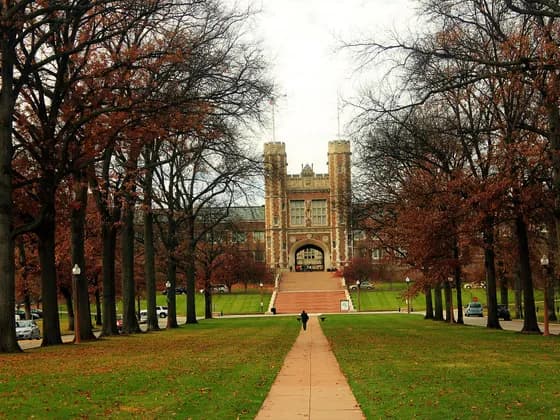


Photo: LittleT889 · CC BY-SA 4.0 · cropped
Photo: Yinan Chen · Public Domain · Photo: Bohao Zhao · CC BY 3.0 · Photo: Jefferson National Expansion Memorial, NPS from St. Louis, MO, USA · CC BY 2.0
The Washington University School of Medicine MD program at a glance (2027 entry)
Washington University School of Medicine, known as WashU Medicine, teaches its four-year MD on a medical campus beside Forest Park in St. Louis, Missouri. Since 2020 it has used the Gateway Curriculum, which replaced a model of two preclinical years, a clerkship year and an elective year. In 2025-26 it enrolled 123 first-year students: 93 MD and 30 MD/PhD.
Phase 1, the pre-clerkship (preclinical) phase, lasts about 16 months: seven integrated science modules, broken up by three three-week clinical immersions and a four-week EXPLORE project block. It ends with a one-week Capstone and four weeks of study for Step 1 of the United States Medical Licensing Examination (USMLE), the national licensing exams. Phase 2 is a year of six eight-week clerkships, the core clinical rotations, from January. Phase 3, about 16 months, mixes required advanced rotations and science courses with electives.
You belong to a small coaching cohort with a faculty coach for all four years. Courses carry no letter grades: a committee decides at the end of each phase whether you have reached competency in six domains, and can rate some competent with distinction.
Clinical training centers on Barnes-Jewish Hospital and St. Louis Children's Hospital, both on the medical campus. Rotations also use the John Cochran Veterans Affairs (VA) Hospital, community hospitals and two federally qualified health centers (FQHCs), which serve under-resourced communities. In rural Missouri, primary care preceptors supervise students in their own practices. There are no regional campuses.
Research is not required. But every MD student outside the Medical Scientist Training Program (MSTP), the MD/PhD program, completes the EXPLORE Immersion in research, advocacy and global health, education or innovation.
| Degree | MD |
|---|---|
| Program length | 4 years in three phases; a research year or master's is optional |
| Class size | 123 first-year students in 2025-26: 93 MD, 30 MD/PhD |
| Teaching style | Integrated science modules; mostly morning classes; team- and case-based learning |
| Anatomy | Dissection of donated bodies in teams of four |
| First patient contact | Year 1: standardized patients from month one; three clinical immersions in Phase 1 |
| Clinical sites | Barnes-Jewish and St. Louis Children's on campus, plus VA and community sites |
| Step 1 timing | After Phase 1, following the Capstone and a four-week study block |
| Grading | Credit or no credit; competency decided each phase, with distinction possible |
| Accreditation | Liaison Committee on Medical Education (LCME): full; next survey 2030-31 |
What makes the Washington University School of Medicine MD program different
Three clinical immersions before clerkships begin
During Phase 1 you spend three separate three-week blocks on clinical teams, with no other classes: in clinics and emergency departments, on inpatient wards and in procedural settings, including labor and delivery. All three share the same objectives and assessments, so you might learn the work through cardiology, neurosurgery or pediatric emergency medicine.
One coach and one cohort for four years
At orientation you join a cohort of about eight students led by a faculty coach, a clinician-educator. The cohort meets weekly to work through the curriculum and your experiences, and your coach reviews your competency portfolio with you one-on-one. Coaching replaces traditional academic advising, and coaches' assessments are formative only, meant to help you improve rather than to decide your progress.
EXPLORE: a mentored project in one of four pathways
Students outside the MSTP choose research, advocacy and global health, education or innovation in March and spend four weeks on it in May and June of year 1. A shared Inquiry Curriculum on scholarship runs alongside pathway teaching, and you start a project with a faculty mentor. Many continue the work in later phases and can present it at the yearly EXPLORE Symposium.
Keystone courses that return to the science
Phase 3 includes eight weeks of Keystone Integrated Science Courses (KISCs), each following one topic from basic science to its effect on society. The 2026-27 list has 16, from addiction medicine and the AI Imperative to end-of-life care and precision medicine. Most run four weeks: the diabetes course spends a week in class, then a week each on inpatient, outpatient and community services.
Competency decisions instead of letter grades or class rank
Courses earn credit or no credit, clerkships are judged competent or not in patient care, and a committee reviews your portfolio at the end of each phase, with distinction possible in some domains. In the 2025-26 student guide, the assistant dean for student assessment wrote that the school keeps no internal class rankings. It also does not select students for Alpha Omega Alpha (AOA), the national medical honor society.
How Washington University School of Medicine teaches medicine
Phase 1 is built from seven Foundational Science Modules, each organized around a function or structure of the body. Every module teaches basic and clinical science alongside social and health systems science, and all share a similar structure. In Circulation and Breathing, for example, anatomy, histology and physiology sit beside heart and lung disease and its diagnostic tests, and you start using a stethoscope.
The curriculum also runs on threads, each with named faculty leads in the 2026-27 Bulletin. They include basic sciences such as anatomy and pharmacology, clinical skills and diagnostic reasoning, ethics and law, health equity and justice, health systems science, professional identity formation and artificial intelligence. Service learning is built in: in Phase 1 you volunteer at three separate community sites.
Teaching changes shape later. Each clerkship opens with a week of specialty foundations taught around signs and symptoms, revisiting Phase 1 science, and closes with an ARCC week for assessment, reflection, coaching and community. In Phase 3, on Advanced Clinical Rotations (ACRs), you work close to the level of an intern, a first-year resident doctor, while the KISCs bring you back to the classroom and lab.
The ways you will learn
| Lectures | Most Phase 1 mornings, in person or online and recorded for the learning platform. A student in the 2026-27 Dis-Orientation Guide says most lectures do not require attendance in person. |
|---|---|
| Team-based and case-based learning | Active-learning methods the school lists, along with flipped classrooms and labs. In team-based learning you prepare beforehand, then solve problems with your team in class. |
| Clinical skills sessions | A student describes a two-hour clinical skills session every other week, small-group workshops on vital signs and examination in between, and sessions taking histories from and examining standardized patients, actors trained to play patients. |
| Coaching groups | Weekly sessions with your cohort and coach, where ethics, health equity and justice, professional identity and community engagement are also taught and debriefed. |
A typical week on the Washington University School of Medicine program
In Phase 1 most instruction falls on weekday mornings. Two or three afternoons a week go to activity-based sessions, such as clinical skills training, coaching, community engagement, advocacy, education and research. A student writing in the 2025-26 guide describes modules of about seven weeks with exams typically twice per module.
School policy caps the load. In the classroom courses of Phase 1, required learning activities, including set preparation, take no more than 35 hours a week. During clinical immersions the cap is 50 hours, covering clinical work, classroom sessions, coaching and online work.
Clerkships run under a duty-hour policy: no more than 80 clinical hours a week, averaged over four weeks, and at least 10 hours off between shifts. You get at least four 24-hour periods off in every four weeks, overnight call no more than every third night and every official university holiday off.
How anatomy is taught at Washington University School of Medicine
Anatomy is taught by dissection. In the 2026-27 Dis-Orientation Guide, which first-year students write each year, two anatomy faculty from the Department of Neuroscience describe the lab. You dissect a donated body as a team of four, working through the structures set for each week, with faculty and teaching assistants there to help. They stress learning the language and concepts of anatomy rather than every detail.
The Department of Neuroscience trains every MD and MD/PhD student in anatomy and also teaches histology and neuroscience in the Gateway Curriculum. The 2026-27 Bulletin lists anatomy and embryology as one of the basic science threads, with two thread leads. Bodies come through the university's Body Donor Program, and each year medical students organize a ceremony to honor the donors and their loved ones.
In his welcome in the same guide, the assistant dean for admissions places the gross anatomy lab on the top floor of one of the school's historic buildings. It has windows on three sides and teaching specimens collected over the years. The Phase 3 catalog also includes a four-week non-clinical elective called Advanced Dissection, offered by the Department of Neuroscience.
When you first meet patients at Washington University School of Medicine
Patient contact begins in a protected setting. You learn to take histories and examine patients soon after starting, practicing with standardized patients from the first month and getting feedback on videotaped encounters. Fourth-year students mentor first-years in pairs through the clinical skills course. Students say these mentors take them into the hospital early in year 1 to meet patients and practice history taking.
The immersions are the big step; a student in the 2026-27 guide says their order is assigned at random. In one example the school gives, immersion students spend time on radiology's ultrasound service, where diagnostic scans and biopsies are done. Phase 1 students may take histories and examine patients under indirect supervision, meaning a supervisor is on site and immediately available, but observe or assist with procedures only under continuous direct supervision.
Students' accounts in the guide show the settings. On the ambulatory/ED immersion you spend a few days a week in the emergency department, rotating through pods such as triage, psychiatric, trauma and discharge. The other days are at an outpatient site, such as an FQHC or a specialty or primary care clinic. On the inpatient immersion students pre-round, checking on their own patients before the team's rounds, and present on rounds, much as clerkship students do.
The Department of Emergency Medicine says every student rotates through emergency departments during the immersions, at Barnes-Jewish Hospital and community emergency departments or at St. Louis Children's Hospital. Obstetrics and gynecology runs two procedural immersion sites, labor and delivery and gynecologic oncology, each taking two students at a time.
Year by year at Washington University School of Medicine
- Phase 1 (about 16 months)
Gateway to Foundations
Phase 1 is the pre-clerkship phase. The school's pages give it 16 months; the 2026-27 Bulletin counts 62 weeks of curricular time in its text and 66 in its course list, which adds the four-week Step Preparation course. For 2027 entrants, orientation is set for August 9, 2027, and teaching for August 16, both subject to change.
- Transition to Gateway (1 week): online orientation, then campus sessions where you meet your coach and coaching cohort.
- Modules 1 and 2 (7 weeks each): Health and Homeostasis, built around four well-visit scenarios across the age range. Then Defense and Response to Injury, on how the body defends itself and how systems fail, starting with the skin.
- Module 3, Circulation and Breathing (8 weeks): the heart and lungs together, with sessions on medication adherence, environmental causes of disease and clinical epidemiology.
- Module 4, Ins and Outs (7 weeks): four weeks on the gastrointestinal tract, then three on the kidneys and genitourinary tract.
- Module 5, Metabolism and Reproduction: hormones, from nutrition and endocrinology to reproduction, contraception and abortion. Its description says six weeks; the 2026-27 course list gives it 3 units, and a unit is a week.
- Modules 6 and 7: Scaffolding and Movement (5 weeks), on the neuromusculoskeletal system, then Brain and Behavior (7 weeks), home to neurology, psychiatry, neurosurgery, ophthalmology, otolaryngology and pain medicine.
- Three three-week clinical immersions, in ambulatory/ED, inpatient and procedural settings, at intervals through the phase.
- The EXPLORE Immersion (4 weeks): required outside the MSTP, with a pathway chosen after optional lunchtime conferences, networking sessions and career panels.
- Phase 1 Capstone (1 week) to consolidate knowledge for Step 1 and clerkships, ending with an exam, then the four-week Step Preparation course and Step 1.
- Phase 2 (12 months)
Gateway to Clinical Medicine
Phase 2 starts each January and comprises a one-week course, Transition to Clerkships, and six eight-week clerkships. On the 2026-27 calendar, the class that entered in August 2025 starts its first clerkship block on January 11, 2027, and finishes on December 19, 2027.
- Each clerkship: a foundation week, six clinical weeks on patient care teams, then the ARCC week.
- Internal medicine: inpatient medicine on the care team, with attention to clinical reasoning, evidence-based medicine and how racism, stigma and identity affect care. General medicine teaching services are at Barnes-Jewish Hospital and the VA medical center.
- Surgery: two three-week services from a list of 16 that includes Barnes-Jewish West County and the VA hospital, plus one overnight shift on Trauma and Acute Care Surgery.
- Pediatrics: inpatient teams at St. Louis Children's Hospital, newborn deliveries and newborn care, and an acute care setting; every student works in the St. Louis Children's emergency department.
- Obstetrics and gynecology: a foundation week, two weeks each on labor and delivery, inpatient gynecology and ambulatory care, then the ARCC week, with a lottery shaping your settings. The department's website describes a six-week clerkship; the Bulletin gives eight.
- Psychiatry: inpatient psychiatry plus a choice of child and adolescent, consultation or outpatient experiences. Neurology: inpatient and outpatient care, building on Phase 1 teaching on where in the nervous system a problem lies.
- There is no family medicine or emergency medicine clerkship and no longitudinal integrated clerkship (LIC), the model in which you follow patients across specialties for months.
- Students interested in science can spend 8 to 16 weeks on research from January of Phase 2, deferring clerkships.
- Phase 3 (about 16 months)
Gateway to Specialization
Phase 3 starts in January and runs to graduation in the spring of year 4. The viewbook and admissions pages call it 16 months, 10 of them entirely elective. The Bulletin counts 56 weeks of courses (24 required, 32 elective) in its text and 64 in its course list, plus four weeks of holiday time and up to eight unscheduled weeks.
- Internal Medicine ACR (4 weeks): a sub-internship, also called an acting internship, that imitates intern year, with 4 to 6 patients by day and, on nights, cross-cover for other patients and new admissions. It runs at the John Cochran VA Hospital and on Barnes-Jewish medicine, cardiology or hospitalist services.
- Two more ACRs of your choice, done at WashU. The 2026-27 Bulletin lists ACRs in 24 areas, from anesthesiology and emergency medicine to newborn critical care, radiology and urology.
- Eight weeks of KISCs; MSTP students take none.
- Phase 3 Capstone (4 weeks, early in your graduation year): structured days, mostly 8 a.m. to 5 p.m., of teaching, small groups, hands-on skills and simulation, partly tailored to your specialty.
- 32 weeks of electives: clinical electives, research, EXPLORE projects, reading and special study electives, and up to 12 weeks away.
- USMLE study weeks in Phase 3 come on top of the Phase 1 Step Preparation block. The curriculum page allows up to eight; the Bulletin text agrees, with four for Step 1 and four for Step 2 Clinical Knowledge (CK), but its 2026-27 requirements table lists four, if necessary.
- Taking Step 2 CK and passing the Comprehensive Clinical Exam (CCX) are graduation requirements; residency applications and interviews also fall in this phase.
- In year 3 you choose a career advisor in your intended specialty, who reviews your fourth-year electives. You must also meet the assistant dean of career counseling by the last business day of June of your Match year; the Match is the national system that places graduates in residency programs.
How you are assessed at Washington University School of Medicine
Assessment is competency-based. You are measured against six domains of program objectives: foundational knowledge for practice, patient care, interpersonal and communication skills, professionalism, systems-based practice, and practice-based learning and improvement. Tests, essays, clinical observation, peer assessment, standardized patients, simulations and projects feed a portfolio that the Competency Attainment Committee, a faculty committee, reviews. Every required course or clerkship of four weeks or more must give you formative feedback by its midpoint.
Phase 1 courses earn credit or no credit, and at the end of the phase you are recorded as competent or not in each domain. Each clerkship is judged competent or not in patient care. At the end of Phase 2 you can earn competent with distinction in foundational knowledge, patient care, and interpersonal and communication skills. At the end of Phase 3 distinction is possible in systems-based practice and in practice-based learning and improvement.
The assistant dean for student assessment, writing in the 2025-26 student guide, likened Phase 2 distinction to honors, though any number of students can earn it. She also explained that you cannot fail out on a single exam or module. Using a 70% threshold as her example, she said a miss does not mean retaking the module, because performance is tracked across courses and assessment types. Exam grade distributions are not shared with the class.
The Liaison Committee on Medical Education (LCME) accredits MD programs in the United States. Its directory, updated July 22, 2026, lists WashU with full accreditation and a next survey in 2030-31. For US MD students, the Bulletin explains, LCME accreditation is what makes them eligible to sit the USMLE. Step 1 tests the sciences behind medicine and has been pass or fail since 2022; Step 2 CK tests how you apply clinical knowledge to patient care.
WashU schedules Step 1 after Phase 1 and Step 2 CK during Phase 3. The Bulletin's USMLE policy, last approved December 4, 2023, expects you to complete both by September 1 of the fall before you graduate, so residency programs see your scores. To be certified for the Match you need passing score reports by the end of January of your graduation year. You must take both exams to graduate, but passing them is not a graduation requirement.
In August 2026 the USMLE program announced a move to designated testing dates from January 2029, with Step exams offered less often each year. The date had already moved once, from 2028. On the current schedule, a student entering in August 2027 would finish Step 1 study around December 2028 and sit Step 1 then or in early January 2029, at or just before the switch. Step 2 CK would fall in Phase 3, in 2030, under the new model. The 2027-28 Bulletin and calendar are not yet published.
- Clerkship exams: students sit National Board of Medical Examiners (NBME) subject exams, the national end-of-clerkship tests often called shelf exams, and are released from clinical work by 5 p.m. the evening before. The registrar's clerkship exams are web-based, 110 questions in 2 hours 45 minutes, on a Monday and Tuesday near each block's end.
- End of Phase 1: the one-week Capstone closes with the CBSE examination; CBSE is the usual abbreviation for the NBME's Comprehensive Basic Science Exam.
- Graduation: you must pass the Comprehensive Clinical Exam (CCX), listed in the Bulletin as MEDICINE 8330, a course that carries no credit. A February 2026 Department of Medicine page says its clerkship leaders create, edit and oversee the grading of standardized patient assessments, including Phase 3 CCX examinations.
Where you will actually train at Washington University School of Medicine
Your clinical base is the Washington University Medical Campus, 186 acres on the east side of Forest Park. Barnes-Jewish Hospital and St. Louis Children's Hospital stand on it, both staffed by WashU Medicine physicians, part of BJC HealthCare and holding about 1,893 beds between them. Most clinical assignments are here. Patients come from city, suburban and rural communities, and the school describes Barnes-Jewish and St. Louis Children's as important safety-net hospitals that provide a large amount of care for underserved patients.
The admissions FAQ also names Missouri Baptist Medical Center, the VA medical center, Progress West, two FQHCs, Care STL and Affinia, and primary care preceptors in rural Missouri. Barnes-Jewish West County Hospital in Creve Coeur appears in course descriptions for surgery and emergency medicine.
Off-campus rotations follow the Bulletin's transportation policy, and the school does not reimburse gas, mileage, parking or fares. Not having a car is not in itself a reason to change an assignment, so carpools, ride services, transit, rental cars, biking and walking are the suggested options.
A list of off-campus rotations is updated each year, travel is tracked centrally to share those assignments fairly, and you can sometimes rank choices in advance. You can also ask the Registrar's Office in writing for a different site within two weeks of an assignment's release, and directors may allow trades between classmates.
Home of most clinical assignments, including the pediatrics clerkship and most emergency medicine ACR shifts.
- Barnes-Jewish Hospital
- St. Louis Children's Hospital
A VA St. Louis Health Care System teaching hospital, used for the internal medicine ACR.
- John Cochran VA Hospital
Used for some rotations, such as surgery and emergency medicine shifts.
- Barnes-Jewish West County Hospital, Creve Coeur
- Missouri Baptist Medical Center
- Progress West
Affinia hosts the family medicine elective; students say an FQHC can be the outpatient site in the ambulatory/ED immersion.
- Affinia Healthcare
- Care STL
Used in particular courses: child psychiatry teaching, and the Comprehensive Approach to Disability KISC.
- 4444 Forest Park Child Psychiatry Clinic
- Rehabilitation Institute of St. Louis
- Paraquad
Listed in the admissions FAQ among the clinical settings available to students.
- Primary care preceptors
Electives, selectives and away rotations at Washington University School of Medicine
Phase 3 holds 32 weeks of electives. The 2026-27 Bulletin lists clinical electives of two or four weeks across departments, from medical toxicology, emergency ultrasound and emergency medical services to dermatology, child abuse pediatrics and autopsy pathology. Non-clinical options include clinical informatics, patient safety and quality improvement, care of the homeless, forensic psychiatry, health law and humanities in medicine.
Family medicine is offered as Community-Based Family Medicine at Affinia Healthcare, a two-week clinical elective at its health centers. You see patients of all ages, from well-child checks and prenatal care to chronic disease and office procedures. The school says it has no Department of Family Medicine or family medicine residency, though it supports students who match into the field.
You can also design your own time. EXPLORE electives give credit for a scholarly project, usually one to four months long, approved in advance by a pathway lead. Proposals are due at least four weeks before you start, or three months ahead for projects needing VA resources. Reading electives, about 30 hours a week, and special study electives cover topics or clinical experiences outside the catalog.
Away electives at other institutions can fill 1 to 12 weeks, and international away electives 1 to 4 weeks, according to the Bulletin's requirements table. The global health page adds that up to 16 weeks of EXPLORE elective time can be spent abroad, with grants available. Global health rotations can use 12 partner sites, in countries including South Korea, Japan, Ghana and Australia, or 64 global partners approved by the Association of American Medical Colleges (AAMC).
Dual degrees and research years at Washington University School of Medicine
Research is not required, and the Bulletin's graduation requirements include no thesis. The school's participation figures vary by page: over 95% complete a research project, says the admissions curriculum page; more than 90% take part in research, says the admissions FAQ.
The MD5 program adds a year of full-time independent research with a WashU faculty mentor, paid by a stipend from the Office of Medical Student Research and Scholarship. There is no thesis, but you submit a final report and your mentor grades the year pass or fail. The wider Medical Scholars Program also includes the Clinical Research Training Center's TL1-Intensive, a mentored clinical research year, and a paid Health Equity Fellowship for Phase 3 students.
One-year master's options include the Master of Science in Clinical Investigation (MSCI), 33 credits ending in a manuscript submitted to a journal, and the 10-month Master of Population Health Sciences (MPHS), with no thesis. There is also a Master of Business Administration (MBA) with the Olin Business School. For the Master of Public Health (MPH), you apply during the clerkship phase and complete it in your fourth year. The Bulletin names the Bursky School of Public Health for the MPH; the Medical Scholars Program page still names the Brown School.
For the one-year master's programs and the MD5 year, the time-to-graduation policy sets a seven-year limit, against six years for the standard MD. There is also an MD/MS in Biomedical Data Science and AI, with tracks in biostatistics, data science and biomedical informatics.
The Roy Vagelos MSTP dates from 1969 and takes an average of 25 students a year, about a fifth of the entering class, says the Bulletin. MSTP students do a July research rotation, Phase 1 with a weekly MSTP Thread course and a second lab rotation, then three to five years on the PhD. They return for clerkships and a shorter Phase 3 without KISCs, and in 2026-27 all receive a stipend, health coverage and full tuition remission.
The Bulletin puts the length at seven or eight years with at least three years of research; the MSTP site says eight on average and as little as seven. The time-to-graduation policy allows 9 to 13 years at most. PhDs are in Division of Biology and Biomedical Sciences programs or biomedical engineering, and you can apply with your medical school application or transfer in later.
Facilities and support at Washington University School of Medicine
Where you will learn
The Farrell Learning and Teaching Center, a six-story building completed in 2005, is the main teaching building. It has two auditoriums, classrooms and labs, and a study carrel with secure storage for every first- and second-year student. Its Clinical Skills Instruction Suite has 13 simulated outpatient clinic rooms and two inpatient rooms, where faculty and peers watch your standardized patient encounters live and sessions are recorded.
Simulation is used in all three phases: clinical skills in Phase 1, foundational skills for clerkships in Phase 2 and preparation for internship in Phase 3. The Immersive Learning Center combines the Standardized Patient and Howard and Joyce Wood Simulation Centers. Its own site lists over 11,000 square feet with 17 exam rooms, four simulation suites, a task-training room and four conference rooms, and trainers for skills such as airway management, lumbar punctures and ultrasound.
The Bernard Becker Medical Library is open to students 24 hours a day and has run a Center for Health and Science Communication since fall 2021. Course materials, schedules and exams sit on Keystone, the school's learning platform, and you must own a cellphone and a laptop that meets the school's laptop guidelines.
Support while you study
Support starts with your faculty coach, who stays with you from the first day to graduation and gets to know your goals, values and struggles. Coaches attest twice a year that they have given you narrative feedback, written comments on your knowledge, skills and behavior.
Learning communities take the form of three academic societies, Cori, Erlanger-Graham and Lowry-Moore, formed by the faculty in 1985. Each hosts about three social events a year, usually off campus, and society student leads run the Big Sib program, which matches every entering student with a second-year student with similar interests or background. Society events are encouraged but optional.
The Office of Academic Support and Career Development arranges free one-on-one tutoring by senior students or residents, including Step 1 and Step 2 CK tutors who help plan your study. The admissions FAQ says every student gets a UWorld question bank subscription for Step 1 and Step 2, plus practice exam vouchers. There is also disability support, a writing center and funding for travel to present scholarly work.
For well-being, trained Peer Advocates from every phase listen and point you to mistreatment reporting and mental health support, answering requests within 24 hours. Each class has a student wellness officer, students organize a Wellness Week each spring, and the Office of the Ombuds offers confidential, off-the-record help.
Is the Washington University School of Medicine program right for you?
This program may suit you if
- You want real clinical time early: three full-time, three-week immersions on clinical teams before clerkships start.
- You want one faculty coach and the same small group of classmates to stay with you through all four years.
- You would like a mentored project in research, education, advocacy and global health or innovation, without a required thesis.
- You would rather be judged on competency across a portfolio than on course letter grades and class rank.
- You want a long elective phase for research, away rotations or a dual degree, with 32 weeks of electives in Phase 3.
Things to think about
- There is no family medicine or emergency medicine clerkship and no LIC; family medicine is a two-week elective, so plan ahead if primary care interests you.
- Training is concentrated in St. Louis: there are no regional campuses, and off-campus rotations mean arranging and paying for your own travel.
- Step 1 comes straight after Phase 1, with four weeks of study; for 2027 entrants that falls around the USMLE's January 2029 switch, and the 2027-28 Bulletin is not yet out.
Washington University School of Medicine MD program — frequently asked questions
Applying to Washington University School of Medicine?
How to get into Washington University School of Medicine
Prerequisites, MCAT, AMCAS personal statement, secondaries and interview, step by step.
Open the guide →Washington University School of Medicine admissions profile
MCAT and GPA profile, acceptance rate, interview format and key dates.
See the profile →Compare Washington University School of Medicine with other schools
Put the teaching style, anatomy teaching and clinical sites next to another school.
Open the comparison →Prepare for the Washington University School of Medicine interview
Format breakdown, school-specific sample questions and prep tips from tutors who interviewed here.
Read the guide →Where this Washington University School of Medicine program guide came from
This guide was written from 91 official sources — Washington University School of Medicine's own program pages and curriculum documents, plus the accreditor and the hospitals and health systems the school trains students in where they publish detail — read on 2026-10-10, then checked claim by claim against those sources.
- WashU MD Program: Gateway Phases
- WashU MD Program: Guiding Principles of the Gateway Curriculum
- WashU MD Program: Mentoring (M1:M4 first-year mentors)
- WashU MD Program: Competency-based Assessment
- WashU MD Program: Educational Technology (Keystone, laptop requirement)
- WashU MD Program: EXPLORE
- WashU MD Program: EXPLORE Phase 3 Electives
- WashU MD Program: EXPLORE Symposium
- WashU MD Program: Medical Scholars Program (MD5 and dual degrees)
- WashU MD Program: Academic Societies
- WashU MD Program: Academic Support
- WashU MD Program: Coaching
- WashU MD Program: Learning Support and USMLE timing
- WashU MD Program: Wellness
- WashU MD Program: Transition to Gateway orientation
- WashU MD Program: Community Engagement Hub (service-learning requirement)
- WashU MD Program: Learning Environment and Office of the Ombuds
- Washington University Bulletin 2026-27: Doctor of Medicine (Gateway Curriculum, courses, requirements)
- Bulletin 2026-27: Grading System
- Bulletin 2026-27: USMLE Policy for Students Entering the Match
- Bulletin 2026-27: Policy for Review of Student Attainment of Competency
- Bulletin 2026-27: Narrative Assessment Policy
- Bulletin 2026-27: Formative Assessment and Feedback Policy
- Bulletin 2026-27: Grade Notification Policy
- Bulletin 2026-27: Duty Hour Policy for Medical Students on Clinical Rotations
- Bulletin 2026-27: Clinical Supervision Policy
- Bulletin 2026-27: Policy for Monitoring of Student Time
- Bulletin 2026-27: Transportation Policy for Clinical Assignments
- Bulletin 2026-27: Procedure to Request an Alternate Site or Clinical Assignment
- Bulletin 2026-27: Policy on Time to Graduation
- Bulletin 2026-27: Credit Hour Definition
- Bulletin 2026-27: Doctor of Medicine (Five-Year Program)
- Bulletin 2026-27: Doctor of Medicine and Doctor of Philosophy (MSTP)
- Bulletin 2026-27: MD/MBA
- Bulletin 2026-27: MD/MPHS
- Bulletin 2026-27: MD/MPH
- Bulletin 2026-27: John T. Milliken Department of Medicine (teaching)
- Bulletin 2026-27: Mary Culver Department of Surgery (teaching)
- Bulletin 2026-27: Department of Obstetrics and Gynecology (teaching)
- Bulletin 2026-27: Department of Neurology (teaching)
- Bulletin 2026-27: Department of Psychiatry (teaching, child psychiatry sites)
- Bulletin 2026-27: Department of Emergency Medicine (teaching by phase)
- Bulletin 2026-27: Department of Neuroscience (teaching)
- WashU Office of the Registrar: MD Program Academic Calendars 2026-27 and 2025-26
- WashU Office of the Registrar: MD Clerkship and Elective Intervals
- WashU Office of the Registrar: MD Clerkship Exam Schedule
- WashU Medicine: The Study of Medicine viewbook, 2025-26
- WashU Medical Student Admissions: Frequently Asked Questions
- WashU Medical Student Admissions: Curriculum
- WashU Medical Student Admissions: Clinical Training
- WashU Medical Student Admissions: Degree Programs
- WashU Medical Student Admissions: Student Research
- WashU Medical Student Admissions: Coaching and Advising
- WashU Medical Student Admissions: Teaching Facilities
- WashU Medical Student Admissions: Simulation Centers
- WashU Medical Student Admissions: Farrell Learning and Teaching Center
- WashU Medical Student Admissions: Becker Library and Information Technology
- WashU Medical Student Admissions: Phase 1, Preclinical
- WashU Medical Student Admissions: Phase 3, Specialization
- WashU Medical Student Admissions: Important Dates (2027 entering class)
- WashU Medical Student Admissions: Global Health
- Roy Vagelos MSTP: Curriculum
- Roy Vagelos MSTP: Academics
- Roy Vagelos MSTP: Frequently Asked Questions
- Roy Vagelos MSTP: Stipends and Benefits, 2026-27
- WashU Medicine: Affiliated Hospitals and Centers
- WashU Medicine Facts (MD Program 2025-26)
- WashU Medicine news, September 19, 2023: LCME accreditation and the Gateway Curriculum
- WashU Medicine Immersive Learning Center
- WashU Department of Neuroscience: Education
- WashU Body Donor Program
- WashU Department of Psychiatry: Medical Student Education
- WashU Department of Obstetrics and Gynecology: Medical Students
- WashU Department of Medicine: Medicine Clerkship Associate Director, February 19, 2026 (clerkship standardized patient assessments and Phase 3 CCX)
- Dis-Orientation Guide 2026-27 (student-written): The Gateway Curriculum and Anatomy Lab
- Dis-Orientation Guide 2026-27 (student-written): Clinical Skills
- Dis-Orientation Guide 2026-27 (student-written): Study Styles
- Dis-Orientation Guide 2026-27: home page and assistant dean's welcome
- Dis-Orientation Guide 2025-26 (student-written): The Gateway Curriculum and assessment framework
- VA St. Louis Health Care System: About Us
- LCME: Accredited Programs directory (updated July 22, 2026)
- USMLE: Updated Timeline for Designated Testing Dates, Transition in January 2029 (August 6, 2026)
- USMLE: Designated Testing Dates Information Hub
- USMLE: Transition to Limited Testing Dates Starting in 2028 (June 23, 2026, since updated)
- USMLE: Step 1
- USMLE: Step 1 Transition to Pass/Fail Only Score Reporting (from January 26, 2022)
- USMLE: Step 2 CK
- NBME: Clinical Science Subject Exams
- NBME: Basic Science Subject Exams (Comprehensive Basic Science Exam)
- NBME: Comprehensive Basic Science Subject Exam, Content Outline
- NBME: Comprehensive Basic Science Examination (CBSE) Score Interpretation Guide
Curricula are restructured between cycles. Anything here that decides your application — how anatomy is taught, a clinical campus assignment, a required research year — should be confirmed against the official page for your entry year.
Applying to Washington University School of Medicine?
We help US applicants with MCAT strategy, the AMCAS personal statement, secondary essays and interview prep — everything you need for a competitive Washington University School of Medicine application.