US Medicine · 2027 Entry

Washington University School of Medicine (MD) Medical School2027 Entry Requirements & Interview Format

Location St. Louis, MO, United StatesEstablished 1891Interviews September–JanuaryDecisions March 30

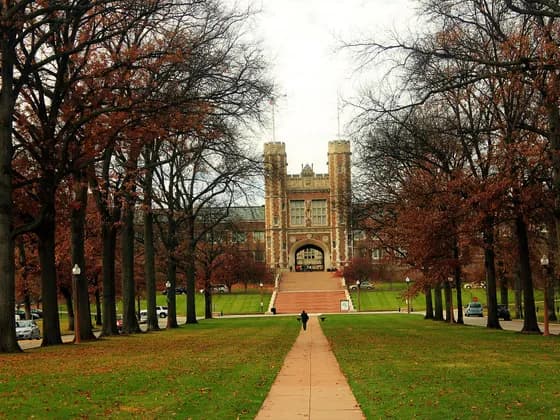
Photo: LittleT889 · CC BY-SA 4.0

Start here
Overview

About Washington University School of Medicine (MD)

Washington University School of Medicine in St. Louis, founded in 1891, is consistently ranked as one of the top five medical schools nationally for research funding. Affiliated with Barnes-Jewish Hospital and St. Louis Children's Hospital — both nationally ranked — the school offers exceptional clinical training alongside a world-class research environment. WashU Med is particularly renowned for producing physician-scientists through its NIH-funded MD-PhD MSTP.

What makes it different

WashU Med receives one of the highest levels of NIH funding per faculty member of any medical school in the United States. The MSTP (MD-PhD) program is highly regarded and fully funded. St. Louis has a lower cost of living than peer cities (New York, Boston, San Francisco), which provides quality-of-life advantages during training.

Course & teaching

Integrated curriculum. 4-year MD with curriculum emphasizing research integration throughout. Discovery Curriculum redesign integrates basic science with clinical application from Year 1. Scholarly track and MD-PhD MSTP available. Clinical rotations at Barnes-Jewish Hospital, St. Louis Children's, and affiliated community sites.

Research strengths

Washington University School of Medicine (MD) has notable research strength in Cancer genetics, Neurodegenerative disease, Immunology, Cardiovascular disease, Genome-wide association studies.

Interview

Washington University School of Medicine (MD) interviews via Traditional one-on-one; typically 2 separate faculty/student interviews on interview day.

Intake

Approximately 123 students per year.

At a glance

Founded in 1891, based in St. Louis, MO. Programmes offered: Biomedical Research, Oncology, Neuroscience, Genetics, Internal Medicine.

Entry requirements

What you need to apply to Washington University School of Medicine (MD)

Admission overview
Bachelor's degree and MCAT required. Strong research background is highly valued. Clinical experience and service expected. Secondary application required.
MCAT median
520 (range 515–525)
GPA median
3.88 overall / 3.91 science (BCPM)
Acceptance rate
3.3%
Class size
123
In-state preference
None
CASPer
Not required
AAMC PREview
Required
Holistic review emphasis
Research excellence, academic medicine potential, and intellectual leadership.
Notes
MCAT/GPA approximate from WashU Med class profile.
Specialities offered
Biomedical Research, Oncology, Neuroscience, Genetics, Internal Medicine
Interview

How Washington University School of Medicine (MD) interviews applicants

Format
Traditional one-on-one; typically 2 separate faculty/student interviews on interview day
Interview window
September–January
Decision date
March 30
Tutor insight
WashU Med's traditional interview is research-focused — be prepared to discuss your research experience in depth and articulate specific future research interests. The school values intellectual curiosity and a desire to pursue academic medicine; if your goal is a community practice career, you should still demonstrate scholarly engagement during the interview. WashU's location in St. Louis is often underappreciated: it offers a top-5 research environment and elite clinical training at a fraction of the cost of living of coastal peers. Demonstrate genuine enthusiasm for the Discovery Curriculum's integration of basic science and clinical reasoning.
Practice

Practise for your Washington University School of Medicine (MD) interview

PrometheusQuestion Bank621 medicine questions inside

Interview questions matched to Washington University School of Medicine (MD)

Two questions our tutors flagged as a strong fit for Washington University School of Medicine (MD)’s interview style. Try answering them out loud, then open Prometheus for the model answers and follow-up tips.

HardPanelQ1

Holistic Review: Race as Lived Experience in a Post-SCOTUS Admissions Context

Following the Supreme Court's 2023 ruling in Students for Fair Admissions v. Harvard and UNC, race-conscious admissions are no longer permissible at universities and medical schools receiving federal funding. You identify as Black and grew up in a predominantly Black neighbourhood with high rates of uninsured residents and a single hospital with a poor safety rating. How do you authentically convey the relevance of your racial identity and lived experience without treating race as a classification factor?

Likely follow-up · What is the difference, under the SCOTUS ruling, between treating race as a demographic classification and describing the impact of race as a lived social experience?

3 expert tips in Prometheus
MediumMMI · PanelQ2

Motivation: Why Medicine and Not Another Health Profession

You clearly value patient care, but nurses, physician assistants, and nurse practitioners all care for patients — and several of those paths are shorter and less expensive than the MD or DO route. Why medicine specifically, rather than one of these other health careers?

Likely follow-up · What did you observe about the physician's role, versus the PA's or NP's, that made you choose the longer path?

3 expert tips in Prometheus
Get support

Apply to Washington University School of Medicine (MD) with confidence

We've helped students into Washington University School of Medicine (MD) and other US medicine schools — get tailored support for each stage of the application.

FAQ

Washington University School of Medicine (MD) — frequently asked questions

Apply to Washington University School of Medicine (MD) with confidence

We've helped students turn their MCAT, personal statement and interview prep into offers from Washington University School of Medicine (MD) and other US medicine schools.