
Washington University School of Medicine Interview
Format, Questions & Prep Tips
Washington University School of Medicine medicine interviews for 2027 entry are a traditional interview, held October 2026 through February 2027. Published figures: Annual MD class size ~124; NIH funding rank #2 in the US (FY2024); Tuition (2025–26) ~USD 65,000/year.
- Institution
- Washington University School of Medicine
- Interview (2027 entry)
- October through February
- Decisions (2027 entry)
- Regular decisions by late March; waitlist through spring

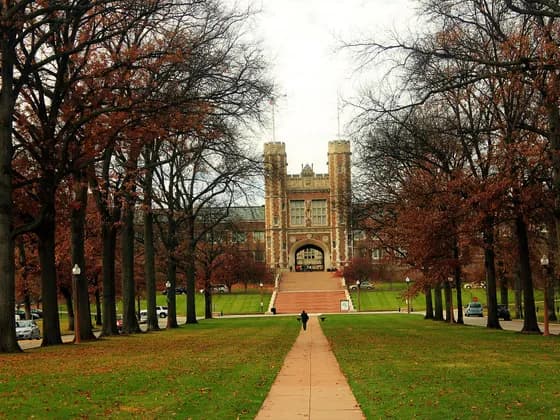


Photo: LittleT889 · CC BY-SA 4.0 · cropped
Photo: Yinan Chen · Public Domain · Photo: Bohao Zhao · CC BY 3.0 · Photo: Jefferson National Expansion Memorial, NPS from St. Louis, MO, USA · CC BY 2.0
How to get into Washington University School of Medicine (MD) medicine
Step-by-step: entry requirements, admission tests, personal statement, interview format and the key deadlines.
Open the guide →Washington University School of Medicine (MD) entry requirements
Admission profile, interview format, decision dates and what makes Washington University School of Medicine (MD) different.
See the profile →The Washington University School of Medicine MD program
Integrated + Spiral, 4 years, clinical rotations across the St. Louis area and rural Missouri.
See the program →The Washington University School of Medicine (MD) medicine interview
Washington University School of Medicine uses a traditional open-file interview — typically two sessions (one faculty, one student) of 30–45 minutes. WashU is ranked #2 in the US for NIH research funding (FY2024), and the culture is intensely research-driven — applicants who have not pursued substantive research are at a disadvantage, and interviewers probe the depth of scientific understanding behind every research experience listed.
WashU's close integration with Barnes-Jewish Hospital (a US News top-5 hospital) and the Siteman Cancer Center means clinical training is high-acuity and subspecialty-rich. Interview questions often probe resilience in the face of clinical complexity and the ability to function in a high-stakes environment.
A distinctive WashU theme is financial accessibility — the school has expanded scholarship support substantially and interviewers may probe how financial barriers have affected your path and what WashU's investment in your education means to you.
Washington University School of Medicine (MD) interview at a glance (2027 entry)
| Annual MD class size | ~124 |
|---|---|
| Interview format | Traditional open-file — faculty + student sessions |
| NIH funding rank | #2 in the US (FY2024) |
| Tuition (2025–26) | ~USD 65,000/year |
| Application system | AMCAS + WashU secondary |
| Interview window | October–February |
Interview format
- Two sessions: faculty (open-file, ~45 min) and student (~30 min).
- No MMI; research depth is probed explicitly.
Working towards the MCAT score Washington University School of Medicine (MD) expects? Build a week-by-week plan from your test date — free for the first two weeks.
Sample interview questions
Walk me through your most significant research experience. What was your actual hands-on contribution, what were the limitations of the study, and what would the next experiment be?
WashU faculty interviewers probe methodological depth. Knowing the limitations and next steps signals scientific maturity well beyond data collection.
Pick a finding from a field you know and explain why you believe it. What evidence would change your mind?
Show genuine scientific reasoning — evidence hierarchies, replication, and falsifiability. WashU values applicants who hold beliefs proportionate to the evidence.
How would you design a study to test whether a new biomarker actually predicts disease progression?
Discuss controls, sample size, confounding, and validation in an independent cohort. A rigorous, self-critical sketch matters more than a flawless protocol.
A surprising result contradicts your hypothesis. Walk me through how you would respond as a scientist.
Check for error and artifact, consider alternative explanations, and resist forcing the data to fit the hypothesis. Intellectual honesty is the point.
WashU has one of the highest NIH funding levels of any medical school. How do you see research shaping your identity as a physician, even if you do not pursue a full physician-scientist career?
Even clinically focused applicants should have a considered answer about research literacy in evidence-based practice and how inquiry will inform their clinical thinking.
Why WashU specifically, given its intensely research-driven culture? What about that environment fits you?
Name the research depth, Barnes-Jewish and the Siteman Cancer Center, and the physician-scientist ethos, and connect them to your own trajectory. Avoid generic prestige answers.
What first drew you to think of medicine as a discipline grounded in science rather than only in caregiving?
Connect a specific experience — a research moment, a mentor, a question that hooked you — to a view of medicine as evidence-based. WashU prizes the scientific mindset.
WashU has expanded scholarship support substantially. How would the institution's investment in your education shape what you do with your training?
Reflect seriously on the obligation and freedom this creates rather than treating it as financial relief. Connect it to the kind of physician or physician-scientist you want to be.
A colleague is under-performing in their clinical duties and you believe it is because of a personal crisis, not incompetence. How do you balance support for your colleague with the safety obligations of the clinical environment?
Patient safety versus collegial loyalty, handled in phases: a private conversation first, then escalation if patient risk is present, with Physician Health Program referral.
You are offered authorship on a paper you barely contributed to. Do you accept?
What they are listening for:
- Authorship criteria
- research integrity
- the cost of gift authorship to science and to trust
A research-intensive school expects you to understand and uphold these norms.
A patient at Barnes-Jewish with a complex cancer is eligible for an experimental trial that may not help them but could advance the science. How do you discuss it?
What they are listening for:
- Therapeutic misconception
- voluntary and informed consent
- putting the patient's interests ahead of the study
Distinguish what is good for science from what is good for this patient.
Explain a complex scientific concept from your research to a patient with no science background.
Use plain language and a concrete analogy, check understanding, and avoid jargon. Translating science for patients is a core skill of the physician-scientist WashU trains.
A patient is anxious in a high-acuity, subspecialty environment and feels like a 'case' rather than a person. How do you change that?
WashU's clinical training is high-acuity and subspecialty-rich. Show how you keep the person central — names, plain explanation, and acknowledging fear — amid complex care.
A research mentee is discouraged after their experiment failed for the third time. Talk to them.
What they are listening for:
- Normalize failure as part of science
- help them extract what the failures taught
- rebuild confidence without false reassurance
Mentorship sustains a research culture.
A patient asks you for a new treatment they saw promoted online that has weak evidence. Respond to them.
Explore why it appeals, share the state of the evidence honestly, and reach a shared decision. Combine scientific rigor with respect for the patient's autonomy.
You are shown a graph where a drug significantly improves a lab value but shows no effect on patient survival. How do you interpret it?
Distinguish surrogate endpoints from clinical outcomes and explain why a moved number is not the same as a benefit patients feel. This is core evidence-literacy reasoning WashU prizes.
Practise the Washington University School of Medicine (MD) interview
Rehearse the real format before the day — on demand with our AI interviewers, or live with a tutor.
Sit a mock with photoreal AI interviewers — any time
A timed MMI or panel interview on video — American & international voices — with interviewers who listen, react and press with follow-ups. Rubric-scored feedback and a replay the moment you finish.






Live mocks with a tutor who’s been in the room
A full Washington University School of Medicine (MD)-style mock with a medic or dentist tutor — honest scoring against real marking criteria, a station-by-station debrief and a written action plan.
Book a mock interviewHow to prepare for the Washington University School of Medicine (MD) interview
Common pitfalls to avoid
Washington University School of Medicine (MD) interview — frequently asked questions
Sources & official admissions information
Ready to nail your Washington University School of Medicine (MD) interview?
Book a mock interview with a tutor who knows the US interview formats, orpractice unlimited stations from our interview question bank.