
Saint Louis University School of Medicine Interview
Format, Questions & Prep Tips
Saint Louis University School of Medicine medicine interviews for 2027 entry are a traditional interview. Published figures: Annual MD class size ~180; Interview format Traditional — faculty + student, ~30–45 min each.
- Institution
- Saint Louis University School of Medicine
- Interview (2027 entry)
- October through February; rolling invitations after secondary review
- Decisions (2027 entry)
- Rolling decisions; final offers by late March; waitlist activity through summer

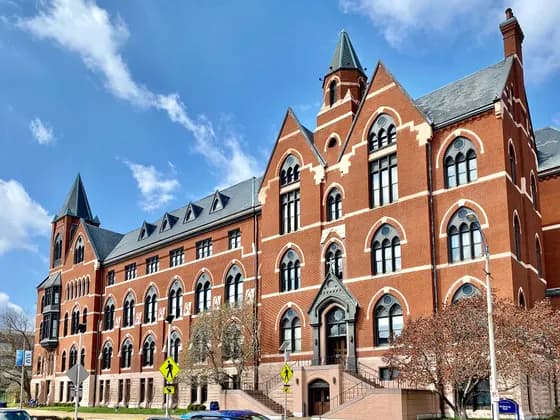


Photo: w_lemay · CC BY-SA 2.0 · cropped
Photo: w_lemay · CC BY-SA 2.0 · Photo: Teemu008 from Palatine, Illinois · CC BY-SA 2.0 · Photo: Brian Zinnel · CC BY-SA 4.0
How to get into Saint Louis University School of Medicine (MD) medicine
Step-by-step: entry requirements, admission tests, personal statement, interview format and the key deadlines.
Open the guide →Saint Louis University School of Medicine (MD) entry requirements
Admission profile, interview format, decision dates and what makes Saint Louis University School of Medicine (MD) different.
See the profile →The Saint Louis University School of Medicine (MD) medicine interview
Saint Louis University School of Medicine uses a traditional interview format with one-on-one sessions with a faculty physician and a medical student, each approximately 30–45 minutes. As the nation’s pre-eminent Jesuit medical school — and one of the oldest in the American Midwest — SLU’s interview is as much a values screen as a competency assessment.
Expect questions that probe the AAMC Premed Competencies, but the Jesuit principle of cura personalis (care for the whole person) runs through every stage of the day. Candidates are expected to articulate a personal values narrative grounded in service, social justice, and care for the whole patient — not just academic achievement.
SLU draws a national applicant pool with no state residency preference, and its class of ~180 is competitive. Interviews in St. Louis place students adjacent to SSM Health Saint Louis University Hospital, giving the day a clinical presence that grounds abstract questions in real healthcare environments.
Saint Louis University School of Medicine (MD) interview at a glance (2027 entry)
| Annual MD class size | ~180 |
|---|---|
| Interview format | Traditional — faculty + student, ~30–45 min each |
| Application system | AMCAS + SLU secondary |
| Interview window | October–February |
| Clinical training | SSM Health Saint Louis University Hospital and affiliated sites |
| Mission | Jesuit — cura personalis, service, social justice |
Interview format
- Traditional one-on-one interviews: one faculty physician and one medical student, each in a separate session.
- Sessions approximately 30–45 minutes; open-ended and conversational.
- Interviewers have read the full application in advance.
- Interview day: SLU Medical Center campus tour, SSM Health SLU Hospital overview, admissions briefing, student Q&A.
- No MMI format; holistic evaluation weights character and values alongside academic profile.
- Jesuit mission alignment assessed explicitly and implicitly across both sessions.
Working towards the MCAT score Saint Louis University School of Medicine (MD) expects? Build a week-by-week plan from your test date — free for the first two weeks.
Sample interview questions
Saint Louis University is a Jesuit institution guided by cura personalis — care for the whole person. How do you embody that principle in your life and work?
Be concrete and specific. The Jesuit screen is genuine — vague answers about "treating the whole patient" without personal story or values reflection are insufficient.
Why SLU specifically? How does a Jesuit medical education differ from what you would receive at Washington University or Mizzou, and why does that difference matter to you?
Show real research. SLU's Jesuit pedagogy, global health program, and SSM Health affiliation are differentiated from WashU's research intensity or Mizzou's rural focus.
A patient tells you privately that they are in an abusive relationship but begs you not to involve social services or their family. What do you do?
Intimate partner violence: address duty to inform (which varies by state), patient autonomy, safety planning, and the physician's role in empowering the patient to make safe choices with support.
SLU is a Catholic Jesuit institution. Should a physician working at a Catholic hospital be required to provide emergency contraception to a rape survivor even if it violates institutional policy?
Directly relevant to SLU's institutional identity. Address patient rights, emergency exception protocols (Missouri law), physician moral distress, and the duty to refer. Handle with nuance — this is a values-based question with no easy answer.
Tell me about a time you provided service to a community in need. What did you learn about yourself as a future physician?
STAR. The "service" theme is central to Jesuit education. Go beyond listing volunteer hours — reflect on what the experience revealed about your values and what kind of physician you want to be.
St. Louis has among the highest rates of uninsured residents and poverty among major US cities. How should physicians practicing in this environment respond?
Apply social determinants framework to St. Louis specifically: the CORTEX medical corridor, SSM Health safety-net hospitals, community health centers (Grace Hill, Family Care), and advocacy roles.
A terminally ill patient of deep faith asks you whether they will be cured by their prayers. How do you respond?
Spiritual care in a Jesuit context. Respect faith without false hope. Explore what the belief means to the patient's coping. Connect to chaplaincy/spiritual care resources. Do not dismiss or reinforce false prognosis.
Describe a time you advocated for someone who did not have a voice in a system or institution. What was the outcome?
Advocacy narrative — central to the Jesuit social justice mission. Could be a patient, a student, a community member. Show that advocacy is a practiced behavior, not an aspiration.
If you could eliminate one structural barrier to healthcare access in the United States, what would it be and why?
Policy-grounded question testing systems thinking and values. Choose a specific barrier (e.g., prior authorization burden, Medicaid coverage gaps, geographic maldistribution) and argue for its elimination with evidence.
A medical student discovers that a classmate has been dishonest in a clinical skills documentation. They are close friends. What does the student do?
Professional integrity and the duty to report even at personal cost. Medical school honor codes and professionalism standards are non-negotiable. Address the process of reporting and the personal cost of doing so.
St. Louis has historically been one of the most racially segregated US cities, and life expectancy can differ by more than 15 years between zip codes only a few miles apart. What do you think explains a gap that large, and what does it tell you about the limits of clinical medicine alone?
Interpret the figure rather than just repeating it: segregation legacy (the Delmar Divide), disinvestment, environmental exposure, and access to care all compound. Connect to why cura personalis pushes beyond the exam room into advocacy and community partnership.
Role play: you are a third-year student at SSM Health Saint Louis University Hospital. An uninsured patient is being discharged and quietly tells you they cannot afford the medication you have just explained. The attending has already left. Talk me through how you handle the conversation.
Acknowledge the disclosure without judgment, avoid empty reassurance, and pivot to concrete options — generic alternatives, $4 formularies, patient-assistance programs, pharmacy social work, and flagging for follow-up. Demonstrate practical compassion, not a lecture.
Tell me about a time your own values were in tension with the expectations of an institution, team, or authority figure. How did you handle it?
STAR. A Jesuit institution prizes reflective integrity. Show that you can hold a principled position with humility — not rigidity or quiet capitulation — and what you learned about yourself.
Spiritual and existential care is taken seriously in a Jesuit clinical environment, yet it is rarely emphasized in standard medical training. How should physicians who do not share a patient's faith engage with the spiritual dimension of illness?
Distinguish respecting and inquiring about spiritual needs from imposing or endorsing belief. Reference chaplaincy and spiritual-care teams, taking a spiritual history (e.g. FICA), and the evidence linking attention to meaning with coping and goals-of-care conversations.
Jesuit education describes its graduates as 'people for and with others' and emphasizes lifelong formation rather than a finished product. Where do you most need to grow before you would be ready to care for patients, and how would SLU help you get there?
Show genuine self-awareness — name a real growth edge, not a humble-brag. Connect it to SLU's formation-oriented culture, reflective practice, and mentorship rather than to prestige or outcomes.
Practise the Saint Louis University School of Medicine (MD) interview
Rehearse the real format before the day — on demand with our AI interviewers, or live with a tutor.
Sit a mock with photoreal AI interviewers — any time
A timed MMI or panel interview on video — American & international voices — with interviewers who listen, react and press with follow-ups. Rubric-scored feedback and a replay the moment you finish.






Live mocks with a tutor who’s been in the room
A full Saint Louis University School of Medicine (MD)-style mock with a medic or dentist tutor — honest scoring against real marking criteria, a station-by-station debrief and a written action plan.
Book a mock interviewHow to prepare for the Saint Louis University School of Medicine (MD) interview
Common pitfalls to avoid
Saint Louis University School of Medicine (MD) interview — frequently asked questions
Sources & official admissions information
Ready to nail your Saint Louis University School of Medicine (MD) interview?
Book a mock interview with a tutor who knows the US interview formats, orpractice unlimited stations from our interview question bank.