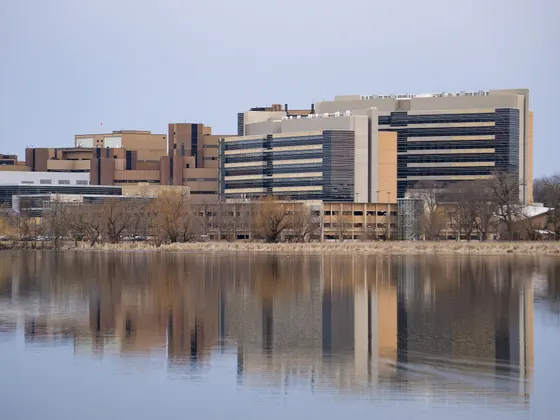
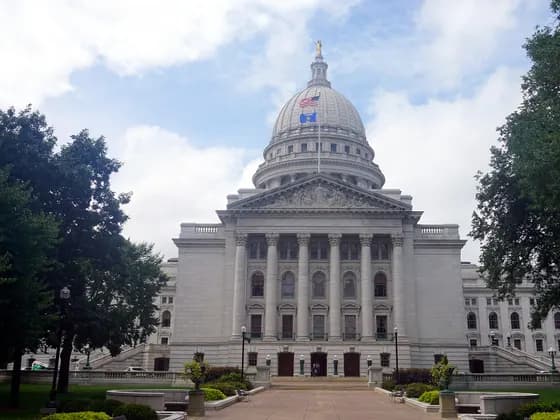
Madison, WI, USEst. 1907

University of Wisconsin School of Medicine and Public Health (MD) Medical School - 2027 Entry Requirements & Interview Format

The University of Wisconsin School of Medicine and Public Health, uniquely integrated with UW's School of Public Health, is a leading public medical school in Madison, Wisconsin. The school strongly emphasises primary care, rural medicine, and population health — reflecting Wisconsin's diverse geography and the needs of both urban and rural communities. UW-SMPH has one of the highest proportions of graduates entering primary care of any medical school nationally.

Entry Requirements

What you need to apply to University of Wisconsin School of Medicine and Public Health (MD).

Admission overview
Bachelor's degree and MCAT required. Wisconsin residents receive strong preference as a public state medical school. Research, clinical experience, and community service expected. No situational-judgment test (CASPer/PREview) is required.
MCAT median
511 (range 508–518)
GPA median
3.78 overall / 3.75 science (BCPM)
Acceptance rate
5.0%
Class size
175
In-state preference
Strong — primarily in-state
In-state matriculants
77%
CASPer
Not required
Holistic review emphasis
Primary care commitment, rural medicine, public health, and Wisconsin community service.
Notes
Strong in-state preference — OOS acceptance rate significantly lower than the overall figure. MCAT/GPA from UW-SMPH class profile.
Specialities offered
Primary Care, Rural Medicine, Population Health, Public Health, Research

Interview Format

How University of Wisconsin School of Medicine and Public Health (MD) interviews applicants.

Format
MMI (multiple stations, conducted via Zoom)
Interview window
September–January
Decision date
March 30

What makes University of Wisconsin School of Medicine and Public Health (MD) different

UW-SMPH is the only major US medical school fully integrated with a School of Public Health, enabling easy dual-degree MD-MPH completion. The rural medicine curriculum and TRIUMPH primary care track are nationally recognised pathways. The school actively produces primary care physicians for Wisconsin's underserved rural communities.

Tutor insight

Wisconsin has a very strong in-state preference — out-of-state applicants face significant headwinds and need to demonstrate exceptional commitment to Wisconsin communities or align strongly with the school's primary care/rural medicine mission. No situational-judgment test (CASPer or PREview) is required, so you can focus your preparation on the MMI and secondary essays. The MMI reflects the school's collaborative, community-oriented values — demonstrate genuine interest in primary care and population health, not just subspecialty research. If you are a Wisconsin resident considering primary care or rural medicine, UW-SMPH is one of the best value medical school choices in the country.
Prometheus
595 medicine questions inside

Interview questions matched to University of Wisconsin School of Medicine and Public Health (MD)

Two questions our tutors flagged as a strong fit for University of Wisconsin School of Medicine and Public Health (MD)’s interview style. Try answering them out loud, then open Prometheus for the model answers and follow-up tips.

MediumMMIQ1

Service Orientation: Global Health vs. Local Underserved Community

You have completed two international medical mission trips to rural Guatemala and also volunteer weekly at a community health centre in an under-resourced neighbourhood in your own city. A fellow pre-med peer argues that international medical volunteerism is 'medical tourism' that primarily benefits the volunteer's application rather than the community. How do you respond, and how do you think about the relative value and ethics of global versus local service?

Likely follow-up · What are the criticisms of short-term medical volunteerism (sometimes called 'voluntourism'), and do you think they apply to your experience?

3 expert tips in Prometheus
HardMMI · PanelQ2

US Healthcare Ethics: The Coverage Gap

Millions of low-income adults in non-Medicaid-expansion states fall into a coverage gap: their income is too high to qualify for Medicaid under their state's rules but too low to receive marketplace subsidies under the ACA. A patient in your clinic is one of them -- she has Type 2 diabetes, cannot afford insulin, and is rationing doses. Her state has not expanded Medicaid. What are the ethical obligations of her physician, and what practical options exist?

Likely follow-up · What is the difference between a physician's duty to an individual patient and a physician's duty to advocate for systemic change?

3 expert tips in Prometheus

Ready to practise University of Wisconsin School of Medicine and Public Health (MD)?

Book a school-specific mock interview with University of Wisconsin School of Medicine and Public Health (MD) preselected.

Book a University of Wisconsin School of Medicine and Public Health (MD) mock

University of Wisconsin School of Medicine and Public Health (MD) - Frequently asked questions

Bachelor's degree and MCAT required. Wisconsin residents receive strong preference as a public state medical school. Research, clinical experience, and community service expected. No situational-judgment test (CASPer/PREview) is required.

MMI (multiple stations, conducted via Zoom)

University of Wisconsin School of Medicine and Public Health (MD) typically interviews in September–January.

Decisions are released March 30.

UW-SMPH is the only major US medical school fully integrated with a School of Public Health, enabling easy dual-degree MD-MPH completion. The rural medicine curriculum and TRIUMPH primary care track are nationally recognised pathways. The school actively produces primary care physicians for Wisconsin's underserved rural communities.
Reviewed by Isaac Butler-King, medical student at the University of Glasgow. Last reviewed: 6 June 2026 · NextGen MedPrep editorial team
University of Wisconsin School of Medicine and Public Health (MD) | MCAT median 511, GPA & Interview Format | NGMP