
The University of Wisconsin School of Medicine and Public Health MD program
What you actually study, and where you will be
University of Wisconsin School of Medicine and Public Health's MD is a 4-year program taught through case-based learning in an integrated curriculum, with patient contact from Year 1 and clinical rotations in Madison, Milwaukee, Green Bay, La Crosse, Marshfield and rural Wisconsin (2027 entry). UW–Madison's MD runs on the ForWard Curriculum, which replaces two years of science and two of clinical work with three phases. You spend 18 months on integrated science blocks built around small-group patient cases. Full-time clinical rotations start in January of your second year, and the last 16 months bring acting internships, selectives and electives, with public health running through all of it.
- Degree
- MD
- Length
- 4 years
- Teaching
- Integrated + Case-based learning
- Clinical contact
- Year 1

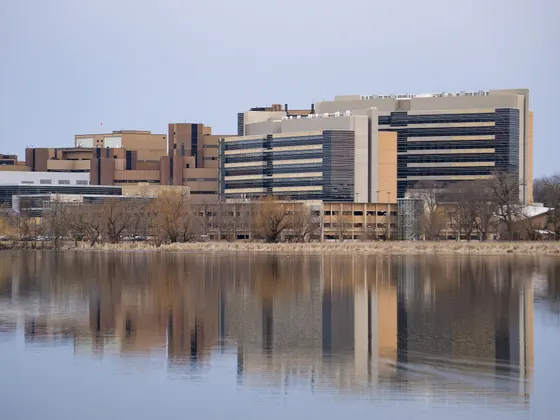
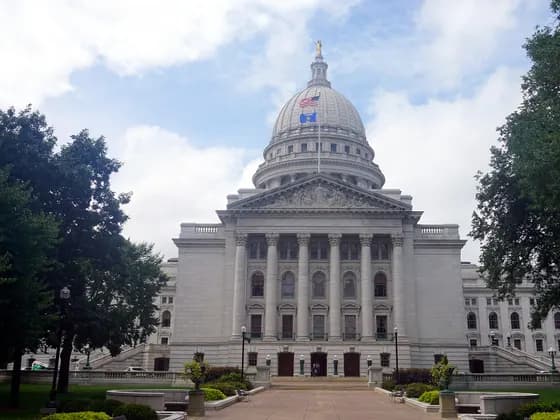

Photo: w_lemay · CC BY-SA 2.0 · cropped
Photo: Av9 · CC BY-SA 4.0 · Photo: Michael Barera · CC BY-SA 4.0 · Photo: Wikimapeditor · CC BY-SA 4.0
The University of Wisconsin School of Medicine and Public Health MD program at a glance (2027 entry)
The University of Wisconsin School of Medicine and Public Health runs a four-year MD in Madison, and 171 students entered it in 2026. Since the 2016 entering class it has used the ForWard Curriculum, which replaces two science years and two clinical years with three phases of 18, 12 and 16 months. Basic science, clinical science and public health are taught together throughout, much of it in small groups working through patient cases called Patient-Centered Education (PaCE) Cases.
Patients appear early, and so does the clinical year. Your first block includes interviews with real patients and standardized patients, people trained to play a patient realistically and consistently. Full-time rotations in the core specialties, called clerkships, begin in January of your second year. Step 1 of the United States Medical Licensing Examination (USMLE), the first national licensing exam, comes after that clinical year.
Phase 3 then gives you 16 months to try specialties before residency, the specialty training that follows medical school. In acting internships you take on a first-year resident's duties under supervision.
You start in Madison, but much of your clinical training can happen at partner sites in Milwaukee, Green Bay, La Crosse, Marshfield and smaller Wisconsin towns. Two tracks within the MD are built around this statewide network. The Wisconsin Academy for Rural Medicine (WARM) is for future rural doctors, and Training in Urban Medicine and Public Health (TRIUMPH) is based in Milwaukee.
The Liaison Committee on Medical Education (LCME), which accredits MD programs in the United States, continued the program's full accreditation in 2018 for the maximum eight-year term. The school scheduled its next LCME survey visit for April 13–15, 2026. The LCME directory, updated October 14, 2026, still lists the program as fully accredited, with 2025-26 as its survey year.
| Degree | MD |
|---|---|
| Program length | 4 years in three phases of 18, 12 and 16 months |
| Class size | 171 students entered in 2026 |
| Teaching style | Integrated blocks built around weekly small-group PaCE patient cases |
| Anatomy | Dissection in Phase 1; optional full cadaver dissection course in Phase 3 |
| First patient contact | Year 1, from the first block; full-time clerkships from January of year 2 |
| Clinical sites | Madison plus Milwaukee, Green Bay, La Crosse, Marshfield and smaller communities |
| Step 1 timing | After the clerkship year; attempt by March 1 of year 3 (2024-25 handbook) |
| Grading | Satisfactory/unsatisfactory in all required courses (2024-25 handbook) |
| Accreditation | LCME: full, accredited since before 1942 (directory updated October 14, 2026) |
What makes the University of Wisconsin School of Medicine and Public Health MD program different
Clerkships start halfway through your second year
Phase 1 lasts 18 months, so your clinical year begins in January of year 2. The school says the earlier start is meant to help career exploration and residency applications.
Public health built into every phase
Public health is one of ten curriculum threads, topics taught in every phase of the program. In Chronic and Preventive Care, every student works on a community health engagement project across all 12 weeks. Phase 3 then requires four credits of public health selectives.
A faculty coach for all four years
Every student is paired with a longitudinal teacher/coach (LTC), a practicing physician who facilitates your PaCE group and leads your clinical skills sessions in Phase 1. At least once a semester, you and your coach review your progress and plan for any gaps.
A rural track based outside Madison
WARM, chosen when you apply, is open to residents of Wisconsin, Illinois, Iowa, Michigan and Minnesota. After Phase 1 in Madison you move to Green Bay, La Crosse or Marshfield. Most of your rotations, including both acting internships, then take place within the WARM network of sites.
Two and a half years in Milwaukee
TRIUMPH is a track you apply to during year 1. From January of year 2 you do Phase 2 and most of Phase 3 in Milwaukee. Throughout those 2.5 years you run a community health improvement project with a local partner organization, alongside seminars on urban health, equity and advocacy.
How University of Wisconsin School of Medicine and Public Health teaches medicine
The ForWard Curriculum is competency-based, and its teachers plan it together across all four years. Besides small-group PaCE Cases, the course catalog lists large-group team-based learning among the curriculum's session formats. In Phase 1 each block builds a theme from basic science to the bedside. Invaders and Defense, for example, teaches the immune system as an army, with foot soldiers, special forces and friendly fire. Alongside it you study the ethics and public health of vaccination and practice the head and neck exam.
The ten threads are each sequenced to deepen as you move through the phases. They cover ethics, evidence-based medicine, health information technology, communication skills, teamwork across professions, patient care, professionalism, public health, quality and safety, and scientific inquiry.
Phase 2 centers on clinical work, with structured sessions such as case-based learning, podcasts, webcasts, readings and national online modules, plus simulation in Surgical and Procedural Care. In Phase 3, several internship preparation courses also use simulation.
The ways you will learn
| PaCE Cases | Each week your small group works through a patient case linking the block's science and threads, with each member in a defined role. Students do most of the talking, spotting gaps in their knowledge and researching them. The facilitator, usually your coach, keeps the group on topic and gives feedback rather than teaching content. |
|---|---|
| Clinical skills sessions | Your coach leads the clinical skills sessions, teaching history-taking, physical examination and communication with standardized patients. You practice and are tested in the Wichman Clinical Teaching and Assessment Center. |
| Acting internships | An acting internship, called a sub-internship at many schools, is a rotation where you take primary responsibility for patients at the level of an intern, a first-year resident. You need one inpatient and one ambulatory (outpatient) acting internship, and residents and faculty still supervise you throughout. |
A typical week on the University of Wisconsin School of Medicine and Public Health program
Under the school's Contact and Duty Hours policy, approved in June 2025, a Phase 1 block may require no more than 30 hours a week. That counts everything required: lectures, labs, case-based sessions, PaCE, clinical skills and clinic visits with a preceptor, a practicing physician who supervises you, plus required readings and online modules.
The 2024-25 handbook set the limits another way: no more than 21 hours a week in person, plus up to 10 hours online. In person, at most 12 hours could be large or medium group sessions and at most 9 hours of lecture, never more than 3 in a row. Online, 4 hours could deliver new content and 6 could prepare you for flipped sessions, where class time applies what you studied.
The same handbook says the curriculum assumes full attendance, and it makes clinic visits, PaCE sessions, small groups and any session with real or standardized patients required. It allows up to two student-managed absence days, flexible days off for any reason, in each Phase 1 block except the first.
Clinical weeks in Phases 2 and 3 have a much higher cap. Duty hours are limited to 80 a week, averaged over four weeks and including on-call time spent in the hospital. No shift may run past 24 hours, plus a six-hour sign-off for handing over patients, and you get at least one full day off a week on average.
How anatomy is taught at University of Wisconsin School of Medicine and Public Health
Your first encounter with human anatomy comes in your first block, framed as part of the privileges and responsibilities of becoming a physician. The technical standards require every student to be able to observe anatomic dissection and to take part in dissecting a human cadaver. The June 2025 contact-hours policy lists laboratory and dissection sessions among in-person teaching activities. This teaching relies on bodies given through the school's Body Donor Program.
The Radiology department says it builds radiology into every Phase 1 block through dissection and interactive large-group sessions, to reinforce what you learn in lectures and dissection. In Integrated Radiology and Anatomy sessions you use your anatomy to identify normal structures and signs of disease.
Anatomy returns later if you want more. Clinical Anatomy and Radiology, a two-credit Phase 3 course, is built on complete dissection of human cadavers, from the head and neck to the limbs and pelvic outlet. Practicing surgeons add surgical teaching, you interpret cross-sectional scans, and you produce an oral presentation and a dissection video. An independent advanced dissection course, by instructor consent, lets you study one region in depth.
When you first meet patients at University of Wisconsin School of Medicine and Public Health
Your first block, Patients, Professionalism and Public Health, opens with Faces of Patients and has you practice patient-centered interviews with real and standardized patients. You learn how the social history reveals the circumstances behind a patient's health. The block ends with Faces of Physicians, on how doctors advocate for individual patients and whole populations.
Phase 1 also includes a three-semester longitudinal experience in outpatient clinics in Madison and surrounding counties. The 2024-25 handbook describes MoMS-Dando a Luz, in which preclinical students follow a pregnant patient under the supervision of a UW faculty or community physician. You can also volunteer at MEDiC's student-run free clinics in the Madison area, alongside pharmacy, nursing, physical therapy and physician assistant students.
Full-time clinical work starts in January of year 2, after a two-day orientation called Transition to Clinical Settings (December 15–16 in the 2026-27 calendar). It includes a panel of third-year students on using clerkships to explore specialties.
Year by year at University of Wisconsin School of Medicine and Public Health
- Phase 1
Six integrated science blocks
Phase 1 is the pre-clerkship stage: it teaches the science of the body in six blocks over three semesters, finishing within 18 months of starting. Clinical skills, clinic visits and the ten threads run alongside the science throughout. For most students the summer between years 1 and 2 has no required courses, and it is when the main summer research programs run.
- Patients, Professionalism and Public Health (4 credits) opens the program in mid-August with health equity, the systems that shape health, quality improvement and teamwork. The White Coat Ceremony ends your first week (August 21 in 2026).
- Body in Balance (11 credits) follows a red blood cell from the bone marrow through the heart, lungs and kidneys, covering anemia, clotting, heart disease, lung disease, kidney disease and blood pressure.
- Food, Fasting and Fitness (9 credits), starting in January, runs from nutrients on a plate through digestion and metabolism to fasting, diabetes, obesity, lipid disorders, exercise and the removal of waste and toxins.
- Human Family Tree (8 credits) casts you as a family physician following one couple from planning a pregnancy to end-of-life care. Along the way it covers birth, childhood, adolescence, menopause, cancer, genetics and embryology.
- Invaders and Defense (9 credits) opens year 2 in August with immunology, microbiology, infectious and autoimmune disease, blood cancers and skin disease.
- Mind and Motion (10 credits) closes the phase with psychiatric, neurologic, eye and musculoskeletal medicine, taught with neuroanatomy, neuroscience and drug treatment, and limb anatomy through fractures, sports injuries and nerve entrapment.
- Phase 2
Four 12-week clinical blocks
Phase 2 runs from January of year 2 to December of year 3, with a short summer break in between. Each block is worth 12 credits, and the four can come in any order. Across them you rotate through anesthesiology, emergency medicine, family medicine, internal medicine, neurology, obstetrics and gynecology, pediatrics, psychiatry and surgery. Madison, Milwaukee, Green Bay, La Crosse and Marshfield each offer all nine.
- Specialized Care of Obstetric, Gynecologic and Pediatric Patients (SCOPE): pediatric primary care, labor and delivery, and gynecology. You assist with prenatal visits, vaginal and cesarean deliveries and well-child exams from newborns to teenagers, and perform pelvic and speculum exams and Pap smears.
- Chronic and Preventive Care: primary care, behavioral health and community settings, with continuity in primary care clinics across the 12 weeks and a community health engagement project throughout. Required experiences include writing a prescription, screening for substance use and checking whether a patient needs an interpreter.
- Acute Care: the emergency department, general and subspecialty inpatient medicine, psychiatry and neurology. You help care for patients with core conditions such as heart attack, sepsis, stroke and suicidal thoughts, and follow one patient from urgent admission through treatment to discharge.
- Surgical and Procedural Care: operations and procedures from general and orthopedic surgery to ophthalmology, urology and interventional radiology. You follow one inpatient from preparation through anesthesia, surgery and recovery. You also gown and glove and suture, and you place an IV and manage an airway at least three times each.
- Radiology seminars run through the blocks, and Surgical and Procedural Care offers an optional two-week interventional radiology rotation.
- Phase 3
Acting internships, selectives and electives
Phase 3 lasts 16 months, from January of year 3 to graduation in May of year 4, and its parts can come in any order. You need 50 credits, 16 of them in required courses. Residency interviews fall over the winter break, before Match Day in March, when residency places are announced.
- Inpatient Acting Internship (4 credits): as primary inpatient provider you draw up management plans, hand patients over and write discharge summaries. Options include internal medicine, surgery, pediatrics, obstetrics and gynecology, and neurological surgery.
- Ambulatory Acting Internship (4 credits): primary responsibility for outpatients under direct faculty oversight, focused on deciding which tests, medications and treatments to order. It is offered in various specialties at the school's sites across the state.
- Basic Science Selectives (4 credits): interactive courses that tie foundational science to clinical practice, including options aimed at your specialty. Public Health Selectives (4 credits): interactive courses that build public health skills for your future practice.
- Electives: at least 16 credits of patient care at UW Madison and statewide campus sites and at least 18 unrestricted credits. The 2024-25 handbook caps electives from any one department at 16 credits.
- Internship preparation courses of 1 or 2 credits rehearse the skills and conversations of the first weeks of residency. They run in internal medicine, surgery, pediatrics, obstetrics and gynecology, family medicine, psychiatry and emergency medicine, plus a WARM version.
How you are assessed at University of Wisconsin School of Medicine and Public Health
Assessment is tied to the school's graduation competencies, grouped in six domains such as Patient Care and Professionalism. The current competencies page lists 21, while the 2024-25 handbook counts 20. At least once a semester you and your coach rate your progress. A Competency Review Committee looks more closely at anyone rated as progressing with some concern, or where student and coach disagree.
The 2024-25 handbook describes Phase 1 midterms set by the phase's teachers and basic science exams from the National Board of Medical Examiners (NBME). It also requires an NBME subject exam, or shelf exam, in each Phase 2 block: a national multiple-choice test of clinical knowledge in a specialty. Phase 2 uses Objective Structured Clinical Examinations (OSCEs), hands-on tests of communication, physical examination, procedures and interpreting lab results. In the handbook, grades typically combine these with assignments, professionalism and clinical assessments based on observation by supervising faculty, fellows and residents.
Required courses are pass/fail: the 2024-25 handbook grades them all satisfactory or unsatisfactory. It also builds a comparative standing, the Cumulative Comparative Performance, from Phase 2 results only. No numeric rank is released. Your standing appears as a graph on your Medical Student Performance Evaluation (MSPE), the school's summary of your performance for residency programs, with verbatim comments from your clinical teachers.
Step 1, on the sciences basic to medicine, has been pass/fail since January 26, 2022, while Step 2 CK, on clinical knowledge, is still scored. For MD students, LCME accreditation is what makes you eligible to take them, though DO and international students qualify by other routes. You must pass both to graduate. The 2024-25 handbook requires you to pass Phase 1, the clinical parts of Phase 2 and every Phase 2 shelf exam before Step 1. You must then take Step 1 before Phase 3 coursework begins.
In August 2026 the USMLE program announced a move to designated testing dates from January 2029, with Step exams offered less often each year. That replaced a 2028 start announced in June 2026. The USMLE has also encouraged schools to review rules that restrict when students must take the exams.
On the current schedule, projected from the 2026-27 calendar, an August 2027 entrant would finish Phase 2 in December 2029. Under the 2024-25 handbook's deadlines you would then attempt Step 1 by March 1, 2030, and Step 2 CK before the 2030-31 MSPE release. Both fall after the change, and the school's Phase 3 timeline puts the two exams in Phase 3's first spring. A current school page says no longitudinal (part-time) electives are allowed in that semester, leaving January to early February for Step 1 preparation.
- A June 2025 policy requires feedback that does not count toward your grade at the midpoint of every Phase 1 and Phase 2 block. It comes from your coach in Phase 1 and from a clinical team member in Phase 2.
- You must pass every course in a phase to move on, and failing the same course twice means dismissal (June 2025 Advancement policy).
- If you fail a USMLE Step, the 2024-25 handbook allows two more attempts, with a pass needed within a year of your first try. A third failure means dismissal.
Where you will actually train at University of Wisconsin School of Medicine and Public Health
The school calls its clinical network the Statewide Campus. Hundreds of physicians across Wisconsin teach as volunteer community faculty. Rotations and acting internships run in more than 30 communities, organized through academic campuses run with partner health systems.
The 2024-25 handbook describes a lottery for most students. Details go out about four months before Phase 2. You are assigned a year-long schedule, then sites, and Phase 3 is booked through further lotteries from year 3. Unless you are in WARM or TRIUMPH, the handbook allows no more than three of your four Phase 2 blocks outside Madison.
The handbook also lets you ask to stay in Madison, for reasons such as caring for a dependent or ongoing health care. It says housing is provided at sites away from Dane County and south-central Wisconsin.
WARM students spend Phase 1 in Madison, where rural preceptors, a lunch speaker series, a rural health elective and summer externships are on offer. A required WARM Welcome week before year 2 covers rural Wisconsin's history, culture and community resources. A ranked-choice lottery then assigns you to Green Bay, La Crosse or Marshfield for Phases 2 and 3, 28 months in all. There you complete a community health project and rural core days on procedures such as suturing, laceration repair, casting and bracing, and cardiac stress testing.
WARM began in 2007, and a May 2025 university news story expected 327 graduates by that month. A 2023 alumni magazine story put the intake at 26 a year, with Phase 2 core days on ultrasound in Marshfield and a mock disaster drill in La Crosse. The same story said a 20-hour Advanced Wilderness Life Support course in Green Bay became a required final-year core day in fall 2022.
TRIUMPH students apply in the late fall of year 1 and take a one-credit course, Integrating Medicine and Public Health, before starting. A two-week Community and Public Health Enrichment Experience (CAPHENE) in Milwaukee comes in August before year 2. You then meet your TRIUMPH peers every other week, work with your own clinical preceptor, a practicing physician with a UW faculty appointment, and complete four two-credit TRIUMPH courses. The TRIUMPH page currently reports more than 245 students enrolled since 2008.
Base for Phase 1 and Madison rotations (sites from the 2024-25 handbook and the 2026-27 elective catalog).
- University of Wisconsin Hospital and Clinics
- UW Health American Family Children's Hospital
- William S. Middleton VA Hospital
- UnityPoint Health - Meriter Hospital
- UW Health clinics
- Group Health Cooperative of South-Central Wisconsin clinics
- SSM Health Dean Medical Group clinics
TRIUMPH's base and a Phase 2 location, run with Advocate Aurora Health and its more than 300 teaching faculty here. The community health centers and free clinics host TRIUMPH students.
- Advocate Aurora Sinai Medical Center
- Advocate Aurora St. Luke's Medical Center
- Advocate Aurora Midtown Clinic
- Advocate Aurora Walker's Point Community Clinic
- Bread of Healing Clinic
- Sixteenth Street Community Health Centers
- Progressive Community Health Centers
A WARM site and Phase 2 location. WARM students work one-on-one with attending physicians and take part in patient care, including procedures and deliveries.
- Aurora BayCare Medical Center
- Clinics in Sturgeon Bay, De Pere, New Franken, Two Rivers, Howards Grove, Sheboygan and Plymouth
Gundersen's 325-bed hospital has a Level II trauma and emergency center. Students outside WARM and TRIUMPH can take Phase 2 clerkship rotations here and Phase 3 electives in about 20 specialties. WARM students may work with Plain People, Latinx migrant workers, Native American and Hmong communities.
- Gundersen Health System hospital, La Crosse
- Rural clinics in Viroqua, Sparta, Tomah, Whitehall and Decorah, Iowa
Marshfield Clinic became WARM's first host site in 2009. Rotations include gynecology, psychiatry, surgery and primary care, and WARM students join resident teams. The 2024-25 handbook lists the two Marshfield Medical Center hospitals under their former names, St. Joseph's Hospital and Lakeview Medical Center.
- Marshfield Clinic
- Marshfield Medical Center, Marshfield
- Marshfield Medical Center-Rice Lake
- Clinics and hospitals in Minocqua and Chippewa Falls
Electives, selectives and away rotations at University of Wisconsin School of Medicine and Public Health
Phase 3 electives can be UW courses, away rotations at other US or international sites (called extramural electives here), individualized clerkships or research, under current policy. The UW course catalog runs from advanced emergency medicine and inpatient psychiatry to wilderness medicine with backcountry skills. A narrative medicine course helps with residency personal statements.
Teaching in the Classroom electives let you help run anatomy lab and clinical skills sessions, or facilitate PaCE groups, simulation and Integrated Radiology, Anatomy and Histology (iRAH) sessions. A Guatemala Health Advanced Elective, for final-year students with intermediate Spanish, builds on a first-year service-learning trip, with traveling clinics around Lake Atitlan run with the San Lucas Mission.
You can apply for away rotations in your final phase if you are in good academic standing. Applications go through the Visiting Student Learning Opportunities (VSLO) service of the Association of American Medical Colleges (AAMC), or directly to the host. An affiliation agreement between the schools must be in place first, and international extramural electives are capped at eight weeks, or 8 credits, in Phase 3.
Under the June 2025 Advancement policy, electives taken in Phase 1 do not count toward Phase 3 credit. School policy does let them count toward a Path of Distinction, an optional focus recognized at graduation. Examples include the one-credit Overview of Rural Health and Integrating Medicine and Public Health.
Dual degrees and research years at University of Wisconsin School of Medicine and Public Health
Research is optional but widely taken up: the school says 90 percent of its students engage in research. Its cornerstone, the Shapiro Summer Research Program, runs between years 1 and 2. About 100 students a year spend 8 to 10 weeks with a faculty mentor in any department, and most projects need no prior experience.
Family Medicine and Community Health and the Department of Surgery run smaller summer programs, for 10 and eight students. Summer projects are showcased at the Medical Student Research Forum each November.
The Path of Distinction in Research, awarded at graduation, asks for at least 16 weeks of mentored research, a manuscript or thesis on original research, research learning activities and local and regional presentations. The Yearlong Medical Student Research Fellowship pays a stipend for a full year of research, usually after Phase 2 once you have taken Step 1. One award is typically made each March.
The Medical Scientist Training Program (MSTP), the MD-PhD, takes 8 to 10 students a year into a program of about 80 and usually lasts seven to eight years. You take Phase 1, with a weekly Integrated Molecular Medicine course and summer lab rotations, and then Phase 2. The PhD takes 3.5 to 4.5 years, with clinic sessions alongside, before you return for Phase 3. Funding is guaranteed throughout.
The MD-MPH takes five years. Your Master of Public Health year comes either before medical school or between your third and fourth years, with core public health courses and a summer Applied Practice Experience. Some MPH credit comes from public health work within the MD, and you can apply with your MD application or during your first three years.
MD students, including those in WARM, TRIUMPH or the Path of Distinction in Public Health, can add the school's online Graduate/Professional Certificate in Global Health. It has five two-credit online courses and a one-credit field experience, usually in the summer after year 1. Two of the courses, taken in Phase 3, can count as your required public health selectives.
- Path of Distinction in Public Health: a public health course, eight Phase 1 meetings, a first-summer project, a symposium presentation and a learning community.
- Path of Distinction in Medical Education: online teaching modules, a Phase 3 teaching elective and a mentored education project.
- Path of Distinction in Bioethics: two bioethics courses, a learning community, a hospital ethics committee meeting and a supervised research paper.
- Path of Distinction in Interprofessional Practice and Education: a two-year program shared with other health professions students, with learning, leadership and a project.
Facilities and support at University of Wisconsin School of Medicine and Public Health
Where you will learn
The Health Sciences Learning Center (HSLC) at 750 Highland Avenue holds classrooms, clinical skills training and the Ebling Health Sciences Library (2024-25 handbook). On its third floor, the Wichman Clinical Teaching and Assessment Center has 24 rooms set up like clinic exam rooms. Ceiling cameras and microphones can record your encounters with standardized patients, whose program began in 1994.
The UW Health Clinical Simulation Program occupies 8,500 square feet inside University Hospital. It has an operating room, trauma room and three-bed ICU suite for immersive simulation, and a wet lab with 13 dissection stations for practicing procedures on tissue. Its dry lab has six laparoscopic training stations, and a virtual reality room holds ultrasound, endoscopy, endovascular and robotic surgery simulators. Both are open to medical students around the clock.
Support while you study
You belong to one of five houses, Bamforth, Bardeen, Gundersen, Middleton or McPherson, which together form a learning community called the Neighborhood. The 2024-25 handbook places you in a house before your first day, with about 35 students from each year per house. Each house has a practicing physician as its academic and career mentor, elected student house officers and its own wellness sessions.
Your house mentor guides you through the Academic and Career Advising Program (ACAP) in three stages: understanding yourself, exploring options, and choosing a specialty and landing a residency. The current houses page sets eight required touchpoints with your mentor from the fall of year 1, while the 2024-25 handbook listed seven. Along the way come the AAMC's Careers in Medicine self-assessments, a career workshop in your first block and Career Advising Day in Phase 3.
Student Academic Success Services (SASS) learning specialists help one-on-one or at drop-in sessions with study skills, test anxiety, tutoring, exam review and USMLE preparation, and run Med*STAR, a short orientation before year 1. University Health Services has psychologists who work only with health professions students, with no cap on sessions, and a medical student ombudsperson offers a confidential route for concerns.
Is the University of Wisconsin School of Medicine and Public Health program right for you?
This program may suit you if
- You want full-time clinical rotations from January of year 2, with Step 1 after your clinical year rather than before it.
- You learn well by talking through patient cases in a small group each week, with a coach guiding rather than lecturing.
- You want public health built in, from a 12-week community health project to required public health selectives.
- You see yourself in rural practice and would move to Green Bay, La Crosse or Marshfield for your clinical training through WARM.
- You want to prepare for underserved urban communities through 2.5 years in Milwaukee with TRIUMPH.
Things to think about
- Outside WARM and TRIUMPH, a lottery can place up to three of your four Phase 2 blocks away from Madison (2024-25 handbook).
- Under the 2024-25 handbook, required courses are pass/fail, but Phase 2 results build a comparative standing shown on your MSPE.
- Choosing WARM is a commitment: leaving it for the regular program needs the WARM director's written approval and a petition showing your site cannot meet your training needs.
- Step deadlines come from the 2024-25 handbook and may shift with the USMLE's January 2029 change.
University of Wisconsin School of Medicine and Public Health MD program — frequently asked questions
Applying to University of Wisconsin School of Medicine and Public Health?
How to get into University of Wisconsin School of Medicine and Public Health
Prerequisites, MCAT, AMCAS personal statement, secondaries and interview, step by step.
Open the guide →University of Wisconsin School of Medicine and Public Health admissions profile
MCAT and GPA profile, acceptance rate, interview format and key dates.
See the profile →Compare University of Wisconsin School of Medicine and Public Health with other schools
Put the teaching style, anatomy teaching and clinical sites next to another school.
Open the comparison →Prepare for the University of Wisconsin School of Medicine and Public Health interview
Format breakdown, school-specific sample questions and prep tips from tutors who interviewed here.
Read the guide →Where this University of Wisconsin School of Medicine and Public Health program guide came from
This guide was written from 66 official sources — University of Wisconsin School of Medicine and Public Health's own program pages and curriculum documents, plus the accreditor and the hospitals and health systems the school trains students in where they publish detail — read on 2026-10-14, then checked claim by claim against those sources.
- UW School of Medicine and Public Health: MD Program
- MD Admissions (entering class figures)
- Entering MD Class Statistics (entering class of 2026)
- MD ForWard Curriculum
- ForWard Curriculum: Phase 1
- ForWard Curriculum: Phase 2
- ForWard Curriculum: Phase 3
- Patient-Centered Education (PaCE) Cases
- MD Curriculum Threads
- MD Graduation Competencies
- MD Academic Calendar 2026-27
- MD Longitudinal Teacher/Coach Program
- MD Statewide Campus
- Marshfield Clinic Health System: Marshfield Medical Center - Marshfield
- Marshfield Clinic Health System: Marshfield Medical Center - Rice Lake
- Marshfield Clinic Health System news, July 1, 2017: Saint Joseph's Hospital now called Marshfield Medical Center (archived copy; the live page is gone)
- Marshfield Clinic Health System news, August 13, 2018: Lakeview Medical Center renamed Marshfield Medical Center-Rice Lake (archived copy; the live page is gone)
- MD Program: LCME Accreditation
- LCME Accreditation Timeline
- LCME directory of accredited programs (updated October 14, 2026)
- About the LCME
- Wisconsin Academy for Rural Medicine (WARM)
- WARM Curriculum and regional sites
- WARM Admissions
- Training in Urban Medicine and Public Health (TRIUMPH)
- TRIUMPH Curriculum
- TRIUMPH Admissions
- TRIUMPH Community Practice Sites
- UW-Madison News, May 5, 2025: first graduate of the accelerated WARMeRR track
- Wisconsin Medical Alumni Association Quarterly, April 2023: WARM feature
- MD Program Student Handbook 2024-25, effective July 1, 2024 (archived copy of the former PDF address)
- MD Program Policy: Advancement (June 2025)
- MD Program Policy: Curriculum and Student Review
- MD Program Policy: Narrative Assessment (June 2025)
- MD Program Policy: Mid-Point/Interim Feedback (June 2025)
- MD Program Policy: Contact and Duty Hours (June 2025)
- Phase 2 locations and clinical specialties (Acuity evaluation overview)
- Phase 2 Duty Hours Policy
- UW-Madison Guide: Medical Sciences (MED SC-M) courses
- UW-Madison Guide: clinical department courses, including acting internships, internship preparation and electives
- UW-Madison Guide: Senior Medical Program (SR MED) courses, including extramural electives and TRIUMPH courses
- Electives catalog for visiting students, 2026-27
- Medical Student Resources
- MD Academic and Career Advising Program
- MD Houses and House Mentors
- MEDiC student-run free clinics
- MD Student Research Programs
- Paths of Distinction
- SMPH Yearlong Medical Student Research Fellowship
- MD-PhD Program Overview
- MSTP Curriculum
- MD-MPH dual degree
- UW-Madison Guide 2026-27: Global Health Online, Graduate/Professional Certificate
- SMPH Office of Global Health: Graduate/Professional and Capstone Certificates in Global Health Online (FAQ)
- MD Technical Standards
- Body Donor Program
- Department of Radiology: medical student curriculum
- Wichman Clinical Teaching and Assessment Center
- UW Health Clinical Simulation Program facility
- USMLE Designated Testing Dates Information Hub (lists the August 6, 2026 update)
- USMLE: Updated timeline, transition to designated testing dates in January 2029
- USMLE: June 2026 announcement of limited testing dates from 2028, since updated
- USMLE Step 1
- USMLE Step 2 CK
- USMLE Bulletin of Information: eligibility
- USMLE examination results and scoring
Curricula are restructured between cycles. Anything here that decides your application — how anatomy is taught, a clinical campus assignment, a required research year — should be confirmed against the official page for your entry year.
Applying to University of Wisconsin School of Medicine and Public Health?
We help US applicants with MCAT strategy, the AMCAS personal statement, secondary essays and interview prep — everything you need for a competitive University of Wisconsin School of Medicine and Public Health application.